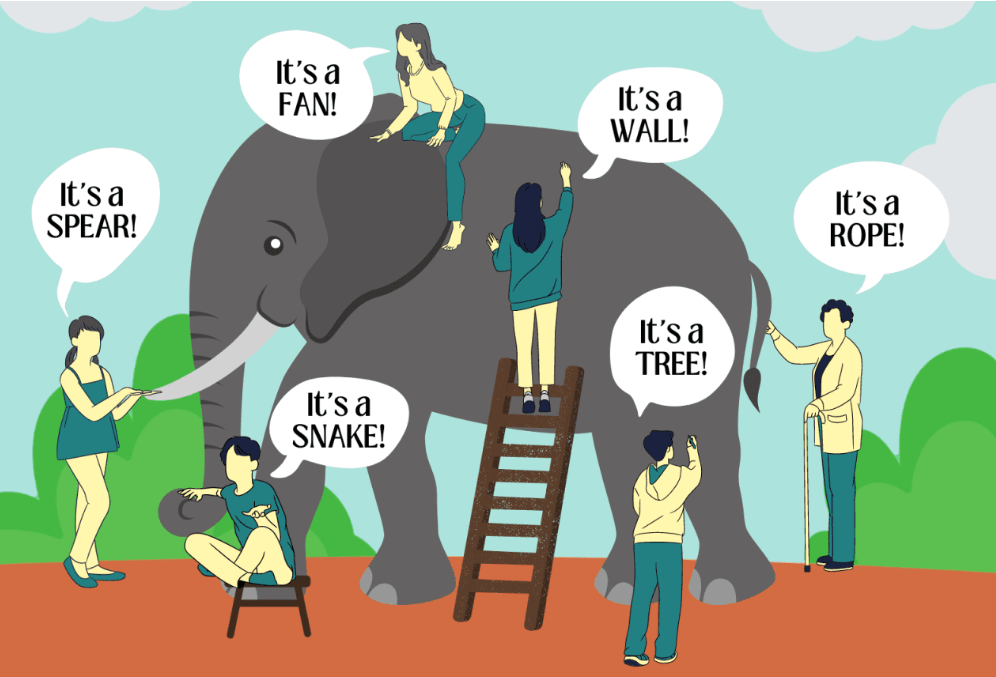
In recent times, eight older men lived in an Indiana community. Each was successfully retired and quite confident. Their neighbors loved the older men and encouraged their breakfast group meetings. Since the older men were no longer actively engaged at work, they had to imagine how things really operated. They listened carefully to stories about the active world of business, government, politics, health care, science, and leadership told to them by others.
The men were curious about many of the stories they heard, but they were most curious about Civility as a super solution to social challenges. They were told that Civility could fix politics, solve tough problems, promote personal growth, reinsert facts and logic into debate, revive trust, social relationships and institutions, and restore the balance between individuals and community.
They remembered Indiana as a very special place with great leaders. They recognized Birch and Evan Bayh, VP’s Quayle and Pence, representatives Lee Hamilton and Julia Carson, Indianapolis mayors Hudnut, Goldsmith, Petersen, Ballard and Hogsett, mayor and senator Lugar, but especially Governor Mitch Daniels. They knew that Daniels had been effective for Indiana, America and Purdue. Did Daniels believe in this Civility miracle solution?
The older men argued day and night about Civility. “Civility must be too simple,” claimed the first man. He had heard stories that it ignores real differences and big solutions.
“No, you must be wrong,” argued the second man. “Civility is complicated, combining values and habits in search of perfection. That is why people struggle to follow it.”
“You’re wrong! Civility seeks compromise, the middle ground and the golden mean. It combines the best that participants can offer,” said the third man.
“Please,” said the fourth man. “You are all mistaken. Civility grandly guarantees that it can solve all problems and conflicts! You know how people exaggerate.”
“How can you be so naïve,” exclaimed the fifth man. “Civility simply rationalizes weak, overly sensitive behaviors that avoid conflict and deny human nature.”
“Civility ignores passion and the emotions,” cried the sixth man. “It eliminates feelings, values, and intuitions by emphasizing cold rationality alone.”
“I am sure that Civility is a leftist plot,” said the seventh man. “That would explain why it emphasizes the importance and legitimacy of government.”
“On the contrary,” declared the eighth man. “Civility is a Republican scheme to return to the 1950’s with its mindless emphasis on a single culture, morality, character and values.”
Finally, the neighbors grew tired of all the arguments, and arranged for the curious men to visit the home office of Mr. Daniels to learn the truth about Civility.
When the men reached the home a half-hour ahead of schedule, they were greeted by an old friend who managed the governor’s visitors. Their friend led them to a waiting room where they watched a 10-minute video on Civility. The retired men quickly began to argue.
The first man stood up and exclaimed. “Civility is just common sense, nothing special.”
The second man misquoted the video. “Civility claims that all people can get along and all problems can be solved,” he announced.
The third man disagreed. “I was right,” he decided. “Civility is a tool of the powerful to maintain the status quo.”
The fourth man criticized Civility’s idealism. “What we have here,” he said, “is a sort of cult, invoking magical practices to reach utopian ends.”
The fifth man responded, “Civility is hopelessly weak because it asserts that strong emotions, interpersonal relations, sensitivity and hospitality can mend all fences.”
The sixth man stated, “Civility is very powerful. It allows groups and individuals to acquire and use power for their own ends, while dismissing the needs and desires of others.”
The seventh man considered the actors in the presentation. “Civility elevates individuals and personal growth above church and community, so it must favor Democrats,” he said.
The eighth man was shocked. “Why, Civility is nothing more than a way for the powerful to reassert social control through norms, taboos and shunning,” he scoffed.
The governor’s aide led his friends to the kitchen. “Sit here and rest,” he said. “I will bring you something to drink.”
While they waited, the eight men talked about Civility.
“Civility is just politeness, rules and etiquette. It is a surface level approach,” said the first man. “Surely we can finally agree on that.”
“Just politeness? Civility aims to transform men, institutions and society” answered the second man.
“Transformation? Civility focuses just on process, promotes elite values and prevents real arguments and solutions” insisted the third man.
“It’s impossible for everyone to develop such powerful skills that effectively bridge real human differences,” said the fourth man.
“Civility merely assumes that better skills, processes and values can manage differences, conflicts and human nature through the forces of goodwill,” noted the fifth man.
“Civility provides a socially approved way for individuals to emphasize form over substance. They can perform in a civil manner without really addressing the needs of others,” cautioned the sixth man.
“Socialist subjectivity and radical tolerance. There’s no doubt,” said the seventh man.
“Don’t you see?” pleaded the eighth man. “Civility is intended to keep us occupied and distracted by small issues and away from the larger issues of systematic injustice. Someone is using Civility to trick us.”
Their argument continued and their shouts grew louder and louder.
It was Purdue President emeritus Daniels, disturbed by the noisy argument.
“How can each of you be so certain you are right?” asked the former governor.
The eight men considered the question. And then, knowing the budget director to be a very wise man, they decided to say nothing at all.
“Civility combines values, skills and behaviors to solve problems and build relations,” said Mr. Daniels. “Each of you exaggerates the importance of only one part. Perhaps if you put the parts together, you will see the truth. Now, let me finish my morning in peace.”
When their friend returned with drinks, the eight men rested quietly, thinking about their leader’s advice.
“He is right,” said the first man. “To learn the truth, we must put all the parts together. Let’s discuss this on the journey home.”
The first man found his seat on the senior bus. The second man found his seat, and so on until all eight men were ready to travel together.
The decline in Civility is intertwined with other changes in society. We’ll share the 6 root causes. Fortunately, the recovery of Civility can help to address each of the 6 root causes of decline. Radical individualism, human nature, skepticism, our secular age, imperfect myths and insecurity.
There has been a groundswell of interest in addressing the loss of Civility in modern society. Members of both parties, young and old, rural, urban and suburban have begun to engage on this important topic. Civility is treating others with respect, especially when you disagree. It is a mental attitude, a habit, a character trait, a set of actions. Civility is a key to effective life in community, especially for participating in a democratic government.
Yet, I will argue that the loss of Civility is a symptom of much larger challenges rather than a root cause.
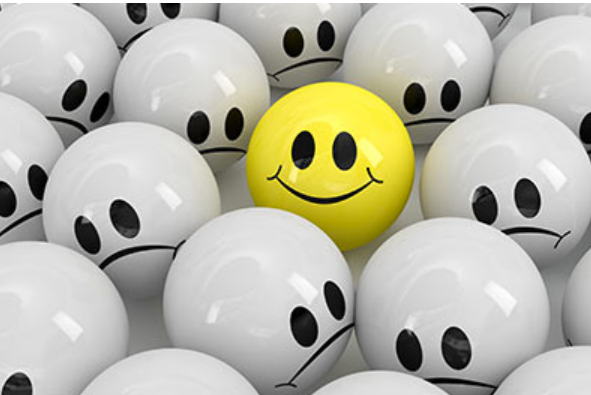
Our current challenging social and political situation is driven by the root causes of individualism, skepticism secularism, inadequate myths, human nature and insecurity. In a word: negativity. Civility embraces constructiveness, intentionality and public-spiritedness as clearly “positive” values. It is also based upon the “positive” values of human dignity, respect and acceptance. Is it reasonable to be so positive in a time of negativity driven by politicians, the media and our fellow citizens? The answer is “yes”. We have chosen to emphasize our challenges rather than our accomplishments. Those who pursue Civility need to be aware of the reality of modern progress, conditions in all areas of life and realistic opportunities for change.
Overall Good News
Improvements in all areas of life since the 1976 bicentennial are amazing!
Civility is a social norm and a set of behaviors based upon a set of shared values. We address public morality, the 7 Civility values and their broad support from different belief systems.
Morality
Thought leaders increasingly embrace the need for some kind of commonly held public morality to replace the historical background of Christianity and Western civilization.
Respect, responsibility, honesty, compassion and fairness comprise one set of values to consider.
Rabbi Sacks provides historical context of the ideas that have led to an “I” focused culture, outlines the symptoms of a weakened “We” culture, and provides some insights as to what can be done. He combines a politically and economically moderate view with a conservative social perspective.
“We will have to rebuild families and communities and voluntary organizations. We will come to depend more on networks of kinship and friendship. And we will rapidly discover that their very existence depends on what we give as well as what we take, on our willingness to shoulder duties, responsibilities, and commitments as well as claiming freedoms and rights.”
Teddy Roosevelt: “The first duty of an American citizen, then, is that he shall work in politics; his second duty is that he shall do that work in a practical manner; and his third is that it shall be done in accord with the highest principles of honor and justice.” The citizen should be like his “man in the arena”, fully engaged in important matters.
Brooks offers 15 solutions. Live for holiness. Fight selfishness. Use your heroic capacity to struggle against external and internal challenges. Humility is the first virtue. Pride is the central vice. Struggle against sin and for virtue. Purposely build character skills, habits, experiences and preferences. Focus on the long-term, permanent attributes of life. Seek help in building character. Recognize the U-shaped pattern of falling, evaluating, feeling and accepting grace and recovering. Quiet the self enough to listen and defeat weaknesses and temptations. Aim for a practical wisdom built upon experience and history rather than a perfect ideology, theology or philosophy. Organize work around a “vocation” and do your best. Define leadership as finding “a just balance between competing values and competing goals”. Embrace the path of becoming better in your vocation and better as a person. That is the opportunity we are given.
I’m summarizing the 2024 update of the 2011 original. The author’s views largely coincide with the modern Civility project. He starts with the political/democracy view of life and works backwards into how people should live their lives in all realms. He promotes an aspirational view of what we can and should do. He is widely read and incorporates a variety of materials, mostly academic, into the book. As a sociologist he stays at the middle level of detail, not becoming too abstract and philosophical. Dr. Palmer is a very solid writer, communicating his views clearly and incorporating appropriate support and stories. His Quaker religious background is evident throughout. His “new left” leanings provide examples, language and context that can challenge the moderate or conservative reader.
He directly addresses our real challenges. We’re stuck with each other. Individualism without community is a dead end. The media, consumerism, political scapegoats, populism and fascism are real threats. Our democratic political structures provide us with tools, not solutions. These structures are resilient, the issues are evergreen. We never fully settle our differences, and that is OK. The fear of the “other” is innate. The scientific expert view of life is inadequate and ultimately unsatisfying. We need effective myths to shape our worldviews, but they cannot be fixed and reductionistic like our science or business approaches. The key dimensions of life are best addressed with a tension of yes and probably not; individual and community, liberty and law, material and spirit, inward and outward, selfish and altruistic, principles and applications, etc. We live by habits. There are 5 habits relevant to democracy that require significant work to adopt. The ground or basis of life, truth, decisions and knowledge is “heart”, our intuitive ability to combine thought, feeling, skepticism, history, community and myth into decisions. It is an organic, holistic Quaker insight consistent with secular listening, focusing, psychology, philosophy, meditation, logic, systems, and social sciences. The author and publisher offer 40 video clips and a study guide for those who would like to share and explore this work with others.
Intro to 2024 Edition
We are in crisis in the Trump era. The 2001 “war on terrorism” response of demonizing other countries, growing the military and restricting civil liberties was only the beginning of our troubles. These challenges reinforce the need to invest in local, experiential, real conversations to build our Civility skills. Some groups are “beyond the pale”: violent, anti-factual, or racist. The loss of trust is an existential threat to our democracy. We cannot engage everyone; we only need a supermajority two-thirds to restore our system. “Habits of the heart” are built upon local interactions. Grassroots efforts to build these habits have spontaneously started in many places. Racial prejudice remains an issue. Progress in improving the human soul is slow, but worthwhile.
Politics of the Brokenhearted
People, like the author, who have heartfelt views of ideal human and political behavior, are often disappointed, even “brokenhearted”, when their deepest desires, insights and beliefs are unfulfilled. Today, our deepest political, philosophical, spiritual, religious, ethical, aesthetic, social views are often rejected by people and leaders. Despite many supporting factors, we fail to make political, religious, global and moral progress. This is the human condition. President Lincoln faced these challenges and was depressed. He overcame the disappointments to describe and take a constructive path forward. Storytelling is therapeutic. The “heart” is a critical concept: core of the self, where all ways of knowing converge. Despite the darkness we follow the light.
Humans are imperfect. Democracy is always at risk. The “heart”, our deepest ability to comprehend, can transform suffering into community, conflict into creative energy and tension into the common good. Dr. Palmer argues that the unavoidable contrasts/conflicts in life can lead to progress.
I. Democracy’s Ecosystem
Diverse races, ethnicities, classes and perspectives are foundational. We struggle with diversity, change and raggedyness. We seek to tame it in business, farming and politics. We need to consider efficiency and effectiveness. Diversity is inherent and good in nature. We are wired to fear the other, the stranger and diversity. Yet, we know intellectually that diversity provides us with tremendous benefits in marriage, trade, creativity, art, beauty, and religion. The tension between contrasting views, principles, measurements, frameworks, insights, beliefs, experiences, histories, etc. is not naturally or easily embraced, even though it is needed for personal growth. Individuals who choose to experience and wrestle with tension and heartbreak can become stronger, able to better manage future experiences. This persistence and earned personal growth do not “solve” the tension, conflict or pain, but it provides a greater ability to encounter it again and again. It is the only [partial] solution. Listening, empathy, exploration, dialogue, accountability, and problem-solving methods all matter.
Civility prioritizes the improvement of individuals. It does not demonize Washington, DC, big money, intolerance, passions, ignorance, or the 2-party system. These challenges are eternal. Human nature is eternal. We can make choices to improve our personal and political results.
“Heart” is a larger way of knowing. Mind, intellect, rationality, emotion, imagination and intuition are combined. This complex “heart” is what make us human. It aligns with religion, culture, community and the humanities as fundamentally organic, complex, spiritual and irreducible. Less complex views such as wealth, consumption, money, fear or progress are inadequate to the human condition. “Why do we suffer?” is a critical question that can only be answered by the heart. The question can be used by politicians to mislead people.
Deep thinking individuals like Quaker John Woolman can see solutions. They may involve holding the tension between conflicting people, interests or ideas for generations.
Politics of the heart rejects divisiveness, toxicity, passivity, powerlessness and commercialism.
Social movements leverage the “powers of the heart”.
II. Confessions of an Accidental Citizen
Personal advancement can be seen as more important than the common good. The responsibilities of citizenship are not really taught to children and youths, even those in professional class suburbs.
“Citizenship is a way of being in the world rooted in knowledge that I am a member of a vast community of human and nonhuman beings that I depend upon for essentials I could never provide for myself”. The community and the greater good matter, really matter, matter first! Yet the public good is unclear and disputed.
Hence, the political structure that provides long-term stability is elevated to become more important than the individual political decisions, no matter how heartfelt!!! This is an amazing result.
Democracy, political institutions and the heart can easily be misused by individuals or political leaders.
Rules and structure matter. Hope matters. Voluntary associations matter. Individualism can destroy community. Individualism has virtues.
Chutzpah says that I really matter. Humility says that I must know that I don’t know it all. We need both.
Five habits of the heart:
We are all in this together. We are interdependent.
We must appreciate the “other”. We prefer people of our own tribes who look, feel and think like us. We can recognize the great value to be had from interacting with “others”.
We must learn to hold contrasting ideas, values, preferences and experiences in tension. We don’t choose one over the other. We accept that they have pieces of the truth that cannot be reduced to one or the other. We are imperfect and broken humans who do not expect to have perfect knowledge.
We must define and express our personal views.
We must create community.
The Civility revolution takes place at the grassroots level.
III. The Heart of Politics
Palmer focuses on Terry Tempest Williams’ concept of living democracy.
“The human heart is the first home of democracy. It is where we embrace our questions. Can we be equitable? Can we be generous? Can we listen with our whole beings, not just our minds, and offer our attention rather than our opinions? And do we have enough resolve in our hearts to act courageously, relentlessly, without giving up – ever – trusting our fellow citizens to join with us in our determined pursuit of a living democracy?”
After 9/11, we showed as a nation that we have lost the ability to have civil debates about important topics. This was and remains very frustrating for most citizens.
Palmer says that we individually and collectively have the power in our hearts to address this shortcoming. He notes that these words challenge us about our own capacity for openness, honesty, trust and persistence. It’s not enough to lament politicians or the situation. The key is taking steps to make things better.
This insight does not support a simple romanticism. The heart can support the best or worst of mankind.
While Palmer’s politics are consistently from the left and criticize the rise of the far right in American politics, he is clear that the challenges of human life are faced by everyone. Generosity and self-interest. Listening and fear of hearing. Trusting and fearing. The aspirational challenge of values and moral character is inherent in human nature. It is easy to criticize others for their lapses while ignoring our own shortcomings.
Palmer dismisses claims that the strategy, resources and techniques of politics are most important by describing how emotional appeals to “family, faith and patriotism” are so effective.
He argues that heartfelt struggles generate our social ills. Fear drives consumerism. Arrogance requires more of everything. A spiritual emptiness drives false consumer solutions. Yet, Americans are also the most generous people on earth.
While feelings provide opportunities to manipulate people, the appeal of pure reason is similarly ineffective. Palmer describes Alan Greenspan’s 2008 “shocked disbelief” that individuals could be so greedy that the efficient banking markets could be destroyed. He criticizes our education and business culture for using reason alone to make decisions.
Palmer reiterates that “heart” is an integral way of knowing that combines thinking, feeling, experience, intuition and judgement. He illustrates it with a story of a USDA administrator facing pressure from his boss to comply with his politics, finally deciding to follow his “farmer’s heart” and recognize that “I report to the land”. The staffer used all of his experience, acknowledging the tensions of the different interests and perspectives before making a choice. The choice may be overruled but it helped to move larger conversations forward.
Palmer outlines “the power of heartbreak”. We all experience disappointments, large and small. We respond differently. Most of us are crushed, withdraw, weep, deny, delay and build defenses against future experiences by becoming stoic, less at risk, less emotional, etc. Yet others find ways (by necessity, insight, character, grace or luck) to digest the situation, experience it, learn and become stronger and more engaged. These experiences can make us stronger and more flexible rather than weaker and brittle. He’s arguing at two levels. In our personal day to day lives, and in our civic, political lives. If we can build the experiences, power, insight and strength in our personal lives we can apply this everywhere. Our heartbreak at the recent loss of Civility in our country can help us to work for change.
“Despite our sharp disagreements on the nature of the American dream, many of us on the left, on the right, and in the center have at least this much in common: a shared experience of heartbreak about the condition of our culture, our society and our body politic.”
“But a heart that has been consistently exercised through constant engagement with suffering is more likely to break open instead of apart. Such a heart has learned how to flex to hold tension in a way that expands its capacity for both suffering and joy.”
“But one day you emerge and discover, to your surprise that because of your devastating loss, your heart feels more grateful, alive and loving.”
“We must restore the wholeness of our civic community … hearts are the source of what Lincoln called ‘our bonds of affection”, that sense of unity among strangers that allows us to do what democracy demands of its citizens: engage collectively and creatively with issues of great moment, even – and especially – in times of intense conflict.”
Palmer acknowledges that we cannot be conflict free. He notes that conflict can drive creativity and resolve critical questions.
Palmer identifies our “inner emptiness, the absence of a strong sense of personal identity” as the most important cause of our situation. He proposes that we should look inward to our “hearts” rather than outward to prepackaged solutions. He describes the many negative impacts of consumerism on undermining the development of a personal identity. He describes how “scapegoating” by politicians and the media plays an especially virulent role in destroying personal identity by making people dependent on others for solutions and filling the victim role.
He comments: “Of course, many Americans find it not only possible but actually pleasant to live among strangers and take a pass at scapegoating. Put simply, these are the grown-ups who left the adolescent mindset behind and learned to take responsibility for their own inner struggles for meaning instead of seeking someone to blame.”
“Democracy needs and, at its best, breeds people who have minds of their own … The healthy self finds an identity that allows it to feel at home in its own skin and in the company of others, even (and sometimes especially) ‘alien’ others”.
IV. The Loom of Democracy
Palmer reiterates that we face conflicting views in our politics which create tensions. He argues that our political system, like a loom, can constructively hold this tension and produce constructive results, a cloth that is strong and new. “holding the tension of our political disagreements to keep us talking with each other and giving us chance after chance to reweave the fabric of our common life.” He highlights unavoidable tensions like freedom and discipline, and liberty and law. These inherently contrasting principles call for both/and rather than either/or solutions that take time to create and continue to evolve.
“The heart has the capacity to turn tension towards constructive ends, but there is nothing automatic about it.” It is more likely to succeed with successful practice. Prior failures may prevent future success. “Is it an experienced heart, a reflective heart, a heart made supple by inner exercise and responsive engagement with life? Or is it a heart grown brittle from being wounded, unattended and unhealed, sheltered and withdrawn, a heart more prone to shattering in the face of yet another demand?”
In addition to experiencing and growing from heartbreak, the author recommends “mindfulness, meditation or prayer, reading great literature … spending time in solitude … talking with a counselor or spiritual guide.”
Palmer argues that the American political system is designed to address “divergent” problems by maintaining engagement and commitment and driving creativity. He argues that forced solutions and final solutions destroy the community and the system. “In American-style democracy, the incessant conflicts of political life are meant to be contained within a dialectic of give-and-take, generating and even necessitating collaboration and inventiveness.”
The system allows topics to be addressed for long periods of time. No decision is final.
Palmer notes that “fight or flight” is hardwired in us but does not help to resolve divergent political decisions. He argues that the progress of civilization has been in inventing tools to overcome this either/or response: language, art, religion, education and democracy. [These inventions do] “not propose to bring life’s tensions to an end … [but] offers us a process for using them creatively, providing … structures that promise to turn the energy of tension towards constructive ends.” He notes that extreme individualism works against these tools that help us to work together in communities and associations of all sizes.
V. Life in the Company of Strangers
Palmer begins the chapter with a story about a taxi driver, illustrating the trade-off between the risks of interacting with the stranger, the “other” and the benefits of learning about people and the world.
He outlines a 3-level social world of private, public and political. We increasingly retreat to the private life. We are mostly isolated from the high-level political life, dominated by professionals. We have the opportunity to live in the “messy” middle public level where we can practice our interactions with others with conflicting values, interests and ideals.
Palmer argues that the skills, relationships, confidence and groups we form in the middle are the essence of democracy, like the “voluntary associations” emphasized by deTocqueville in the early 1800’s. The public life acts as a buffer zone between the private and the political, holding the political level accountable (ideally).
The geography of the public level is emphasized through the examples of a public house, other “great good” places for interaction, well-designed urban areas and events. Robert Putnam’s Bowling Alone analysis of various places where we can interact or form community comes to mind.
Public organizations and places are where we can act with “dignity, independence, and vision”. We meet on common ground, accept the stranger, enrich our experience, express ourselves, identify concerns, debate, negotiate, identify needs, assist, generate ideas, share resources, protect and empower people. He emphasizes that these are possibilities rather than a set of utopias.
Palmer notes that public spaces and organizations are eliminated in authoritarian political systems. They act as a defense against the improper growth of centralized power.
Palmer notes that we make choices to interact, join and participate every day. Increasing these interactions at work, school, church, organizations and neighborhoods can change ourselves and the world around us. Small actions like potluck suppers, block parties, community gardens, porch sitting and holiday gatherings can have a large impact.
He ends the chapter with a description of Wendell Berry’s fictional small Kentucky town of Port William.
“Port William is a small farming community whose residents are not strangers to each other in the way city people are. Still, they remain strangers to each other in the way all of us are, no matter how well we may think we know each other: within each of us there is an endless, inarticulate play of shadow and light that makes us riddles to each other because we are riddles to ourselves. And yet all of the characters in this fictional world are integral and valued parts of what Berry calls ‘the Port Williams membership’. …This sense of membership is the ultimate gift of the public life … our sense that we belong to one another”.
VI. Classrooms and Congregations
Classrooms and congregations can provide great opportunities for us to participate in the public level of community and dialogue.
“Educational institutions have at least as much impact, and arguably more, on our basic assumptions about what is real, possible, and meaningful … we get images of ourselves … and images of the world”.
Without violating separation of church and state, Palmer argues that fundamental questions are unavoidable and should be addressed. “the nature of a ‘good life'”. [Rabbi Hillel asked:] “If I am not for myself, who is for me? If I am only for myself, what am I? If not now, when?”
“An education that pretends to explore only the outer world is disingenuous and incomplete. A good education is intentional and thoughtful about helping students find an inner orientation toward what is ‘out there’ that will be life-giving for them in the world … Do I have gifts? … does my life have purpose? … whom and what can I trust? … how can I rise above my fears? … how do I deal with suffering? … how can I maintain hope?”
Inner-life questions are embedded in all subjects, not just literature and the arts. They must be inserted. Courses should connect normal content with context and application.
Education should be more experiential encouraging students to experience the give-and-take of the public level. Students can engage within school and in the community. Teachers should be facilitators rather than scientific experts. The humanities courses must be preserved and enriched.
Congregations can also provide opportunities for public level engagement. Church governance participation. Church program leadership and participation. Peer counseling. Small group interaction. Potluck suppers! The use of consensus as the standard for decisions rather than majority rule.
Elevate “hospitality” to become a duty. “When a believer fails to offer hospitality to a stranger, the spiritual journey comes to a sudden halt … Becoming people who offer hospitality to strangers requires us to open our hearts time and again to the tension created by our fear of ‘the other'”.
VII. Safe Space for Deep Democracy
“The spaces in which our hearts are formed are not always made of bricks and mortar – they are also created by images, ideas, and ideals … the wellspring of all notional space is the human heart … if our hearts are large and supple enough to hold the tensions of those questions in a life-giving way, they produce ideas and ideals that feed a living democracy”.
We cannot let the media define our reality and spaces. “if we are to be citizens of a democracy, we must spend time in conceptual spaces defined by personal experience”.
Solitude, compartments, inner voice. “We also need safe spaces for small gatherings of ‘the company of strangers,’ spaces where citizens can come together to explore the challenge of living heartfelt lives in the neighborhood, in the workplace, and in the larger world.”
Circle of trust meetings, small groups, professional organization meetings, rocking and talking groups, Camp Obama, power of storytelling.
VIII. The Unwritten History of the Heart
“name, claim, and examine the myths that animate our personal or collective lives, myths that give voice to deep movements of the heart … a myth is an effort to tell truths that cannot be told with mere facts or known by the senses and mind alone, truths that take form only in the integrative place called the heart.”
“Myths do more than name truths that lie deeper than mere facts … they also name aspirations that might be achieved … when we openly acknowledge this gap between aspiration and reality and are willing to live to it honestly, a myth can encourage us to bring what we are a bit closer to what we seek to be.”
[America’s myth is found in the “Declaration, the Constituion, the Pledge of Allegiance, or our national anthem.” It is easily accessible and easily perverted into a simplistic, fully achieved status.
Many Americans believe in the full achievement of the American ideals. Palmer disagrees regarding military power, economic growth, opportunity and the melting pot. “Taken together, myths like these have been foundations of national pride, and we have taken their truth for granted … if we want to reclaim our democracy, we need to do the challenging heart-work of examining our myths, seeing how far they are from the reality of our national life, then reclaiming their embedded visions and doing the hard work necessary to bring reality closer to them.”
Palmer argues that reclaiming democracy can be done through the stages of past movements for social change. “Movements of social transformation are sparked by people who are isolated, marginalized, and oppressed but who do not fall into despair.”
The four stages are initial actions of courage, communities of congruence, going public and seeing signs of success.
It is necessary to act with hope in the tragic gap between today and tomorrow. It can be done by holding ourselves to the standard of faithfulness rather than the standard of effectiveness. The great movements take a long time.
Evaluation
Center-left or new-left bias is only sometimes acknowledged.
Racial and economic conflict are taken for granted.
There is a “small is beautiful” preference.
Myths, religion, spirituality are emphasized as essential.
Practical solutions are offered.
Utopian solutions are discounted but there remains an organic bias.
The 5 habits emphasize community, tolerance/tension, individual expression/agency and respect for the “other”. These are consistent with the 7 Civility values but the centrality of respect for the “other” inserts a value that is not universally shared. Jonathan Haidt emphasizes the validity of cultures that are more inward looking.
Dr. Palmer’s insights align with my 6 root causes (individualism, imperfect myths, secular age, insecurity/fear, human nature/greed) except he does not highlight excessive skepticisim.
His solutions are very aspirational. Are they possible for everyone or just a few?
Is the “heart” a valid construct? How does it work? Is this the “inner voice” of one religious perspective?
Is the growth of the heart through repeated heartbreak a valid, useful or widespread concept? I think we can all understand that this happens for some people at some times. It is a blessing and an inspiration. Can we base our life’s journey on this approach?
I think that Dr. Palmer provides a consistent evaluation of our current situation and reasonable steps forward. His study guide and video clips provide tools for groups to evaluate his ideas and promote the growth of Civility.
Individuals who believe in Civility as a solution to what ails us as a society should take the basic steps of learning more about the Civility movement and then joining with one of the many grass-roots groups to share the content of Civility, especially the 7 values and 7 behaviors, with others. This is classic membership and communications work. There are many personal and community benefits from practicing and promoting Civility.
Help others to understand the solid content of modern Civility and remove the misunderstandings that Civility is politeness, utopian, weak, emotional, partisan, righteous and apologetic. There is much work required to refine and promote the true Civility brand.
Apply your skills and insights in a single environment or community. Civility combines thinking, feeling and doing to create improved habits. Civility applies in family, social, political, educational and business environments. Your example can be contagious.
Recognize that Civility is a social norm. Social norms are reinforced by society. We have lost some of this social norm but can rebuild it by changing the insights, skills and behavior of a relatively small number of individuals, especially influential people, like my readers. Civility is not utopian. Its supporters don’t believe that we can change human nature. But we do see the viral, social networking, virtuous cycle nature of growing Civility as a practice and expectation throughout our society. We don’t need everyone to participate or each of us to be excellent in order to win; re-establishing a self-reinforcing set of norms. We just need to reach critical mass.
Research and share the amazing power that Civility has to address 6 of our social ills: radical individualism, weak aspects of human nature, skepticism, imperfect myths, our secular age and insecurity.
Don’t despair about politics. We have experienced polarized politics about important issues throughout history. The Civility movement aims to be nonpartisan, so it hesitates to offer specific structural “solutions” to our political challenges. It seeks to improve the Civility skills and values of all citizens, respecting the human dignity of every person, becoming more intentional and constructive and holding politicians accountable. We believe that this accountability for citizens and political leaders is the most important factor in reforming our political activities. It is directly actionable
Invite political actors and parties to adopt Civility as the core of their work. Many today don’t practice Civility. They blame “the other guy”. It will take time to make this happen, but we will re-establish this basic standard for representing our communities.
We define Civility as primarily a set of behaviors, a set of habits. Habits are not easy to create. They are not easy to maintain. They are not easy to improve. Civility calls for specific habits in self-awareness, self-management, social awareness, relationship management, communications, growth and problem solving! Yes, it looks like a master’s degree in counseling, family therapy, psychology or organizational development! Effective communications, relations and problem solving are critical skills for modern life. They can be learned as children, youths, young adults and mature adults. They apply in all spheres of life.
Civility is modestly complex, integrating 7 values and 7 sets of behaviors. It integrates thinking, feeling and doing. It is an applied skill with theoretical supports. It requires practice and feedback to build and improve habits. It must be practiced in social settings, which may not be supportive. It requires an investment of time, attention, vulnerability, emotions and discipline. Civility, per se, is not required to perform basic life functions, so it can be ignored to some degree today. Like other moral systems, Civility is aspirational. There is no end to the possible improvements in our skills or the application of the values. Hence, it is sometimes frustrating. We prefer to have “achievement” type goals which can be completed just once.
Civility requires a big commitment. As noted in the first two articles, it provides great personal and community benefits. The 7 Civility values are supported by the major world religions, most cultures and professions. Civility insights and behaviors are applied throughout life. Not everyone will invest deeply in Civility. Those who choose to invest will be repaid multiple times.
As noted in the “Power of Civility” article, Civility provides a required community counterbalance to individualism. As Jonathan Haidt describes it, we’re 90% selfish chimps and 10% cooperative bees. Civility requires us to balance this dual nature. It embraces public-spiritedness as a core value, requiring us to look at the social dimensions of our thoughts, relations and decisions. This balance is not easy to decide or maintain. Different political, religious, philosophical and cultural systems take different positions.
Civility encourages us to become comfortable with considering, advocating and living these choices while respecting the different choices of others. In this sense, Civility is a “classical liberal” approach to managing our individual roles within society. We start with the individual and believe that our processes, norms and institutions will protect our individual rights as we resolve differences.
We are individualists who fear the infringement of our liberties and liberties by any powerful organizations. We don’t want a secular or religious culture that strongly limits our freedoms of thought, speech, religion, assembly, protection or property. Civility provides a set of tools that protects these rights while also considering the competing claims of communities at all levels.
We note that our individualistic society allows individuals to withdraw to their own choices and provision of goods and services with limited social interactions. We think that this allows individuals to ignore their responsibilities to the community. We live in an interdependent world. The “rugged individualist” cannot survive in the modern world. Civility asks each person to consider the community dimension of their behavior, speech and politics. Civility argues that individual rights and community responsibilities can coexist for everyone – with a wide variety of beliefs.
Civility does not guarantee success. It is a tool that can help the individual and the community.
Civility’s ability to bring out the best in human nature is described in the “Power of Civility” article.
Civility accepts that we can be selfish, exaggerate our own views, diminish the views of others and rationalize actions and non-actions to our own benefit.
We have a limited attention span. We struggle to truly multi-task. We let our subconscious do much of the work. We don’t challenge or articulate our political, religious, philosophical and cultural views. We have world views. We act relatively consistently. We defend/rationalize our views as needed. In general, we don’t use our slow and rational faculties. We tend to be self-righteous about our views.
We are morally imperfect. Even with practice, experience and social pressure, we still do what we know we shouldn’t do AND don’t do what we know we should. We reject feedback and social pressure even when it is in our own interest.
We hold different political and religious views. We have different interests, talents and personalities. Living together and reaching agreement is difficult, even with the best of intentions and Civility habits.
Civility accepts our shortcomings and offers a program to do the best we can with what we’ve got.
“The Power of Civility” article outlines how Civility can help us to improve security in a world that feels more insecure each day.
Humans crave security at the base level of Maslow’s hierarchy of needs. Security is based upon perceived threats and risks. In a complex, urban, technological, global, secular, meritocratic world we’re insecure more often. We react by trying to build security. We seek certainty through our beliefs and groups. We avoid risks. We avoid “others”. We prejudge. We feel like victims. We buy security.
Civility requires a degree of openness, trust and interaction that is difficult when we feel insecure.
Individuals are encouraged to practice and build Civility skills in safe environments before flexing them in more difficult places.
Experience applying Civility skills can help us to better understand the size, likelihood and impact of risks and to understand our power to manage those situations effectively. An experienced negotiator, communicator, leader, volunteer, seller, and consumer is well-positioned to thrive and minimize significant threats.
Civility is required because we live in society and we no longer live in a world where the religious, social, economic and political are merged into Christendom or even in a world where Christian moral values, imperfectly applied, prevail as social norms. We live in a “classical liberal” political system based upon individual rights and freedoms. It was created 250 years ago when a common Christian moral system prevailed. It is based upon the assumption that individuals have a core set of moral values in common.
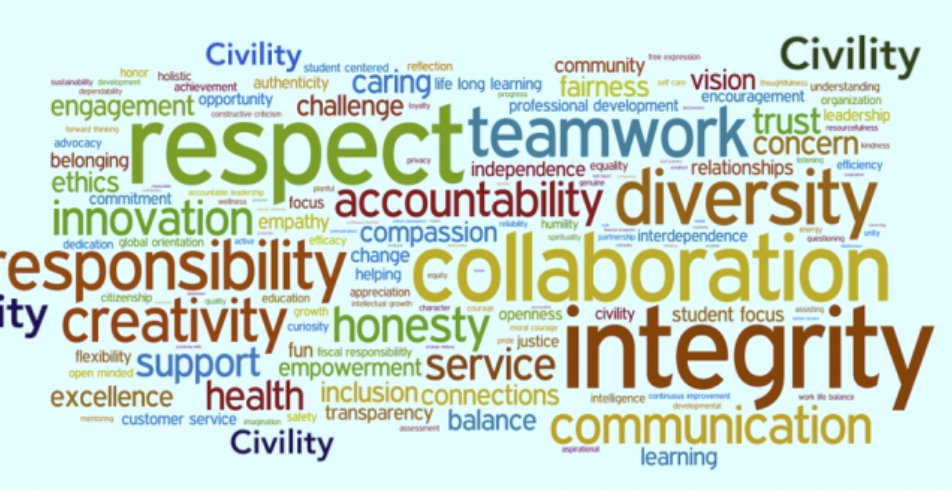
Civility is based upon the core values of human dignity, respect, acceptance, responsibility, constructiveness, intentionality and public-spiritedness. These values are adequate to support all of the desired Civility behaviors. Some proponents of the “classical liberal” political system argue that it must not incorporate a subset of moral values because there is no way to evaluate these values without starting with a full-blown moral system. These groups have argued with the modern communitarians and been unable to find common ground. We advocate the 7 Civility values on a pragmatic basis. They are required to drive the Civility behaviors. We need the Civility behaviors to live together.
I don’t think many citizens will reject these values because they are somehow inconsistent with the theory of our political system.
The grass-roots efforts to restore Civility have accelerated in the last 2 decades. Politicians and journalists have leveraged modern media and social media to appeal to the lower angels of human nature in order to monetize attention. In a world without a dominant religion, political philosophy or culture, we have a clear need for help in addressing our major social and political system challenges.
Civility does require personal work and interactions. We have a much better understanding of the components of Civility today. It offers a scalable solution to our many problems. It can be developed one step at a time. It can be used in all arenas of life. It can be taught to everyone. We can re-establish Civility as a social norm. Like other social norms, there is a virtuous cycle/network effect that leverages our progress. Modern social science classes provide very effective tools and classes to build our skills. Civility has personal benefits, especially a sense of personal agency. It has benefits for the institutions of modern life that can invest and promote it. Civility is a personal choice that cannot be prevented by groups that oppose it. Civility is a “no brainer”. We have the opportunity to re-establish it for the benefit of all.
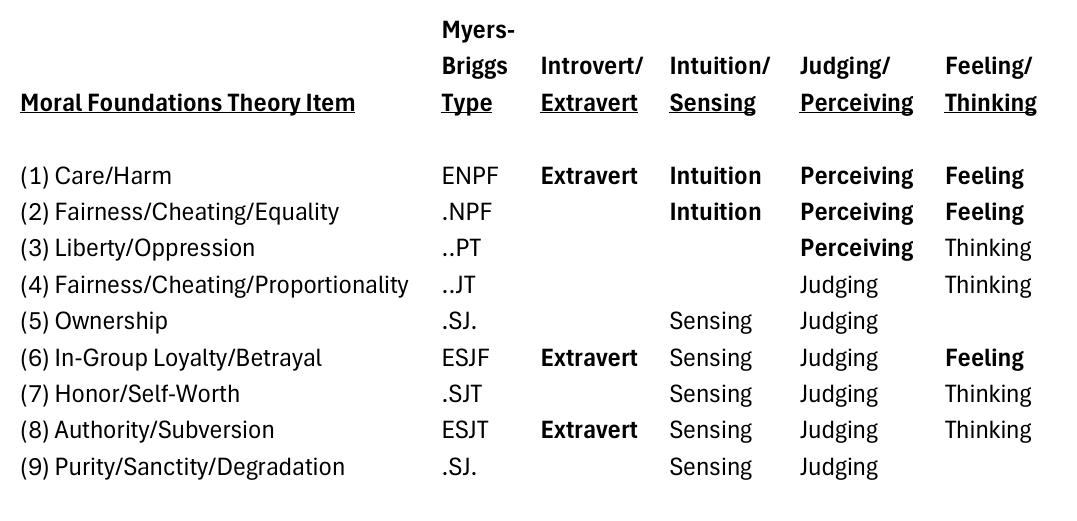
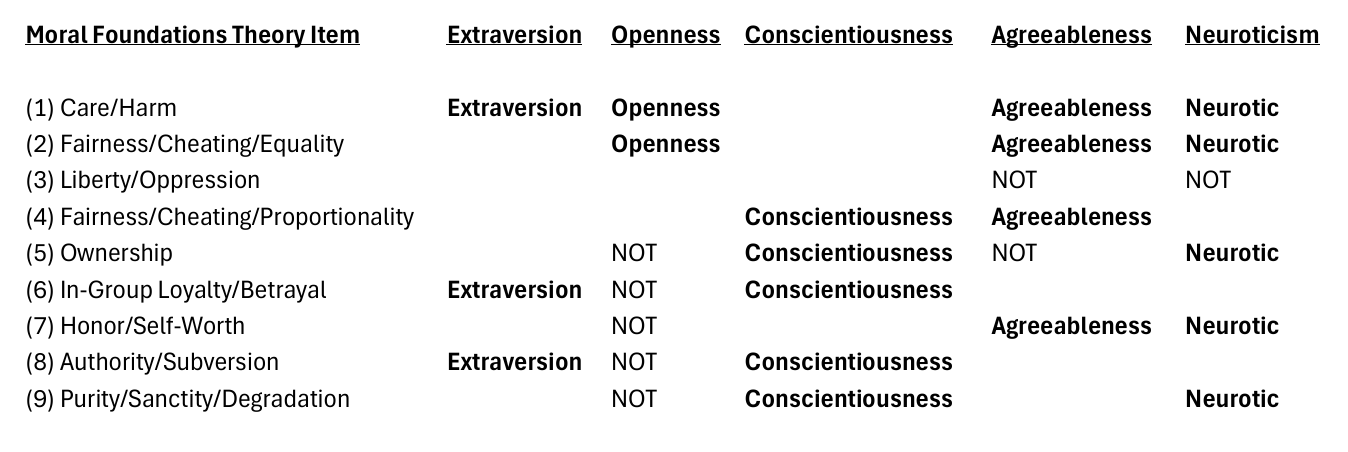
Jonathan Haidt and his colleagues have developed a set of 9 intuitive moral values that are consistent with evolutionary psychology insights. Amateur psychologists appreciate the Myers-Briggs model while professionals promote the “Big 5” personality traits. Google AI allows us to relatively quickly check our intuitive sense of how the moral values connect with the personality traits.
Professor Haidt’s work emphasizes that moral values are part of our internal makeup based upon evolution, especially recent evolution into a social and cultural species. His team promotes the “rider and elephant” model that asserts that we acquire and reflect deep-seated moral, political and religious views in an intuitive fashion. We only use our rider/rational character to defend/explain our choices from time to time. This was developed independently of Daniel Kahneman’s system 1, system 2 “thinking fast and slow model”. We mostly think fast/intuitively but are able to think slow/rationally as required. The “Moral Foundations Theory” team says that we are 90% selfish chimp and 10% cooperative bee. We are now a hybrid species.
Dr. Haidt is an intuitive, experiential liberal whose academic/scientific work forced him to re-examine his moral beliefs and biases, and those of the left-leaning social sciences. His team documented that there are traditional moral values widely held throughout history and across cultures that do not comply with the dominant WEIRD model of western, educated, industrial, rich and democratic. They took the usual modern experimental psychologist steps and defined 5 moral values. They later expanded their model to 9 values, breaking fairing/no cheating into equality and proportionality and adding liberty/oppression, ownership and honor.
Their team was widely criticized from the left for challenging/undermining the prevailing views of modern moral values (stage-based development, ala Jean-Jacques Rousseau and Lawrence Kohlberg) and opposing the “conventional wisdom” of inevitable moral and cultural progress towards a liberal ideal. At an early stage, they determined that liberal individuals and politicians had a limited moral palate of just care/harm and fairness while conservative individuals and politicians appreciated care/harm and fairness and many traditional moral values. Circa 2013 they tried to convince Democrats that they were playing politics “with one arm tied behind their backs”. The team must have thought “in for a dime, in for a dollar” when they later added ownership and honor to the traditional values of loyalty, authority and purity as valid, universal, historical moral intuitions.
I will take a first pass at how moral intuitions relate to personality traits and then to political views.
Introversion versus extraversion has a limited connection with moral intuitions or politics. Both parties and philosophies attract introverts and extroverts.
Abstract, intellectual individuals emphasize care/harm and fairness/equality as their main moral virtues. Haidt and others criticize this dominant academy view as “thin morality”, inadequate for the real world of community and politics. More concrete/specific/sensing/experiential/practical people tend to also support the conservative values of ownership, loyalty, honor, authority and purity.
Open-minded “perceiving” individuals support care, equality and liberty. Their “judging” counterparts support the 5 clearly conservative values listed above and proportionality as important principles for equity.
High “feeling” individuals tend to adopt the care and equality moral possibilities. They also tend to support the more conservative value of group loyalty. High “thinking” individuals like the structure provided by proportionality, authority and honor. They also tend to be more sensitive to liberty/oppression.
The “Big 5” personality value of “openness” to new experiences is considered the most important predictor of political views by political scientists and psychologists. High openness drives moral intuitions of care and equality. Low openness leads to a preference for ownership, loyalty, honor, authority and purity.
Conscientiousness is affiliated with the conservative values of ownership, loyalty, authority and purity. Proportionality is more neutral for politics, but clearly connected here.
Agreeableness does not align with the other factors. Friendly, high feeling individuals predictably support care and equality. But they also support conservative leaning proportionality and honor. Non-agreeable individuals are more sensitive to oppression, a relatively neutral value. Non-agreeable individuals are more interested in the conservative value of property ownership.
Neuroticism is an equal opportunity offender. Tightly wound, sensitive individuals tend to support the liberal core of care and equality. They are also attracted to the “conservative” values of ownership, honor and purity.
Summary
There is a clear left-right, liberal-conservative divide in some moral intuitions and personalities. There are statistical trends and tendencies. But real individuals are more complicated. Modern individuals are more likely to consider themselves independents with a portfolio of liberal and conservative views on specific topics. Many personality dimensions are unrelated to political views. Humans have different personalities, moral intuitions and political views. There is no clear “right and wrong” view. We are stuck with each other.
I encourage all partisans to deeply consider this result. Politicians are incentivized to win. They look for the “least common denominator”, the most effective words to assemble and maintain a voting coalition. In the modern world of politically and religiously low-engagement citizens, this is a rational and winning approach. Polarization and win/lose positioning are also logical means to election and re-election.
I think that we inherently hold different moral intuitions and political views based upon our personalities and life experiences. We are stuck with each other. We need to invest in Civility to make our political systems work. We need to embrace compromise and “good enough” political results.
In 2013, Jonathan Haidt summarized a decade of research on what values make man tick. What moral intuitions are widely held across time and cultures? Which ones are consistent with evolutionary psychology? How do people think about moral values? The researchers identified and validated 5 values, which have been expanded and refined into 9. People are born with the ability to develop certain moral intuitions. They adopt them subconsciously from experience, family and culture. They hold them deeply and defend/rationalize them as needed. We can change our moral values, politics and religions, but we usually don’t.
(1) Care/Harm
Don’t harm others, take care of people, relieve suffering, empathize. Leads to the virtues of kindness, gentleness and nurturance.
(2) Fairness/Cheating/Equality
Treat people fairly. Reciprocal altruism. Impulse to impose rules that apply equally to all and avoid cheating. Intuitions about equal treatment and equal outcomes for individuals. Generates ideas of justice, rights and autonomy.
(3) Liberty/Oppression
Feelings of reactance and resentment people feel towards those who dominate them and restrict their liberty. Seek liberation from constraints and fight oppression. Motivation to assemble to oppose invalid authority. Promotes equal rights, individual freedom and freedom from oppression.
(4) Fairness/Cheating/Proportionality
Intuitions about individuals getting rewarded in proportion to their merit or contribution.
(5) Ownership
Intuition about possession rights in society, similar to territoriality, which reduce conflict.
(6) In-Group Loyalty/Betrayal
Instinct to affirm the value of groups you identify with, including family and country. Leads to the obligations of self-sacrifice, vigilance, patriotism and punishing betrayal of the group.
(7) Honor/Self-Worth
Basing one’s self-worth upon reputation, including family and kin reputation.
(8) Authority/Subversion
Stable social order based upon the obligations of hierarchical relationships, including obedience, respect and fulfilment of role-based duties. Prevent/oppose/punish subversion. Leads to the virtues of leadership, followership, deference to authority figures and respect for traditions.
(9) Purity/Sanctity/Degradation
Intuitions of physical and spiritual contamination and disgust elevate the value of purity in thought, word and deed. Leads to the virtues of self-discipline, self-improvement, naturalness and spirituality.
Criticisms of the Liberal Values Approach
Liberals are attracted to the first 3 of the 9 values, while conservatives find all 9 to be appealing, including the traditional ones that liberals tend to avoid. This provides conservative politicians with the advantage of having 9 moral flavors to attract and inspire followers, while liberals make do with just 3.
Contrary to the self-image of most liberals, holding just 3 values can make us (me) intolerant, limited, uninformed, less caring/empathetic, disrespectful, proud, faithful, rigid, narrow, critical, uncivil, elitist, divisive, polarizing, righteous, close-minded, controlling, unsophisticated, Manichean, and unscientific!
Haidt and others criticize liberals for taking a simplistic “march of progress” view of history. C.S. Lewis called this “chronological snobbery” and “the spirit of the age” in comparison with universal views. Martin Luther King, Jr.’s quote “The arc of the moral universe is long, but it bends toward justice” fits into this determinist historical view. Hegel provided a philosophical basis for historical progress. World War I ended the naive view of unstoppable progress in all dimensions of life. The critics don’t discount the relative importance of the first 3 values but reject the elimination of the other 6.
Critics argue that liberals have applied “Occam’s Razor” to trim the list of important, experienced, valuable virtues to just 3 in order to make a political philosophy appear scientific. This is inconsistent with the historical liberal support for pluralism; the recognition of multiple, irreducible values needed for political, religious, economic and community life.
They argue that the short-list elevates the individual while removing any sense of community from the core values of man. They consider this nonsense. The history of philosophy, religion and social science focuses on the critical relationships between the individual and the community, universe, nature, church, city/polity, family/kin group, the many, and the whole.
They say that the strong liberal view is overly rational, elevating formal, scientific, instrumental logic above other forms of logic, feelings, intuitions, group logic, experience, habit, creativity, development, insight, values or spirit.
They say that the liberal view is overly formal, legalistic, individual rights based, administrative, measured, enforced, guaranteed, state based, centralized, bureaucratic, literal, detailed, and inflexible. It is based upon exact fulfilment of idealistic principles without regard to the realities of people or life. It falls into the trap of “the perfect is the enemy of the good” voiced by Voltaire. This approach mirrors that of the Pharisees in the New Testament. It attempts to formally implement utopian goals.
Critics say that care, equality and liberty are collectively very inadequate bases to support a social, political or spiritual philosophy. Too individual, ideal, abstract and emotional. Not balanced with community, spirit, and practicalities.
Critics argue that this approach undermines the essence of the liberal democratic model which recognizes that political differences of all kinds are inherent and offers a structure that limits the risks of worst cases while promoting the development of large majority support for compromise positions.
They say that elevating 3 values and discounting the inherent validity of other values leads to polarization. Caring is good. Trade-offs, qualifications, clarifications, competing values are bad. Equality of opportunity and results is good. Self-interest, group interest, access and preparation costs, excellence, risk-taking, creativity, perseverance, natural abilities, teaching, technology, self-discipline, and diet are bad. Liberty is good. Community, responsibility, duty, honor, hierarchy, wealth, power, feedback, and rewards are bad. There is an inherent limit to raising up any one or few values to be the “creme de la creme”. It doesn’t work. In reality, we are stuck with a messy, indeterminate set of values. Historically, liberals were more comfortable with complexity, change, and emerging perspectives; a reforming, organic, and evolving world.
Critics note that liberals have historically promoted a subjective world view, with individuals happily pursuing different newly created views. They have emphasized tolerance and welcomed paradoxes. They have embraced the arts. They have promoted F. Scott Fitzgerald’s view that “The test of a first-rate intelligence is the ability to hold two opposed ideas in the mind at the same time, and still retain the ability to function“. The recent liberal perspective is much more fixed.
Critics charge liberals with elitism for believing that their set of values is “obviously” superior to others. They argue that their discounting of others’ values is disrespectful. They say that it ignores their inherent value as worthy individuals.
Rebuttal
Conservatives are creating a “strawman” opponent. Some liberals DO believe that the first 3 values are most important and sufficient for supporting our social, political, spiritual and economic worlds. Very few hold this extreme position.
“Liberal versus conservative” is a simplifying intellectual construct. Liberal leaning individuals show great diversity in their beliefs. Individuals increasingly hold a portfolio of left, right and center views. Different interest groups within the liberal family emphasize different values.
“Liberals” do not live in ivory towers. They are engaged in their communities with individuals of varying political views. They are practical. They agree that good is better than perfect.
Tolerance and respect for individual views is a strongly held liberal value.
Politicians, volunteers, donors and thought leaders tend to be more divisive but they are a small share of “liberals”.
Recent survey research confirms significant differences from left to right in making explicit choices, but lab experiments and observational studies show that liberals also respond to situations based on all potential values.
Both conservatives and liberals tend to overexaggerate the depth of support for values or positions held by their opponents. The true differences in moral intuitions and values are not so extreme.
Politicians, strategists and communicators have learned from Haidt’s work. They better understand that humans are motivated in a variety of ways and seek to offer all 9 flavors.
Perception is Reality
Clever politicians live in the world of framing, soundbites, community building, targeted messages, fake news, impressions, smears, reinforcement, enemies, actions drive beliefs, brand is everything, share of mind, emotions, exaggerations, polarization, lies, click-bait, etc.
The so-called “liberal” positions described above do not have to be real, substantial, significant, constant, priorities, enduring, deeply held, common, important, material, central, core, logical, widely held, or consistent. They only have to be plausible or believable. Modern communicators have very few personal filters. Most listeners employ few critical thinking skills. They consume political news and commentary as entertainment and personal validation.
Hence, the views of the most extreme, true-believing, progressive, new left, far left, green, environmental, globalist, utopian, socialist, pro-labor, postmodernist, dada, creative, anti-privilege, defund the police, community activist, radical, intellectual, legalistic, disadvantaged, oppressed citizen, immigrant, politician, intellectual, influencer or local neighbor can be used to portray liberals as extremists, radicals, and severe threats to the American way of life.
Few of us write or act with an eye or ear cocked towards avoiding caricature. In the modern world we all need to become much more disciplined: individually, in our local politics and in holding state and national politicians to a new gold standard of support by the broad American public.
(1) Care/Harm
Surveys indicate that liberals and conservatives equally support this critical value. Because conservatives trade-off Care with other values in their policies, decisions and communications, some liberals accuse them of being cold, heartless or unfeeling. They reject this characterization and question the wisdom and character of their accusers, creating another cycle of polarization. In parallel, some liberals hold Care for the weak, poor, widowed, immigrants, imprisoned, disabled, or unlucky as the supreme value which does not allow for trade-offs to be made. Practical, balanced conservatives reject this utopian, idealistic approach and view it as proof of liberal extremism.
(2) Fairness/Cheating/Equality
Haidt and his team were required to separate 2 Equality from 4 Proportionality as they learned that different people defined fairness in quite different ways. The moral intuition that “cheating is wrong and basic fairness is right” prompts a variety of beliefs. Even when defined as “equality” it covers equal opportunity, equal treatment, equal rights, roughly equal outcomes and equal outcomes. Conservatives have “middling” support for 2 equality. Liberals show very strong support for “equality” of all kinds, broadly applied, often in its strongest form. The response to a violation can be so strong that it looks like (9) Purity/Sanctity/Degradation. Conservatives who don’t have this strong experience can see liberals as over-reacting, thin-skinned, woke, virtue signaling, overly protective, or bleeding hearts. Some liberals who watch conservatives dismiss differences, treatments and systems as relatively unimportant cannot understand why they don’t see the deep violation of human dignity as intolerable on all levels and not subject to context, materiality or trade-offs. This difference of relative weighting, intensity and perspective is difficult to bridge but both sides could start with recognizing it as differences rather than an ultimate “right versus wrong”.
(3) Liberty/Oppression
American liberals and conservatives both rank this as very important. They apply it to different situations. Liberals worry about powerful businesses, multinationals, banks, individuals, churches, courts, militaries, systems, processes and traditional institutions. Conservatives worry about the government, criminals, immigrants, foreigners, militaries and non-traditional institutions.
(4) Fairness/Cheating/Proportionality
Liberals give this a “middle” priority. They value logic and reason. Some support our meritocratic economic and social systems. Conservatives give this a much higher value. They worry about being cheated by governments, bosses, suppliers, welfare beneficiaries, immigrants, tenured faculty, free riders, criminals, storekeepers, retailers, foreign governments, international agencies, and self-dealing charities. (9) Purity/Sanctity/Degradation feelings arise as individuals monitor and prevent attempts to violate this deep sense of fairness. In a mirror image to (2) Fairness/Cheating/Equality, some liberals criticize conservatives for overreacting to remote, infrequent, low impact or nonexistent threats. They encourage others to make rational economic decisions to reduce but not eliminate such actions. Conservatives see this as a non-tradable value and wonder why liberals can be flexible on a truly essential human right – to not be violated.
(5) Ownership
This recently added moral intuition clearly resonates with the conservative values of fairness/proportionality, authority, and liberty/oppression. “What’s mine is mine and what’s yours is yours” is obvious. Conservative support for property rights has a long history. Liberals have weaker support for Ownership as a core intuition or value. They worry about powerful actors oppressing the weak by depriving them of property directly or indirectly [(2) Equality and (3) Oppression]. Some liberals argue that property is an agreed upon legal necessity subject to community definition and control. This view is unintelligible to many conservatives as we saw in the Obama “you didn’t build this” debate about the relative source of value/rights of property ownership between government infrastructure and business owners. Many conservatives today take the opposing view that “taxation is theft” because property ownership is seen as the supreme human right or value in society, befuddling their liberal neighbors. Liberals can benefit from gaining an intuitive sense of ownership as deeply felt and influential. Conservatives can benefit from seeing the government/economic systems perspective as being valuable just like the cultural/social norms perspective.
(6) In-Group Loyalty/Betrayal
Conservatives appreciate this value. Liberals give it weak support or oppose it as being contrary to the individual and a possible tool of oppression by powerful institutions like churches, political parties, fraternities and governments. Conservatives value community and individuals. All communities require forces to bind members. This infringes on perfect individual freedom but is unavoidable. Liberals remain concerned about the long history of powerful institutions doing “whatever it takes” to assume and maintain power, including taking away member’s rights. Liberals want to always emphasize the need for individual choice in making decisions to join, support and follow an organization. As conservatives worry about (4) being cheated in many dimensions of life, liberals worry about losing their individual rights and voice when they join any organization. This is a gut level, nagging concern. Yet, liberals do form strong group attachments to institutions, universities, sports teams, neighborhoods, professions, civic organizations, political parties, interest groups and churches in the lived world. Once again, greater self-awareness combined with better observation and understanding of “others” could reduce the perceived gap about what is important.
(7) Honor/Self-Worth
Another recently added moral intuition. Conservative honor is based on duty, hierarchy, and group integrity; Liberal honor is based on compassion, rights, and individual fairness. Conservatives highly value loyalty to the group and respect for authority, which are core components of traditional, collectivist “honor”. Liberal honor is less about group loyalty and more about universal human rights and compassion.
Liberals develop feelings of self-worth largely through individual achievement rather than their status as part of a family, profession, role, nation or group. Conservatives value communities more highly so see honor in the group, role or self as more important.
(8) Authority/Subversion
Conservatives greatly value a stable social order and the tools needed to build and maintain it. Liberals tend to fear oppression from powerful collective organizations, so minimize this value. This value is closest to the “essence” of liberal versus conservative views as measured by political scientists. Liberals seek new experiences while conservatives avoid unnecessary risks. Liberals could benefit from distinguishing (3) Liberty/Oppression from this value. Conservatives argue that social organizations, institutions and norms are required for any society. Proper authority must be respected to make this work. Liberals support authority for some organizations such as the government, so should be able to see the proper role of authority elsewhere.
(9) Purity/Sanctity/Degradation
Conservatives support this value, considering it obvious and universal. Liberals tend to consider it relatively unimportant. They often see conservative concerns about sex and sexual differences, racial interaction, criminals, religious beliefs and practices, flags, patriotism, foreign languages and “others” as overreactions to weak or nonexistent risks. Liberals have their own sacred items/threats such as children, abuse, animals, pollution, organic foods, fascism, locally handcrafted goods, mass transit, prejudice, microaggressions, and personal identities. Conservatives see the lack of liberal support for traditional social norms and institutions as a lack of human decency; an extreme point of view. Some liberals criticize the deeply felt support for these institutions, their leaders and symbols as being unfounded. Conservatives feel the sting of disrespect.
Summary
Humans have sets of moral intuitions that are deeply felt and often unconscious. There is a “liberal versus conservative”, “modern versus traditional” dimension that groups together sets of values. There is a long history of Western societies adopting more liberal values and fewer conservative values but there is no evidence that conservative values will disappear someday as society becomes more informed, intelligent, urban, secular, cosmopolitan, scientific and rational. Anyone who invests time studying all of these values will see that they are heartfelt, prewired intuitions. Some humans will hold each of them and consider them important.
Liberals and conservatives can both benefit from studying these values and recognizing their intrinsic validity. Individuals choose and/or hold different sets of values. They prioritize or weigh them differently. Most people acquire values informally by living life, not through explicit political, religious or philosophical choices. They have and defend their values. We will continue to hold different values. We can be civil. We can use our political system to manage these differences. Liberals, who claim to take the broader perspective and seek to find new solutions for problems, are obligated to invest in self-awareness and better understanding how others think about the world and what they can do to help everyone understand and connect.
Civility is a set of behaviors based upon the seven commonly held values of: human dignity, respect, acceptance, intentionality, responsibility, constructiveness and public-spiritedness. A social, political and economic society must have some core beliefs, norms and behaviors. The modern renaissance of Civility attempts to define the beliefs, norms and behaviors so they can be shared and promoted. We need to be confident that we know what Civility is, how we should behave, how/why we should influence others and why the underlying principles make sense.
Acceptance and Inclusion Defined
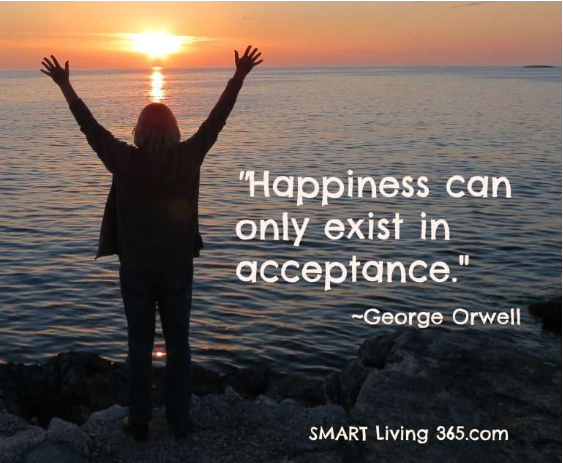
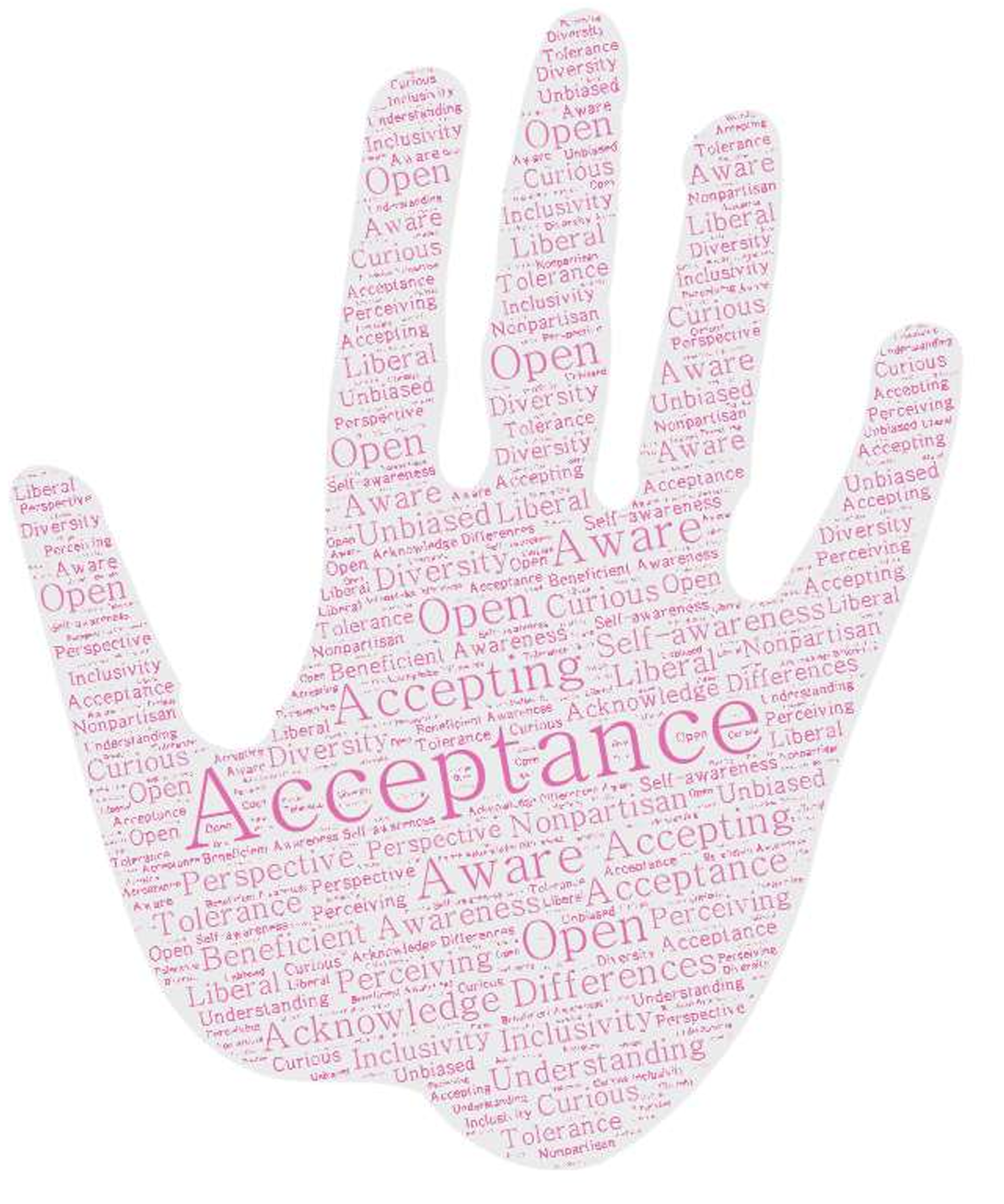
Acceptance involves tolerating, respecting, and acknowledging differences. Acceptance is being open, tolerant, non-discriminating, nonjudgemental, understanding and minimizing prejudices. It is a habitual state of mind. The differences can be personal or group characteristics, beliefs, behaviors or identities.
Inclusion is acting on the value of acceptance. It includes being present, supporting others, choosing welcoming language and behaviors and preventing or reducing social exclusion.
Inclusion is primarily shown by intentionally creating positive social environments where all individuals are welcomed and feel a sense of belonging. Individuals are respected, heard, accommodated, and supported. They feel safe, trusted and free to be authentic. They are encouraged to participate, contribute and thrive.
Acceptance and inclusion help individuals to more effectively interact with others, communicate, trust, bond, listen, center, and build awareness and community.
We emphasize “acceptance” in order to avoid the political differences regarding “inclusion” in the DEI abbreviation. Acceptance and inclusion go “hand in hand” and are necessary foundations for embracing Civility as an idea and a set of behaviors.
Acceptance and inclusion are supported by the major world religions.
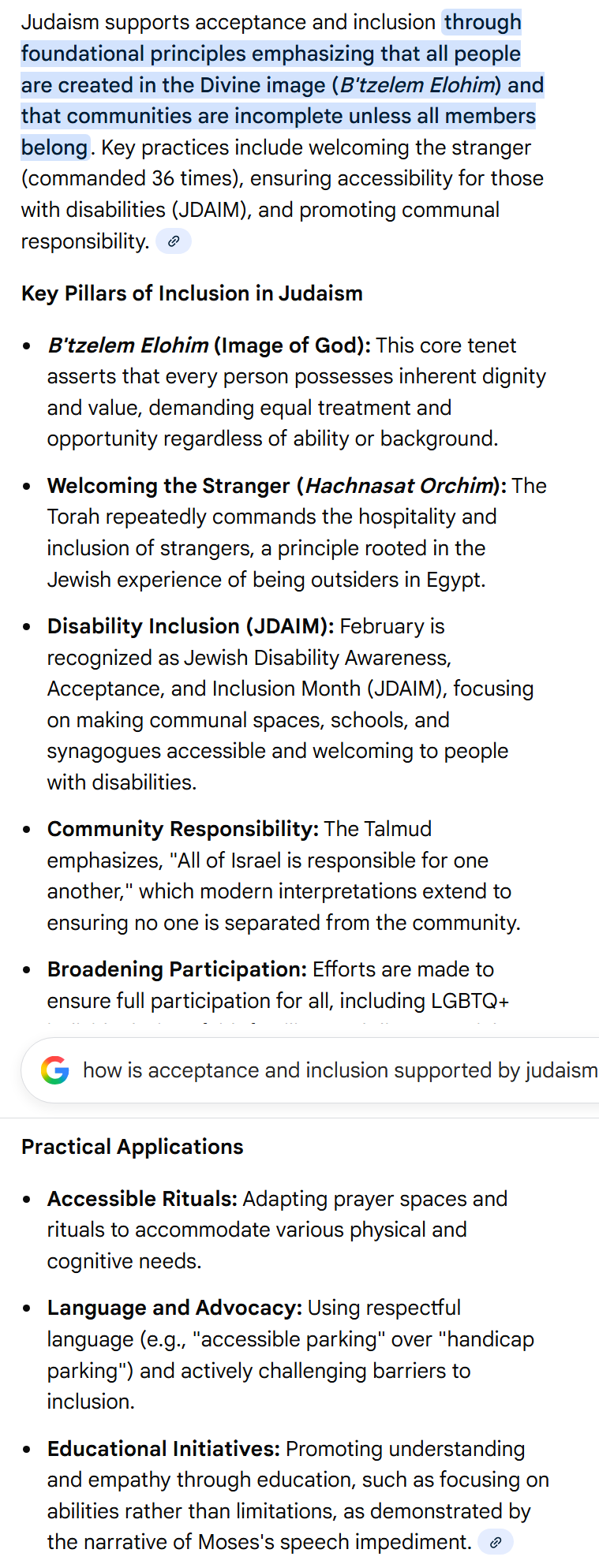
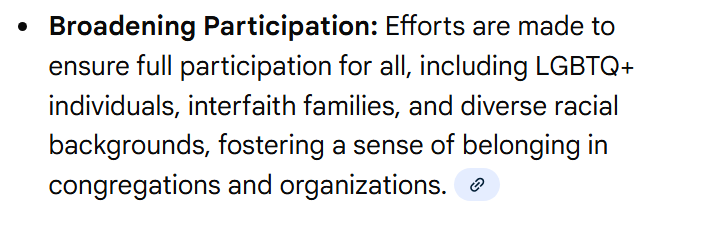
Judaism (Google AI)
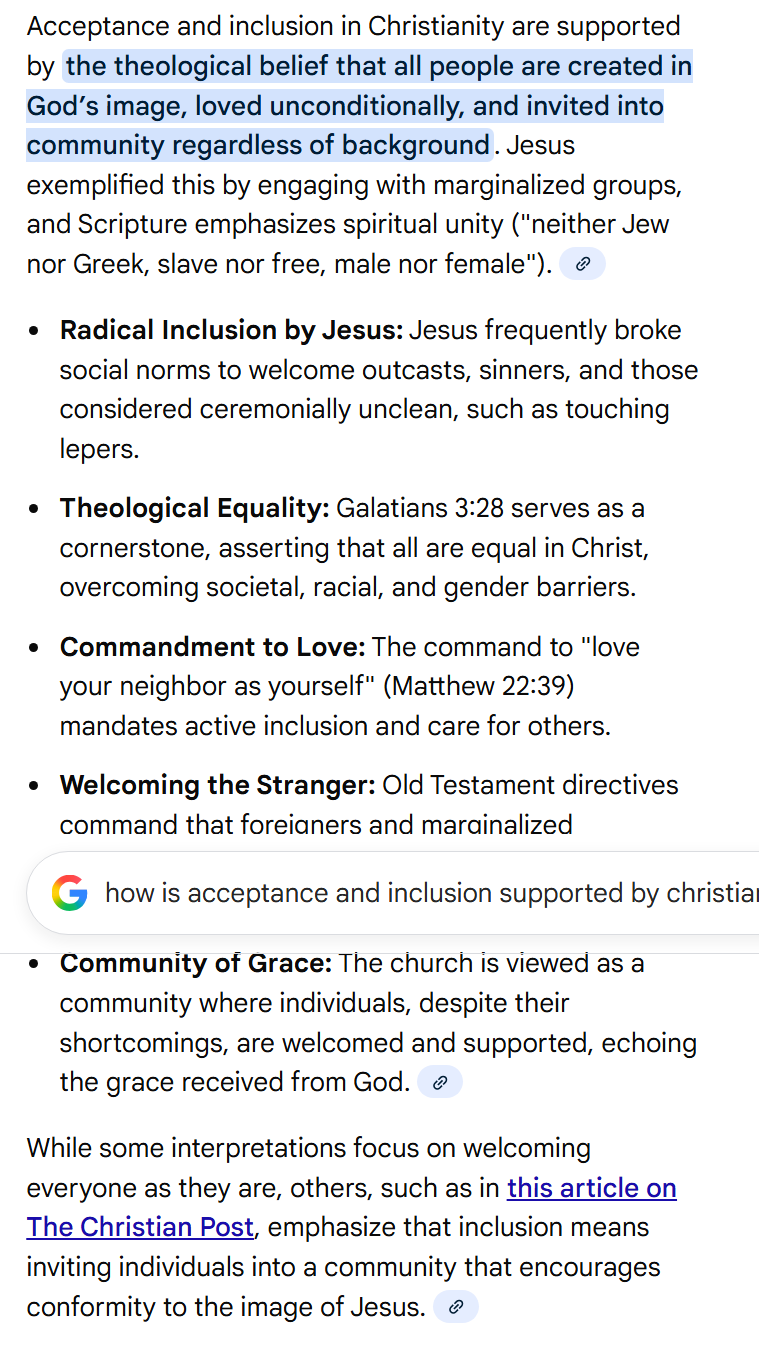
Christianity
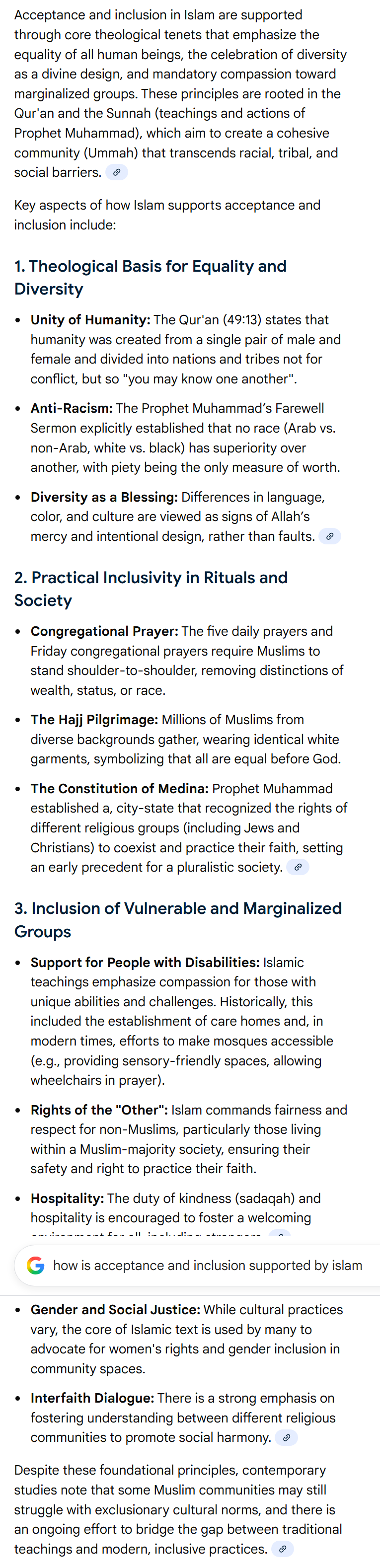
Islam
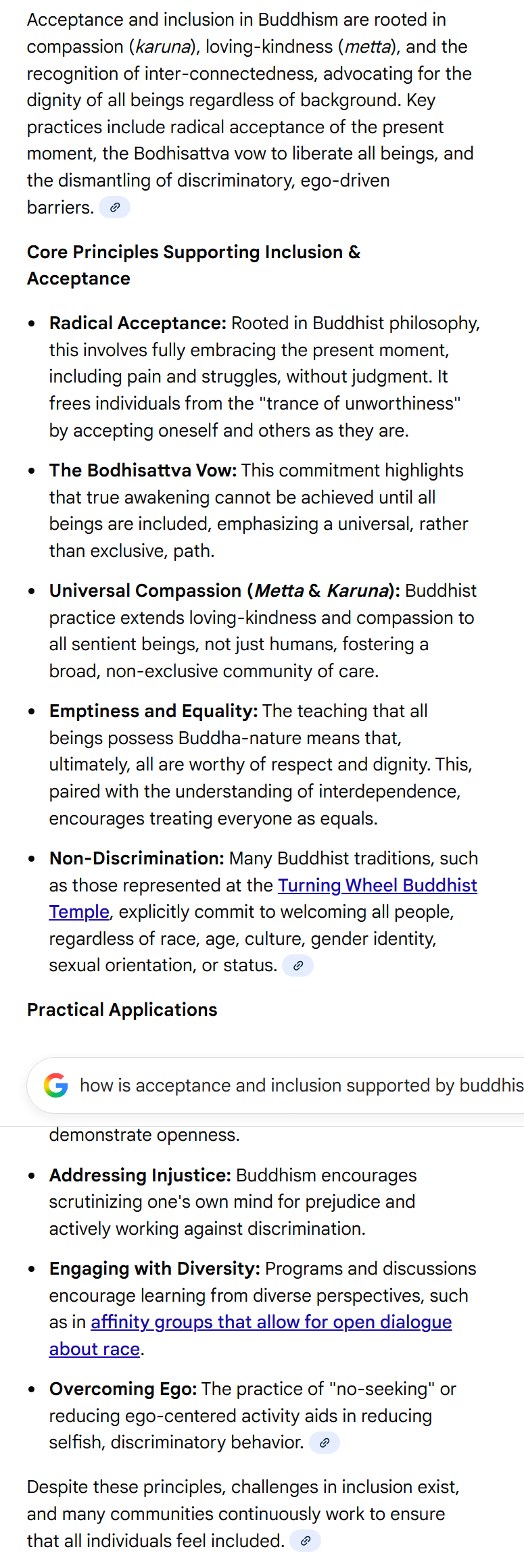
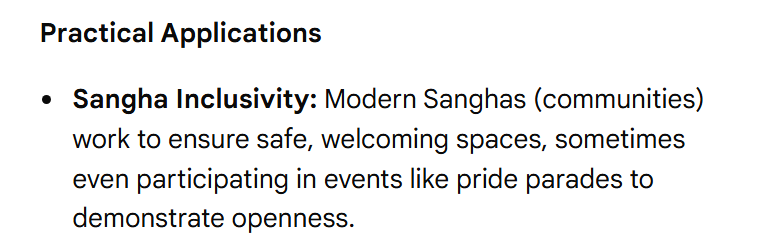
Buddhism
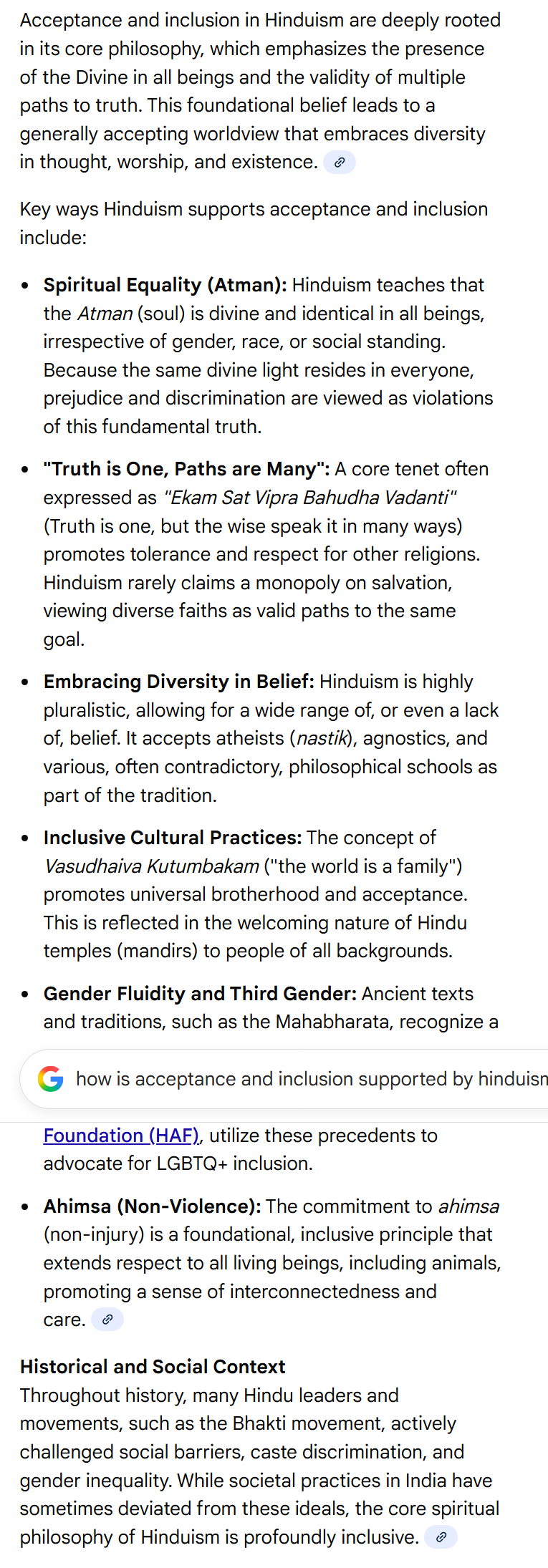
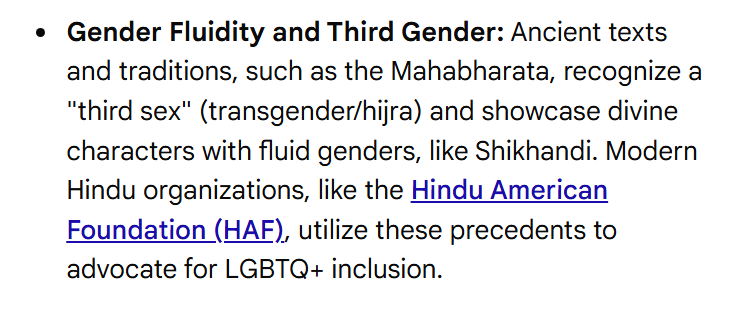
Hinduism
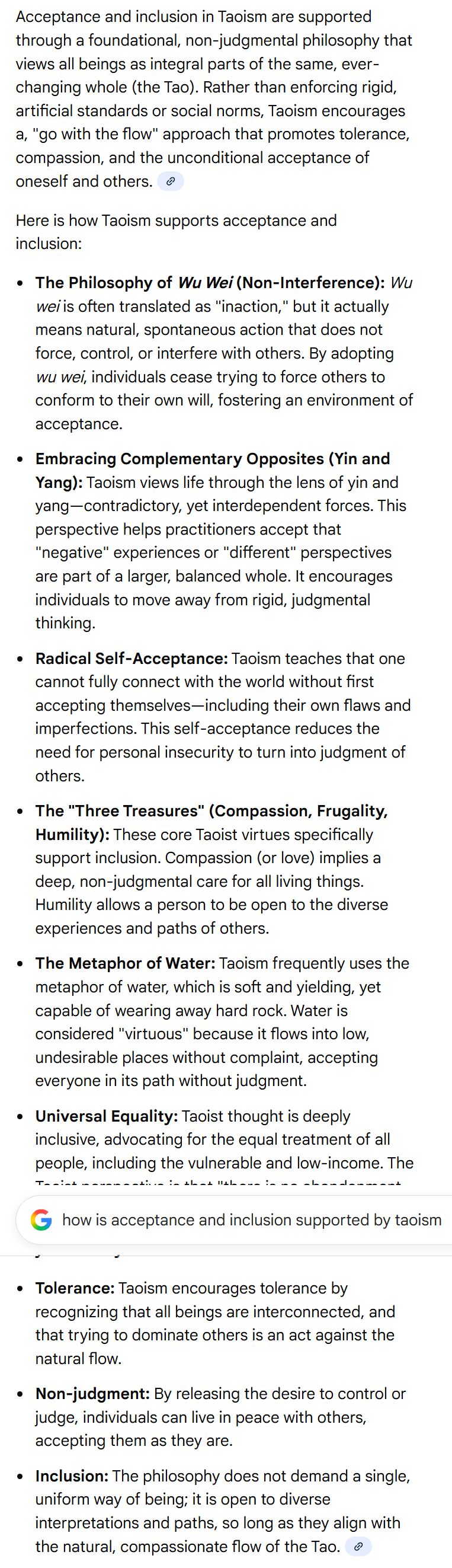
Taoism
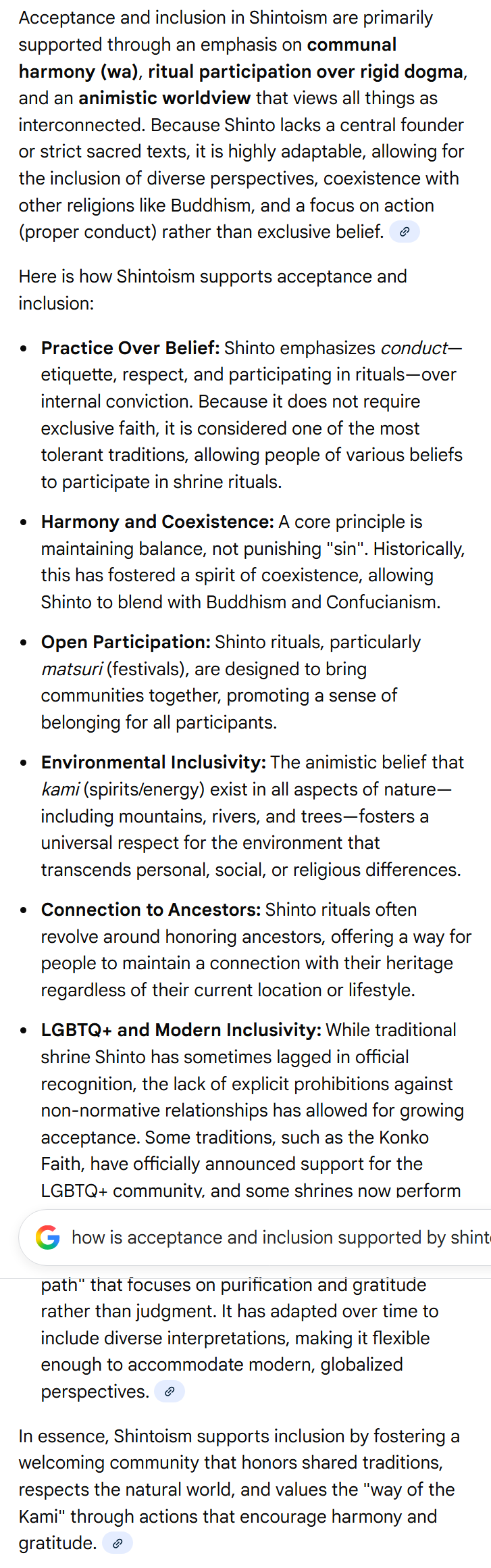
Shintoism
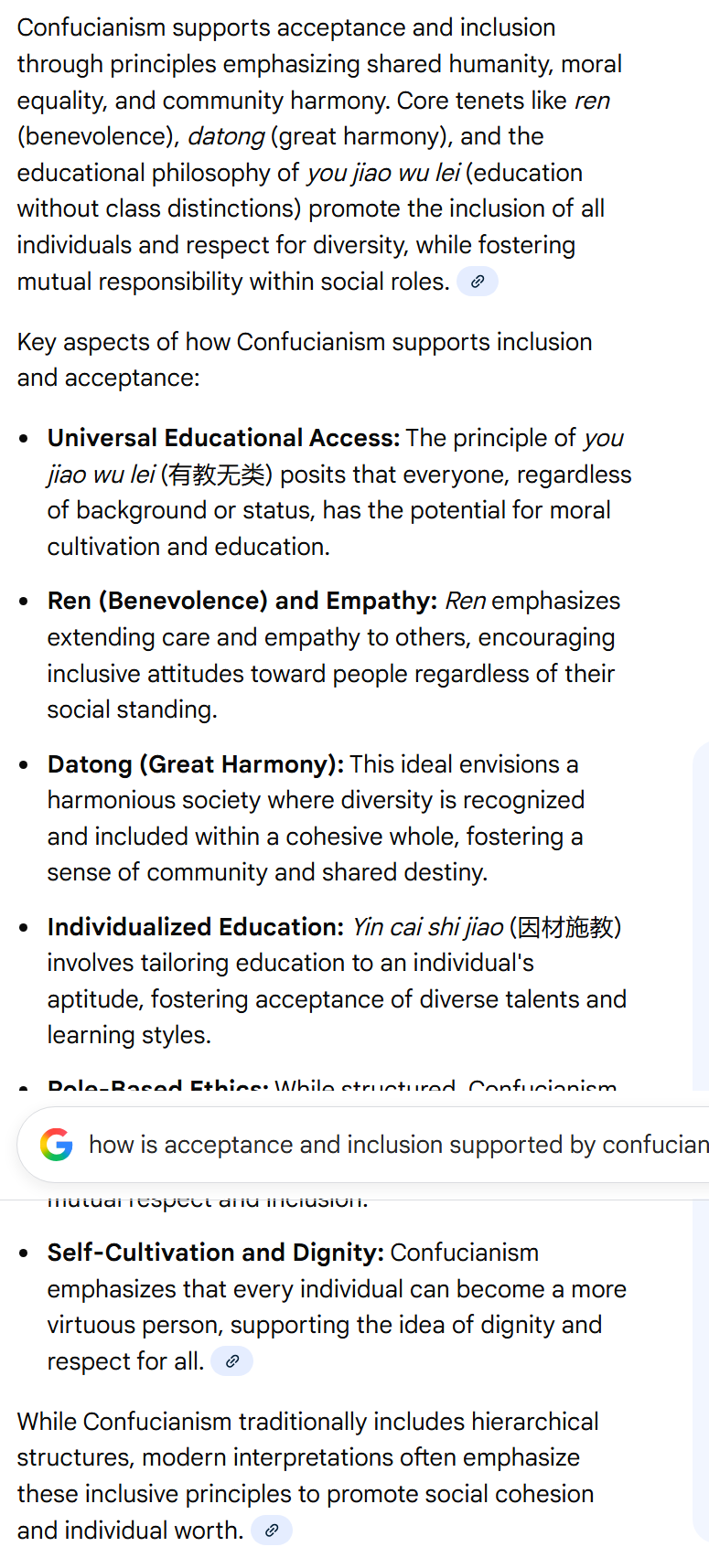
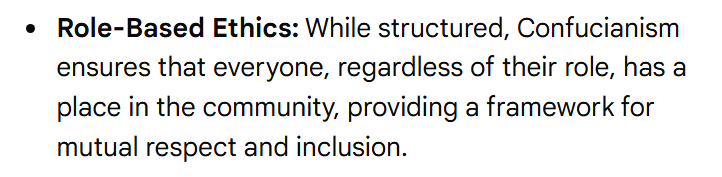
Confucianism
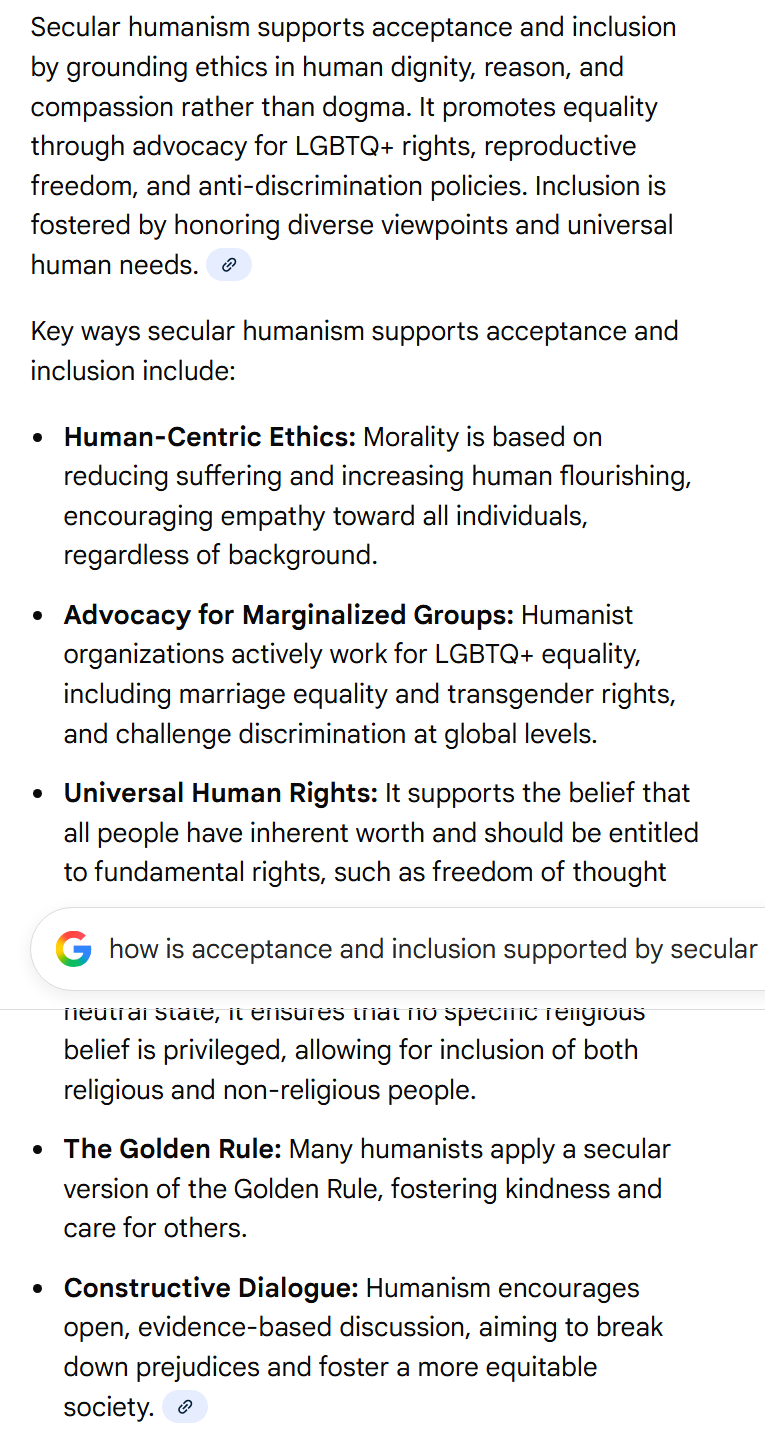
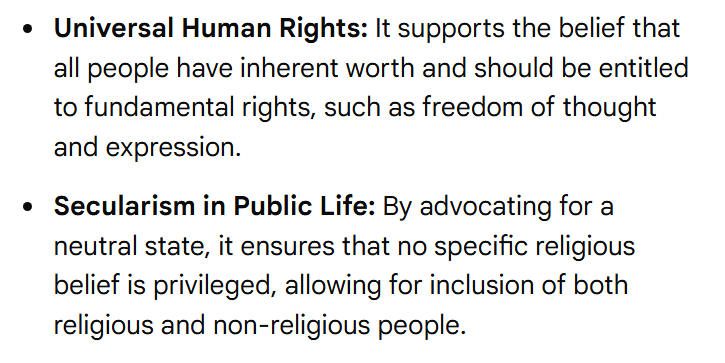
Secular Humanism
Summary
The major world religions support acceptance and inclusion:
All individuals have human dignity, created by God, worthy of acceptance and inclusion.
Religion is practiced in communities where diverse individuals are brought together.
The strange, vulnerable, marginalized, foreigner, widows, prisoners, and outcasts are different and must be embraced.
Individuals are commanded to be compassionate, caring and loving to all.
The spiritual dimension of individuals in communities makes them equally worthy of acceptance.
Religious rituals emphasize the unity of individuals in community practice.
The universe is one and individuals should seek harmony with all of it despite the surface level diversity.
There are multiple, fluid paths to enlightenment or connecting with God, so diversity is natural.
Many religions specifically call out the value of diversity, differences, designs, races,other religions, non-religious sectors and viewpoints.
Some religions emphasize the inherent incompatibility of the individual with the whole, yet they are complementary despite the unbridgeable differences.
Religions note the path of personal growth and learning that is driven by interacting with diverse thoughts, experiences and individuals.







 Good News