Good News: Private Pension Funding Ratios Near 100%

Milliman Summary of 100 Largest Plans Offers Best Details

https://us.milliman.com/en/insight/2022-Corporate-Pension-Funding-Study

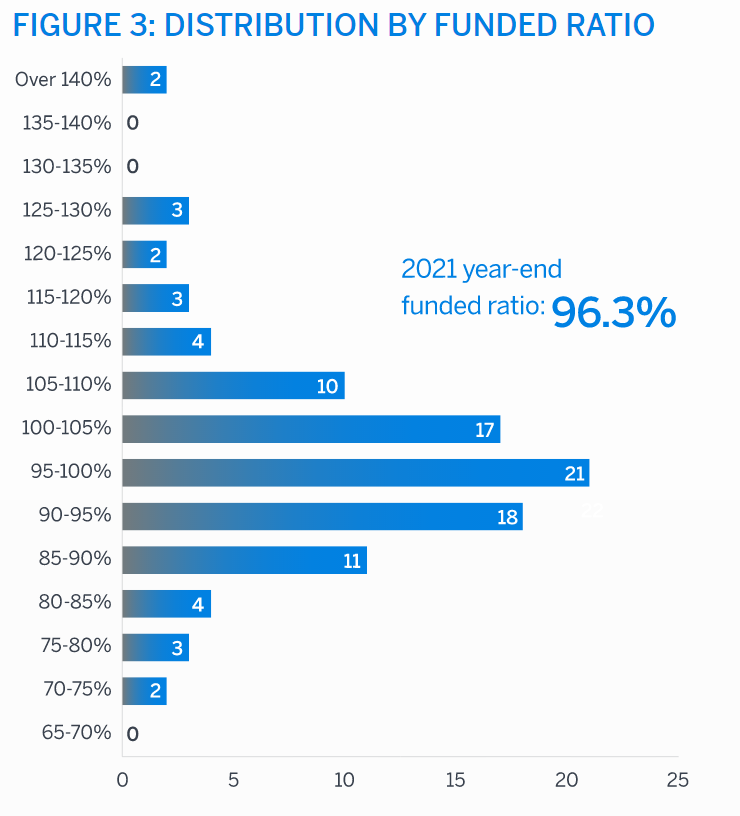
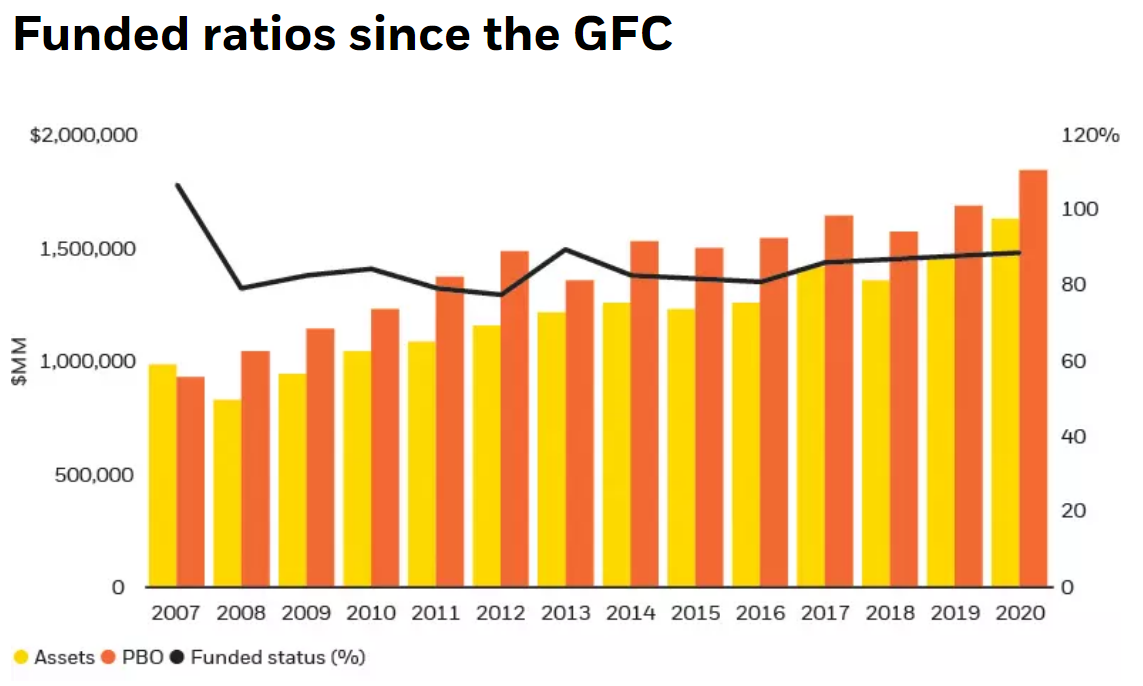
Just 5% of the largest plans have a funded status (assets/liabilities) less than 80%.

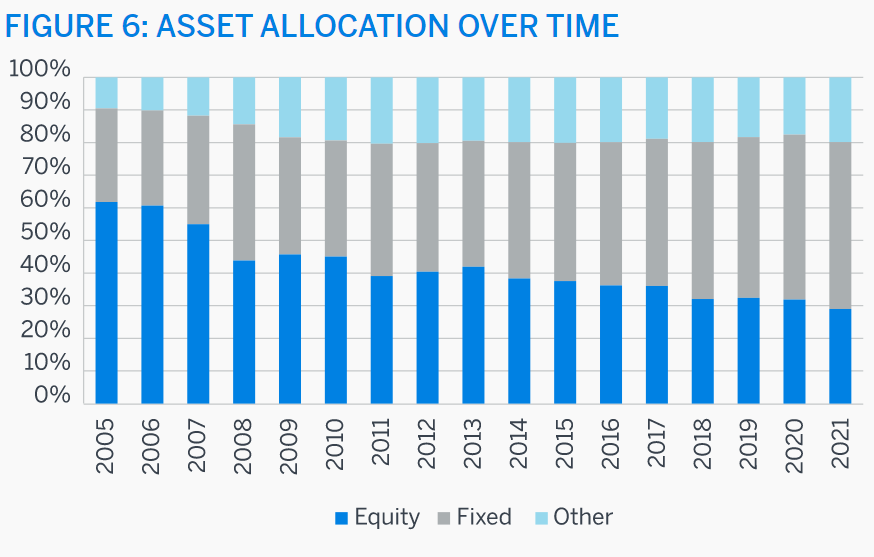
This is in spite of an increase in lower risk/lower return fixed income/bond funding growing from 30% to 50% of invested assets.

Plan assets took a big hit in 2008 but have slowly recovered.

Historically, 80% funded was considered to be “fully funded”. Corporations increased contributions after 2008 to slowly ensure plan funding ratios would increase. The 96% level in 2021 is unusually high, driven by many years of increased corporate cash contributions and higher than expected investment returns that have offset planned future investment returns which have dropped from 9% to 6.5%, thereby decreasing the ability of firms to simply rely upon investment returns to fund their pension liabilities.

Almost one-half of the largest firms have funded ratios of 90-105%, a very safe level. More firms have greater than 105% funding than have less than 90% funding.

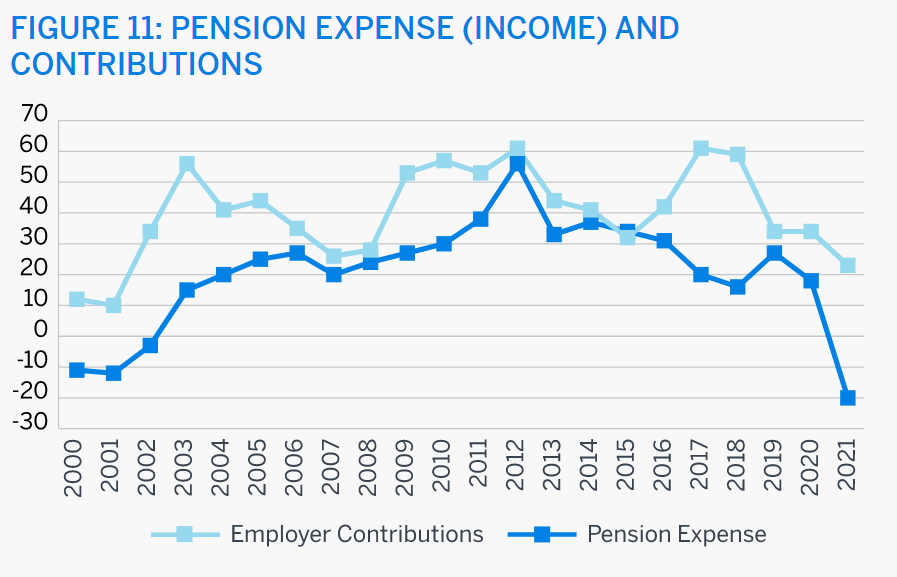
Pension accounting is a complex and subjective area. Cash contributions have consistently exceeded the accounting basis expenses recognized. This reflects a conservative actual funding strategy.

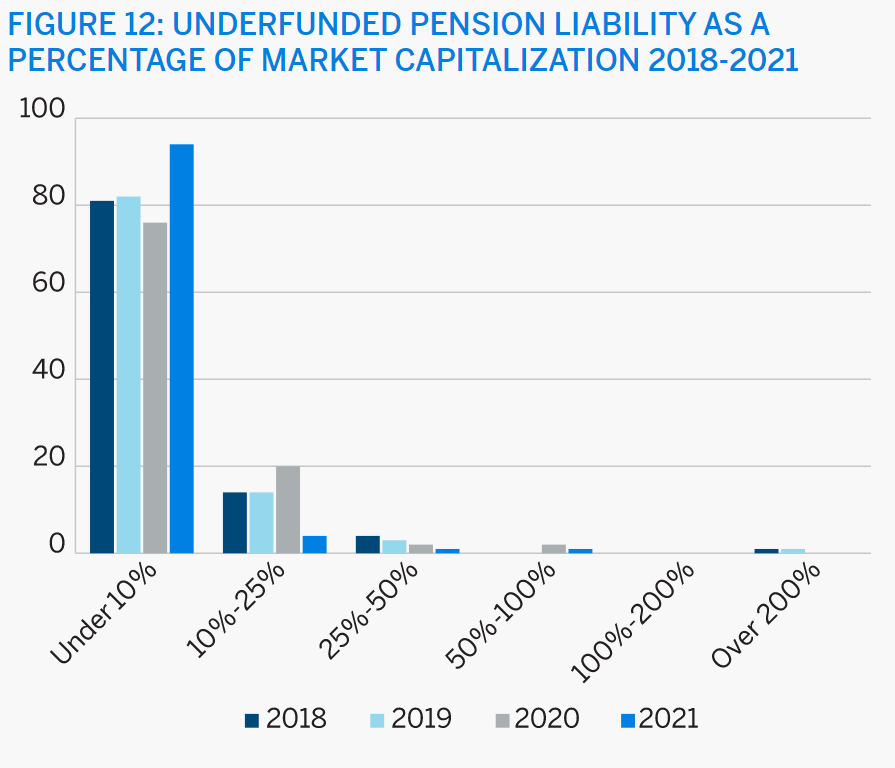
The net unfunded pension liability is an immaterial share of the value of major corporations.

https://www.blackrock.com/institutions/en-us/insights/investment-actions/corporate-pensions-funding-ratios

Blackrock summarizes funded status for 200 large defined benefit pension plans. The funded ratio declined in 2008 and has slowly recovered. It reached 95% in 2021.

https://www.mercer.us/newsroom/s-p-1500-pension-funded-status-increased-by-13-percent-in-2021.html

Mercer summarizes 1,500 defined benefit pension plans. 80% funded is pretty typical since the Great Recession. Mercer reports 97% funded status at the end of 2021.

Summary

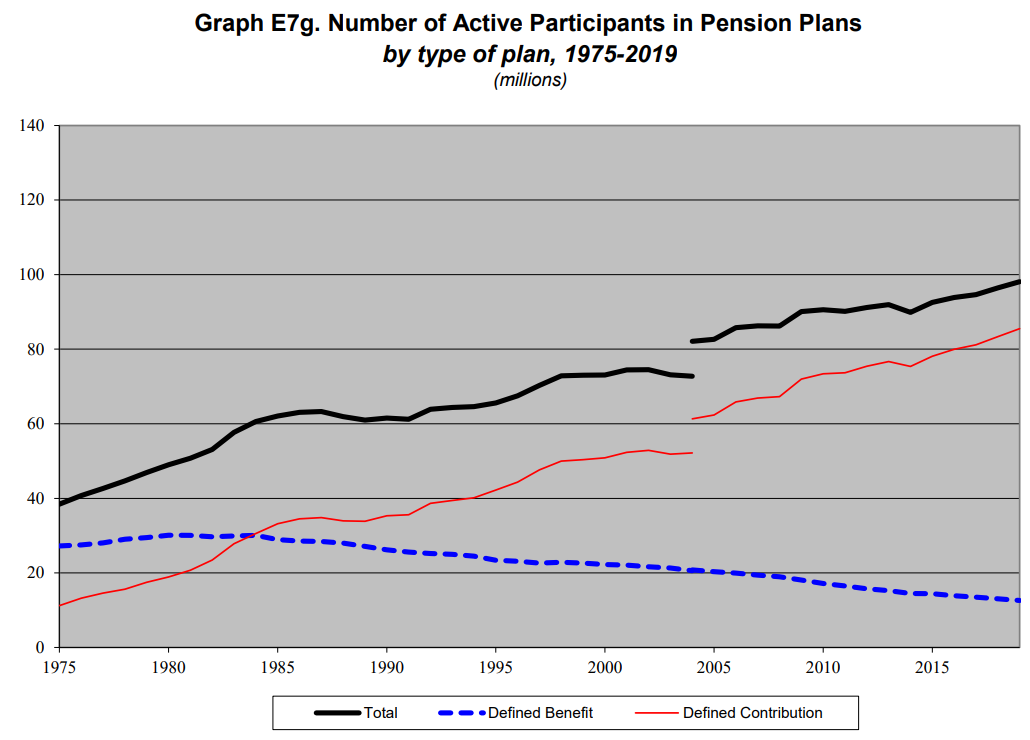
Defined benefit pension plans are an increasingly smaller share of all retirement savings plans. However, corporations are funding their future liabilities at a fully adequate level.

Good News: Oil 2022 is not Oil 1972!

World Oil Dependency is Less than One-Half What It Was

https://www.energypolicy.columbia.edu/research/report/oil-intensity-curiously-steady-decline-oil-gdp

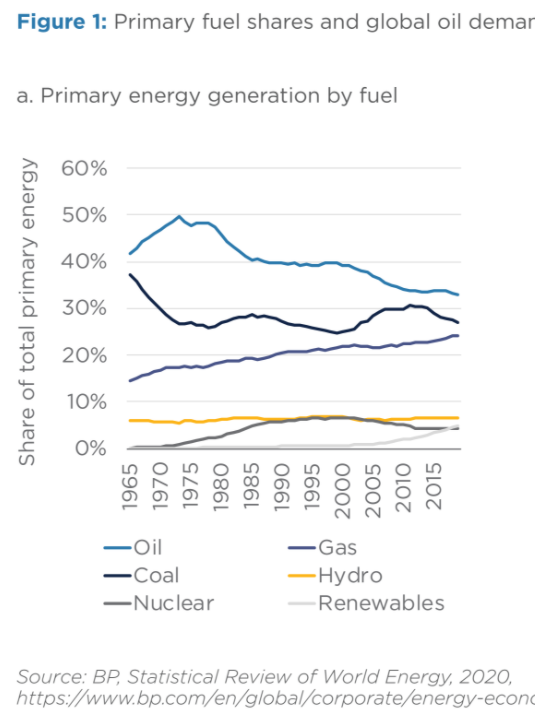
Oil Matters, But Other Energy Sources are Growing

https://www.energypolicy.columbia.edu/research/report/oil-intensity-curiously-steady-decline-oil-gdp

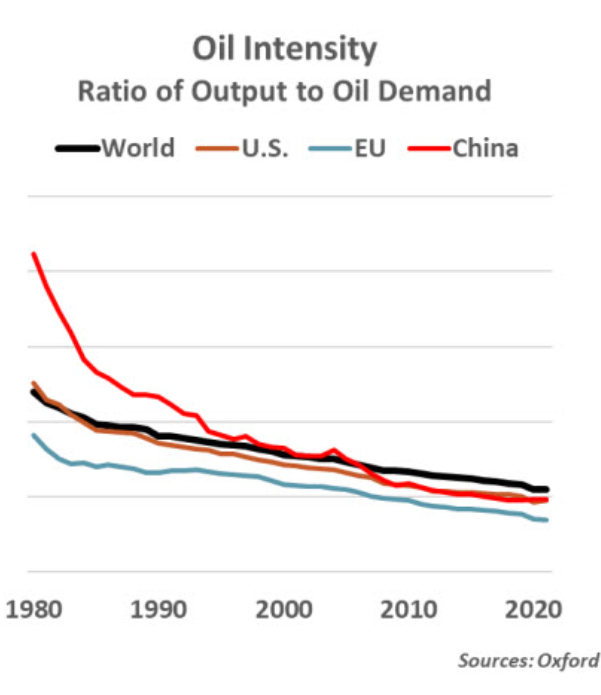
Oil Intensity is Declining on Many Continents

https://www.energypolicy.columbia.edu/research/report/oil-intensity-curiously-steady-decline-oil-gdp

https://www.northerntrust.com/africa/insights-research/2022/weekly-economic-commentary/oil-intensity

Oil Intensity Has Declined Even While Demand Has Grown

https://www.energypolicy.columbia.edu/research/report/oil-intensity-curiously-steady-decline-oil-gdp

https://www.mckinsey.com/industries/electric-power-and-natural-gas/our-insights/the-decoupling-of-gdp-and-energy-growth-a-ceo-guide

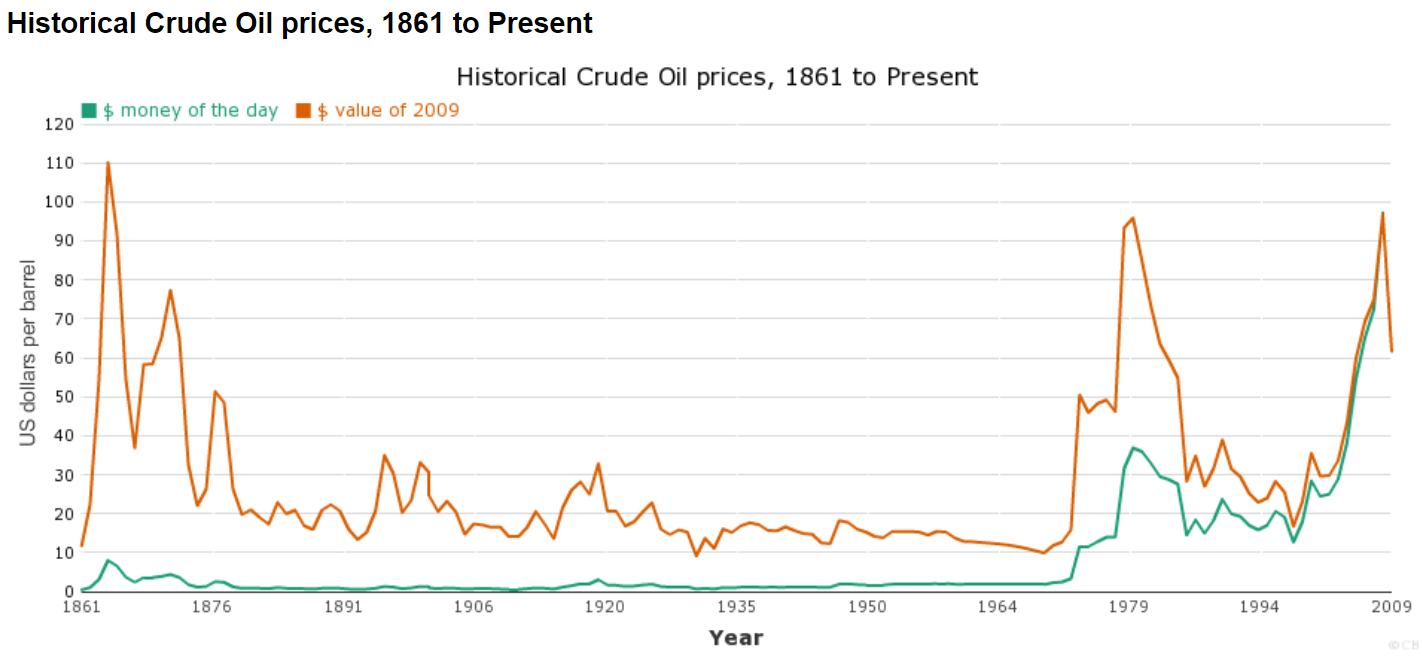
Context of Historical Real Prices

http://chartsbin.com/view/oau

https://www.mckinsey.com/industries/electric-power-and-natural-gas/our-insights/the-decoupling-of-gdp-and-energy-growth-a-ceo-guide

Future Global Oil Intensity is Declining

https://www.energypolicy.columbia.edu/research/report/oil-intensity-curiously-steady-decline-oil-gdp

https://www.reuters.com/business/energy/why-todays-economy-can-handle-oil-100-barrel-or-higher-2021-10-21/

Energy intensity is down as the service economy becomes a greater share of GDP, energy efficiency improves for consumer and industrial uses, electricity power grows with its inherently higher efficiency, and renewable energy grows as a source of power.

https://www.mckinsey.com/industries/electric-power-and-natural-gas/our-insights/the-decoupling-of-gdp-and-energy-growth-a-ceo-guide

Recent Global Oil Price Spikes Had Limited Impact

https://www.energypolicy.columbia.edu/research/report/oil-intensity-curiously-steady-decline-oil-gdp

https://www.reuters.com/business/energy/why-todays-economy-can-handle-oil-100-barrel-or-higher-2021-10-21/

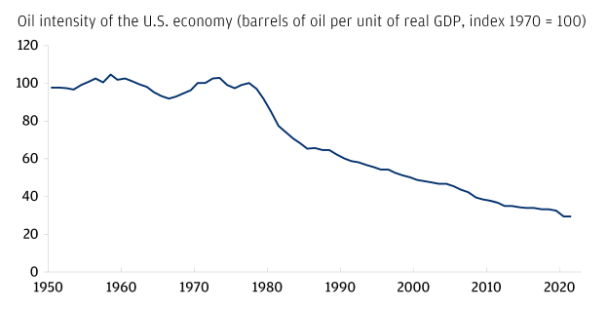
US Economy Energy/Oil Intensity Improves

https://www.eia.gov/outlooks/aeo/consumption/sub-topic-03.php

https://www.eia.gov/todayinenergy/detail.php?id=42895

https://www.jpmorgan.com/wealth-management/wealth-partners/insights/stagflation-is-not-here-to-ruin-our-economy-once-again-heres-why#infographic-text-version-uniqId1649120345700

Future Energy Intensity Improvements in All US Sectors

https://www.eia.gov/todayinenergy/detail.php?id=42895

https://www.eia.gov/outlooks/aeo/consumption/sub-topic-03.php

https://www.northerntrust.com/africa/insights-research/2022/weekly-economic-commentary/oil-intensity

Risks

US consumer price index still weights motor fuel consumption at 4%, so spikes in market prices effect consumers and politics.

The long-term downward trend in oil required per dollar of GDP slowed after 2014.

https://www.energypolicy.columbia.edu/research/report/oil-intensity-curiously-steady-decline-oil-gdp

It’s possible that ALL energy prices may increase, especially during the transition to renewable energy sources.

https://www.reuters.com/business/energy/why-todays-economy-can-handle-oil-100-barrel-or-higher-2021-10-21/

Finally, individual country risks still matter: Russia, Iran, Venezuela and Saudi Arabia.

Summary

The Oil Shocks of the 1970’s were due to a drastic shift in the pricing power of the OPEC countries following 30 years of greatly accelerated global demand for oil while it was priced attractively. Demand and supply have both grown in the last 50 years. The role of oil in the global and US economies (compared with real output/GDP) has dropped by more than one-half. Increased oil prices can and will have a significant effect today, but less than one-half of that in the past. Long-run trends indicate that the role of oil as a critical resource will continue to decline, although there remain risks as the world closes coal and nuclear power plants and makes the investments required for a renewable energy world.

Good News: Consumer Debt Payments at Record Low

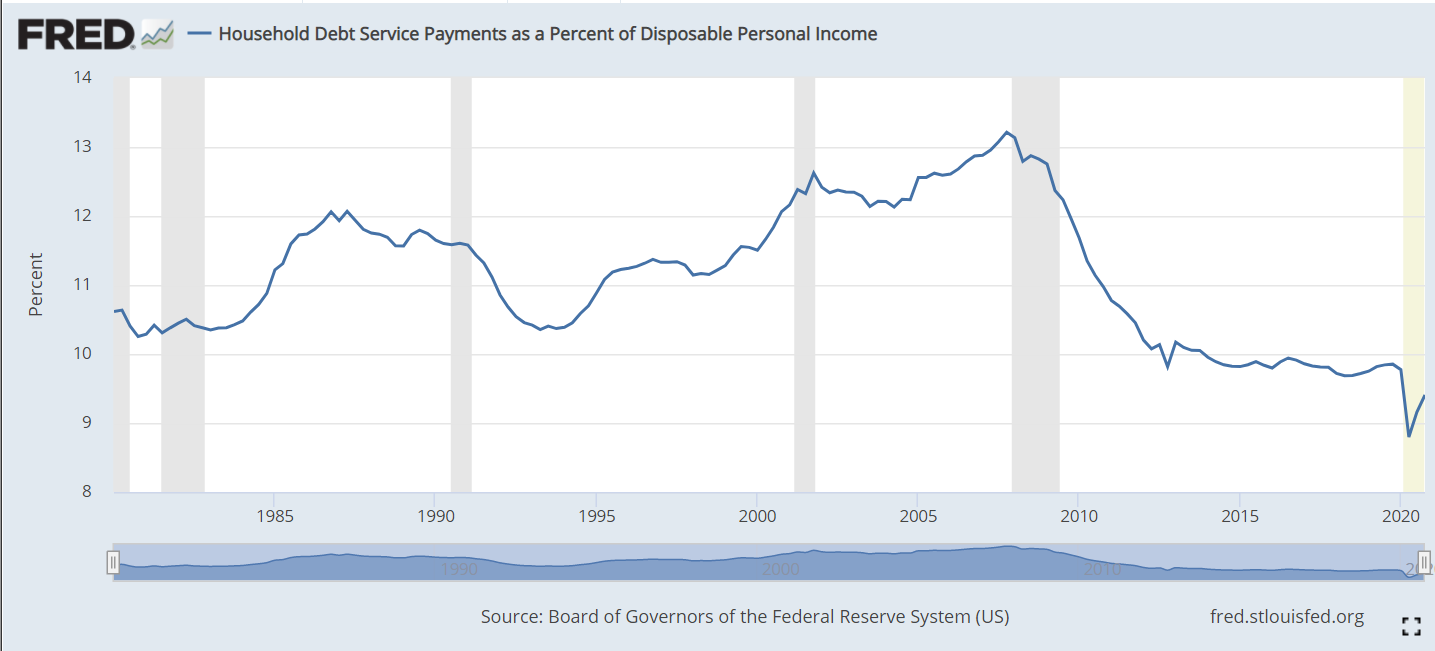
Household Debt Service Payments as a Percent of Disposable Personal Income (TDSP) | FRED | St. Louis Fed (stlouisfed.org)

The ratio of household debt service (loan payments) to disposable personal income includes both mortgage payments and consumer debt payments. From 1980-2000 it fluctuated between 10.5% and 12%. Following the 2001 recession it increased to more than 13% before falling steeply to 10% in 2012. During the long recovery from the Great Recession it remained just below 10%. During the pandemic time it fell as low as 9% as personal incomes were boosted through stimulus payments. In total, this is a healthy situation. American families worked through an unsustainable runup of debt and payment during the “ought” decade, the Great Recession and the pandemic. They are well positioned at les than 10% to either save or spend, depending on their preferences. This is good news for the economy, the housing market and risks to financial markets. This is often called the Debt Service Ratio (DSR).

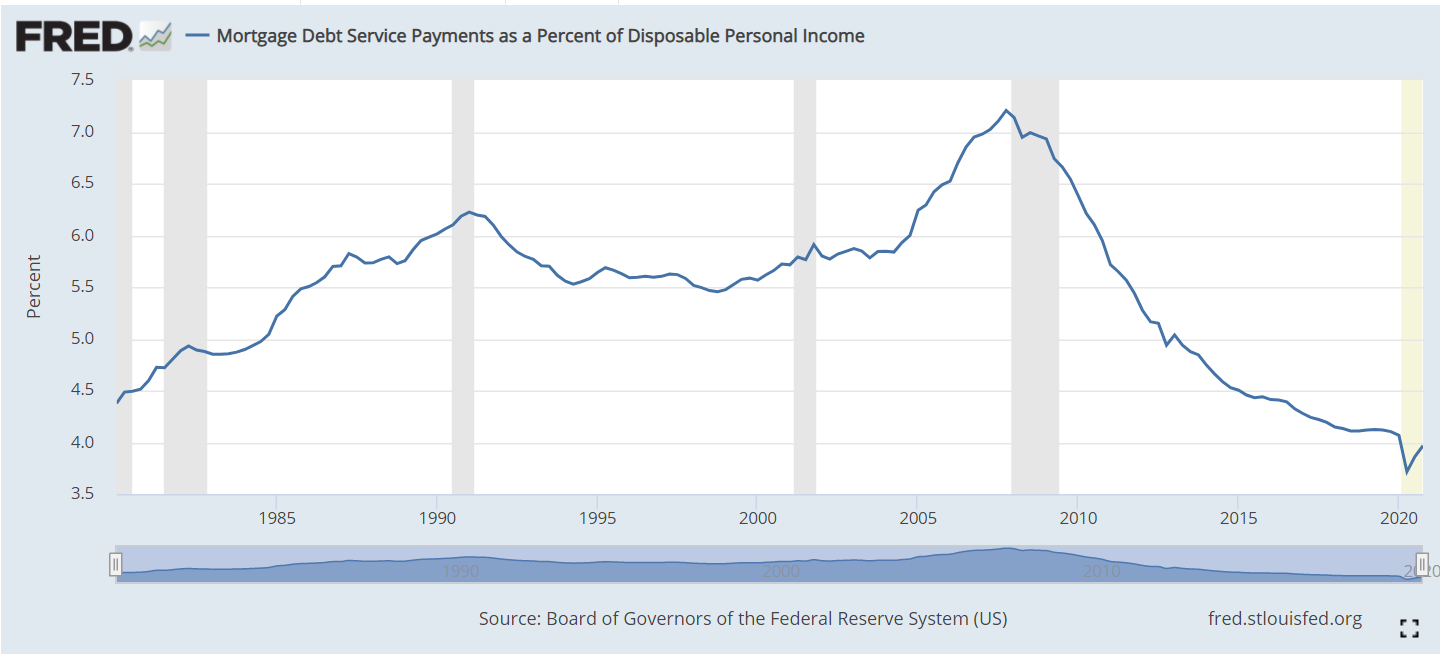
Mortgage Debt Service Payments as a Percent of Disposable Personal Income (MDSP) | FRED | St. Louis Fed (stlouisfed.org)

The mortgage component averaged 5.5% of personal income from 1980-2000. It remained below 6% through 2004, before increasing quickly to 7% in 2007. This was unsustainable. Mortgage foreclosures and revised lending standards reduced mortgage lending balances quickly. The Fed reduced interest rates and kept them low. Mortgage payments as a percent of disposable personal income fell to just above 4%. This is a 40% drop (3/7). Even compared with the 5.5% average, this is a 27% reduction in debt service expenditures. This ratio is threatened by future interest rate increases, but current mortgage holders will benefit from years of low mortgage rates and refinancing for decades to come.

Consumer Debt Service Payments as a Percent of Disposable Personal Income (CDSP) | FRED | St. Louis Fed (stlouisfed.org)

Consumer debt has also fluctuated across these 40 years, reaching an early peak of 6.4% in 1986 during the confusing era of stagflation. In the next 6 years, families reduced their debt percentage by 1.7% to a safe minimum of 4.7%. Consumers were more confident through the 1990’s and took on more debt, allowing the payment ratio to rise to a new record of 6.6% before the 2000-2001 recession triggered less borrowing. Although mortgage payments increase during the 2000’s, consumer debt payments eased back to just 6.0%. Families were scared by the Great Recession and reduced their debt levels (and helped by lower interest rates) and payments to just 5% in 2010. The ratio remained low for 2 years, before resuming a familiar optimistic climb to 5.8% of disposable income before the pandemic.

Household Financial Obligations as a percent of Disposable Personal Income (FODSP) | FRED | St. Louis Fed (stlouisfed.org)

The Household Financial Obligations Ratio (FOR) follows the same pattern as the Debt Service Ratio (DSR). It is a higher percentage as it includes other “fixed” obligations such as rent. We see relative stability between 16-17% through 2004. The mortgage driven increase to 18% by 2008 is evident, followed by a very rapid fall to 15% in 2012. This broader ratio has remained flat since then. The pandemic drop is due to extra stimulus income.

File:Total US household debt and its composition over time.png – Wikimedia Commons

The composition of total consumer debt for the last 20 years highlights the rise and fall and rise of mortgage debt and the increase in student loan debt.

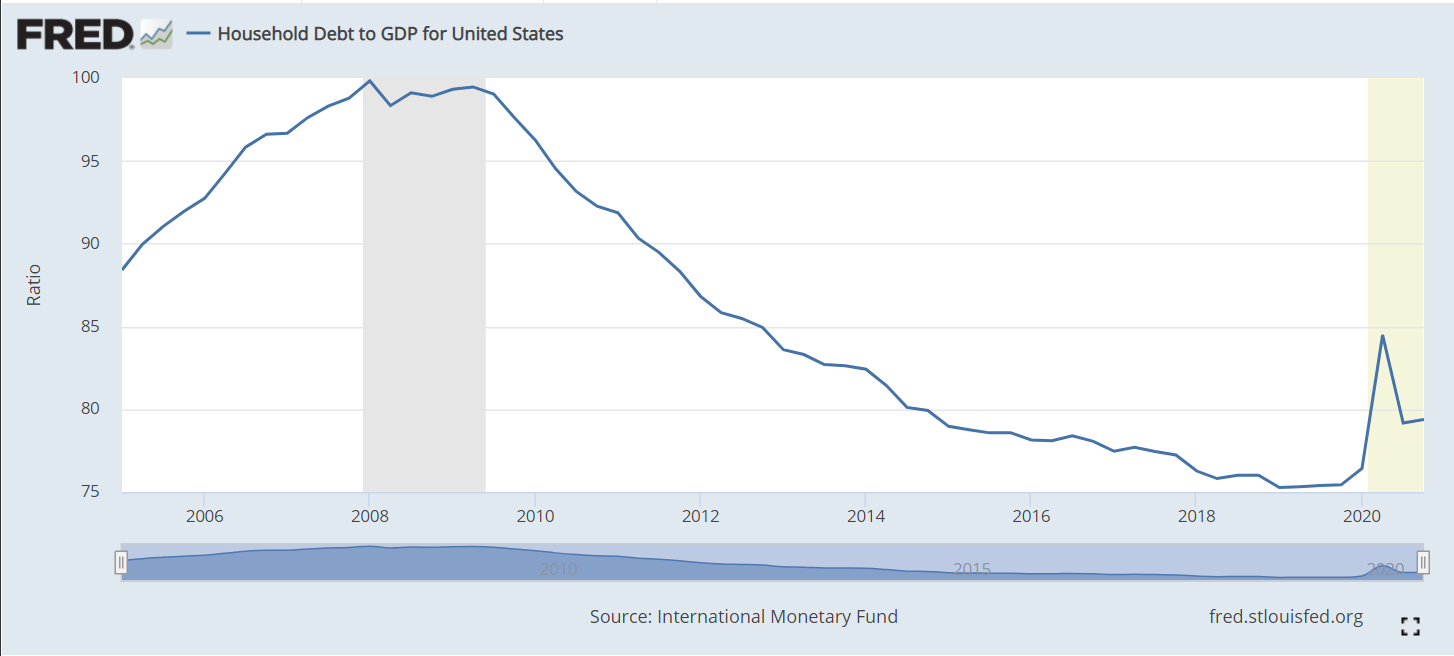
Household Debt to GDP for United States (HDTGPDUSQ163N) | FRED | St. Louis Fed (stlouisfed.org)

Household debt to GDP peaked at 100% before the Great Recession and has fallen by one-fourth in the next 10 years. Unpaid mortgages and other consumer debt have begun to accumulate in the last year.

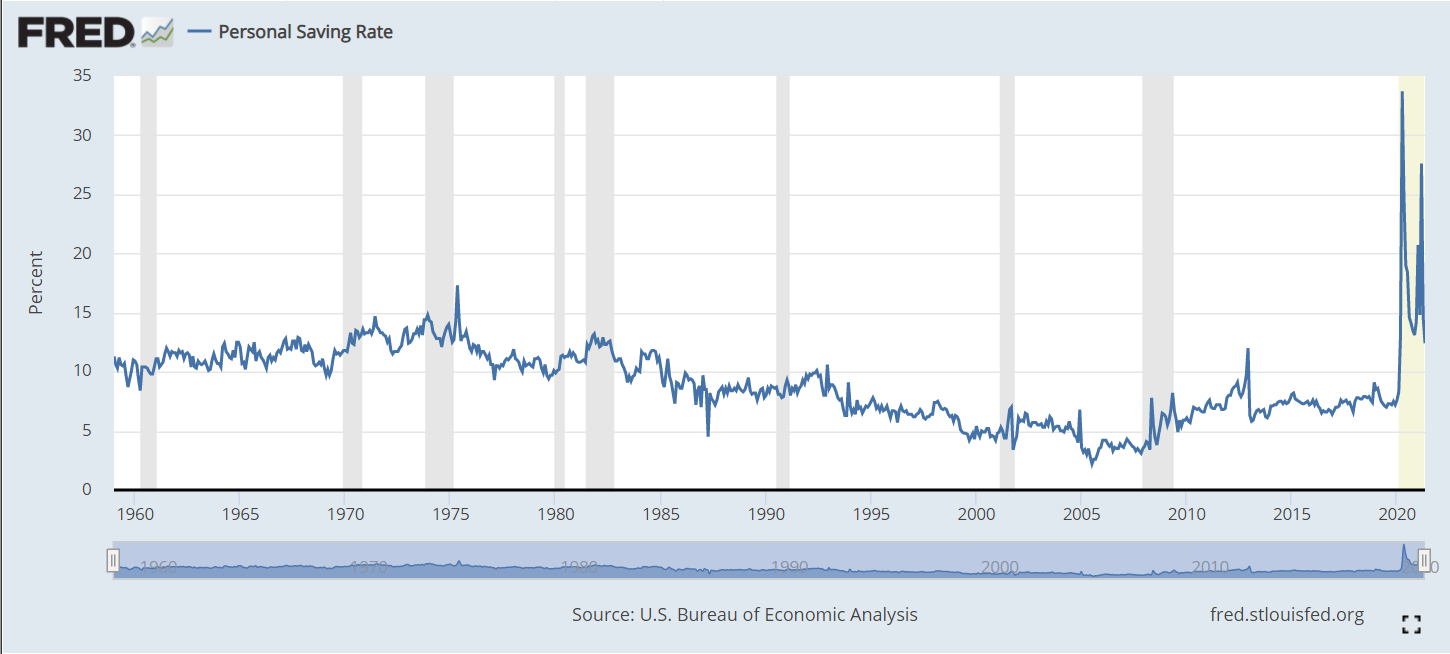
Personal Saving Rate (PSAVERT) | FRED | St. Louis Fed (stlouisfed.org)

The personal savings rate averaged 10-13% from 1960-1985. The country’s economic challenges lead families to save less to maintain their standard of living, falling in half (5%) by 1999. It remained in the 4-5% range through the next expansion. The Great Recession triggered families to replenish their savings, with a 7-8% rate. The pandemic period shows a 15% savings rate. In all likelihood, this rate will fall back below 10% soon.

Education | How has the percentage of consumer debt compared to household income changed over the last few decades? What is driving these changes? (frbsf.org)

How Stretched are Today’s Borrowers? Debt Service Levels in Fourth District States (clevelandfed.org)

Not Every Household Feels Relief amid Our Record-Low National Household Debt Service Ratio | Urban Institute

Household debt jumps the most in 12 years, Federal Reserve report says (cnbc.com)

Household Debt Service Drops to a Record Low – AIER

Household Debt Rising, but Payments Remain Under Control | LPL Financial Research (lplresearch.com)

Dow 15,700

Dow 35,000 was a dream in the go-go 1990’s when the new economy had supposedly broken all of the old rules.  Dow 3,500 was a distinct fear in March, 2009 when stocks had fallen by more than half from their peak.  Dow 10,000 is the most visible reference point in the current stock market.

Every investor and business degree holder knows that stock values are fundamentally based on the expected risk-adjusted net present value of future after-tax cash flows.  They are also tempted by the “efficient markets hypothesis” that says that stock valuations incorporate all information about future returns and therefore set the present value in a rational manner.  On the other hand, they understand fluctuations, random walks, animal spirits and the history of under and over valued stock markets.

http://stockcharts.com/charts/historical/djia1900.html

http://www.investorsfriend.com/return_versus_gdp.htm

Individuals who believe that stocks return 7-8% on average in the long-run through 2-4% dividend yields and 4-6% price increases, must conclude that the stock market is inherently irrational.  It has been 30% undervalued or overvalued a majority of the last 100 years.  Overvalued 1922-31.  Undervalued 1932-54, except for 1936-37.  Undervalued 1974-86.  Overvalued 1996-2008. 

Stocks were overvalued by 137% in 1929 before tumbling to -67% undervalued in 1933.  Stocks reached an undervaluated low of -58% in 1942.  Stocks reached a new -50% undervaluation during the depths of the 1982 recession.  In 15 short years, by 1997, they reached a 57% overvaluation.  They rose to 115% overvalued in 2000, before retreating to a mere 38% overvaluation in 2003.  In 2008, stocks were 67% overvalued compared with the long-run trends.

Based on 100 years of history, the Dow Jones Industrial Average at the end of 2010 should be 9,000.  The expected value in 2020 is 15,700, providing a 5% annual valuation return and 2% dividend return.  Investors who bet against long-term average valuations do so at their own risk.

Year  Trend  Actual +/-
1910             50 62 24%
1911             53 60 14%
1912             55 60 9%
1913             58 60 4%
1914             61 58 -5%
1915             64 56 -12%
1916             67 80 19%
1917             70 80 14%
1918             74 70 -5%
1919             78 75 -3%
1920             82 100 23%
1921             86 70 -18%
1922             90 80 -11%
1923             94 90 -5%
1924             99 85 -14%
1925            104 100 -4%
1926            109 130 19%
1927            115 140 22%
1928            121 190 58%
1929            127 300 137%
1930            133 250 88%
1931            139 190 36%
1932            146 80 -45%
1933            154 50 -67%
1934            161 90 -44%
1935            170 90 -47%
1936            178 130 -27%
1937            187 175 -6%
1938            196 100 -49%
1939            206 130 -37%
1940            216 125 -42%
1941            227 125 -45%
1942            239 100 -58%
1943            250 125 -50%
1944            263 130 -51%
1945            276 160 -42%
1946            290 200 -31%
1947            304 170 -44%
1948            320 170 -47%
1949            336 175 -48%
1950            352 200 -43%
1951            370 250 -32%
1952            388 260 -33%
1953            408 260 -36%
1954            428 260 -39%
1955            450 380 -15%
1956            472 500 6%
1957            496 500 1%
1958            521 475 -9%
1959            547 525 -4%
1960            574 600 5%
1961            603 580 -4%
1962            633 700 11%
1963            664 550 -17%
1964            697 750 8%
1965            732 900 23%
1966            769 950 24%
1967            807 850 5%
1968            848 900 6%
1969            890 950 7%
1970            935 800 -14%
1971            981 850 -13%
1972         1,030 900 -13%
1973         1,082 1000 -8%
1974         1,136 850 -25%
1975         1,193 700 -41%
1976         1,252 850 -32%
1977         1,315 1000 -24%
1978         1,381 850 -38%
1979         1,450 850 -41%
1980         1,522 850 -44%
1981         1,614 950 -41%
1982         1,710 850 -50%
1983         1,813 1000 -45%
1984         1,922 1200 -38%
1985         2,037 1200 -41%
1986         2,159 1300 -40%
1987         2,289 1900 -17%
1988         2,426 1900 -22%
1989         2,572 2100 -18%
1990         2,726 2600 -5%
1991         2,890 2500 -13%
1992         3,063 3000 -2%
1993         3,247 3300 2%
1994         3,442 3700 8%
1995         3,648 3800 4%
1996         3,867 5000 29%
1997         4,099 6500 59%
1998         4,345 7800 80%
1999         4,606 9000 95%
2000         4,882 10500 115%
2001         5,175 10000 93%
2002         5,485 10000 82%
2003         5,815 8000 38%
2004         6,163 9500 54%
2005         6,533 10500 61%
2006         6,925 11000 59%
2007         7,341 12000 63%
2008         7,781 13000 67%
2009         8,248 7000 -15%
2010         8,743 10000 14%
2011         9,268    
2012         9,824    
2013       10,413    
2014       11,038    
2015       11,700    
2016       12,402    
2017       13,146    
2018       13,935    
2019       14,771    
2020       15,657    

The Knee Bone’s Connected to the Shin Bone

In simplest terms, the mortgage lending industry collects deposits to make loans possible.  As mortgage lending has grown increasingly complex, the checks and balances of a simpler time have been lost.  Like the proverbial frog boiled as the water temperature rose, bankers did not perceive the changes in systemic risks.  Like the subjects in Hofstadter’s “Escher, Gödel and Bach”, a strange loop has been formed that could not be predicted from its components.

http://en.wikipedia.org/wiki/G%C3%B6del,_Escher,_Bach

In place of the original triplet of depositor, banker and borrower, today we have no less than 14 actors to consider: borrower, mortgage broker, mortgage product, mortgage broker firm, mortgage lender, guarantor, consolidator, mortgage-backed security, securitized asset, credit default swap, credit rating agency, investment banker, investors, regulators and auditors.

In 1776, Adam Smith provided scientific, philosophical, ethical and political support for free markets of independent buyers and sellers. Academic economists from Alfred Marshall through the Chicago School provided sophisticated theoretical, historical and statistical support for free markets.  Ronald Reagan and Margaret Thatcher consolidated political support for free markets.  NONE of them had a 14 step conga line in mind.

http://www.youtube.com/watch?v=RKtPrOiMj3o

At every step, we have the risks of self-interest creating failure rather than an efficient market with optimal social welfare.

Borrowers have an incentive to lie to mortgage brokers about their income.

Mortgage brokers have an incentive to process as many successful mortgages as possible, coaching borrowers and appraisers.

Mortgage lenders and firms have an incentive to devise mortgage products that are most attractive to borrowers, including no money down, variable interest rates and negative amortization beauties. 

Mortgage broker firms have an incentive to generate volume, without regard to the risks that will be born by the lenders or investors.

Mortgage lenders have an incentive to book as much volume as possible; locking in profit spreads for 30 years.

Fannie Mae and Freddie Mac serve a pivotal role, consolidating and guaranteeing individual loans and collections of loans in support of the American ideal of home ownership.  As quasi-government agencies, they have an incentive to capture congressional support through campaign contributions.

http://www.diffen.com/difference/Fannie_Mae_vs_Freddie_Mac

Mortgage backed securities provide the key gap in the chain of responsibilities.  They allow the mortgage brokers and lenders to transfer liability for mortgage defaults to investors.  Theoretically, these financial instruments greatly increase the sources of funds and through the portfolio effect reduce risks for everyone.

http://en.wikipedia.org/wiki/Mortgage-backed_security

The most sophisticated financial engineering is used to transform a portfolio of mortgages into a new set of securities that separate risks into layers, theoretically allowing some investors to have low risks and returns while others assume moderate and higher risks and returns.  This financial alchemy also increases the pool of potential investors and fine-tunes the risks assumed.

http://en.wikipedia.org/wiki/Securitization

Investors in mortgaged backed securities and their derivatives are not fools.  They understand that risks accompay these innovative instruments and that there are inherent underlying risks.  As sophisticated investors, familiar with derivatives of all flavors, they seek ways to limit their risks.  Credit default swaps were created to provide them with additional security about the risks involved in investing in securitized mortgage based securities.

http://en.wikipedia.org/wiki/Credit_default_swap

Credit default swaps and mortgage-backed securities are evaluated by credit rating agencies.  The growing complexity of financial instruments greatly increased their business volume and relations with investment banks.  They provided overly positive ratings historically.  They were paid by the firms that created the securities.  No one should be surprised by the results.

http://en.wikipedia.org/wiki/Credit_rating_agency

Investment bankers have played a key role in the growth of the securitized mortgage industry. They collect fees as advisors in the creation of products and as advisors to mortgage brokers, mortgage lenders,  guarantors,  consolidators and investors.In their banking role, they have invested directly in these securities, provided funds for others to invest and developed derivatives to allow bets against the securities.  Investment bankers have supported both political parties.

The securitization of mortgages has allowed a wide variety of individuals and firms to invest in these assets, including banks and investment banks as part of their overall portfolios.

Regulators have tried to keep pace with these innovations, but failed.

Auditors have invested their resources complying with the details of the Sarbanes-Oxley legislation, but missed the change in risks in this complex system.

The mortgage world has become very complex in the last 30 years.  The proponents of “financial reform” in both parties need to closely review the reality of a 14 actor system.  There is a trade-off between the benefits of financial innovation and the regulatory costs of financial complexity.  We have clearly crossed the line where the costs of complexity (regulatory and risk) have exceeded the benefits of innovations (funding and reduced risks).