The Chevy Chevette was the best product of the largest and most successful corporation in 1976. [WOWSER] It was marginally better than the Corvair or the Vega. Major US corporations had taken advantage of the post-WWII opportunity to produce for the world and perfected minor changes each year to further stimulate consumer demand. Functional roles in corporations were largely unchanged since the 1920’s. Japanese competition in the auto and consumer electronics industries in the 1970’s caused American corporations to eventually reinvent themselves and move into a world of perpetual change management.
It’s difficult to describe the size and impact of these changes. They were like a compounded series of paradigm shifts. I worked with many organizations from 1975-1989: Koppers, Avery Label, Sherwin-Williams, multiple S&L’s, United Telephone, AmeriTrust, E&Y, Tandy Radio Shack, EDS, IBM, Microsoft, GM, NASA, Zenith, Allison Transmission, City of Cleveland, McCormick Convention Center, Amway, US Navy, US Health & Human Services, Lorain Community College, Baldwin-Wallace University and the University of South Florida.
I completed a finance MBA at Case Western Reserve University in 1984. I joined Ernst & Young as a junior management consultant and learned from Dr. E. Leonard Arnoff, one of the founders of the discipline of operations research.
FEW of the most important concepts and skills of my 35-year professional career existed or were rarely applied in 1984. The smartest academic and business leaders were aware of some of the changes that would shape the next 50 years, but the typical 1984 manager was still working from a 1930’s view of business.
I’ll group the more than 100 HUGE advances into 6 categories.
Strategy
Strategy really matters. A strategy function is needed.
Competitive advantage is critical (Michael Porter).
Companies cannot be all things to all people.
Strategy is a process to focus and facilitate thinking, not a mainly a means of control.
Market leaders have a better chance of winning. Better to be a leader in a small market segment than a follower in a large one. Long-tail opportunities.
In many markets, leading market share (1, 2 or 3) is essential.
Product differentiation is required to avoid commodity pricing.
Universal customer needs of quality, speed, flexibility, value (price and function), information/transaction costs and personal relations/risk management can all be used for product differentiation. A customer centric strategic view is necessary.
SWOT analysis is essential. Strengths, weaknesses, opportunities and threats.
Mission, vision and values must be articulated. Begin with the end in mind.
Firms must choose between equity alone and multiple stakeholder priorities.
Modelling and simulation tools can be used to identify, understand and prioritize the critical dimensions of every firm.
International and startup competition must always be considered.
Professional functions within each firm are increasingly essential.
A 3-way strategic choice must be considered: low cost, product differentiation or customer intimacy.
Successful firms clearly articulate abstract ends and flex the means of attainment (Collins).
The customer and retail interface may have more power than the manufacturer/service provider.
Smaller firms are available to be purchased in a roll-up strategy.
In the end, dynamic, sustainable [moats] strategies have the greatest value.
China matters.
As firms become more strategically driven, the fixed costs of SG&A rose, requiring firms to prioritize growth and market share.
Intangible assets may be more important than tangible assets.
Marketing
Market size is essential. Market share is next.
Marketing research of customer preferences matters.
Branding is vital.
Focus groups can provide separate insights and validate numbers.
The marketing function exists to create value, not just sell things.
Targeted marketing is essential. Products must match differentiated markets.
Some customers value quality and reliability.
Some customers value timely delivery.
Digital marketing channels supplement analog channels.
In the digital world, search engine optimization [SEO] matters.
E-commerce is a competitor to analog delivery.
Internet promotion is a competitor of traditional media.
Individuals’ identity and social interests can be targeted.
Some customers are better targeted by 2-way communications or influencers.
Politicians, regulators and courts increasingly matter, and firms must invest accordingly.
Tariffs matter. Firms must invest to manage them.
Finance
Access to debt, equity and start-up financing is much easier.
Access to global investors is possible.
More efficient markets through mutual funds, ETF’s, derivatives, and efficient trading markets matter.
Portfolio management applies to investments, projects, product lines, channels and new product development.
Marginal costs/benefits apply to every activity and project.
Cash and management accounting perspectives are best used for making decisions, separated from accrual and financial accounting measures.
Price discrimination is a major opportunity in every market.
The formal discounted cash flow analyses apply to many situations.
Activity based costing helps to identify necessary costs at 4 levels.
Corporate and product level costs are subject to cost reduction just like plant/facility and production costs.
The balanced scoreboard system ensures that all levels of economic activity are planned, measured and managed.
Human Resources
Human resources are productive assets; they are not simply “personnel”. They should be managed accordingly.
Required staff skills must be defined, measured and enhanced.
Clerical support skills must be cost-justified.
Analytical skills can be captured in separate positions.
The general concept of meritocracy matters. Exceptions must be justified.
COO’s and CFO’s are not alone. IT, marketing, risk, merchandise and people managers are equally important.
Legal compliance matters.
The role of “managers” is essential. Managing people, tasks and processes. Developing talents.
Highly skilled MBA’s have important roles to play.
Organizational development is a value added function.
Matrix (cross-functional) management is just as important as functional management.
Project teams play a critical role.
Firms cannot cost-justify employing thought leaders in every function. Management consultants can fill in.
Employees can be outsourced.
HR information systems (HRIS) are essential.
Centralized professional services functions are typically more cost effective.
Corporate culture is a strategic asset.
Clearly defining role requirements, recruiting, hiring and performance evaluation greatly improve performance.
Human beings have personalities, habits, talents and motivations that can be leveraged and improved.
Diversity, equity, and inclusion is a worthy investment today.
Workplace flexibility is highly valued by employees.
Information Technology
Basic financial and operations systems can be automated.
Detailed transactional processes can be automated, controlled and improved.
Processes can be documented, standardized and enforced.
Relational database logic can greatly reduce work and errors.
Detailed functional IT subsystems can be developed to improve operations and feed the financial systems. Warehouse Management Systems (WMS), as one example.
Enterprise Resource Planning (ERP) systems can be used to leverage the universal core processes of firms while customizing the details and integrating functional subsystems.
Critical data can be stored in data warehouses for analysis. Big Data comes later.
Reduced IT costs improve access to various tools and systems.
Staff can effectively use personal productivity tools: word processing, spreadsheets, graphs, graphics, email, databases, queries, report writing.
Personal computers allow local use.
The ongoing reduction of computer costs makes them more effective for more employees.
The internet provides access to information, teams, suppliers, customers, markets and others.
Internet search tools provide smart access to information.
Crowdsourced applications provide zero cost tools.
Social media apps provide the opportunity to connect with others effectively.
Smartphones further reduce the cost and limits of accessing all data, functionality and people.
Artificial intelligence provides tools to greatly leverage personal skills.
Operations
Forecasting and statistical techniques refined and easily applied using personal computers.
Professional logistics profession developed, applying the best options for all types of cargo.
Manufacturing outsourced routinely to lowest total costs sources worldwide.
Distribution, logistics, IT, HR, R&D, product development and all functions outsourced (sometimes globally) to leverage specialized skills and focus internal operations.
Operations research tools routinely applied for optimization problems, especially critical paths.
All fixed-cost capacities set at lower percentages, with secondary capacity options, in order to optimize profits, especially in low and high demand situations.
All processes defined, standardized, refined and optimized in order to apply IT and process engineering.
Multiple feedback loops routinely used to improve processes through time.
Lower communications and transportation costs further increased outsourcing activities.
The value of time to customers was identified and turned into a competitive advantage, from 6-weeks mail order to same day to same hour delivery.
Just-in-time production philosophies implemented, and inventories slashed towards zero intentionally to force improvements.
Production processes re-engineered according to process and final goal needs, displacing functional and “like kind” groupings.
Continuous improvement, kaizen quick fixes and full process re-engineering take advantage of global best practices.
Project management discipline created and refined. Agile project management used. Project management offices created to manage portfolios of projects, project managers and subject matter experts from inside, suppliers, customers and consultants.
New product development managed as a portfolio of projects, each within a standard process framework. Firms adopt the “layer cake” view of value as the sum of annuity returns from a series of new products.
Basic insights of modern Total Quality Management or Lean Six Sigma adopted, focused on activity and process variability with unexpectedly large results. Relentless elimination of waste.
The Quality paradigm shift places the process view on par with the finance view.
The variability of actions within a sequence of events [Goldratt] is seen as the critical driver of final results. Processes, measurements, goals, investments, staffing, operations planning and outsourcing are adjusted for dynamic effectiveness.
Summary
Modern firms have cumulatively adopted and leveraged these interrelated capabilities to become strategically driven, self-aware, well-managed and improving through time. The marginal finance/portfolio view together with the process view allow firms to identify, deliver and monetize customer needs while outsourcing functions that are not deemed strategically essential. Firms generally invest more resources in planning, optimization, new product development and risk management today.
The application of these principles has varied by industry. Government, not-for-profit and health care have great improvement opportunities remaining.
Firms may invest in Joseph Schumpeter’s “creative destruction” or they may optimize within existing market structures if they see higher returns from internal process improvements, incremental product development, supplier squeezing, price discrimination, targeted marketing or regulatory capture. In other words, the capabilities for ongoing world-changing improvements exist but may not be applied for the greater good.
The brands that are growing the fastest in the world all have this in common: they have a target audience that serves as their guide to build their brand around. These brands are able to see tremendous growth as they focus on the right community of people.
Too many churches don’t take the time to take aim before they take action with their marketing efforts and this creates waste with their resources. Don’t let this happen to you.
Get focused.
A target community allows church leaders to be effective as they build their brand because they are able to focus on those people they are good at reaching.
Let me first say this: As a church, you should welcome anyone that is breathing, because that is what God’s love compels us to do.
The point I’m making is simply that you need to have a strategic target in your approach to marketing and advertising because focus allows you to be most effective in attracting people. I like to say that confusion is the enemy of your vision.
Each church is equipped to reach certain types of people based on the leadership that is in place, the location it is in, the type of ministry it offers and the resources it has. The more clarity a church has on it’s primary people group the more effective it will be in reaching people as the brand is built around this community.
I want to let you in on a little secret: you have a target audience, whether you know it or not. Everything your church does or says is going to appeal to one group more than another. It just is. People don’t all enjoy the same kind of theology, music, decor, or preaching style. Some people like communion to come in little plastic cups. Others prefer intinction.
The choices you make are excluding people who would prefer something else. If they don’t like drums in the worship service, and your church uses drums in some fashion, you’re excluding them. If they don’t like drums but stay anyway, of course you’ll welcome them. It’s not like you’re putting a sign on the front door that says, “If you don’t like drums, go away!” But some of the choices you make will potentially turn some people off — and that’s okay.
One thing stagnant churches haven’t realized yet is that by not choosing who they intend to appeal to, the choice is being made for them. Everything from the interior design to the music is being chosen by different people using their own preferences as criteria. What you often end up with is a strange quilt of elements that might not necessarily appeal to anyone.
Wait, isn’t the Church for everyone? No, the Gospel is.
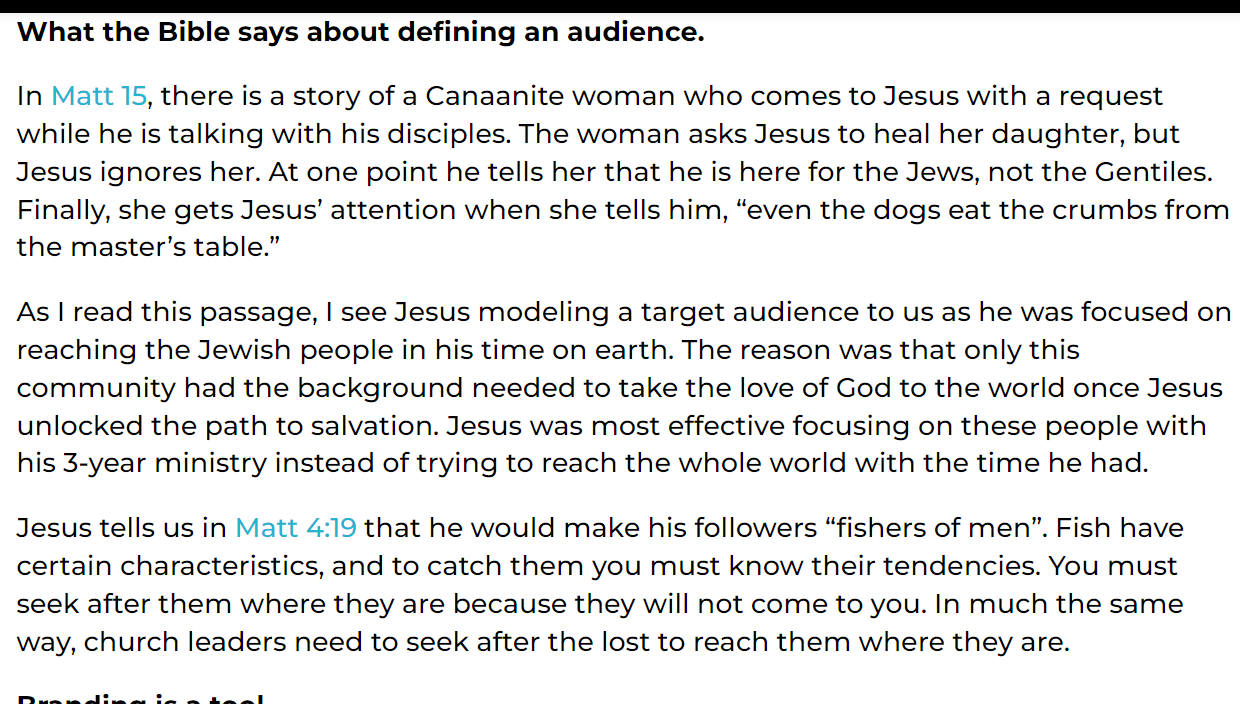
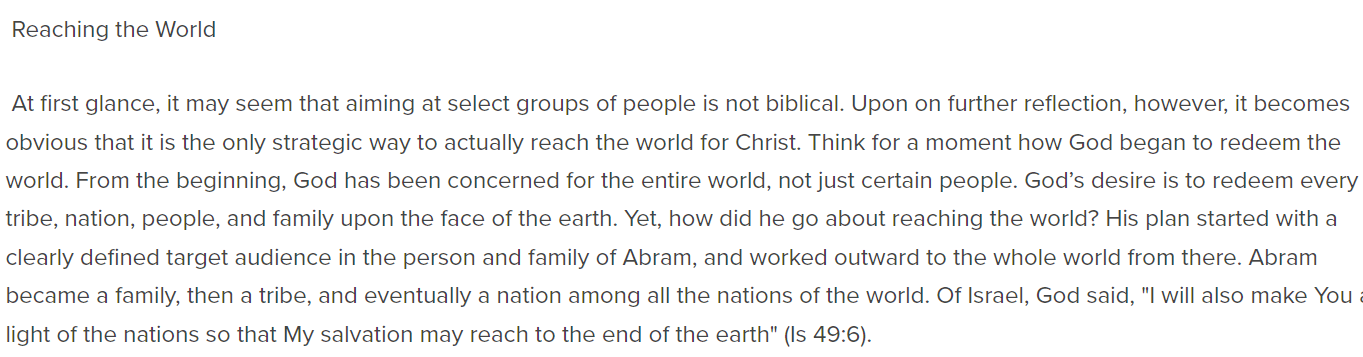
This is the number one mistake we see churches making. They assume that because the Gospel is for all people, their church is too. When in reality every Church is called to a specific group of people, like Paul was called to the Gentiles and Peter to the Jews. So your local church is called reach and minister to a certain, defined, group of people.
JESUS LOVES EVERYONE, SO DON’T WE WANT TO TARGET EVERYONE WITH OUR MARKETING?
Every single person in your city, within a fifty-mile radius… that’s your target audience. Right? If that is your mindset, you have an uphill battle in front of you. Don’t get me wrong, you certainly want to see every man, woman, and child come to know Jesus through your church. As Christians, we love everyone! But here is the crazy truth: to reach more people, focus on fewer people. Your church is going to make a much deeper impact on your community if you tailor the entire experience to a specific demographic. It seems counterintuitive, I know.
While reaching the whole world with the gospel is the mission of the Christian faith, life-giving churches recognize that the world is made up of many different audiences. Since different groups of people have quite different cultures, needs, and methods of communication, a church that intentionally tries to reach a specific group with the message of Christ, will normally be much more effective than one that tries to reach everyone with a general attempt. Every church should have a sign that says, “Everyone Welcome,” but a deliberate strategy must be in place or they will only see accidental growth.
As Christians, we want to reach and include everyone. This is our ultimate goal as disciples. However, from a specific ministry standpoint, this approach ends up reducing the relevancy of the message and spreads efforts too thin for significant impact. Afterall, a standard marketing rule of thumb states:
If you try to reach everyone all the time, you’ll end up REACHING NO ONE.
Each person, ministry, and local church is uniquely equipped and positioned to reach different types of people. Therefore, it is vital to understand who your audience is before you create content, write a single social media post, or spend any money on social advertisements. This section will help you learn how to effectively shape your messages and content to match your audience’s needs and reach them effectively, no matter their age, gender, ethnicity, location, or situation.
There’s a marketing axiom that says if you try and market to everyone, you market to no one.
It works that way in the church too. When a church tries to reach “everyone,” it effectively reaches no one. That doesn’t mean everyone isn’t welcome … if everyone isn’t welcome, you’re not running a church, you’re a private member’s club.
But just because everyone’s welcome, it doesn’t mean you should (or even can) accommodate everyone.
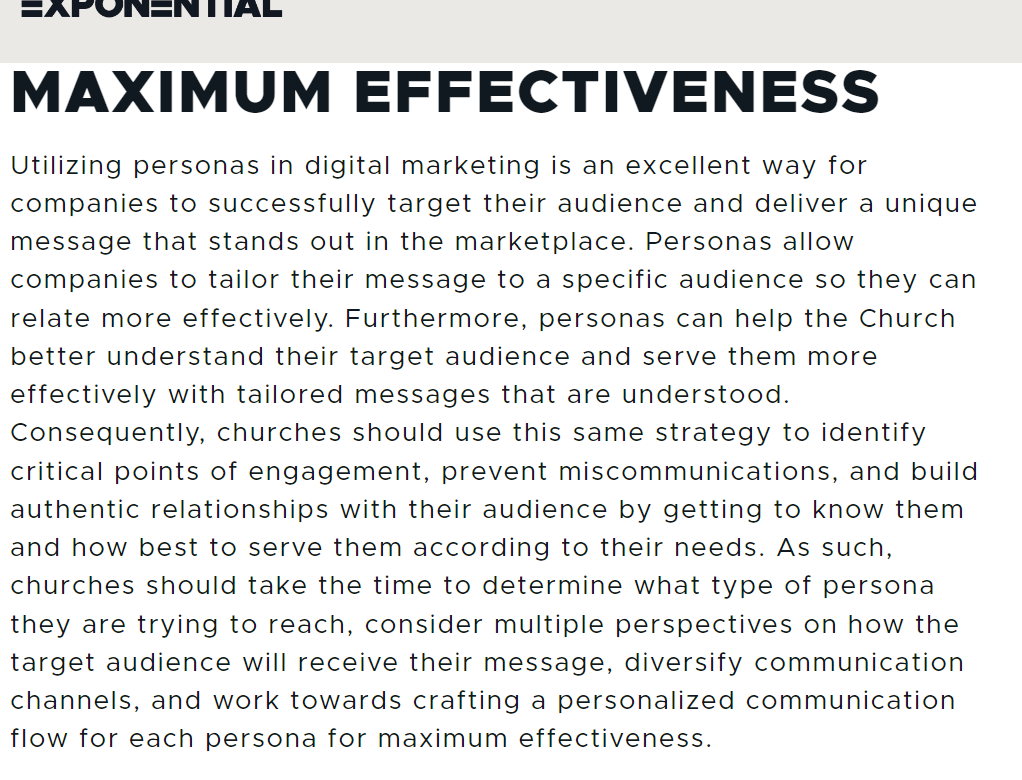
Defining a target audience is a marketing concept where you describe a person who is the ideal customer for a product. It helps to shape branding decisions such as colors and fonts so the designs hit the mark.
A church can use a target audience to provide clarity in the experience it provides online and in person. It creates alignment which builds trust so people decide to be part of your church.
Different groups of people have different felt needs. American firms started to cater to these groups with truly “differentiated products” in the 1960’s, 1970’s and 1980’s. American religious denominations have increasingly offered creeds, worship and experiences to meet diverse needs. By the 1990’s individual congregations began to refine their offerings and messages to match the needs of their congregations. Today, American consumers are spoiled. They expect to be served.
On the universal customer needs dimensions of QSFVIP, “I want it all and I want it now”. Quality: relevant, meaningful and entertaining sermons, worship and program experience. Speed: 45 minutes, on-line, recorded. Flexibility: multiple times and delivery channels. ”Call me”. Value: programs and message directly touch me where I live. No pledge commitment. Ala carte funding of programs. Information: no transaction costs. 6 ways to give. No pledge commitment. Personal: monitor my needs and follow-up.
In a world of such expectations, congregations cannot easily meet the expectations of everyone that visits or becomes a member. They must welcome everyone, but they are unable to serve everyone.
The marketing folks emphasize that effective organizations refine their services so that they clearly meet the needs of a target audience. This allows the marketing machine to do its magic.
Benefits of Defining a Target Market
Much more effective marketing to attract new members and retain existing members.
A consistently defined and executed set of programs, brand image and messages is more effective.
The process of defining a target market forces staff, volunteers and elders to more deeply consider the priority needs of the congregation and community.
A clear target market helps to identify, define and prioritize local mission investments.
Congregations struggle with resource allocation decisions. A clearly defined target market helps to prioritize worship, outreach, youth, children, adult, local mission and global mission efforts.
Prioritization within ministry areas is easier to do.
Able to evaluate and justify investments in marketing and outreach.
Helps to focus all programs to deliver specific benefits to meet the perceived needs of the target market communities.
A target market is needed to do effective marketing. It can also help to shape worship, facilities, programs, outreach, events, music and mission activities to better serve the congregation and the community.
Safeguards When Defining a Target Market
But wait, there is good news. Even though you focus on one demographic, that doesn’t mean you will only reach that one person type. Other demographics will also be served by and attracted to your church. I am constantly amazed by how many people don’t fit into our cultural norms. I see people that don’t fit certain stereotypes—wearing brands, attending events, or watching shows that I would have never guessed that they would like. You don’t have to worry that your church will end up only serving a specific type of person, or that everyone else will feel out of place. This is just about making your marketing specific. You will still have a well-rounded congregation, and people will still feel like they belong, even if they are outside of your defined target audience. Don’t be all things to all people, but find who you truly are and go all in with that.
Targeting a specific demographic as a strategy for church growth is problematic. It can create needless obstacles for any church wanting to have an open door. If you say you are interested in ministering to any and all people, shaping your ministry to fit just one group is contradictory.
People who are not the aim of your reach efforts will feel left out or overlooked. For instance, if you decide that your congregation will be a “family church,” focusing on children’s ministry, marriage sermon series, and small groups for couples, then singles will feel unwanted. Creating a youthful vibe that only interests millennials will make older people feel unneeded or unwanted. In targeting one group, you’ve eliminated any space for other groups.
This is one of the worst unintended consequences of the church growth movement. Many have written solid critiques of the movement and have much to say about other consequences. The most grievous is the contextualization of the gospel. And focusing on one demographic to the exclusion of others can lead down that same slippery slope.
When you direct your ministries toward one group, you run the risk of forcing every message into a one-size-fits-all box. You base every decision on that one demographic you’re trying to reach. You adapt your sermon applications to fit a perceived felt need, rather than letting the Word of God speak for itself and leaving space for application to every life situation.
There is a difference between reflecting your immediate community and targeting a specific demographic. Ultimately, your congregation will likely start to resemble the makeup of the surrounding neighborhoods. If they are homogenous, then your church will probably be the same.
Church marketing won’t work unless: We focus less on what we say and more on how we act. We realize that louder isn’t better. We look at it as relationship-building and stop viewing it as information-sharing. We talk less about how great we are (“organization-focused”) and instead deliver a message and ministry that leads to life change (“people-focused”). We realize we can’t force what we think people need until they know they need it. We reduce the number of competing messages we are trying to communicate. We know who we are trying to reach and we’ve acknowledged we can’t reach everyone. We deliver on what we promise.
Here are some mindset examples of people a church can focus on:
A church may focus on people who love music and they build an experience that is excellent around a worship experience. The church then attracts musicians and those who love to worship by coming to a corporate gathering.
Another church may focus on people who are doers and love to make things happen. They build an experience around outreach to the local community and equipping people to make an impact with their lives. They might have an emphasis on missions work around the globe so the people are able to do the most good with their resources.
Yet another church may focus on people that are business professionals. Their experience may be in line with teaching principles and having opportunities to build projects that make a large impact.
Here are a few more mindsets that a church may target:
Young parents who are in need of a guide to help them do it right
Those who desire to make a difference with their lives
Young adults who are seeking a place to belong with others who are like-minded
When churches begin going down this road, they’ll often decide that their church demographic is something like “young families.” This is a good place to start, but isn’t quite as dialed in as you would like. If you can be even more specific and say, “young families with infants” or “families with elementary-aged kids,” it’s much easier to understand how things could change to be more welcoming for them.
Some churches have had great success focusing on groups like unchurched men, musicians, cowboys, military families, etc.
Here are a few examples of a well-defined target audience: – Young couples with children under ten years old – Men between the ages of twenty-one and thirty who have a worldly past – Established professionals in their forties – Local college-aged students
When it comes to outreach and evangelism, most churches have a “target market”- an ideal audience for their services and ministry programs. Frequently, that tends to be young families, and the key decision maker for church attendance is often the mom/wife. Understanding how women communicate and make decisions regarding church visits can help you create a website designed to appeal to them. If you know women in their 30s are your target audience, don’t design a website that appeals to men in their 50s.
Nearby residents, homes built since 2000 (within 3 miles)
New city homeowners
Office corridor employees
Senior citizen center members
Adult children of church members
Local government and schools’ employees
Local hospital/medical employees
Parents of preschool enrollees.
Former members of the church.
People attending a “civility” meeting.
Parents of on-site and off-site youth sports participants
Parents of cub scouts
Local retail and restaurant employees
Young Republicans and Young Democrats
Determine Your Target Audience
The first step in reaching your audience is to develop a clear picture of who you are talking to. Begin with surface-level demographic information. Use the criteria below and fill in the information for your ministry’s target audience. Surface-Level Demographic Information:
Location
Age
Gender
Ethnicity/Language
Interests
Deep Level Characteristics:
Needs
Core Values
Shared Experiences
Motivations
Additional Insights
hese cultures are potentially endless in variety, but can include:
Platform
Age groups or generations
Gender
Language(s)
People groups: race, ethnic, immigrant v. first generation, etc.
Current location: city/suburbs/country
In school vs. out of school
Lived in a specific geolocation their whole life vs. transplant
Faith groups, life-long Adventists vs. converts vs. former Adventists/Christians
Professional groups vs. homemakers vs. working mothers
College educated vs. blue-collar workers
Offline social clubs vs. online identities and groups
To be honest, most churches today have opted to try and target a shrinking audience … adults who have some history in the church. Lapsed church-goers. The Dones. But almost every church is trying to target all of them all at the same time.
The graduated-from-college but not-yet-married group
Transitioning into the real world is hard enough for young people, so make it easy for them to get plugged in at your church. There is a lot of pressure for this group to land a good job, get their own place and possibly even find a spouse. This group needs support, so be there for them.
Married couples that, for one reason or another, do not have children
Getting married is one of the most exciting times in someone’s life. But afterward, where exactly do married couples without children fit in at church? There seems to be an abundance of ministries for families, but the church lacks in ministering to couples of all ages who don’t (or maybe can’t) have children. Don’t neglect this group.
30- to 40-year-old singles
I think from this short list, this could be the most neglected group. Maybe these people have never married, or maybe they’re divorced. Regardless, they are generally more mature in their faith (and life in general) than younger singles. And because of this, the last thing they want to do is join a small group of 20-year-old singles whom they can’t relate to at all. Men and women who fit into this group can be such an asset to a church. Hmm … and isn’t there a single guy in the New Testament who modern-day churches frequently study? Yeah, his name is Paul. Don’t ignore this group; they could be the “Pauls” of your church.
Discovering your church’s target audience can seem daunting. Still, with a few simple steps, you can clearly define and communicate with the people most likely to engage with your church digitally.
Consider the typical characteristics of the people that attend physical services.
Look at outside influences like location and demographics to determine who could be interested in your message.
Research their motivations, their relationship status, and any other vital details.
Then, create a persona for each segment of your target audience—a living representation of your ideal members.
Finally, create marketing strategies that make use of these personas and help to keep churches on-mission in spreading their message.
For most churches, the most important audience to market to is going to be your existing congregation. That’s because word of mouth is a powerful tool when marketing your church. unSeminary reports, “The fastest-growing churches in the country consistently encourage their people to invite friends and family to be a part of their church. It really is that simple.”
Think of it this way: when your friend recommends something to you, how likely are you to take their advice over the advice of someone you may not know as well? Most of us tend to trust the recommendations of people we love and enjoy spending time with.
For most churches, the primary target market is actually their current congregation. Though it may seem a bit backward, word-of-mouth advertising for churches is one of the most effective. Think about it: Most of us tend to believe the advice of those we cherish and value our time with.
When defining who makes up your church, it’s good to start by differentiating between who is your current audience and who is your aspirational audience. Your current audience is those who your services and events are actually attracting, so it’s a good idea to focus your efforts on people from this demographic. Have a look around your church, you may even have data already. What type of areas do these people live in? What’s their average age? Are they mostly families?
Your Aspirational audience is those your church want to be attending. Is your Church is is called to a specific community or neighbourhood, what are the demographics of the people?
Take a good hard look at your church and ask, “What kinds of people already attend here?” It helped me to understand people and churches immensely when I discovered the homogeneous principle. “A ‘homogeneous unit’ is simply a group of people who consider each other to be ‘our kind of people.’ They have many areas of mutual interest. They share the same culture. They socialize freely. When they are together they are comfortable and they all feel at home.” 2 People are attracted to those who are like themselves. This does not mean that you are not going to minister to those who don’t fit your desired target audience.
Focus on “Felt Needs” and Culture, Not Just Demographics
DETERMINE THE FELT NEEDS
Paul did this in his ministry. His preaching met the needs of people. Listen to him: “Though I am free and belong to no man, I make myself a slave to everyone, to win as many as possible.
“To the Jews I became like a Jew, to win the Jews. … To the weak I be came weak, to win the weak. I have become all things to all men so that by all possible means I might save some. I do all this for the sake of the gospel, that I may share in its blessings” (1 Cor. 9:19-23, NIV).
We can do no less. Unless our preaching and ministry meets the felt needs of people, we cannot succeed.
“This is the only known way to open closed minds. Gearing your message to the felt needs of any audience is the key to unlocking closed filters. In fact, extensive research and documentation confirm that ‘people will not listen to the gospel message and respond unless it speaks to felt needs.'”4
We must do whatever it takes (within the confines of biblical principles) to win the lost around us. If you live in a retirement area, you must have programs for the retired. If you live in a Spanish-speaking community, your services should be in Spanish so those coming will under stand the gospel. If you live in a baby boomer community, your worship service must speak the language and meet the needs of the baby boomers.
Jesus used this approach 2,000 years ago. “Christ’s method alone will give true success in reaching the people. The Saviour mingled with men as one who desired their good. He showed sympathy for them, ministered to their needs, and won their confidence. Then He bade them, ‘Follow Me.'” 5 Every ministry in the church should be examined to see if it is meeting the needs of the people you are trying to reach.
People no longer fit into neat categories, so we must connect with them on a more profound level, transcending the standard marketing demographics of age, ethnicity, gender, language, location, and interests. If you can dig deeper, your audience will be loyal to your brand because you resonate with them at their core.
The best way to do that is to investigate their needs, experiences, values, and perceptions. Conducting surveys and interviews is one key way to collect more information. Then start asking yourself questions that will help you to get inside the minds of your audience members. What motivates their actions? What makes them who they are? What do they have in common? How can I speak and write in a way that my audience will find relatable? What do they value? What do they actually need?
Examples of needs may include: a spiritually supportive community, affordable education, employment, affordable medical care, safe spaces for their children, mentorship opportunities, a better future, healthier relationships, self-improvement, Christian guidance on real-life issues, food security, or practical life-skills training.
Austin and Tamara are a married mid-thirties couple with two preschoolers living in a suburban starter home. They met at a tree-planting volunteer day at a park near the luxury apartment district where they both lived after finishing college. Austin is a systems analyst for a medium-sized firm that owns and operates health care and retirement communities. His parents and a brother live within an hour. He was raised as a Baptist but has been mostly a casual church goer as an adult. He considers himself politically independent but has voted in some Republican Party primaries. Tamara moved to the US at age 5 and identifies as Hispanic. She manages 3 franchises of a hair-cutting business. She majored in “American Studies” in college with an emphasis on American religions, was raised Catholic but has been affiliated with 2 different mainline churches as an adult. She has mostly voted for Democrats but also considers herself a political independent. She has no nearby family members. Tamara has been visiting churches in the area for a year, without Austin, and is ready to share her findings.
The Brand
Austin: Wow, I didn’t see you choosing them. Aren’t they one of those very conservative Protestant churches?
Tamara: The church has a serious side, but it’s generally considered to be one of the more liberal, tolerant, flexible mainline denominations. I think it will work for me.
A: What’s the odd name all about?
T: A presbyter is a spiritual elder. Like many early Protestant denominations, they wanted to break away from the hierarchical Catholic model and manage congregations mostly at the local level. Some churches label themselves as “Reformed” churches or even “Reforming” churches to highlight their role in the Protestant Reformation instigated by Martin Luther and their engagement with modernity, rather than their governance structure.
A: Aren’t they the ones who believe in predestination of the “elect” and got caught up trying to prove that they’re saved?
T: The founder John Calvin’s theology and the early life of the church highlighted this and distinguished them from Lutherans and other Protestants. Keep in mind that “salvation” was the overwhelmingly the main religious focus around 1500. That’s why the Catholic indulgences were such a good source of revenue and at the core of Luther’s criticisms. The Italian Renaissance had started to open the door for modern days and thoughts, but the culture was still mostly Middle Ages, dark ages, medieval. Without science or medicine, with plagues and short lives, common deaths during childbirth, periodic invasions and landowners with arbitrary power, the people were very focused on heaven because the threat of death was a constant companion. Calvin agreed with Luther that people are saved by God’s gift of grace through faith, not through priests, the Catholic Church or good works. Calvin’s logic led to the idea that God has pre-ordained the “saved” versus the others. I didn’t see this as an important part of the modern church in their creeds, confessions or sermons, although Calvin’s seriousness about life and faith continues to be seen.
A: I loosely associate this church with bankers, Puritans and Masons. Any truth in these images?
T: The Presbyterian Church was an early and influential church in the US, so its members have been civic, business and political leaders for centuries. I think they’ve had a half-dozen presidents, probably second to the Episcopalians who have a similar history. They’re definitely part of the so-called “mainline” churches that were highly influential throughout the 21st century. They’re not tied to the Puritans or the Masons as far as I’m aware. They remain mostly a white-collar, professional class church in many places.
Just How Serious?
A: How serious is this church? I was just hoping to find a nice place for our children to learn about the Bible, a social community and an inspirational sermon from time to time.
T: The two Presbyterian churches I visited did have a warm social vibe and a lot of space and volunteers devoted to childcare and youth education. The church radiates seriousness in many ways. The worship spaces and buildings were spare, clean, almost secular. The worship bulletins were pretty structured and part of a calendar of worship. Sermon topics ranged widely, but these places were more focused on “the word”, on logic and rationality than on feelings or mystical spirits. The creeds were highlighted on-line and used in worship. Joining the church requires a public pledge of commitment to the core beliefs. The greeters emphasized that the church works hard to engage new members in the life of the church and expects them to be active members.
I could tell that theology and consistency matters to these groups. One said that we do everything “decently and in order”. Jesus in the New Testament was at the heart of each sermon. The ministers and congregation seemed to be serious about their moral lives and those of their kids. They were hungry for understanding passages from the Bible, thinking about purposes and connecting with God. They believe in free will, responsibility and an objective real and moral universe. Members seemed to be serious about church attendance, prayer, education and behavior. Salvation was not the primary focus, but it was part of the structure of messages.
So … yes, I’d say that they are pretty serious about religion. Not overly so, self-absorbed, proud, self-righteous or imposing on others, but religious belief and practice clearly matter.
A Sense of Humor?
A: Your description helps to explain my preconceptions. I’m a structured guy. I appreciate order. But you can go too far. Are there two sides to this coin? Some positivity to balance the “dead serious” core? A sense of humor, lightness, balance or tolerance even?
T: I’m sorry. I’m answering you too literally, without scope or balance. This is an interesting question. I didn’t find negativity anywhere! Focus, attention, clear thinking, concern and connectedness, yes. But negativity, per se, was absent. Well, they do believe in “original sin” and that Jesus died to remove the burden of sin from man. They know that people are morally imperfect and need help to live moral lives. They believe in some kind of heaven and hell. I guess you might call this “negative”, but all of the Christian denominations generally hold these views.
I think the positivity comes from the “good news” gospel of Jesus saving men and instructing them. Jesus is seen as directly accessible to individuals in prayer. They focus on God creating each individual in his image and giving them a name, to be known. They appreciate the opportunity to join together at church, in communion, in small groups and in service projects. I observed spiritual calm and centeredness at times. They spoke about the gift of “grace” often and appreciated that gift. I witnessed a general confidence and hope about the future in these churches.
Beliefs
A: What are their core beliefs? Do they make logical sense? Are they much different from the Baptists and Methodists? Will I need to take a theology course to join the church?
T: Their main beliefs seem to greatly overlap with the other mainline churches. You won’t need to go to school or pass a test. They do agree that Jesus is fully man and fully God. They describe God, Jesus and the holy spirit as 3 dimensions, faces or “persons” of the single true God. As in the Catholic church they “proclaim the mystery of faith”. People are expected to understand the surface description of the creeds and through time try to better understand the mysteries of “3 in 1” or “both/and”.
A: Which “person” is most important? Jesus seems to dominate in most churches today.
T: Tough question. I agree that some of the more conservative churches really elevate Jesus to be the 90% factor. I didn’t see that in the Presbyterian churches. Jesus was in the sermons, creeds, songs and prayers as the essential connection between God and man. Yet, the Old Testament has its fair share of worship time. Salvation by grace through faith points to God. ”The word” in the whole Bible points to God. The holy spirit gets a smaller billing. It is emphasized in prayer, communion, meditation, moral decisions, accepting grace and many songs.
A: How does this church see the 3 “persons”? What should I expect? Will I be surprised or concerned?
T: The father is seen as an “awesome God”, beyond human comprehension. ”Be still and know that I am God”. The demanding God of the Old Testament is viewed as the same loving God in the New Testament. God is the eternal, infinite, all powerful God, the source and purpose of all, the ultimate. Yet this is a personal God who created Man and individuals, who cares and listens to prayer. He is accessible in prayer and worship, through Jesus and the holy spirit. He is a creator and a mystery. He speaks to man directly, through scripture, prophets, Jesus, the soul, nature and reason. I didn’t hear an appeal to logic, science or history to support God, only acceptance of his obvious presence.
Jesus is seen as a prophet, teacher and savior. Co-equal with God. A more human scale opportunity to intimately connect with God. He is an example of a perfect life and an inspiration to imitate his life. As a largely verbal church, the idea of God’s communications or “the word became flesh” is important. Mystery remains. Guilt for human deeds is summoned by the crucifixion.
The holy spirit is welcomed as a gift. A personal channel for understanding, self-awareness and good moral decisions. An inspiration to do more and better. Presbyterians believe in the spirit having a real impact in this world, just like God, miracles, saints and angels. They believe that the spirit can deliver gifts of teaching, prophecy and tongues, but this is not emphasized. The Presbyterian spirit is more “calm and rational”, rather than fiery, dynamic and emotional, but it matters deeply to active members who seek its guidance and support.
Not many Presbyterians seem to pursue mystical experiences. They don’t devote all of their effort to an eternal life in heaven. They appreciate their lives on earth. I don’t think that other mainline Protestants would find significant differences from the Presbyterian Church. There are some differences of style and emphasis.
Think, Feel and Do
A: That helps. I’m seeing more balance than I expected. How does this church approach the three dimensions of religious life: thinking, feeling and doing? Thinking appears to have the upper hand.
T: This is a “rational” religion, born after the peak years of Thomas Aquinas and Scholasticism. Luther and Calvin were both biblical scholars and wrote great essays and biblical commentaries. They elevated God’s word in the Bible above other sources of revelation. The Presbyterian creeds and confessions guide pastors and members.
The church encourages the use of feelings to motivate individuals. The faith summary of “to love God and to love neighbor” is widely shared. An intimate relationship with the 3-person God is sought. Prayer, scripture, music and worship services include the emotions. God and Jesus ask individuals to bring their sorrows and concerns in prayer to be relieved.
The church is an active church, reflecting Max Weber’s notion of a “Protestant work ethic”. Members are busy with education, small groups, service projects and committees. This work is considered the proper response to God’s grace. Members are expected to fund and serve mission work locally and globally. The three categories are nicely balanced.
Style
A: What will I experience in worship? What’s the style or feeling of the church space? What sacraments are practiced? Is God present? Does it feel sacred?
T: Presbyterians practice holy communion and baptism. God is present in both sacraments and in the church amongst the “community of believers”. Communion and baptism might seem plainer than in other faith traditions. Presbyterians do not believe in transubstantiation. Some sacramental services today are elevated in importance with additional music, time, words, prayers and decorations.
Presbyterians and Lutherans both reacted against the complexity, multiple senses and ornate styles of the medieval Catholic churches. Worship is focused on the individuals’ connection with the spoken word of God. Church architecture is often simple and plain, tan and Scandinavian. It emphasizes the priesthood of all believers. Some Presbyterian churches do have stained glass windows, soaring architecture and added visual features, but the overall look is normally clean.
Likewise, the worship service emphasizes “the word”, church music and personal greetings. Congregational dress is mostly semi-formal today. Ministers and choirs often wear robes. The church employs various forms of audio-visual equipment and broadcasts the service. Most churches incorporate “contemporary” music into some services. The church retains its “low church” simplicity, but some Presbyterian congregations have increased their use of “high church” elements to spice things up, increase engagement and emotion and help people pull closer to God. Presbyterian churches have a communion table without major separation from the congregation. The sanctuary has a sacred presence, though it cannot compete with a cathedral for most visitors!
Discipline
A: How strict are the church’s rules? How are they enforced? Who enforces them? What are the consequences of not complying? How does the preaching emphasize the church’s expectations?
T: More great questions. The church is serious about moral behavior. It has a relatively strong belief in clear “right and wrong” actions. It believes in original sin, free will, personal responsibility, and the necessity of believing and accepting grace to gain salvation. The consequence of sin and non-salvation is eternal separation from God.
Presbyterians believe that the Old Testament is the inspired word of God, so they believe that the 10 Commandments should be obeyed. They believe that Jesus’s injunction to “love God and love neighbor” is a continuation of God’s will for men. They don’t read the Bible literally, so there is room for interpretation of its many instructions. Presbyterians acknowledge that different denominations have different beliefs. They believe that the individual is ultimately responsible for interpreting the “word of God” and responding appropriately. They understand human weakness. Members tend to consider the situation when making a moral judgment rather than attempting to strictly follow all rules. In practice, this makes the Presbyterians a relatively liberal or tolerant church with respect to moral conduct despite its serious, thinking, “right and wrong” foundations.
On the other hand, Presbyterian ministers, leaders and members tend to have high expectations for moral behavior. ”Love God and neighbor” has no limits. ”Accept grace” and “have faith” mean completely, without limits, always. Presbyterians expect themselves to act morally in thought, word and deed in all situations. In response to God’s saving grace, they expect members to donate and serve, and then do some more as requirements become apparent. Members are expected to engage and participate in the congregation and community to identify those needs. The church sometimes takes positions and encourages members to address social justice issues.
Ministers have less formal and informal powers than those in other denominations. The “priesthood of all believers” philosophy levels the status of ministers. Ministers do have formal powers to act on behalf of the congregation and informal powers based on their roles, messages, knowledge, wisdom and relationships. Ministers do provide counseling to members. The church does not hear confessions or assign penance. The church employs professional counselors and uses small groups to provide advice and feedback on personal and moral issues.
The Presbyterian Church today tends to take a constructive approach to moral conduct: instructing, modeling, encouraging, leading, sharing, suggesting, advising and counseling. Removal from membership is rare. ”Fire and brimstone” or fear-based sermons are rare. Individuals are not “called out”, asked to “repent” or “be saved” in services. Individuals are encouraged to privately consider their conduct, feel proper guilt as appropriate and take steps to offset any impacts and improve their behavior.
Community
A: What are the people like at this church? Are they welcoming? Do they get along with each other? Do they work well together? Is there high drama and politics? Who actually runs the church?
T: Presbyterians believe that the church is a holy body established and led by Jesus. Luther and Calvin both stressed the potential of all individuals to directly relate to God. Hence, it is assumed that they are capable of relating to each other, especially as members of the universal church. The “fellowship of believers” is expected.
The church teaches that all humans are equal, created by God in his image, named and known. There are no strangers or “others”. Members have specific instructions to care for strangers, the poor, weak and widowed. Presbyterians are human and imperfect but embrace this responsibility. I was warmly and personally welcomed each time I attended.
The church welcomes new and baptized members with a congregational pledge to support them. Members are expected to serve the church and other members. They are responsible for educating children, encouraging moral behavior, teaching and volunteering on mission projects. They have many opportunities to use their various spiritual gifts.
This “equality” idea also results in ministers having key functional and spiritual roles but lessened political and administrative roles. The congregation is managed by the session of elders. Even functional areas and worship are guided by committees that include elders. This approach requires a large share of the congregation to participate in meaningful committee and service roles.
Members also build relations through their many activities. The church is a busy place. Church service, education, small groups, visitation, social gatherings and service activities abound.
Politics
A: We two have somewhat different political views. Which way does this church lean? Does it embrace different views, doubts or skepticism? I’m predicting the conservative side: historical roots, successful members, community, responsibility, thinking, seriousness, objective values, classic beliefs, simple style, and orderliness. On the liberal side: the individual really matters, tolerance, weak group discipline, feeling, spirit, abstract “3 in 1” God rather than Jesus, equality in governance, not hierarchical, many committees, contemporary music and use of modern technology.
T: Presbyterian churches come in relatively liberal and relatively conservative flavors. Most are considered relatively liberal, despite their “conservative” underlying theology. American churches began to divide in the 1920’s into those who read the Bible literally and rejected several modern science conclusions such as evolution. Today they’re called fundamentalist Christian churches or evangelical Christian churches. They grew slowly until the 1970s but accelerated to have more members than the mainline churches by 1985.
The mainline churches’ seminaries and leaders had adapted to the many changes in the second half of the 19th century, accepting the new science as valid or possible, reading parts of the Bible as stories or allegories, emphasizing the moral dimension of the gospel and addressing social issues such as poverty. Mainline churches kept this “liberal” approach and maintained 30% of Americans as members through 1980. Membership rapidly declined to just 12% by 2010 but has since stabilized.
In American cultural terms with 25% of the population identifying as atheists, agnostics or “nothing in particular”, the mainline churches are now closer to the center. The Presbyterian Church USA has 50% Republican, 42% Democratic and 8% independent voters.
The national Presbyterian Church has adopted the “liberal” position on many social issues: slavery, poverty, race, women’s rights, gay rights, abortion choice and the environment. The church is active in promoting ecumenical ties with other Christian and non-Christian churches. These positions have caused some conservatives to leave and other conservatives to not join a church which otherwise might have met their spiritual needs. Presbyterian churches welcome doubters and skeptics to attend and participate but expects them to develop beliefs consistent with the membership standards before officially joining the church.
Presbyterian churches practice communication skills, civility and tolerance to hold congregations together in a more partisan age. Congregations select and “call” their pastors with some role for regional church offices. Hence, congregations are able to choose pastors whose personal views overlap with theirs.
The Presbyterian Church has found a way to have solid religious beliefs that allow some variation in religious beliefs by members and broad variation in political beliefs. For a family like ours, I think it can work very well.
End of Story: Just Some Notes Below …
Church Decisions: Worship and Programs
More variety, color, interaction, spontaneity, beauty? Better service or just entertainment?
Plan for 25% feeling and spirit in worship. Program options for feeling and spirit?
Popular, familiar music. Introductory comments.
Dynamic visuals, sounds, physical dance, clap, chants, get up out of your seat. Fun.
Fully “high church” small chapel environment, worship services option at times.
Music alternatives in worship. Dance, videos, presentations, sculpture, paintings, nature, photos, comments, maps, puzzles, games, good news, heroes, volunteers, awards, births.
Irresistible children’s programs.
Irresistible new member partners, engagement.
Refocus mission activities on a few critical local needs?
Invest in civility, cooperation, anti-polarization in politics?
Communion more often. Multimedia support.
More sacred sanctuary access, buffer, colors, highlights, spotlights, stations of the cross like exhibits, God, spirit, background music, eternal flame, flowing water, laser lights?
Shared worship services with sister cities.
Ongoing monitoring of attendees and new members to encourage greater participation.
Everyone needs a mentor and counselor matching program.
Church Resources: Theology and Apologetics Materials
Is salvation the first topic, or “God versus meaninglessness”?
Has predestination been sidelined by the church?
Is there some part of “liberal” theology that must be rejected today?
Adult education in Christian apologetics for all members.
We believe in an objective moral and physical universe.
Rationality and scientific proof cannot drive morality. It is fundamentally experiential.
Who is driving Christian apologetics arguments and materials for mainline Christianity?
Why we cannot support the literal view of the Bible!?
Truth in science is not the same as truth in religion.
Certainty is impossible throughout science. We don’t expect it in religion.
How we combine conservative theology and liberal application and tolerance.
The royal “individual” after Luther. How we implement this.
The royal “individual” and the necessity of community.
19th century Christian critics – evaluated today. Marx, Freud, Nietzsche, Darwin.
Nietzche was right about Judeo-Christianity as a radical religious turn.
Christianity and Greek philosophy. Surprising ways they can be connected.
The fallacy of linear progress, modernism.
The impossibility of supernatural forces? History of scientific discovery.
Bankruptcy of atheism. Dawkins only attacks a straw man.
History and scientific undermining of materialism.
Philosophical inconsistency of subjectivism. So many proofs.
Philosophical nonsense of radical skepticism.
Christianity believes there are no strangers or “others”. Diversity 1.0.
Church Resources: Marketing and Communications
Strategy to target “nothing in particular” individuals.
Strategy to target blended left-right families.
Strategy to make the church more attractive to minority individuals.
Strategy for the professional, college educated market.
Strategy for the working and middle classes. Are they the same?
Review the top 25 technical religious terms and replace them with common sense phrases.
Can “Presbyterian” be eliminated or replaced by “Reformed”, “Christian”, “Modern”, “Progressive”, “Universal”, “Blended”, “Both/And”, “Relevant”, “Community”, “Servant”, “Missionary”, “Respect”, “Scottish”, “Genevan”, “Reforming”, “Loving”, “Serving”, “Engaged”, “Locally Owned”?
Can/should mainline Christianity be linked to mixed government capitalism and classic liberal democracy? All 3 take a middle position. The new conservatism of demonstrated effective options?
Framing communications to be better understood in “A Secular Age”.
Communicate the “both/and” of a serious, well-defined theology and a tolerant, diverse, loose, dynamic application of the principles.
Honest communications to emphasize services, fellowship and community without religion.
Marketing style guide that emphasizes warmth and caring in all communications.
Marketing strategy to emphasize and illustrate individual attention and identity affirmation.
Recontextualizing “original sin” as part of the mixed human nature.
Consistent image and language to emphasize “an awesome God”.
Consistent image and language to describe love in relationship to God, congregation, neighbors and mission recipients.
Consistent image and language to emphasize 2,000 years of Christianity and 500 years of the Reformed/Reforming Church.
Consistent image and language to describe the intimate connections of believers and God, Christ and the holy spirit.
Strategic marketing campaign to highlight the role of each local congregation in building community and serving.
Marketing program to share 30 of Jesus’ messages to his local community and how they resonate today.
The “historical Jesus” has been confirmed.
Consistent image and message to emphasize Jesus as a countercultural rebel in his time.
Consistent image and message to explain the meaning of the crucifixion and the cross.
Consistent image and message to highlight the earthly benefits of church participation.
Consistent image and message to promote the trinitarian God. How it meets everyone where they live.
Consistent image and message to describe how the church addresses thinking, feeling and doing dimensions of religion.
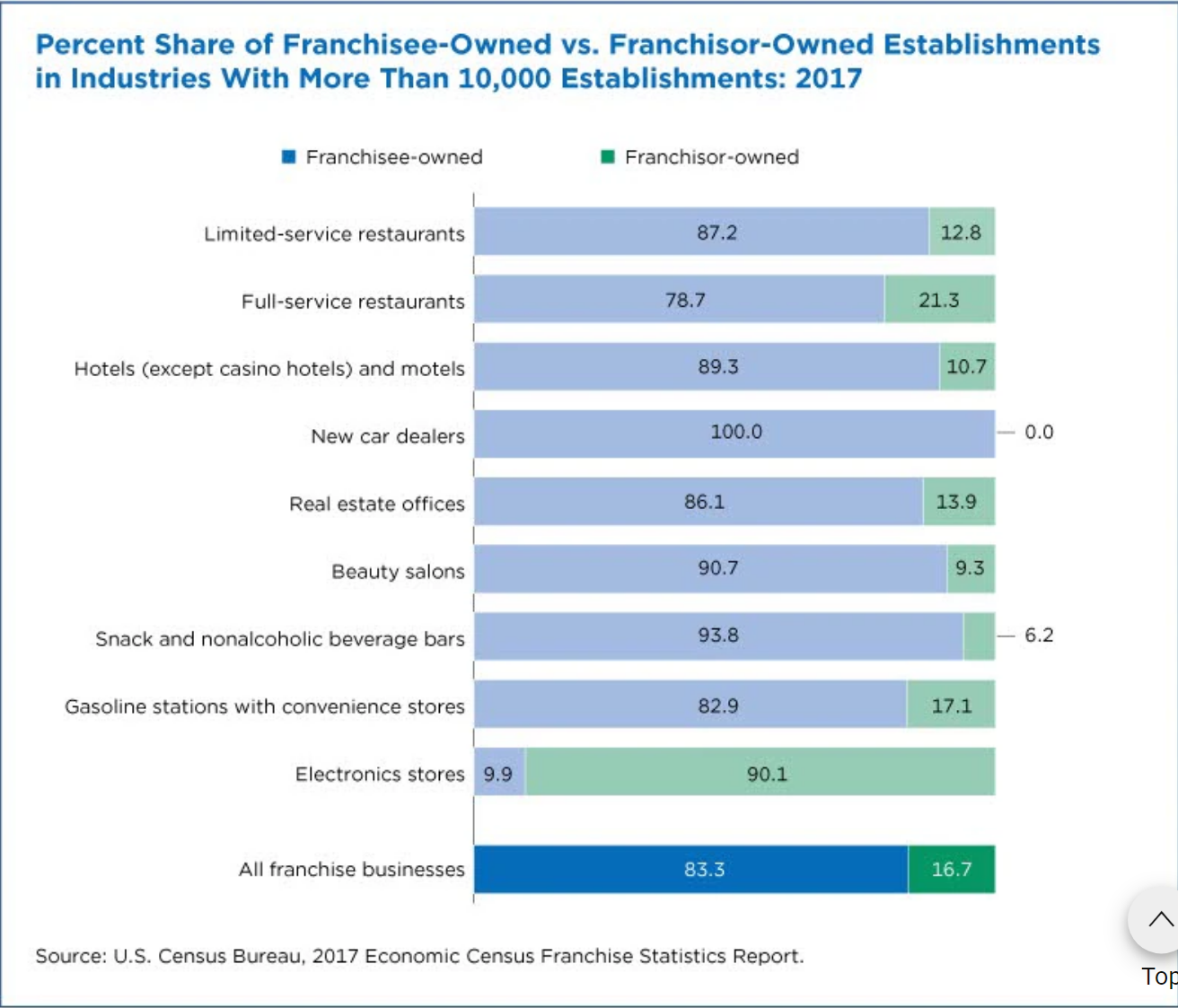
Franchising provides an opportunity for qualified individuals to own a business and earn equity-like rewards, without outstanding industry expertise, with lower business failure risk, requiring relatively modest equity investments and the opportunity for advantageous bank and small business loans.
Franchising provides the owner of a product or service concept with the opportunity to expand using “other people’s money”. It facilitates geographic and international expansion leveraging locally knowledgeable managers/investors. It allows differentiated products, services and systems to be replicated quickly and consistently. It provides legal agreements that ensure that the franchisor’s brand is enhanced and not damaged by the franchisee’s operations. It provides a system that strongly aligns the interests of local managers/owners with those of the central business.
History
Franchising has experienced several “boom and bust” periods, fraudulent deals and changing relations between franchisors and franchisees through time. Initial growth began in the 1850-1920 period together with the growth of the manufacturing and transportation industries. Automobiles, farm equipment, sewing machines, service stations, auto parts, pharmacies, soft drinks and train stop/car hop restaurants lead the way originally using the product franchising model. The depression interrupted the growth of franchising. Automobile dealers, service stations and soft drink distributors accounted for 80% of franchising before the depression.
Franchising accelerated again after WWII with fast-food restaurants leading the way, accompanied by a diverse set of laundry, hotel, rental car, real estate and convenience stores. These businesses were often still tied to products or patented equipment. However, McDonalds (1955) offered the first business format franchises which provided greater opportunities in a growing, travelling society.
Business format franchising “includes not only the product, service, and trademark, but the entire business format itself: a marketing strategy and plan, operating manuals and standards, quality control, and a continuing process of assistance and guidance.”
With rapid growth came accounting fraud by franchisors, one-sided contracts, overlapping deals, pyramid schemes and conflicts between franchisors and franchisees. The Energy Crisis of the 1970’s bankrupted a large share of service stations. State and federal regulations enacted in the 1970’s ensured that standard disclosure agreements were used, allowing potential franchise owners to work with their lawyers to ensure that they understood the deals they were making.
Data on the franchising industry is not standardized. Two industry associations and the US Census Bureau provide somewhat inconsistent data. Nonetheless, the growth of franchising after the “bust” in the 1970’s is amazing. The number of establishments has grown from 375,000 (1973) to 420,000 (1988) to 530,000 (1990) to 775,000 (2021). Total employment has grown more slowly, from 7 million (1988) to almost 10 million (2017). Sales has grown much faster from $160 billion (1975) to $350 billion (1980) to $530 billion (1985) to $1 trillion (2004) to $1.3 trillion (2007) to $1.5 trillion (2012) to $1.7 trillion (2017).
Leading sectors by annual earnings include senior care ($155K), real estate ($153K), personal services ($126K), business services ($122K) and pet services ($119K).
Anyone who has searched for work in the last decade has learned about the importance of the 15 second elevator speech and fine-tuning their personal brand.
Many have rejected this sales and sound-bite oriented approach to career progress as being undignified, unprofessional and personally demeaning. Most have learned that this approach is required for even a scrap of success.
Modern recruiters and counselors advise that “it’s not about you”. It’s about what a hiring manager or screener are seeking. A generalist brand, multiple professions, multiple industries or a complex story are deal-breakers. Hiring agents are seeking an exact match. A Swiss Army knife has no perceived value.
Job seekers are well-advised to network broadly, but to focus on opportunities with a clear match of experience to requirements. Hiring managers want to be sure that professional skills and experience are solid. Degrees, majors, certification and prior job titles provide 90% of the evidence. It is a rare recruiter or hiring manager who will really dig deeply into technical skills. Interviewers also know if they are seeking a specialist or generalist within a profession. Candidates should tailor their resume, cover letter and answers to one or the other. A state and local tax specialist is hired for very different reasons than a division controller.
Most businesses strongly prefer candidates to demonstrate mastery of a single profession, even for entry-level positions. General management majors are handicapped in the job search.
In addition to being technically proficient, most firms want applicants to be dedicated to and knowledgeable about their industry. There are many reasons. Learning industry jargon, technology and the basis of competition takes time. Industry veterans truly believe that their industry is different and special. Sharp managers understand that turnover is lower for industry specialists. Most industries have a well-established culture and a leading function (merchants, scientists, deal-makers, architects). Like most clubs, they prefer to hire familiar faces.
A wide range of professional, industry and project experience is of great value within a firm. Unless an individual is able to sell very specialized technical skills or are seeking work through a consulting firm, they must stay focused on a simple story line when searching for a new firm. “Cost accountant – heavy manufacturing” sells well. “Management accountant with project success in various industries” sends vague signals.
A specialized industry and professional brand is required today.
Process engineers create structures and use them to create infinite value. Most subscribe to the balanced scorecard view of commercial firms as four linked levels: 1) assets/resources used to create 2) operations excellence which 3) satisfies customers, allowing firms to 4) maximize financial returns. Many use some variation of Richard Schonberger’s six universal customer needs (QSFVIP) to structure strategies for satisfying customers. They have found that there is no practical limit to increasing the value delivered to customers.
In the world of quality, we have seen ISO 9000 type quality management systems become standard and Six Sigma quality levels approached. Informal quality assurance has been supplanted by a variety of formal measurement, feedback and improvement systems. Product defect levels have fallen from 5% to 2% to 1% to 0.1% to even smaller fractions. The improvements show no signs of stopping and customers appear to value each new level. The accident rate in commercial aviation provides a powerful case study. The basic quality feedback loop combined with statistical tools and employee engagement have made this possible.
Speed, measured as product delivery cycle time, continues to improve. Manufacturing processes are designed in cells, using “unit of one” batches and just-in-time supplies to reduce production from weeks to days to hours. Supply chain coordination reduces production lead times from months to weeks to days. In distribution, lead times have dropped from weeks to days to latest cutoff hours for air, parcel, LTL and truck load service. Customers continue to ask for more, even beyond 2pm cutoffs for 10am next day delivery.
Flexibility to accept orders of any size or kind at any time continues to improve. Customers no longer order ahead of peak seasons to assure supply. They order when then need goods. Customers share sales forecasts, but have no qualms about ordering 3-6-12 months of supply in a single shot and expect normal delivery. Firms have learned to add low-cost equipment and labor capacity, hold semi-finished goods and outsource peak needs to partners. This pressure has moved up the whole supply chain. Lean manufacturing techniques and integrated supply chain management have facilitated this change.
Value, as measured by unit cost, continues to improve. Labor and total factor productivity increase by 2-4% annually for decades at a time. Quality, supply chain, IT, communications, institutional, engineering and basic science advances drive these benefits.
Value, as measured by combinations of features and benefits that meet individual needs, grows each year. Micro marketing, partnerships and customer intimacy strategies ensure that goods and services better meet expressed customer needs. Data analysis, individual promotions and sales tracking allow firms to anticipate the needs of smaller and smaller groups of customers.
Information or transaction costs continue to fall. EDI and simple electronic markets reduce transaction costs at every stage. Supplier websites, catalogs, pricing, ratings and portals reduce the costs of transactions. Formalized information sharing, vendor managed inventory and evaluated receipt settlements further reduce costs. Standard project and document collaboration systems reduce the cost of product development. Formalized risk management and emergency preparedness resources and plans reduce potential liabilities for all.
Personal attention grows, in spite of the increased complexity of systems and use of high-technology. Firms know more about each other through partnerships, joint suppliers, product development projects and customized offerings. Firms which have adopted customer intimacy as their primary strategy have organized to become customer centric, employing customer relationship management systems (CRM) to shape their data. As routine transactions are automated, sales, customer and technical service staff focus their time on personal attention.
Customers will be fully satisfied when there are no product defects and no risk of product defects, when goods and services are delivered at the second they perceive a need, when no purchase is delayed as being too large or unusual, when products are free or customers are paid to take them, when products are uniquely created for their needs, when transaction costs are zero and when they feel like they are the only customer in the world. Tremendous progress has been made towards those goals in the last 30-50 years, often beyond what was imaginable even 20 years ago. The rate of progress towards those ultimate goals has not yet slowed.
As organizations and organizational units adopt more customer-focused strategies, there is a need to better understand what customers really want. Although firms can invest years and decades in marketing research on this question, they can also choose to obtain 90% of the value in a single day by facilitating an honest discussion with key leaders and customers.
Those who have adopted the quality/process view believe that the first step is to confirm that customers mostly (only) care about the perceived value of final results. They will pay for a value added process or feature, but don’t care about other activities. Richard Schonberger proposed that all customer needs can fit into a small number of categories, which can be used to define and prioritize the findings.
Customers value final product or service quality. More today than before; and more tomorrow than today. Some customers value process quality, because it reduces their risk, serves their customers or is required by regulators. What quality level is required to remain in business, to meet expectations or to differentiate a product?
Customers value delivery speed. Product lead times have fallen from weeks to days to hours to minutes. Service delivery is sometimes measured in seconds.
Customers value flexibility. They expect your firm to have the capacity to meet their orders within standard lead times. They expect you to make exceptions. As in the Pink Panther movies, they may agree to a standard lead time or capacity, but when they need an exception, they want you to ignore what they told you before. Expectations regarding flexibility vary widely across industries and firms and can change rapidly.
Customers seek value. They want lower prices or total cost of ownership. They want features and benefits that are cost-effective, which meet their needs or which are market leading. This is a very broad category, but firms must operate with some understanding of what is expected.
Customers value information. They want business relations with clear information flows, minimal transaction costs and shared accountability for risks. Ideally, you anticipate and fulfill their needs in a cost free way, without surprises and take care of surprises of all kinds: regulatory, supplier, customer, competitor, acts of god, etc.
Finally, customers value personal relationships. This varies by culture, industry, firm and purchasing agent. Business relations are rarely purely business relationships. Personal connections, loyalties, favors, culture and understanding often matter.
Firms or business units should understand what their customers want. They should identify minimal, expected and differentiated performance levels. They should understand relative customer priorities. This may require formal marketing research or trial policies or pricing exercises to determine real preferences. This may require sales, marketing, engineering, production and finance to work together like never before.
A consensus one-page QSFVIP customer profile can help to shape decisions at the strategic and tactical levels.
















 Good News