
Civility, root causes of our problems, community, good news, the economy, Trump, history, religion, popular culture, Indiana, Hamilton County.
Scroll down to the bottom to subscribe.
Civility, root causes of our problems, community, good news, the economy, Trump, history, religion, popular culture, Indiana, Hamilton County.
Scroll down to the bottom to subscribe.

https://en.wikipedia.org/wiki/West_Side_Market
I believe that “community” really matters in our modern world. Ten articles promoting my view. Just like the neighbors who have visited the Cleveland “West Side Market” for 175 years.
I believe that our society has adopted a radically individualist perspective without being aware that “it” has made these choices and transmitted its choices though our culture. Historically, conservatives have been the main promoters of the “community” complement to individualism, but I don’t see any possibility for our current conservative party to effectively fulfill this role in its populist, nationalist, xenophobic, capitalist, commercialist, elitist, authoritarian, transactional state. Liberals have not been exceptionally strong promoters of “community” or community organizations other than the central state historically, but I will argue that 6 core liberal objectives require strong communities and community organizations for success. I have broached this subject in 3 other recent articles.
Strong economic agents often have the ability to misuse their economic resources in all dimensions. They can shape political, governmental, judicial and administrative choices. They can use their power to obtain greater than market returns/rates from labor, suppliers, competitors, lenders, investors, partners, universities, not for profits, professional, managerial and executive staff, nations, non-governmental organizations, immigrants, children, minorities, women, disabled and other low power groups. Strong players can treat other agents purely as means and ignore their humanity. Strong players can shape products, product markets, delivery channels, advertising, marketing and communications to take advantage of human weaknesses in making economic decisions. Radical liberals argue that these abuses are inherent and extreme. Most liberals point to the evidence of historical abuses to support their concerns about concentrated power and advocate for controls, laws, checks and balances, counterweights, information, regulation, expectations, legal opportunities, etc.
Community plays a major role in politics through political parties, unions, community organizations, interest groups, industry associations, professional organizations, government employee organizations, journalist associations, media associations, universities, teachers’ organizations, PTO’s, legal associations, social services organizations, community foundations, churches, civic organizations, social organizations, veterans’ organizations, etc. Individuals who have experience as members, volunteers, funders, leaders and beneficiaries of organizations are likelier to participate in other organizations and believe that organizations make a difference in the political process at all levels.
Community organizations and select industries also play a crucial role in shaping the implicit political, economic, social and moral beliefs of our society. Capitalism, free markets, democracy, liberty, progress, America, opportunity, God, federalism, government, regulation, rule of law, entrepreneurship, free trade, unions, populism, presidential power; the list of concepts and their proper roles is long. Education, university education, churches and religion, mainstream media, other media, entertainment industry, arts, music, professions, industries, youth and college organizations, political communications, etc. The list of influencers is long. Groups, organizations and community matter.
Most importantly, community experience shapes our beliefs regarding the relationship between the individual and the community. We currently emphasize the economic, social, personal development and political rights of individuals. We de-emphasize the rights of communities and organizations and the responsibilities of individuals who “belong” to these organizations. We emphasize individual choice, tolerance, rights and “limited liability” commitments.
The modern right has embraced the “pure” capitalist system as the primary defender of all individual rights, liberties and freedoms. Natural “laissez faire”. Social Darwinism. Anti-communism. Anti-totalitarianism. Anti-government. Anti-regulation. Anti-centralization. Entrepreneurship. Road to Serfdom. Job creators. Greed is good. Wealth is good. Lives of the rich and famous. Horatio Alger. These stories, ideologies, politics, myths, principles, policies, science, and beliefs are centrally important to individuals adopting a view of the role, risks and control of economic power.
Liberals tend to point towards the universal, abstract dimension. The nation. Global humanity. The rational view points towards the highest level as the most effective way to outline or solve problems. The national community is suspect because of fascist risks. Perhaps a proper national community could be used to support liberal views. Lincoln, FDR and Kennedy embraced the nation. The global community may be useful for religious or abstract politics, but it is seen as highly important by only a very small slice of our citizens.
Communities of interest are more important. These organizations shape both political activity and the underlying views of the people.
“Liberals” have mostly discounted the risks of state power, even after the many examples of totalitarian atrocities on the left and right. Yet philosophically this concern was at the heart of “classical liberalism”, which created the relatively low power American national government (even on the second try). The power of the state, the military, the draft board, the DOJ, the FBI, the police, the courts, the national guard and the imperial president were major concerns for liberals in the 1960’s. The power of “the state” to monitor the activities of ordinary citizens was also an issue in the 1960’s and 1970’s as the actions of the CIA and Nixon’s government were revealed. In the second Trump administration many liberals are once again wisely worried about centralized political power.
The use of community organizations in politics is critical as noted above.
Liberals are generally much more concerned about the role that culture can play in indoctrinating individuals to support and comply with a single view of citizenship, politics, religion, culture, law and life. The 1950’s (!) and 1960’s cultural revolution or counterculture was largely about protecting the individual from the forces of conformity to the nation, big business, commercial society, small towns, and religion.
Following Rousseau, liberals believe that individuals have great potential for personal growth and creativity. This expression of individual potential holds a mystical, infinite, divine quality. Forces that constrain this journey should be opposed. Those who support the use of human possibilities must be supported.
I think this is a critical point to reconsider. Government, religion and cultural institutions do have the power to overreach in favor of the views of the powerful actors in society. They can support pure capitalism, nationalism, populism, elitism, religious conformity, commercialism, pragmatism, materialism, etc. They can also support the liberal world view: balance, true individual rights, justice, opportunity, equality, peace, diversity, global community, progress, improvement, human rights. Community, organizations and institutions are tools. They can be used by any political, moral, economic, pragmatic, interest or social group to advance their interests.
As noted in the prior section, organizations are essential to the political process. There is a risk that political and cultural organizations will align to support conservative political views, even the most extreme, fundamentalist, literalist, constraining, oppressive, unequal, static, wasteful, impersonal ones that liberals oppose.
Undermining the role of “community”, of local organizations, of communities of interest, does not help to oppose the ongoing march of conservatives towards a highly structured system that supports the rule by the successful over the rest. The existence of a wide variety of healthy organizations is essential to provide a counterbalance against a single worldview becoming dominant and oppressive.
Historically, philosophical conservatives were MOST concerned about society, the nation, God, tradition, community, family, race, history, avoiding disaster, etc. They wanted to preserve the positive aspects of the inherited society. The individualist, rationalist views of the “Enlightenment” were not embraced. … Until it became clear that the kings, church, nobility, and landed aristocracy were going to be replaced by the new elites of capitalism, trade, ownership, law, university, and denominations. Then, the conservatives “changed horses” to the new winners in modern society. The individualistic strain of economic life in capitalism became supreme. The true “community” dimension of religion, local community, guild, union, charity, service, parish, precinct, tradition, protection, festivals, saints, colleagues, heroes, handicrafts, debt forgiveness, tithes, noblesse oblige, leadership, extended family, common law, music, art, food, dress, language, etc. became much less important. Daniel Bell argued that the “cultural contradictions of capitalism” made it impossible for any society based on pure capitalism to survive or thrive.
https://www.goodreads.com/en/book/show/734077.The_Cultural_Contradictions_of_Capitalism
There is an inherent conflict between social and economic conservatism. The first elevates community. The second elevates the individual. Ronald Reagan was able to combine both strands into a single loosely defined worldview. He argued that traditional American social values are consistent with “free market” economics. Republicans through Trump have managed to maintain the same conglomeration of incompatible views.
Republicans have managed to win the political wars. Democrats have managed to win the culture wars. The Republican cultural counteroffensive is alive today. Anti-trans rights. Public choice education. Anti-mainstream media. Anti-elite. Anti-university. White nationalism. So-called Christian nationalism.
Cultural values are transmitted through communities, organizations, government, laws, businesses, work experience, political experience, family, friends, and colleagues. Democrats would be wise to invest resources in developing and communicating community supporting world views.
Liberals worry about the ability of conservatives to use “human nature” to manipulate citizens. Consider Jonathan Haidt’s moral foundations theory. Humans inherently respond to moral, political and religious calls based on loyalty, authority, purity, honor and ownership. Liberals highlight care, fairness, and equality and some degree of liberty and proportionality. They believe that Western civilization has moved beyond the other 5 values and that politicians who appeal to citizens on these dimensions are merely hucksters. They worry about the framing of issues, groupthink, victimhood, low education, low information, selfish citizens.
Liberals worry about a “least common denominator” world view, and its use by politicians. Fundamentalist, legalistic, fixed religion. Simple slogans. Survival. No change. Polarization. Unthinking either/or. Local/provincial. Commercial. Conventional. Bourgeoisie. Selfish. Self-interested. Unquestioning. Following. Cheering. Uncritical. Short-term. Blindly following “experts” or leaders. Blindly individualistic. Elevating history and personal experience. Family, clan and tribe. They believe that every individual is capable of personal growth and seeing a broader, more abstract perspective of life. Rousseau once again. Infinite possibilities for all. Individuals who do not pursue the great possibilities of life are seen as living a false consciousness. This is most explicit in Marxism and postmodernism but part of mainstream liberal thought.
Liberals tend to embrace the abstract, idealistic views of Plato, Descartes, Locke, Rousseau, Spinoza, Hegel, Marx and Kant. They believe that a single well-defined worldview must be right. They struggle with the messy applied views of Aristotle, Jesus, Hume and Dewey. Normal humans are nearly all on the applied, analog, pragmatic, complex, unfinished, uncertain end of the spectrum.
In all of these areas, culture is transmitted through community. A very small share of people study, or even sample philosophy, theology, sociology, economics or political science. Fewer yet study literature, history, art or the humanities.
“Cultural conservatives” have highlighted the importance of community organizations in transmitting culture. Now, they want to politicize previously neutral or secular institutions. Public schools, libraries, judges, FBI, DOJ, BMV, sheriffs, public health, emergency preparedness and response, private schools, election boards and officials. Moderates and liberals must evaluate and respond to these initiatives. How do we preserve important institutions as truly neutral? What political effort is needed for those that must be politicized?
Until Trump-times, liberals did not need to worry about the basic structure of the American government. The rule of law. Political norms. Objectivity. Facts. Logic. Conscience. Character. Historical traditions. Bipartisan American foreign policy. Voting rights. Civil rights. Freedom of the press. Freedom of religion. Checks and balances. Pride of the Senate. Independent judiciary. Protected federal workers. Nonpartisan military. Independent agencies like Federal Reserve Board. American commitment to allies. American commitment to treaties. In a flash, Trump has used the skepticism of Descartes, Hume, Nietzsche, the existentialists and postmodernists to propose a truly radical world of only “might makes right” without any constraints. Hegel to the infinite power. A portion of the electorate and one party and that party’s leadership and key supporters have embraced this worldview, perhaps without understanding everything that it implies.
We have important cultural beliefs to consider. Strong, dynamic, engaged, tense, battle tested, creative, robust, forward-thinking groups of citizens are needed to formulate alternative views and oppose these challenges to the progress of modernity, Western civilization and classical liberalism.
Our government does not deliver its core services. Government is not efficient or effective compared with private sector firms and industries. Government fails to reflect the will of the people, even when it is strong and clear. The political system has been captured by politicians who have structured the rules to highlight politicians’ re-election and power. The political system has been captured by influential interest groups. Political competition is based on communications rather that content. The political system does not encourage or reward participation by the people. Political parties seek their own best interests rather than the nation’s best interests. The political system strongly favors the status quo. The political system strongly favors the interests of the powerful, wealthy and well organized versus the popular will. Strong forces are able to shape administrative implementation of laws.
Our two-party system is broken. Our media system is broken. Trust in the government at all levels and in all functions has been systematically undermined as a deliberate strategy by one political party.
Community institutions are required to overcome this situation. Political parties, interest groups, churches, community organizations, social welfare organizations, not for profits, professional organizations, industry organizations, states, counties, metro areas, global organizations, environmental organizations, patriotic organizations, veterans’ organizations, civil rights organizations, lifestyle organizations, local charities and United Ways, children’s organizations, youth organizations, fraternities, sororities, civic organizations …
Western civilization improved the opportunities and results for its citizens and the whole world from 1500 through 1914. The world wars, fascism, communism, totalitarianism and the great depression undermined public and intellectual confidence in “progress”. The post-WWII era recovered confidence in slow, sustained global progress based on the “western consensus” of mixed-market capitalism, democracy and international trade. The 9/11 terrorist attacks, the market failure based great recession, the rise of China’s state-oriented system, political polarization, mixed lessons from a global pandemic, rogue Russia, Iran and North Korea, global warming/climate change threats, and BREXIT withdrawal from the European dream have once again undermined our sense of progress. We face challenges, big challenges. Is our political system up to the challenge?
Historically, America has responded to global or conceptual challenges with revised political structures. We seem to be stuck in a trap. Only community organizations that aim to recover the principle of the government reflecting the general will of the people can lead the way. As Americans, we believe in manifest destiny and American exceptionalism. We can do whatever it takes to succeed. That is our history and our calling.
Our culture today focuses on personal growth, development, creativity and possibilities. Yet all individuals have an intense need to be validated for both their performance and their selves. Our society provides many ways to support the results of personal growth but only a few that embrace the individual directly.
A market economy requires us to fill the role of economic man as a specialized producer, employee, investor, property owner, trader and consumer. The economic value of the role is recognized. Only for those in the “creative class” is the individual even partially seen as a human being rather than merely “human capital”. Consistent compliance with the various economic roles is required, so they tend to “crowd out” other ways of thinking.
The market determines the “value” of all things in purely economic terms. The meritocracy funnels us into the highest “value added” activities which don’t often match our talents, personalities or interests. We set aside those other dimensions of ourselves. We start to view all choices as economic choices, pushing aside personal, social, political or spiritual factors.
We practice instrumental rationality in our decision making in business, science and law. We seek of optimize means for given ends. We balance costs and benefits, risks and rewards, short-term and long-term. This habitual way of thinking is reinforced through our “personal productivity” tools. We optimize our writing, data, reports, calendars, projects, processes, teams and schedules. We adopt this optimizing efficiency and effectiveness perspective. We become more like our computers and machines.
We face challenges of scale. Huge bureaucracies in business, government, and nonprofit organizations. They are large and process driven. Most have systematized, automated and optimized their “user interfaces” to the point where connecting with another human is nearly impossible. Some organizations do invest in making “self-service” easier, but the net effect is that we become “cogs in the machine” in order to transact our required daily activities. This is not new, but the pervasiveness, complexity and lack of options accumulates.
Organizations struggle to make individual choices with individual customers, employees, partners or suppliers. In general, a standard process is more effective, less risky and approved by the legal department. A decision-tree outlines all possibilities. Front-line employees, even highly paid professionals, are less empowered to make “business decisions” based upon all factors. This undercuts both the former decision makers and their partners.
Our meritocratic culture highlights the best, the winners, the exceptional, the superb, the most creative or unusual, the leaders, those who have overcome adversity. The focus is mainly on the end results of the few, rather than the common human experience of all. The demands of the meritocracy cause all human activities to be evaluated for resume and career building. No time for the person, the spirit, community, friends, art, health or fun.
We measure everything. What gets measured gets done. Helpful human measures are rare.
Our culture provides very weak philosophical answers. A secular age. Pure materialism. Skepticism, agnosticism, atheism. Pure subjectivism and radical tolerance. Utilitarian, calculating measures of pleasure and pain. Mainly scientific, instrumental, transactional psychologies. Anxiety revealing existentialism and postmodernism. Universities and public intellectuals that have undermined religion.
Our politics has devolved into simple red versus blue tribe allegiances, discouraging efforts at innovation, finding common ground, understanding, empathizing, communicating, or cooperating. Many feel their identities as men or women, whites or blacks, rich or poor as being imposed upon them rather than being chosen.
That’s pretty depressing. Fortunately, we humans are tough. We find some community and validation at home, school, work and other organizations. We use our tools. We squeeze in “real life”. We “check out” from the structures. Overall, we don’t get as much affirmation as we desire, especially in a word focused on personal growth.
There are solutions to address our situation. Legislation and social pressures for human, labor, consumer and patient rights. Traditional and experiential education on community, decision making, spirituality, consumer economics, personal finance, team building, leadership, multiple intelligences, talents, wisdom, creativity, goal setting, planning, leadership, boundaries. A more complex, structured, incentive slanted world requires individuals to understand their situation and what they can do to survive and thrive.
These are classic “liberal” priorities. Protected and well-educated individuals are best positioned to combat the intrusion of external forces that impinge on their humanity. Improved forms of community are needed to support a political party that is focused on the needs of all individuals. New forms of community education and experience are required for the “lifelong learning” needed to build so many competencies, frameworks, tools, insights and wisdom.
I believe that most demographic, class, philosophy and interest groups within the conservative tent have these same experiences with modern life. They hope for a return to an earlier age when the existing institutions were better prepared to help with this most important dimension of human life. I think most really understand that there is no “going back” to the 1950’s exactly as it was. We need to upgrade our institutions and communities to make life better. This is an area where creative bipartisan efforts can deliver great value.
The classical liberal emphasis on human rights, from the “bill of rights” through the recognition of minority rights in the last century is at risk. The “rule of law”, independent judiciary, political norms, civil service, career service, military, agencies, property and other structural components of our political system are at risk in a society that has lost the memory of the wars against fascism and communism. Modern “liberals” allowed “conservatives” to ensure that schools, civic clubs, youth organizations and editorialists would reinforce this critical component. Today, we need a “coalition of the willing” from both parties to protect these guardians of our security.
Post-Reagan America grudgingly accepts a government funded patchwork social safety net. Since 1981, the economy has become more dynamic, specialized, competitive and international. Employees have lost their informal “rights” to lifelong employment, fixed benefit pensions, stakeholder influence, seniority, respect for tribal knowledge, camaraderie, etc. Firms, factories, offices, roles and contracts “come and go”. Firms outsource, import and contract as required. Americans approved the “Reagan Revolution” two generations ago. The social safety net has not been adjusted to match the reality of employment insecurity today. Community organizations that once provided important parts of the “safety net” now play a much smaller part. All employees feel insecure. George W. Bush opened the door for both parties to embrace conservative means to liberal ends with the outline of “compassionate conservatism”. Liberals might find this compromise solution more effective than the current political stalemate that creates a widening gap between personal insecurity and social solutions.
Overall, our economy continues to provide opportunities for employment and ownership. Political parties argue about equal opportunity for different groups, changes in opportunities and the right degree of opportunities.
Our culture offers mixed messages about opportunity. We highlight those who succeed from all backgrounds. We celebrate innovation, creativity, output and entrepreneurship. We support change management as a required part of a dynamic economy. We celebrate American exceptionalism and the growth of opportunity, liberty, and prosperity. We tell our children that they can become anything that they want to be. We have been a confident society.
The politics of equal opportunity has highlighted the real challenges for those who possess less economic, family, neighborhood, education, language, confidence, communications or cultural assets in a competitive world. Slower economic growth for the bottom and middle thirds of the economy for 50 years has dented confidence. Polarized politics makes the economy and other national contexts more negative when the other party is in power. The replacement of a religious culture with a secular culture makes the economy the dominant or only factor in assessing the future. There is a “victimhood” strand within our culture that disconnects many fellow citizens when they experience difficult times. Our media driven world highlights the negative, simple and exceptional stories, overshadowing the long-term progress that continues to be made in most areas of life. The post-1960’s, Vietnam, Watergate mind is ironic and skeptical. We find it difficult to “believe” in progress, institutions or trust. The increased scale of society leads some individuals to doubt that they have any agency whatsoever. Some individuals find cultural, political and business support for “diversity” a threat to their personal opportunities.
Liberal leaders enjoy taking the critic’s role. In this case, we need to define, promote, communicate, implement and sustain a renewed confidence in our society, politics, economy and personal lives. Liberals need to be advocates and promoters. The message has to be based on reality and believable. We have strengths in our society and can develop new ones. This core socialization function is naturally provided through universities, opinion leaders, media, schools, civic organizations, churches, youth organizations, neighborhoods and local governments.
The power and influence of a truly “laissez faire” capitalist system is the root cause of the 5 liberal issues above. (1) Unconstrained economic agents use and abuse their power. Competitive markets are strong forces. Large firms are stronger, smarter, more creative and enduring. (2) The individualist, commercial “free enterprise” system inherently undermines “community” as a force to conserve culture. (3) Economic interests tend to capture the political system and eventually undermine its basic operations. (4) The mature technological economic system undermines our humanity. (5) The fully empowered economic system threatens human rights, security and opportunity.
The root cause of these problems is that a pure market system, unconstrained by law, politics, regulators, religion, culture, history, options, unions, cooperatives grows too strong. There is no limit to corporate size and rewards but the incentives for growth remain. There is no limit to market share without anti-trust laws and enforcement. There are no limits to opportunities from political capture without spending and lobbying regulations. There are no limits to judicial and election manipulation. There are no limits to supplier, labor and customer squeezes. There are no feedback mechanisms to constrain the beast once it has overcome political and cultural/social limits.
There are even more negative consequences that we see today.
The economic system becomes so dominant that it simply excludes all competitors. We see a “race to the bottom” of countries, states and municipalities lining up to incentivize powerful firms to do business by cutting taxes and regulations, reducing labor and environmental burdens and offering subsidies. Employees lose union rights and then even basic employee rights as they become reclassified as contractors. Firms squeeze suppliers down to marginal cost pricing. They collect fees for the “right” to do business with them.
The large scale integrated economic system becomes so dominant that alternatives are eliminated. Everyone must use the banking system. Small scale firms must use the main economic system for supplies, services, logistics, and distribution. Only a small number of suppliers remain for each product or service. Individuals find it difficult to disconnect from the grid.
The system also comes to dominate the culture philosophically. Individualism and commercialism undermine institutions and community. Instrumental, scientific, objective cost-benefit reasoning comes to dominate thinking and become the default way of seeing the world. Utilitarianism, libertarianism, materialism, pragmatism, existentialism and atheism become attractive philosophies. Philosophical conservativism is replaced by winning.
The threat of losing in a meritocratic system with weak safety nets and the need for public affirmation of winners leads to lives devoted to economic success and the exclusion of all else.
Extreme views like “social Darwinism” return. Greed is good. A “winners are good, losers are bad and deserve to lose” view becomes socially acceptable. “Every man for himself” is considered wisdom. All relations become transactional. The pursuit of self-interest is honored. “The end justifies the means” is accepted as valid in all spheres of life. The “great man” theory of history and leadership is adopted. All relations are considered win/lose, even when win/win options are obvious. “Might makes right” is seen as self-evident in all arenas.
In 1992 Francis Fukuyama confidently proclaimed the “end of history” and the permanent victory of Western capitalism and democracy. In the last 30 years Western capitalism has continued to grow, manage technical revolutions and dominate the global economy while other nations have also grown significantly, driving the greatest reduction of poverty in human history. We have not seen the “end of history”. The powerful economic system systematically undermines those who confront it and usually wins. The results for society are mixed, unacceptable and unstable.
https://en.wikipedia.org/wiki/The_End_of_History_and_the_Last_Man
I don’t believe that the powerful interests of unchecked capitalism can be overcome by political tactics or specific reforms alone. I think that they can only be offset when a majority of Americans understand, in some fashion, the threat which this radical ideology and extreme, revolutionary political force poses to our nation and society. It requires a credible political alternative. It requires a groundswell of support for rule by the people interpreted as a solid majority of 60%. It requires idealistic liberals to embrace this centrist bias for the good of society.
We live in the greatest economic society in history. We have the ability to grow, trade, solve global problems and provide greater economic opportunities for all and a more effective safety net without reducing the incentives that drive the economic machine.
To reach these goals, we need to gain broad consensus on the need for balance in our politics. We have 6 political camps in the US: far left, center-left, center, center-right, far right and undecided. We can turn this into dozens by looking at economic, cultural, military, international and philosophical dimensions. We’re not going to get 60% to the left or to the right in the US, even by its relatively conservative political standards compared with other developed countries. We are stuck with each other. We are blessed to live in the first country that embraced the “classical liberal” political system with its “checks and balances” approach. This is an inherently cautious, socially and economically conservative system, but it allows for change when it must occur.
We are at one of those times in history. We must find another “New Deal” that preserves the economic goose that lays the golden eggs, while taming the goose so that she does not become the golden goddess. To do this, we need leadership. We need conversations and interaction. We need trust. We need “liberals” to embrace community and culture as important and valid shapers of public opinion. We need to agree on a revised political system. We need to support community institutions that shape, reinforce and reward cultural beliefs. Laws and education are not enough. Real people learn by experience, examples, stories, friends, neighbors and community leaders who they trust. There is no great leader, communications, tagline, brand, flag, music, framing, research, program or legal shortcut.
I think that radical individualism is the curse of our time. “A pox on both your houses”. Liberals have over promoted social individualism while conservatives have over promoted economic individualism. Unbridled capitalism is the root cause of many of our society’s challenges. I encourage liberals to overcome their historical suspicion of “community” as merely an agent of the Church, priests, kings, lords, landlords, capitalists and merchants. The “classic liberal” political model only supports a “thin” set of moral values promoting the state, separation of church and state and tolerance. That is not enough to offset the power of wealth in the modern capitalist economic system. The financial stakes are much too high in a $27 Trillion economy with 20 million millionaires. Large financial interests will always win and expand to infinity … unless we have some kind of broader agreed upon framework. I believe we can embrace such a framework only if we leverage communities to send, consider and support such a message.
Historically, liberals have welcomed change, considered new ideas, experimented, innovated, broken idols, destroyed sacred cows, valued reason and confidently believed in a better future. Finding a way to make “community” a central part of our politics, economics and society is a new opportunity to apply those values.

George W. Bush promoted the idea of “compassionate conservatism” to enlist local community organizations in delivering government programs. The idea didn’t go far.
I’d like to argue that the idea still has merit. America has been a unique western democracy that has promoted “associations” and “not for profits” as a 3rd alternative to public or private delivery of services. The US has been an innovator in creating organizations that serve the public. Conservatives have often supported these organizations as an alternative to government services. Historically, liberals have also supported many of these “3rd way” options.
Community gardens, food shares, farmer cooperatives.
Small business cooperatives, chambers of commerce, local industry and professional organizations.
Local church congregations.
Book clubs, public libraries, community colleges, public schools, colleges, lifetime learning.
Mutual burial, insurance, health and aid associations. Building & loans, S&L’s, credit unions.
Community hospitals.
Craft, teachers, trades, manufacturing, performers unions.
Civic organizations, civil rights, community organizers, human rights, bar association vetting, ACLU, civil defenders, environmental and trial lawyers, neighborhood associations and local political groups.
Community events, community services, living cooperatives, Habitat for Humanity, Meals on Wheels, environmental services, family, local services, YMCA, YWCA, Salvation Army, local sports teams and leagues, outdoors clubs, cooperative preschools, seniors’ organizations, sports clubs, volunteer fire and emergency groups, women’s shelters, youth organizations
Historically and recently, left and right have argued about who should provide public services. I think we need to walk away from the philosophical politics and find solutions that work. There are many NFP organizations that effectively deliver needed services. I think that they could deliver some services currently provided by governments. I hope that my left/liberal colleagues can step beyond the title “compassionate conservatism” or the corporate origin of “outsourcing” to embrace this potential for using a more effective means to deliver important public services.

https://ylcube.com/c/blogs/broadly-speaking-community-interests-vs-individuality/
I think that we have inadvertently prioritized only the individual and completely discounted the role of “community” in American life. We desperately need to rebalance.
Here you’ll find
6 “good news” posts on American trends
7 “good news” posts on Hamilton County, Indiana
2 posts on the Indianapolis metro area
3 posts on the religious dimension of community
An overview on Our American Community and links to Our Kids, Why We’re Polarized and Little Pink Houses.
Solutions such as community assets (Janesville Plan), school curriculum, civility pledges and candidate approval boards.
Historical overview of the critical role of community, how we have more in common, the role of morality and the conflict between “only the individual” and the community.
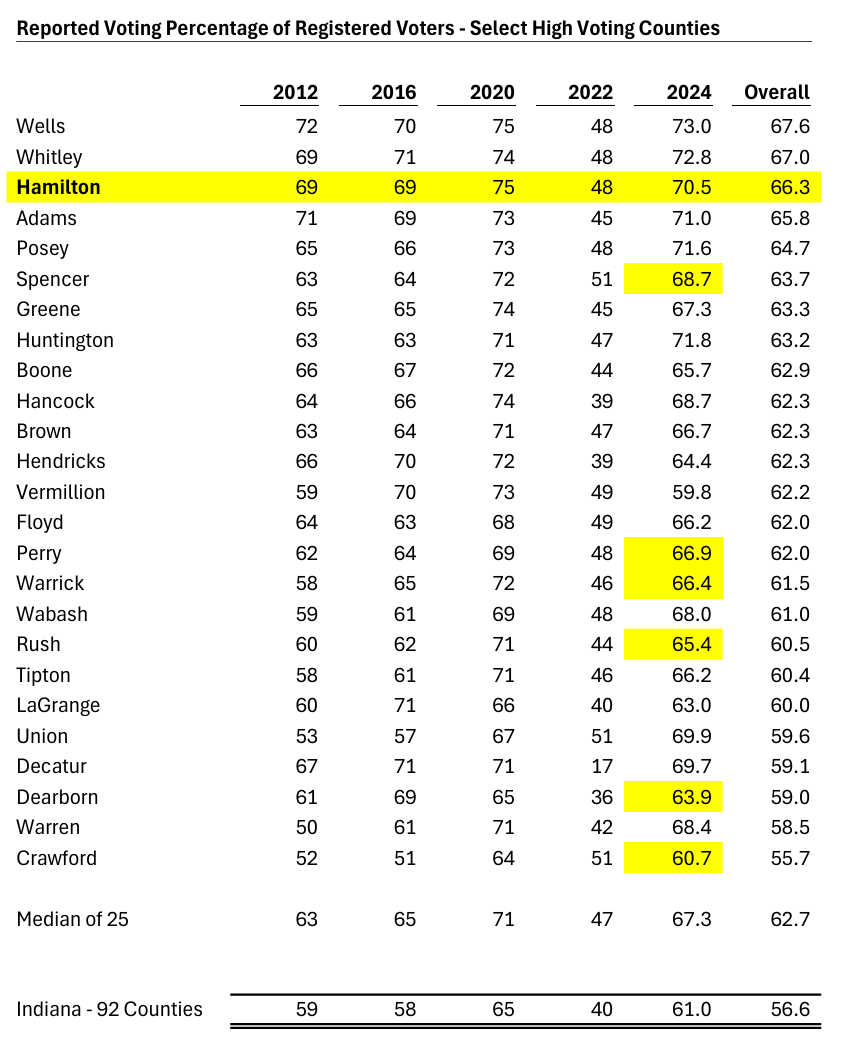
Hamilton County has the 3rd highest average voting rate of Indiana’s 92 counties in the last 12 years. It was tied for 3rd highest in 2012. It was tied for 7th highest in 2016. It was first in 2020. It was tied for 6th highest in 2022. It was 6th highest in 2024.
Hamilton County’s 2024 population is estimated to be 378,000. The 2020 US Census indicates that the non-voting age population is 25%. The resulting voting age population is 283,000. This exactly matches the registered voter population!!! It is very unlikely that every voting eligible person in Hamilton County is registered to vote. Based on national figures, 90% voter registration is the maximum level. If the valid voter registration number was 10% lower than the reported 283,200 level, it would be 254,900 making the voting percentage 78%, far above all other Indiana counties.
https://worldpopulationreview.com/us-counties/indiana/hamilton-county
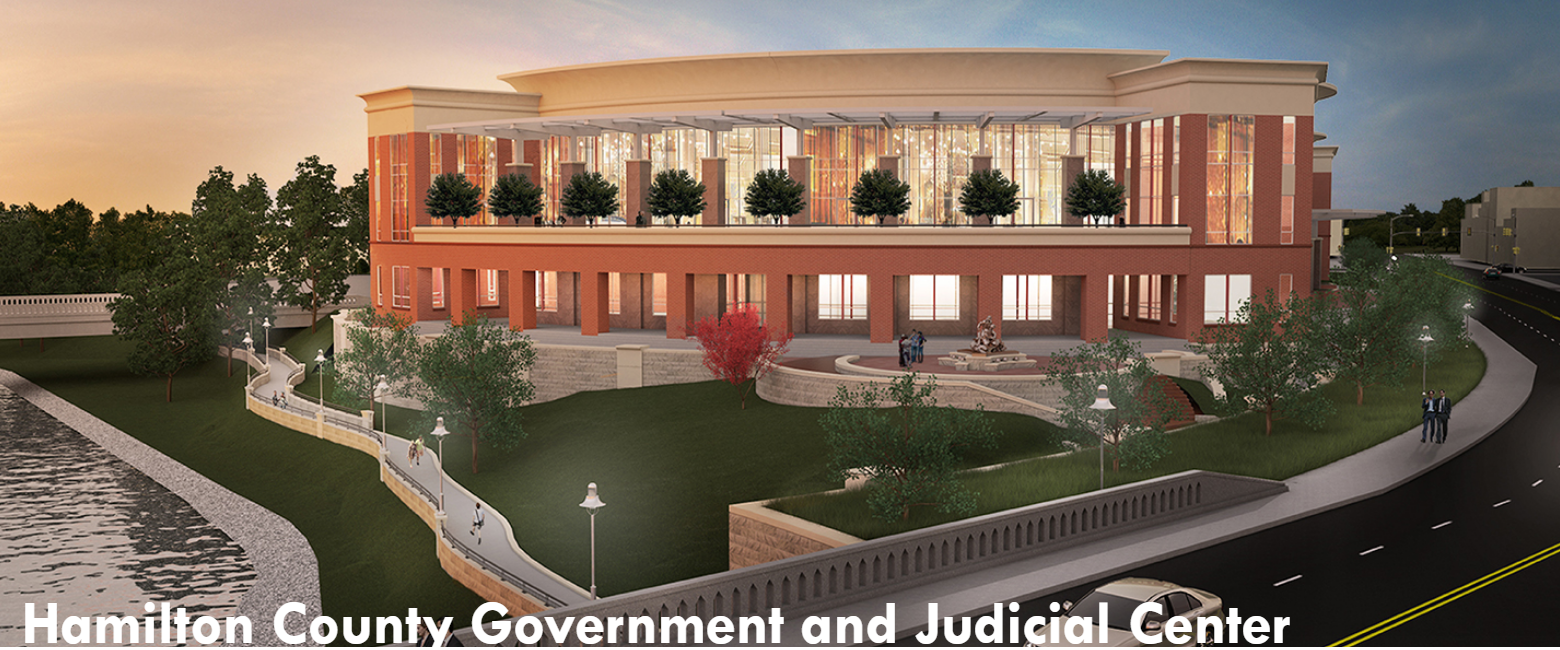
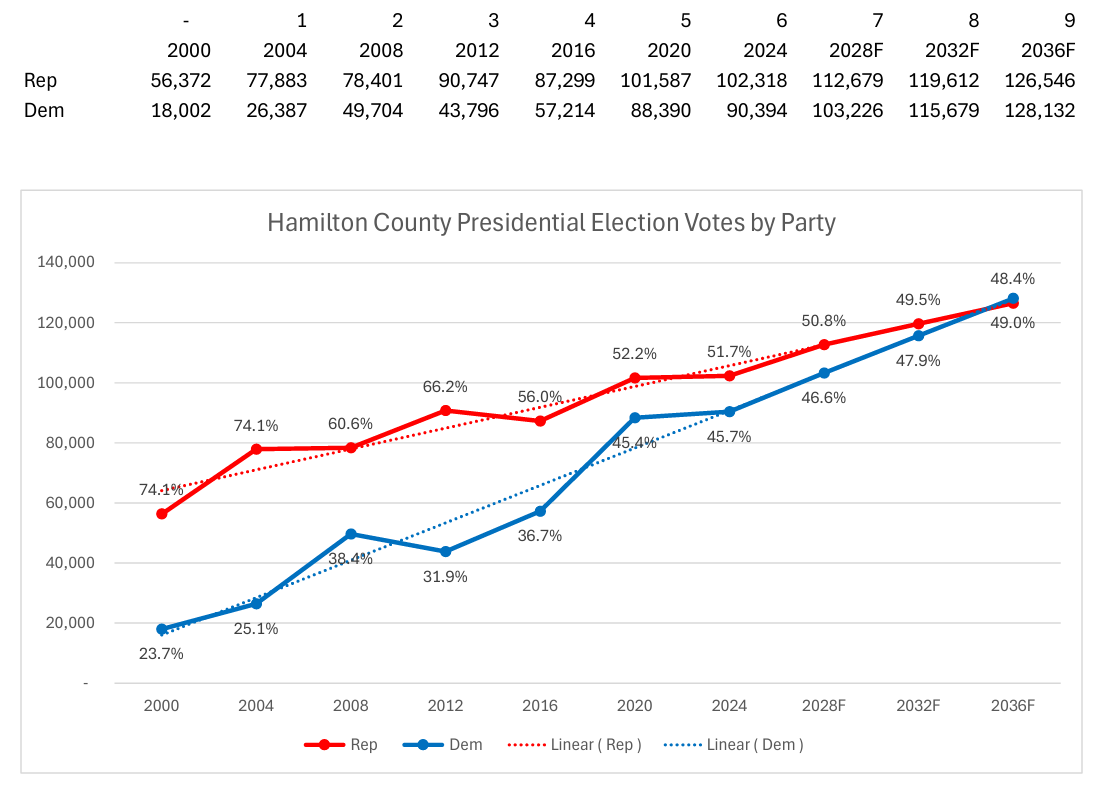
Hamilton County moved from a 30,000 vote Republican advantage in the 2016 presidential election to just 13,000 votes in 2020. Political gurus near and far watched the 2024 race closely to see if the squeeze would continue. It did not. Trump won Hamilton County by 12,000 votes in 2024, just a statistically insignificant shade below 2020.
The long-run trend indicates very competitive political races for the next 3 presidential election cycles.
https://www.wfyi.org/news/articles/hamilton-county-indiana-purple-trump-harris
https://secure2.hamiltoncounty.in.gov/Elections/2024G/results/index.htm
https://www.hamiltoncounty.in.gov/DocumentCenter/View/15431/2020-General-Office-Detail-Report
https://secure2.hamiltoncounty.in.gov/Elections/2016G/results/index.htm
https://secure2.hamiltoncounty.in.gov/Elections/2012G/results/President%20And%20Vice-President.htm
https://secure2.hamiltoncounty.in.gov/Elections/2008G/index.htm
https://secure2.hamiltoncounty.in.gov/Elections/2004G/RESULTS.HTM#0001
https://secure2.hamiltoncounty.in.gov/Elections/2000g/index.htm

Our political party-based election system fails to qualify candidates based on their character. Historically effective groups like the League of Women Voters and the bar association have lost support from the public. A self-appointed nonpartisan grass-roots organization in each of America’s 3,000 counties could re-establish this core function for the benefit of both parties and our country.
Create a county level “Candidate Appraisal Board” as an independent not-for-profit organization. Nonpartisan. 100 members. 4-year terms. 2 groups of 50 join every other year.
Evaluate primary and general election candidates. Not issues, party convention delegates or judges.
Focus on character, constructiveness, community and service as qualifiers for the honor and duty of holding office as a representative of the people. Not evaluating political views. Not evaluating professional qualifications. Seeking to qualify candidates. Multiple qualified candidates per office is possible and expected. Not discounting candidates based upon their personalities, strong views, extreme views, communications styles or strategies.
Board member candidates randomly selected from November registered voters list. Maximum 55% from any one sex. Maximum 40% from one party that voted in the previous primary election. Maximum 25% from any single municipality or township. Rolling nomination and acceptance rounds until seats are filled.
For the first group of 50 board members, ask 5 local Rotary clubs to nominate 10 politically diverse founding members each.
Candidates are deemed “qualified” if they get positive votes from at least two-thirds of the voters with a minimum quorum of 80 voters. Positive qualification votes require “yes” answers on all four dimensions of the evaluation form.
The independent organization seeks small dollar donations from citizens and community groups. It does not accept support from commercial organizations, interest groups, candidates or their families.
The organization defines its own procedures and elects its own officers: president, vice president, secretary and treasurer.
Is candidate John Q. Smith fully qualified to hold public office and serve our community?
https://www.brainyquote.com/quotes/jimmy_carter_453546

https://www.amazon.com/Janesville-American-Story-Amy-Goldstein/dp/1501102265
This 2017 bestseller was applauded by the WSJ, The Economist, Harvard sociologist Robert Putnam, JD Vance (as a complement to Hillbilly Elegy) and Barrack Obama. It tells the story of Janesville, Wisconsin as a General Motors assembly plant with 3,000 workers was permanently closed in the turmoil of the Great Recession. It focuses on the impact on real people and the community’s response. The author concludes that neither the liberal response of job training nor the conservative response of economic redevelopment incentives was adequate to meet the community’s needs. What could work?
The US economic and legal system protects the property rights of investors, corporations, and banks. It doesn’t protect or promote the property rights of the other actors in society quite so well: workers, suppliers, local governments, charities, retirees, and children. It is the fundamental discrepancy between different groups that is highlighted in this book, catalyzing the last 15 year’s populist reaction against our system, and begging for a practical solution.
Financial interests are flexible. They can be bought, sold and mortgaged. They are geographically mobile. Money and financial instruments are fungible. They can be exchanged with zero to small loss of value.
Other interests are much less flexible and mobile. Labor assets are tied to an individual. Individual labor assets may be tied to a specific situation OR broadly applicable. Real property is tied to a local and regional location. Local governments and charities are tied to a geography. Families are emotionally tied to a location.
The historical political conflict was between the wealthy and the non-wealthy. Landed aristocracy and peasants. Capitalists and workers.
Wealth still matters. The advantages of financial wealth have multiplied in the modern world. Financial rates of return are higher. International opportunities exist. Financial markets are effective and efficient. Risk can be managed through portfolios and derivatives. The shear amount of wealth, and wealth per person, is large enough to be scientifically managed. Generational wealth is preserved. Wealthy interests have effectively “captured” the political system to ensure they are not over-taxed or over-regulated. Network effects from neighborhoods and elite colleges accumulate. The network effects from large metropolitan areas accumulate.
As the advantages of financial wealth have compounded in our society, the distribution of income and wealth has become more and more unequal. For the good of our whole society, it’s time to take some steps to “level the playing field”. This is not strictly about protecting the poor or “fairly” taxing the rich. It is about providing “roughly” equal protection to the various property interests in our society.
In a meritocratic, capitalist society, there will be an unequal distribution of income and wealth. It is difficult to find an obvious “rule of thumb” to limit this dispersion. The higher income and wealth individuals are sure that they have “earned” their returns. Many libertarians and conservatives believe that the “job creators” and “value creators” in society are under rewarded, even before progressive taxation claims a greater share. Most working, middle and professional class earners are sure that they are underpaid compared to their value-added and that the tax system is designed to benefit “others”. Many vote for the conservative political party because they accept this as unavoidable, see disincentives and unintended consequences from attempts to change this, or aspire to become one of the winners. Economists and psychologists report that individuals are much more motivated by economic losses, taxes, risks or takeaways than gains. Hence, any kind of straightforward income or wealth redistribution system is difficult to achieve or maintain. The incentives to pull towards one end or the other are very strong. The philosopher John Rawls’ argument that everyone can, should, will agree to a set of reasonable policies pointing towards limiting income and wealth inequality has been applauded by the left, criticized by the right and ignored by most everyone. We need to find a different framework aside from the “tug of war”.
A dynamic capitalist economic system will include Schumpeterian “creative destruction”. There is enough new wealth to be made and captured that competitors will disrupt and compete with existing leaders in all markets. Firms will grow and die. New firms will be founded. Some will succeed. The real and financial capital within some firms at some times will be destroyed. For some firms this will be part of the portfolio of growing, stable and dying components. For some firms, this will be death. Capitalists will focus on the core goals of value creation, value capture and value preservation. They will do whatever is required to meet these goals. As Milton Friedman argued, at the extreme times they will not look out for the interests of other stakeholders. In good times, perhaps, a little. Based on social pressures, in good times, perhaps, a little. We need to clearly separate “what is” from “what should be”.
Financial investors do not have geographical responsibilities. They have financial responsibilities to owners and lenders. They have secondary interests in maintaining positive relations with suppliers, customers, key employees, key executives and regulators. Large organizations will close low performing assets as required, be they small stores or 3,000 employee factories. New and existing businesses locate plants, offices and distribution centers based on expected costs and benefits, risks and rewards. They are also guided by the convenience and views of their senior executives who generally prefer to live in cosmopolitan surroundings. Firms will decentralize and decentralize to meet various needs. For most firms, local economic incentives are a very minor factor.
Employees, suppliers, governments and charities are fundamentally local. They live real lives with a small number of interactions. They stay in place and appreciate the familiarity of their home, church, school and community. They might move when they finish college or before they have children in school or to meet an extreme need. The move from the east coast to the Midwest to the west took centuries. The move from the farms to the cities has continued for more than a century. The consolidation of the population into less than 100 metro areas has accelerated in the last 75 years. The move from the Midwest, northeast and Middle-Atlantic states to the sunbelt has continued for 75 years. Individuals move based on circumstances and incentives. A fair society provides support for individuals who do not wish to move because economic situations have changed.
Individuals who honestly review the growth of incomes, wealth and standards of living in the US for the last 75 years must celebrate the amazing 6-fold increase in real per capita Gross Domestic Product (GDP). Labor productivity and overall productivity have improved similarly. Median incomes rose with GDP and productivity until 1975, stalled for 25 years and have since slowly resumed their climb. Quality of life, including health, economic choices, economic security, leisure, safety, product quality, entertainment, and product choices has continued to improve, even when income growth lagged behind output growth. The US economic system produces great wealth and benefits. There is an inherent tendency for the owners of financial wealth to capture an increasing share. We need to find a balanced solution, not undermine the economic system through misguided taxation or regulation.
The US is an outlier in the developed world in not managing health care as a public good. Liberals see health care as a human right. A majority of Americans disagree. We will not soon adopt “socialized health care”. We can work together to adopt policies that reduce the total cost of health care, and which prevent health care costs from bankrupting our fellow citizens.
We live in a society that prefers to support communities locally and not rely upon government support. We can fine-tune our laws to encourage local support.
In our modern world we have to ensure that all individuals are financially prepared for 30 years of retirement. Early and constant savings. Wise investments. Good advisors. For everyone.
Lifetime employment is gone. Fixed benefits pensions are gone. We live 20 years longer. We need a more robust unemployment insurance system. Individuals may secure a position that pays 25% – 33% – 50% more than their “second best” alternatives. When individuals lose their jobs, we need to buffer their losses and nudge them towards their “next best” options in a timely manner.
In the modern world, consumers face sophisticated marketers and professional services firms. They can benefit from centralized support.
It looks like our economic system is going to require one-thirds college educated and two-thirds less than college degreed adults. Economically and socially, we need to support all individuals to serve in their roles and for all of us to support the various roles. Think “essential workers” during the pandemic.
The corporate world reduces costs and improves valued results by 1-2% year after year after year. We need to set the same expectations for local, state and federal governments.
I have separately proposed a set of constitutional amendments that limit taxation of the wealthy, allowing them to support steps like those above without fear of being fleeced.
Our society hasn’t found a clear organizing principle to guide it between the claims of the people and its leaders. We tend to lean towards the individual, liberty and freedom. This has led to a large number of modest initiatives. We have an opportunity to help our community embrace and support the political steps required to achieve our goals.
https://www.washingtonpost.com/people/amy-goldstein/
https://en.wikipedia.org/wiki/Paul_Ryan
https://en.wikipedia.org/wiki/Barack_Obama
Bernie Staller – National FFA leader (my supervisor from 2000-2004) Janesville leader.
https://www.agrimarketing.com/show_story.php?id=25007
https://wisconsinagconnection.com/news/staller-inducted-into-alpha-gamma-rho-hall-of-fame
https://www.agrimarketing.com/show_story.php?id=25005
https://www.newswise.com/articles/bernie-staller-to-retire-from-the-national-ffa-organization
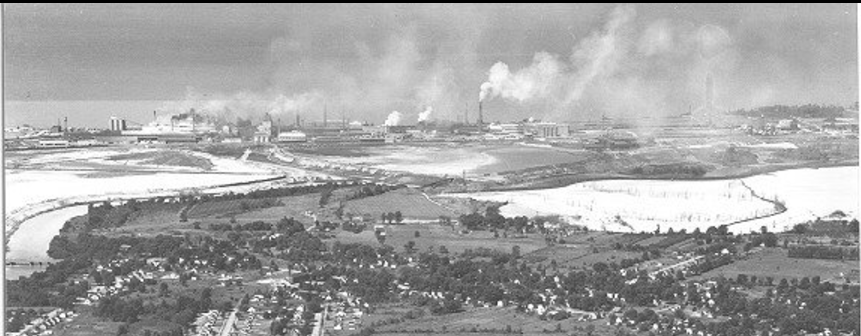
https://case.edu/ech/articles/d/diamond-shamrock-corp
https://cumulis.epa.gov/supercpad/cursites/csitinfo.cfm?id=0504696
On a personal note, I grew up in Fairport Harbor, Ohio, a small village of 3-4,000 people. The Diamond Alkali chemical plant once employed 5,000 people. It shut down in 1976. My dad was a pipefitter and union leader. My uncle Joe was also an employee and a union and political leader. The negative community impact was very large. The negative impacts described by Amy Goldstein in Janesville were exactly the same in Painesville 40 years earlier.
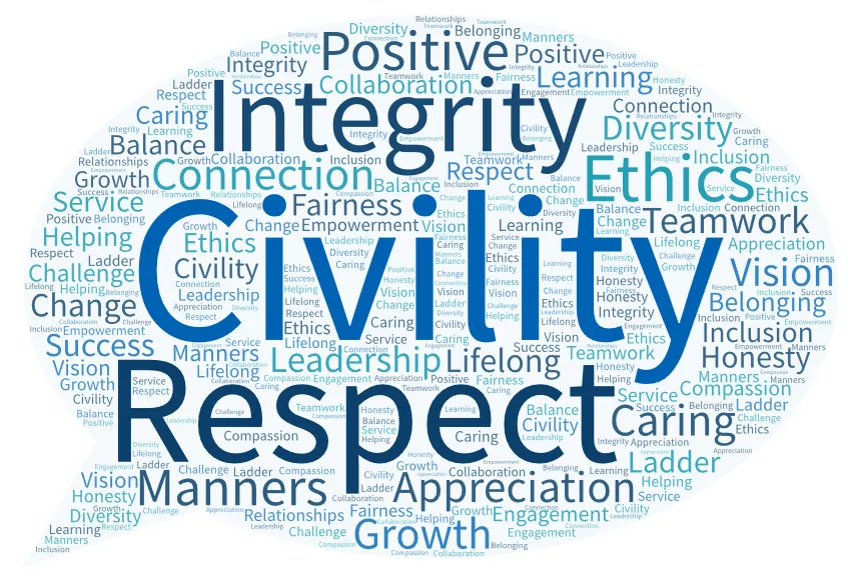
https://toddpopham.com/civility-a-matter-of-respect/
I pledge to participate in my community.
I obey its laws.
I am civil with my fellow citizens.
I participate in our political, economic, social, and spiritual communities.
I respect the innate human dignity and rights of my neighbors.
I accept that we each think, feel, and act differently.
I work to improve my participation, compliance and civility skills and encourage others.
In Carmel, we seek to promote an environment of civility defined as the disposition to respect every human being we interact with as our moral equal and worthy of respect. Therefore, we encourage any candidate seeking public office and asking the citizens of Carmel for their vote, to agree to the following tenets of civility.
The Carmel Civility Project: Candidates Pledge
As a candidate for public office in Carmel, I hereby commit to the following five essential tenets of campaign conduct:
1. Civility and Respect: I will maintain a respectful demeanor towards everyone, regardless of our differences, and foster an environment of open-minded dialogue.
2. Integrity and Truthfulness: I promise to uphold truth and transparency in my campaign rhetoric and actions, swiftly correcting any mistakes should they arise.
3. Positive Focus: My campaign will highlight my vision and policies, eschewing negative attacks on my opponents’ character or record.
4. Informed Discourse: I pledge to inform citizens accurately about my platform and engage in constructive discussions to promote understanding and educated voting.
5. Democratic Process and Accountability: I vow to respect the democratic process, accept its outcomes, and encourage my supporters to engage in campaigns with integrity and decency in support of these principles.
By taking this pledge, I affirm a dedication to dignified campaigning not just out of respect for each resident of Carmel, but also in admiration for the institutions we cherish in our community.
 Good News