Finland is a tiny country. 5.6 million people in a world of 8.3 billion people. One of every 1,500 people lives in Finland. About the size of metro Philadelphia or metro Atlanta. Smaller than 72 cities. Less than Miami, Singapore, Dallas or Toronto. Just 1/5th the size of Jakarta, Dhaka, Tokyo, Delhi or Shanghai!!!!
An unusual language, distantly related to Hungarian and more closely connected with Estonian.
Yet, it clearly “punches above its weight”. 5 Nobel prize winners. Retaining its independence in 1940 against a vastly superior Russian army. 480 Olympic medals. Perennial global ice hockey competitor. Paavo Nurmi, the flying Finn. 2006 Eurovision song winner. Northern lights. Reindeer.
Finland experienced massive outmigration through time. 500,000 to the US and Canada. 650,000 Finnish descendants in the US today. 140,000 to Russia. 500,000 to Sweden.
Balmy Helsinki’s average daily high is 30 in December/January/February and 69 in June/July/August.
Today we incredibly look to Finland as the “happiest” country in the world with the “best” school system! This does not compute!
The SISU attitude is considered a national treasure. Extraordinary perseverance, an action mindset, latent power, resilience, community, spiritual force, the good life. In essence, an indomitable collective will to survive and thrive despite many threats.
Rose Colored Glasses; Man Bites Dog; If it Bleeds it Leads.
Politicians, journalists and influencers of all stripes emphasize the bad, the emotional and the unusual. This burdens us and our society. Allegedly, “it’s bad now, and it was MUCH better in the past”. This eternal NOSTALGIA is a big problem for our society today, leading many people to turn to populists, idealists, authoritarians and charlatans for salvation.
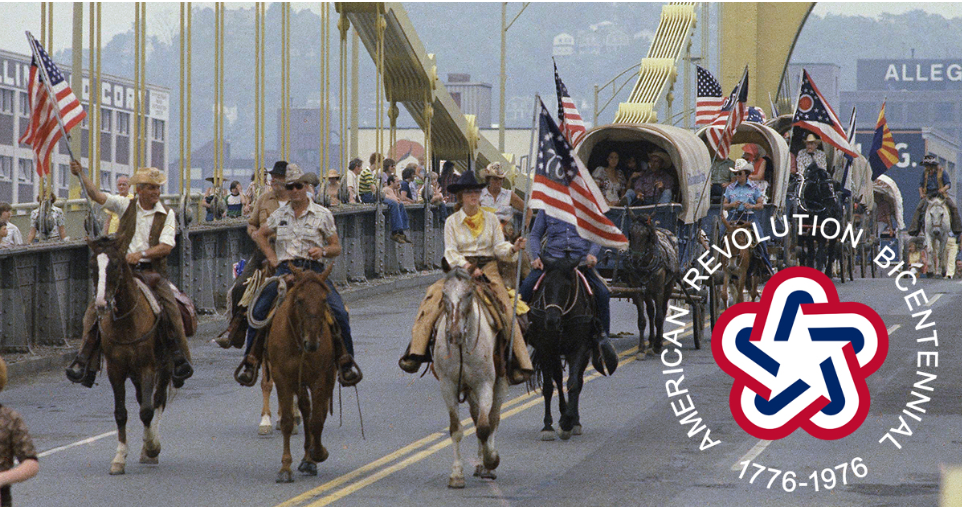
I will outline how much better the United States of America is TODAY than it was in the mid-1970’s. I graduated from high school with the class of 1974. I watched the emotionally mixed American bicentennial celebrations in 1976. I remember Jimmy Carter’s 1979 “malaise” speech in which he said that we, the people, needed to face our challenges directly, especially at a moral level. He was briefly cheered but then criticized for being too negative and pessimistic; an uninspiring leader!
Modern life in the USA is immeasurably better than it was in the 1970’s. It is certainly not perfect. The country has not achieved all that it could have or should have in the last half century. It still faces large global and moral challenges and wonders where it can possibly find the leadership, consensus and engagement to resolve them.
The sheer magnitude of changes in daily life across 50 years is difficult to describe but I hope that my outline will collectively communicate the great scale of improvements we have experienced and the resulting hope and expectation that the next 50 years will deliver the same kinds of positive growth. When we consider the last 50, 100 or 150 years of American life, we should be very optimistic.
Global Threats and Opportunities
The Cold War ended in 1989, relieving the pressure of 4 decades of imminent nuclear destruction. This was a miracle. No war. No revolution. No territories seized. No leaders executed. A quiet end to the threat. The US managed the threat of nuclear terrorism. West Germany embraced East Germany. The European Union welcomed new members. The global economy thrived.
The US established relations with China in 1979, beginning the country’s path to economic prosperity, trade and global influence. The growing trade between China and the world has acted to reduce the threat of conflicts while reducing the cost of goods for all.
The US welcomed the growth of Japan plus the “four tigers” of Hong Kong, Singapore, South Korea, Taiwan, as Asian nations embraced the “Western consensus” of mixed market capitalism, global trade and liberal democracy.
European nations also left behind histories of authoritarian governments or too much socialism to embrace the “Western consensus” and thicken ties through the European Union. Francis Fukuyama prematurely declared “the end of history” but the attractiveness of these successful choices was clear.
The US joined international efforts to reduce tariffs and increase trade leading to a doubling of imports and exports as a share of GDP.
The US adopted a less internationalist position after 9/11/2001, declaring a war on terror, defining the axis of evil, revoking treaty commitments, justifying preemptive war and invading Iraq without UN support. Even with this change, the US largely avoided major military conflicts and losses.
Total immigration to the US grew during this period from 2.3% to 2.9% of the population per decade. Many immigrant groups successfully joined American society.
The US welcomed foreign students to its universities. International tourists increased from 15 to 75 million per year.
The US attempted to resolve the Middle East conflicts with some success, avoiding large scale wars.
The US participated in talks to define and address the threat and impact of global warming. It has taken steps to reduce US carbon emissions.
Politics
Presidents Ford and Carter helped to rebuild confidence in the government after Vietnam and Watergate.
Ronald Reagan established “Conservatism” as a broad political philosophy for the Republican party.
Bill Clinton repositioned Democrats more to the center on economics with his “third way” approach.
Both parties increasingly used wedge issues and either/or choices to polarize parties and choices; although the share of independent voters has grown from 30 to 45%, with the rest evenly split between the two dominant parties.
Perot, Buchannon, Palin and Trump provided social and economic populists with a choice.
The country increasingly accepted racial minorities, women, gays, religious minorities, and immigrants; but the conflict between traditional and modern views was politicized as some could not tolerate the changes and others sought to embed the changes as universal human and legal rights accompanied by social pressures to comply with the dominant “tolerant” view.
Federal government employment was reduced from 5 to 4 million in 50 years, while the population grew by 50%. After Reagan, “government” solutions were inherently suspect. Even Bill Clinton declared “the era of big government” is over.
Total federal, state and local government activities grew a little faster than the economy, with the ratio of tax receipts to GDP inching up from 29% to 32%. The ongoing pressure to “cut spending, taxes and regulations” could not defeat the pressures to address social, political and economic issues and interests.
The top marginal income tax rate was reduced from 70% in 1982 and has remained just under 40% since 1987. Neither party has proposed widespread tax increases.
The Affordable Care Act was enacted in 2010, helping to bring the share of Americans without health insurance down from 20% in 1975 to 8% today.
The US safety net/welfare system has remained intact during this period driving the supplemental poverty rate down from 20% to 15%, while the official poverty rate has declined by just 1%. The share of the elderly (65+) in poverty has fallen from 16% to 8%.
The Economy
Real dollar GDP is 4 times larger at $24 trillion.
US real per capita GDP has remained the highest of all major countries for a century. Continued leadership reflects a dynamically successful economy.
Real per capita GDP has increased by 250% to $70,000.
US fiscal and monetary policy has repeatedly been effective in taming the business cycle and recovering from shocks like the housing crisis and the pandemic.
Industrial production, including energy, is up by 250%.
The number of business establishments has doubled to 8.6M, providing ownership and employment opportunities in a more specialized, globally traded world.
The number of franchise businesses has grown from 375,000 to 800,000+, employing more than 10 million people.
The rate of new business formation and success increased throughout the period, with a new boost after the pandemic.
Businesses responded to the 1970’s “Japanese invasion” and became strategically more focused, measured more effectively, focused on cost reduction, invested in R&D, and applied information technology and process improvement tools. Foreign and domestic competition led businesses to be more cost effective, improve product quality and offer products better tailored to diverse customer wants and needs.
Firms experimented with factory robots by 1975. They now use 380,000 robots, adding 10% more annually.
Auto production in the US has increased from 8 to 10 million units per year.
Farms produce twice as much using 20% less land and 40% less labor.
Businesses adapted to the world of greater international trade by growing or shrinking facilities, markets, products and product lines. They adapted to the new power of consumers and retailers and reduced power of manufacturers. They divested units and rejected the conglomerate model. They rejected vertical integration, learning to outsource all functions where they did not have a competitive advantage.
Firms embraced more effective banking, equity and bond markets to fund their activities. They tapped global sources and private equity. They learned by use financial leverage to increase net earnings and acquire other less dynamic competitors.
Firms changed organizational structures to have fewer layers, less positional power, more staff experts and the ability to use cross-functional (matrix) approaches to core operations, projects and joint ventures.
Education
Preschool/Kindergarten enrollment up from 5 to 9 million. Nearly all part-time in 1975 and mostly full-time in 2025.
High school graduation rate is up from 75% to 85%.
Intelligence test scores have increased by more than 10 points.
Share of young adults who have earned college degrees has doubled from 20% to 40%.
Share of adults with college degrees has more than tripled from 12% to 38%.
Share of young women with a college degree is up from 17% to 45%; shares for men up from 27% to 37%.
Share of degrees in STEM disciplines has grown from 11% to 19%.
Number of college students studying abroad is up by 5 times.
Law school first-year enrollment remains at 40,000, while the population has grown by 50%.
US holds 18 of top 30 global university spots.
The number of annually earned doctorates has doubled.
US accounts for 50% of Nobel prize winners, up from 40% in 1975.
Transportation
22% of new cars are electric. Self-driving cars are widely deployed.
Fuel milage has doubled from 13 to 27 miles per gallon.
New car defects have dropped by two-thirds.
Air travel miles are up by 5 times.
FedEx 2-pound overnight service was introduced in 1975 for $75. Service is widespread today at $55.
Same day and next day delivery services are available today, making Amazon.com, grocery and restaurant deliveries common. Catalog mail order lead times were 6-8 weeks in 1975.
Energy
The US faced energy crises in 1973 and 1979 that disrupted businesses, emptied filling stations and led to recessions.
The US imported 35% of its petroleum products in the 1970’s. It is a net exporter today.
Energy intensity, the ratio of energy used to GDP, has fallen by 60% since the 1970’s.
LED bulbs last 10 times longer. Lithium-ion batteries last 4 times longer.
Wind power is 10% of electricity generation. Solar is 10% of electricity generation. Solar is the lowest cost source today, accounting for two-thirds of new generating capacity added.
Coal production is the same today as in 1975, down 50% from its 2007 peak. It is declining rapidly.
Environment
Toxic air pollution measures are lower by 65-90%.
The world resolved the threat to the ozone layer.
Percentage of US homes in communities with treated wastewater has increased from 50% to 80%.
State parks acreage has doubled. Federal parks acreage has tripled. Land trust additions are equal to the state parks area.
Total US forest land area has increased from 750 to 800 million acres, while the US population has grown by 50%.
Nesting pairs of American bald eagles have grown 100-fold, from 700 to 70,000.
US (1976) and global (2014) birth rates are half of historical levels, reducing environmental demands.
US is on track to reach 50% reduction in greenhouse gas emissions by 2030.
Health
Life expectancy has increased from 73 to 78 years.
Infant mortality rate has dropped by two-thirds.
Smallpox has been eradicated. Polio remains eliminated. Other diseases close to zero.
Smoking rate is two-thirds lower, down from 37% to 12% of adults.
Death rates down: Strokes 67%. Cancer 25%. Flu/pneumonia 67%. Heart disease 50%+. Liver disease 25%.
US governments, medical industry, businesses and people responded to the Covid-19 pandemic resulting in a death rate that was half of the 1917 Spanish flu. Novel vaccine development and flexible delivery resources limited the death toll.
Abortion rates have fallen by 50% since 1980.
Medical research continues to develop new science and solutions. Cloning and human genome mapping.
In vitro fertilization births have grown from 0 to 100,000 per year.
Modern anti-depression drugs (SSRI-Prozac) are much safer and more effective than their predecessors.
Kidney dialysis extends lives for 550,000 today versus 25,000 in 1975.
Americans have 40 million MRI scans done on 13,000 machines, up from zero.
Laser eyer surgery has grown from an experimental procedure to 800,000 annually.
50,000 organs are transplanted each year, up from just a few experiments.
Safety
Property crime rate is down by more than 50%. Violent crime rate is one-third lower.
Both the workplace fatality and injury rates are down by two-thirds.
Traffic fatalities per driven mile are three-fourths lower.
Fire incidents have been cut in half while the population grew by half.
Emergency medical services have grown from 2% to 90% of counties; employing 300,000 people, 50,000 ambulances and 1,300 helicopters.
Consumer
Firms have offered consumers much wider options for products in all industries. A typical Walmart Supercenter has 125,000 different SKU’s.
We enjoy year-round availability of most fruits and vegetables today rather than shopping by season.
Clothing and durable goods prices have been cut by half.
The average automobile is 13 years old versus 6, reflecting massive quality improvements.
Car buyers can choose from 15 major manufacturers instead of just 4.
Appliances in more homes: Washing machines (70-85%), dryers (45-82%), dish washers (28-54%), microwave ovens (4-95%). Refrigerators are 25% larger, half price and 75% more energy efficient.
Median new home square footage has increased by half, from 1,500 to 2,200 square feet.
Mortgage loan rates have declined from 8-14% to 4-7%. Real rates are just 2% today.
Total debt service payments (home, car, credit card, student loan) as a percentage of disposable income have declined from 11% to 10%.
Air-conditioned homes have grown from a hot 55% to a cool 95%.
Away from home food spending has more than doubled from 28% to 59% of total food spending.
Household consumption is up from 87% to 92% of disposable income. Savings is down from 13% to 8%.
Leisure
Many television program options. Top 4 network share down from 90% to 30%. Recording and streaming options exist today.
Cable or satellite TV access has grown from 14% to 100%.
The number of feature films released each year has bloomed from 100 to 700.
Music singles are effectively free today. They cost $7.50 each in current dollars in 1975. The transistor radio has been replaced with portable, wearable devices served by playlists, suggestions and feeds.
Real consumer electronics prices have declined by 80-95%. A 21-25 inch color console was $2-3,000 in 1975 in current dollars. A 50-inch tv is available for $500 today.
A 1982 IBM PC cost $10,000 in current dollars. For $2-3,000 today you get 1,000 times the processor speed, 10,000 times the memory and 100,000 times the storage space.
Video rentals boomed in the 1980’s and 1990’s growing into a digital $100 billion industry.
The $5 billion pinball machine sector evolved into the $50 billion handheld and online gaming industry.
Virtual reality equipment is increasingly popular.
Passports are held by half of US citizens, up from 5% in 1975.
Following deregulation, the real price of air travel per mile has glided down by 40-60%.
Hotel room capacity has doubled from 2.4 to 5.3 million.
Pet food consumption has tripled.
American wine production has increased from 250 to 700 million gallons, along with quality.
American brewery count has increased from 150 to 7,000, along with quality.
Wealth
Mutual funds, index funds and 401K’s offer investing to everyone. Percentage of stockholders has grown from 12% to 60%.
The number of retirement plan participants has grown by 250%.
Real dollar retirement plan assets have grown thirty-fold, from $1.6 to $48 trillion.
Homeownership rate increased from 64% to peak of 69% before falling back to 66%.
Family wealth more than doubled for those in the 1st-25th, 26th-50th, and 51st-90th percentiles between 1989 and 2022. Summary data for 1975 to 1989 is not readily available. Real home prices increased by 20% and the real dollar S&P 500 increased by 75% during this period, overall.
Labor
Compounded labor productivity has increased by 150%, more than 2% per year!
Manufacturing, administrative and farm jobs were reduced by 20% of the total during these 50 years. They were replaced by STEM/analysis, management and health care jobs.
Prime age labor force participation increased from 74% to 84%.
Typical unemployment rate declined from 6.5% to 5%.
Share of self-employed workers increased from 9% to 11%.
According to the Gallup Organization, the share of “engaged” workers has increased greatly in the last 20 years.
Real median family income increased by 40% from 1984 to 2024.
There are dozens of expert calculations of real incomes, adjusted for taxes, government benefits, charity, fringe benefits, hours, etc. Most show that 1975-1990 was flat and that 2000-20 showed modest increases.
Society
The US continues to lead the world in charitable giving as a percentage of income, double the nearest country, Canada.
US migration and population growth in the “Sunbelt” impacted local and national economies, politics and society. Texas (13-31M), California (21-39M) and Florida (8-23M) showed the greatest growth and national influence.
Share of adults cohabiting has increased from 1% to 13%.
Teen pregnancy rate has been cut in half.
The share of married couples has declined from 83% to 67% of households.
Parents now invest 20 hours per week caring for children, up from 12 hours in 1975.
Same sex marriage was legalized by the US Supreme Court in 2015.
Female labor force participation rate has increased from 46% to 57%.
The female to male wage discount has been reduced from 35% to 10%.
The number of congresswomen increased from 19 to 155 (7X).
Women today have access to credit and credit cards in their own names.
Black unemployment declined from 15% to 7%, with the excess above whites falling from 7% to 2%.
Black poverty rate has declined from 30% to 18%.
The Black to White income ratio has improved from 60% to 67%.
The share of interracial marriages has increased from less than 1% to 10%.
Percentage of Americans moving per year has declined from 20% to 12%. Interstate moves have declined from 3% to 2%.
Robert Putnam’s “Bowling Alone” shows a 40% decrease in social participation during this time.
Awareness, tolerance and support for “differences” is higher by an order of magnitude: races, nationality, immigration status, physical or mental disability, gender identity, mental health, autism, obesity, and personality.
Hispanic Americans have increased from 6% to 20% of the population.
The percentage of non-Christians, including religiously unaffiliated, has increased from 12% to 35% of the population.
The share of 40-year-olds never married has increased from 6% to 25%.
Computers
Personal computer software and phone apps provide tools for email, calendars, word processing and spreadsheets to everyone today.
Personal computers are in 95% of homes versus 0% in 1975.
More than 90% of jobs today require computer skills.
Home internet access is 92%.
Digital cameras, music, videos, sound and storage make everything portable.
Voice controlled devices and instant language translation.
Today’s 10-day weather forecasts are as reliable as next day forecasts in 1975.
Google search and artificial intelligence provide access to all of man’s writings and promise thought, itself.
Communications
Internet structure and web browser provide access to everything and everyone.
Smartphones integrate computing and communications. 90% ownership rate. Provides photo, filming and navigating capabilities.
Mobile/cellular phone networks and wifi routers offer universal access to the internet and phones.
Social media networks combine the input of many to build and use networks.
Internet allows for open-source software and information creation.
Video conferencing and internet enabled phone/video calls are common.
Voice mail, answering machines, caller ID and 911 were invented.
Digital books have grown to 25% market share.
Annual first class mail per person increased from 240 to a peak of 360 in 2000 before falling to 130 today.
Daily newspaper subscriptions have plunged from 60 to 20 million.
Share of homes with landlines has fallen from 90% to 30%.
A 3-minute long distance call in 1975 cost $8.70 in current dollars. An international Skye call today is 77 cents.
Summary
The world is a better, richer and safer place. Politics has evolved. The economy is 4 times larger. Businesses and education are more effective. Energy is cheaper. Transportation is better. The environment is much better. Health is much better. Safety is much better. The consumer is king. Leisure options and quality can’t even be compared with 1975. Wealth is up. Incomes are up. Society is digesting many large changes. The computer and communications revolutions have delivered miracles and promise more.
We face social, political and environmental challenges. We have more resources than ever before. Based on American history we should be very confident about solving our challenges.
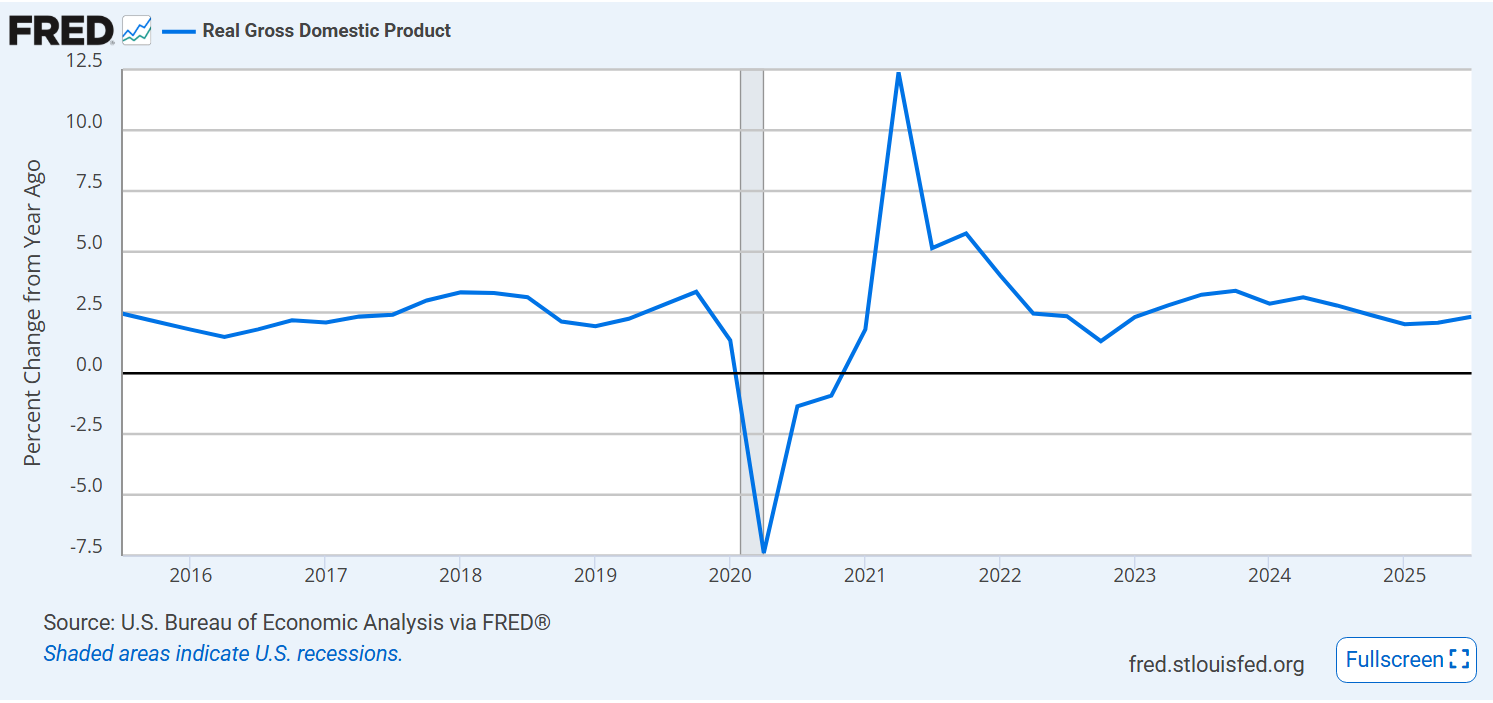
Overall, at the same core 2.5% growth rate seen for the last decade.
Labor productivity growth down a bit from the pandemic recovery bump.
Median wage growth remains at 2%, down a bit from pre-pandemic 2.5%.
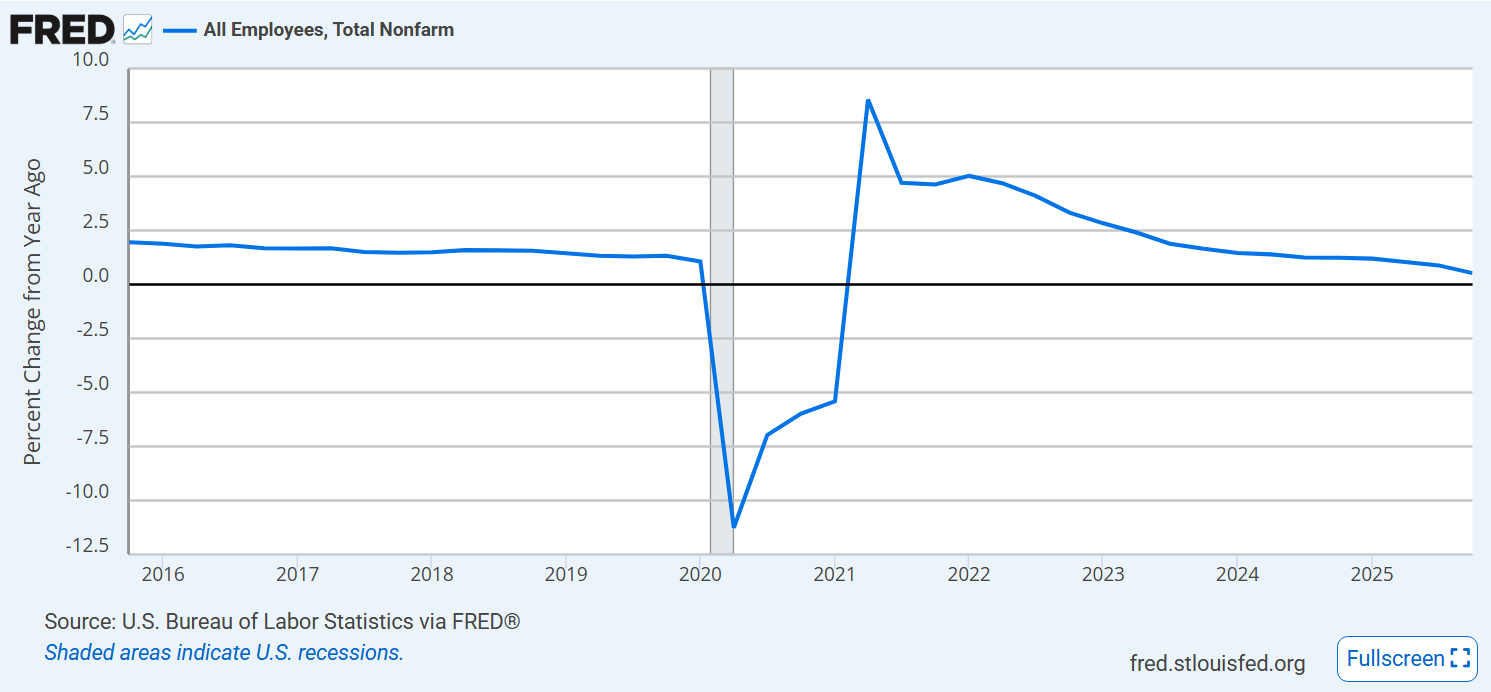
Job growth is very weak. Typically, this indicates a coming recession, but the reduction of the immigration labor supply makes historical comparisons difficult.
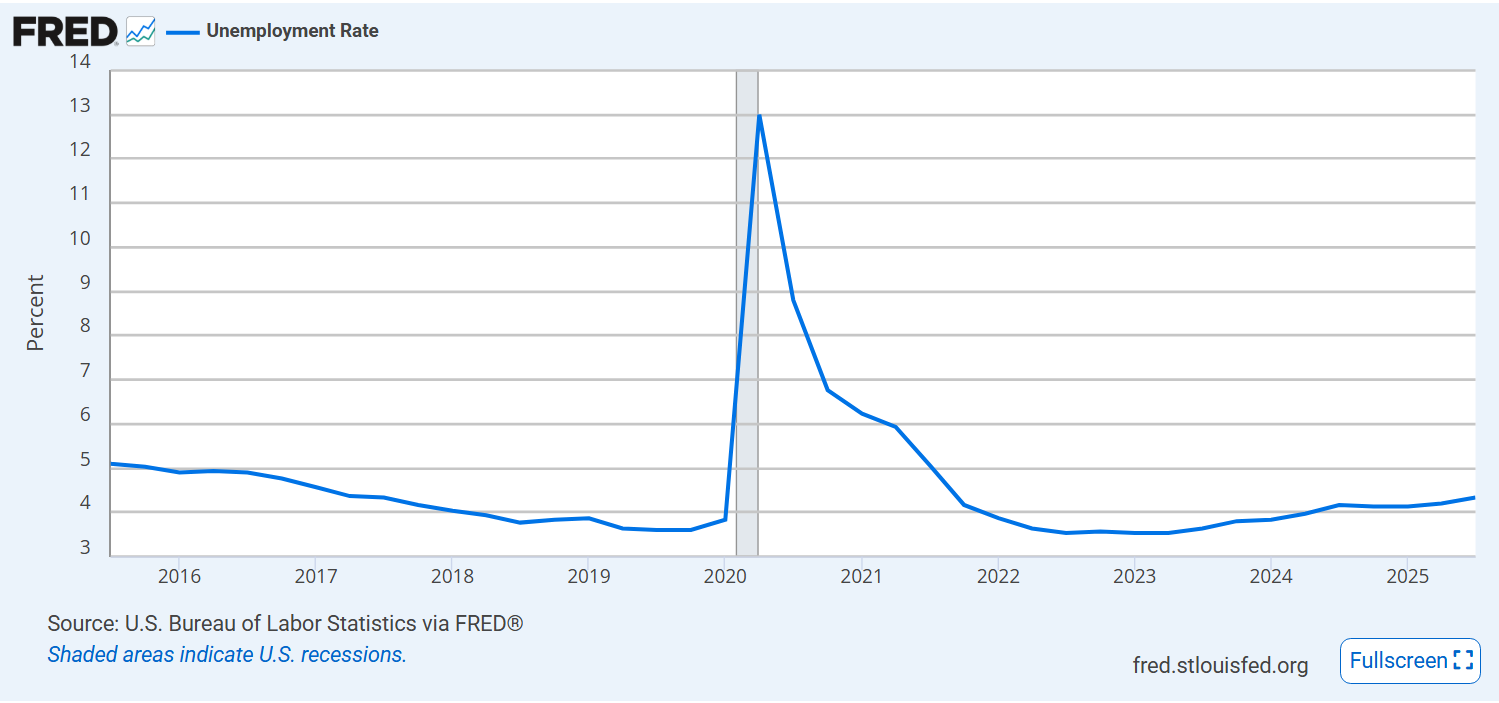
Unemployment rate remains at historically low 4.5% but it has been increasing for more than 2 years.
The “underemployed” rate shows the same relative level and trend.
Labor force participation hit record levels after the pandemic and has remained there.
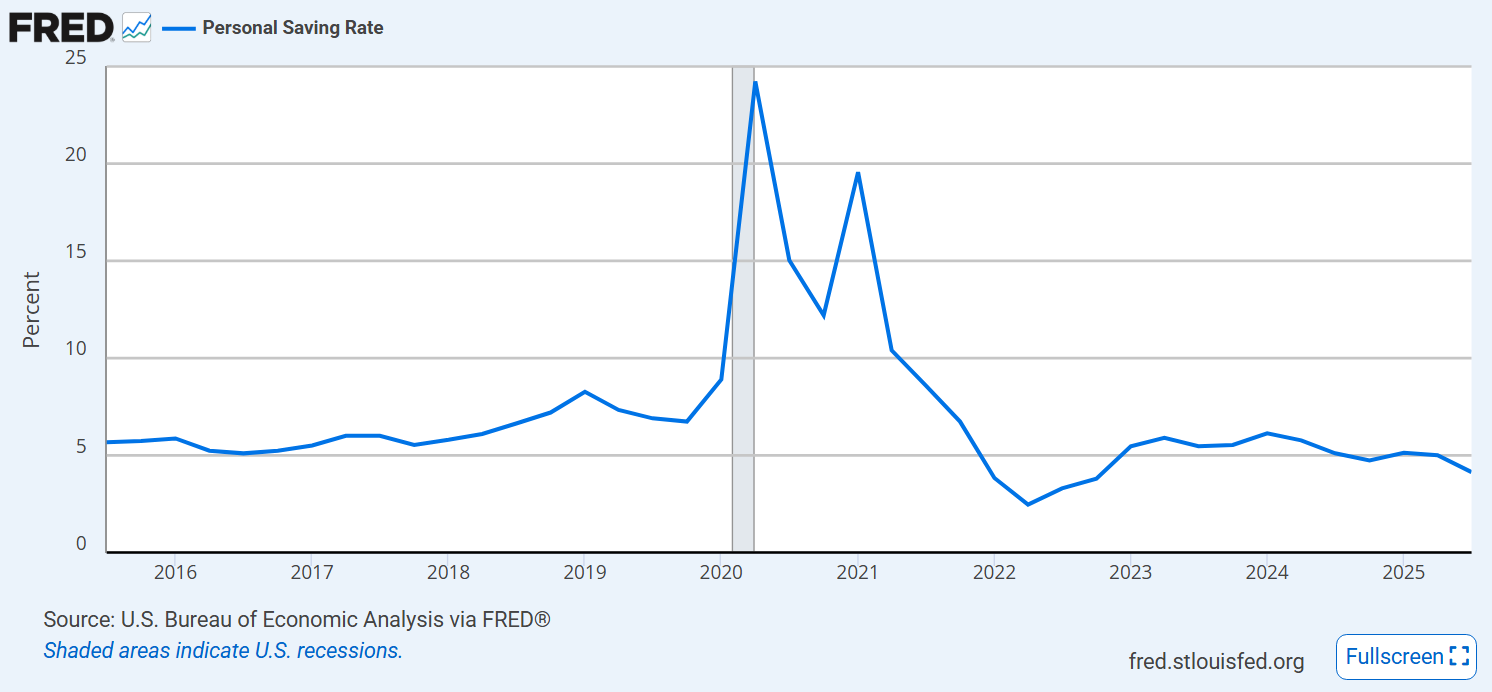
The personal savings rate is low, a bit below the pandemic and trending slightly downward.
Mortgage rates remain elevated, around 6.5%.
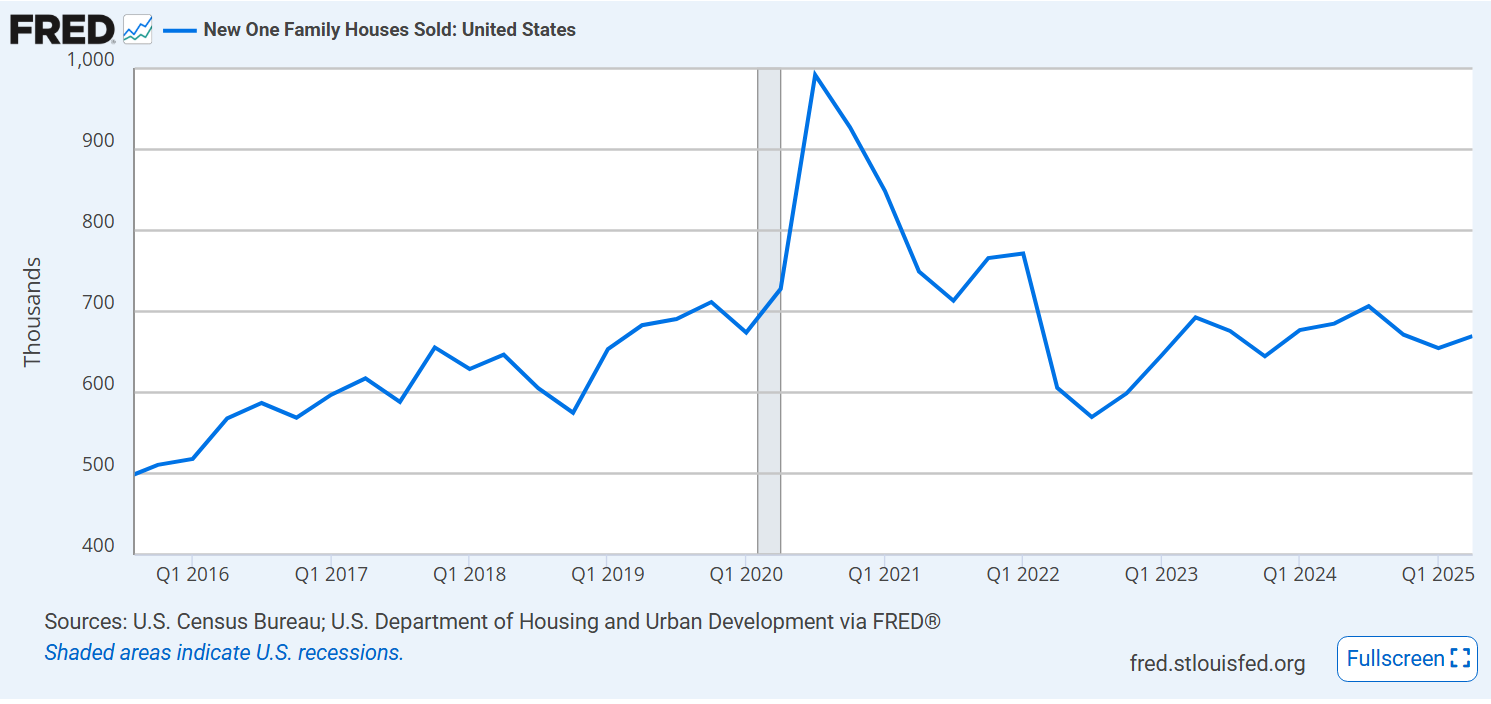
New home sales are pretty stable, at pre-pandemic level.
Housing prices jumped from $320,000 to $440,000 after the pandemic. They have fallen back by 5% in 4 years.
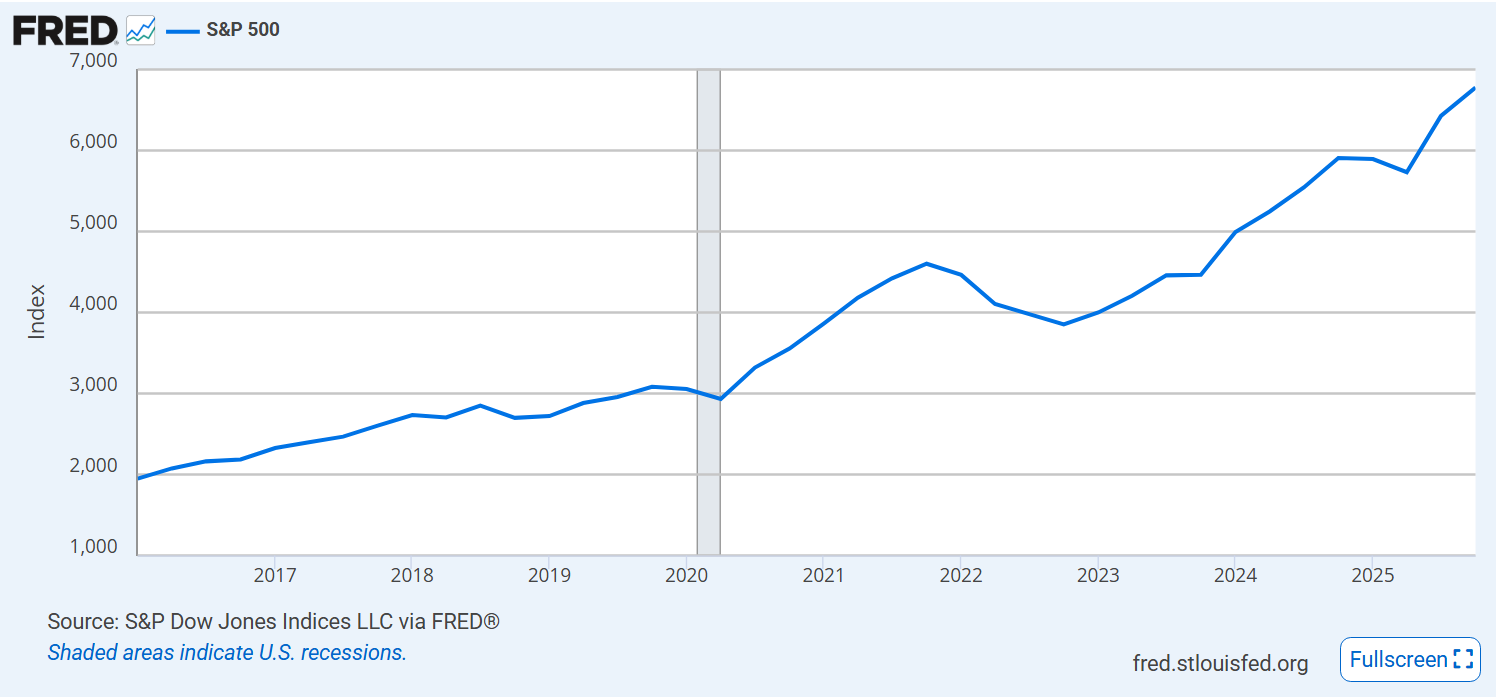
The US stock market continues to climb.
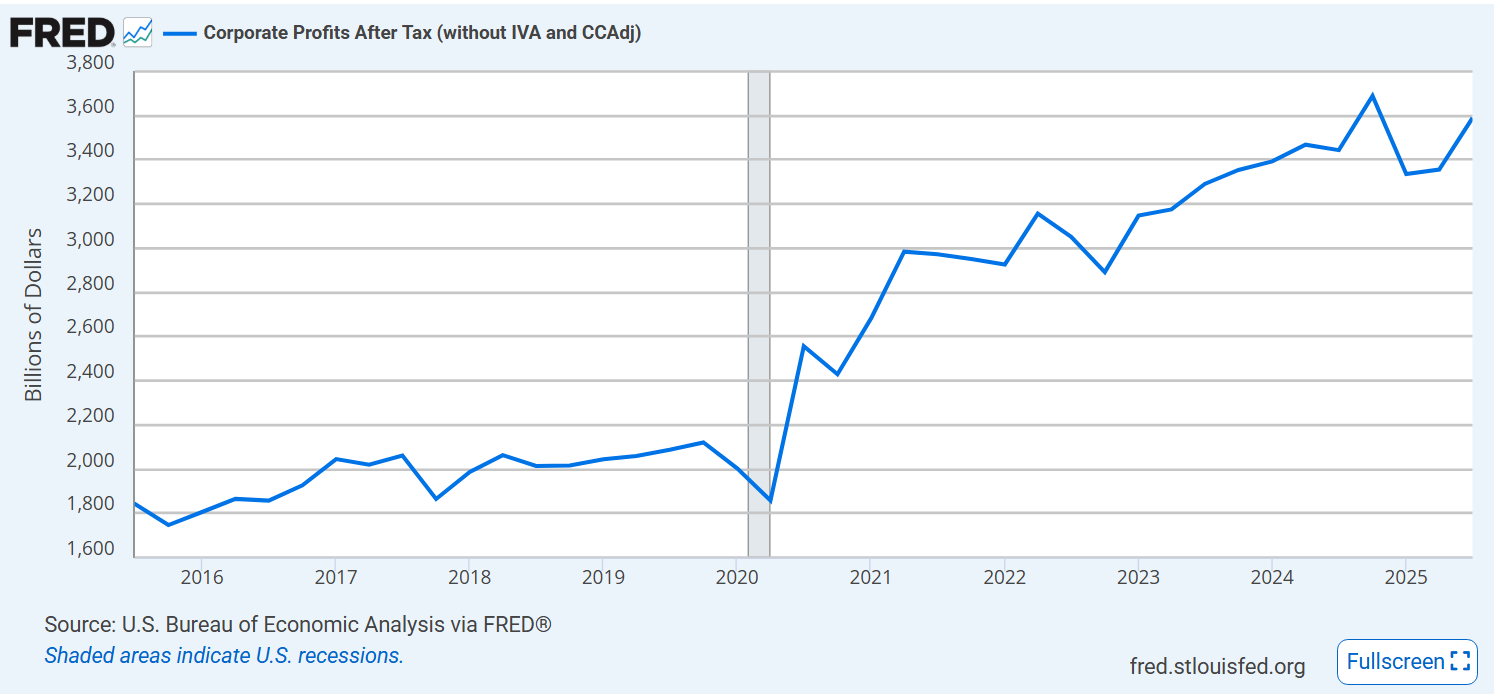
Corporate profits have roughly doubled since before the pandemic.
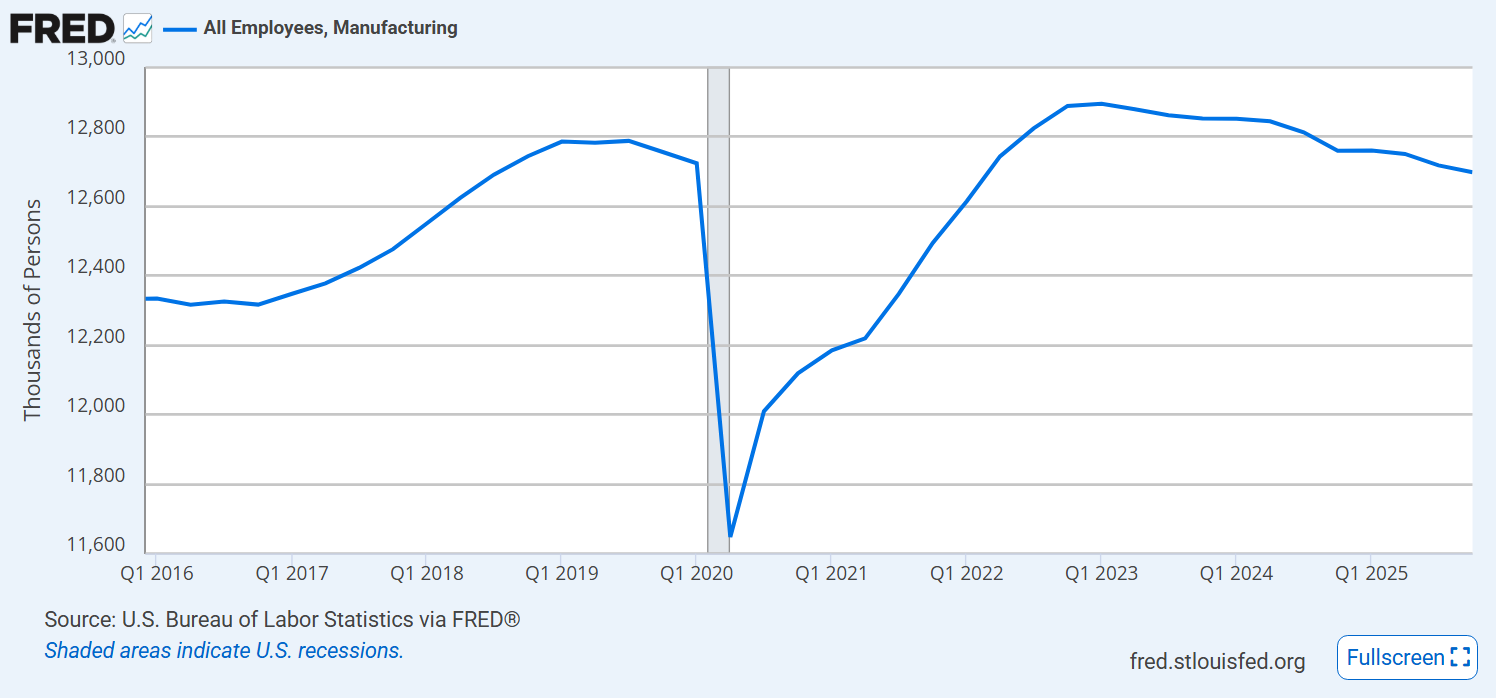
Manufacturing employment continues to decline.
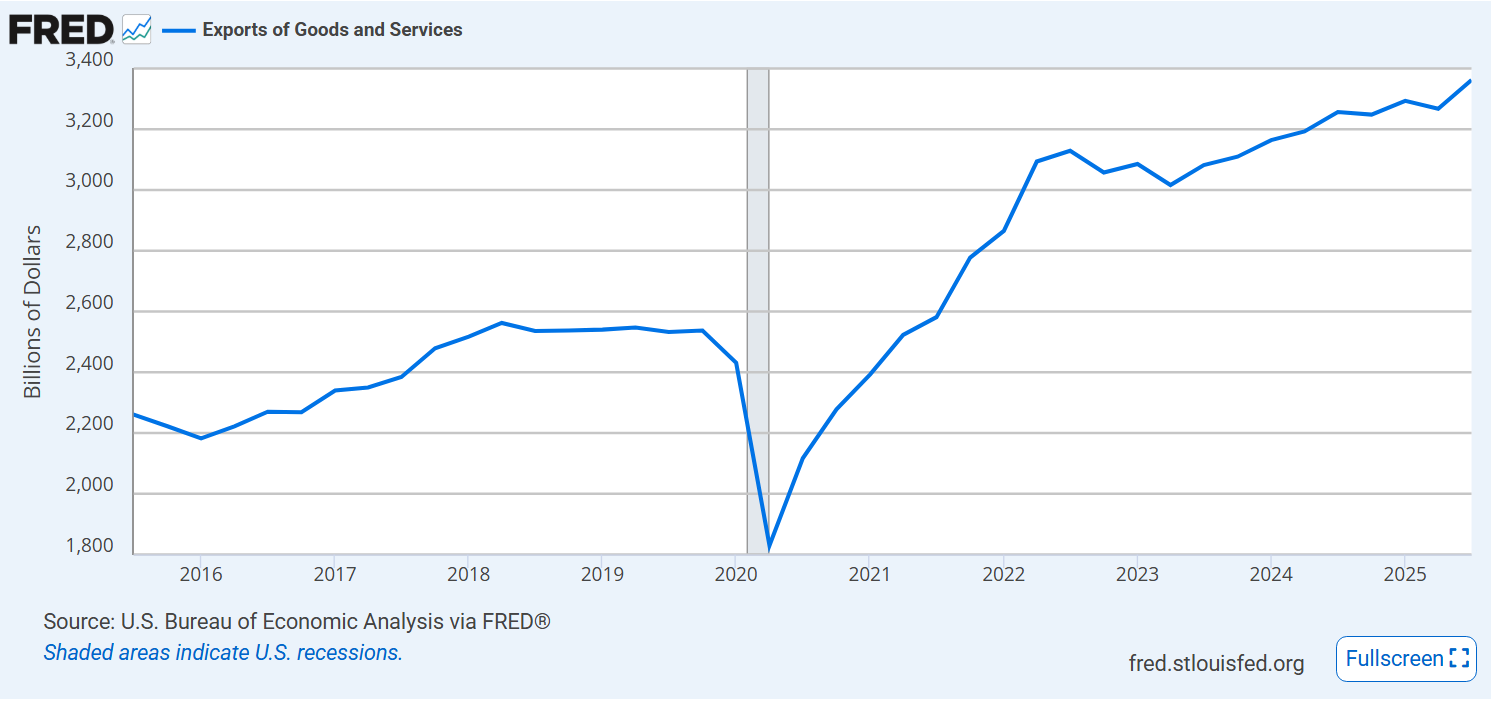
Exports are up 50% and still growing slowly.
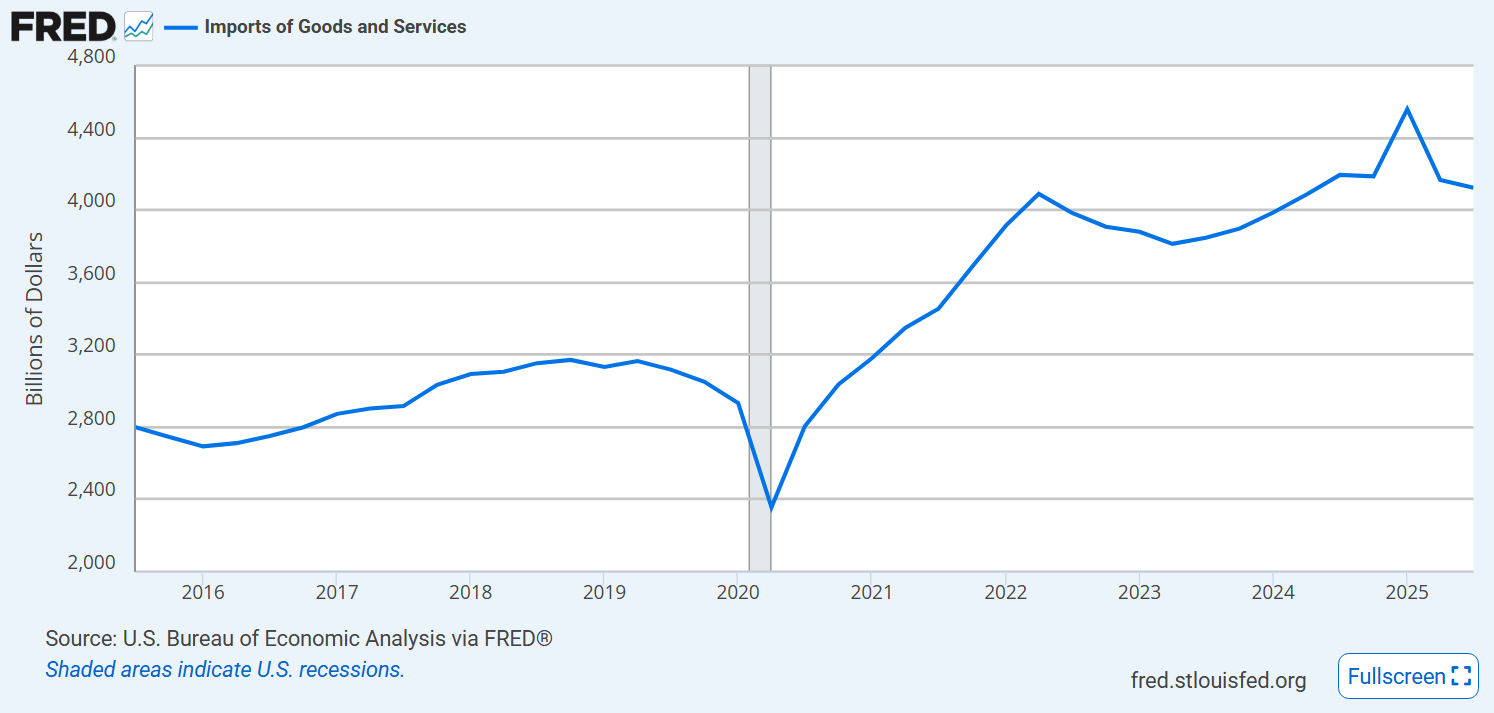
Imports also increased by 50%.
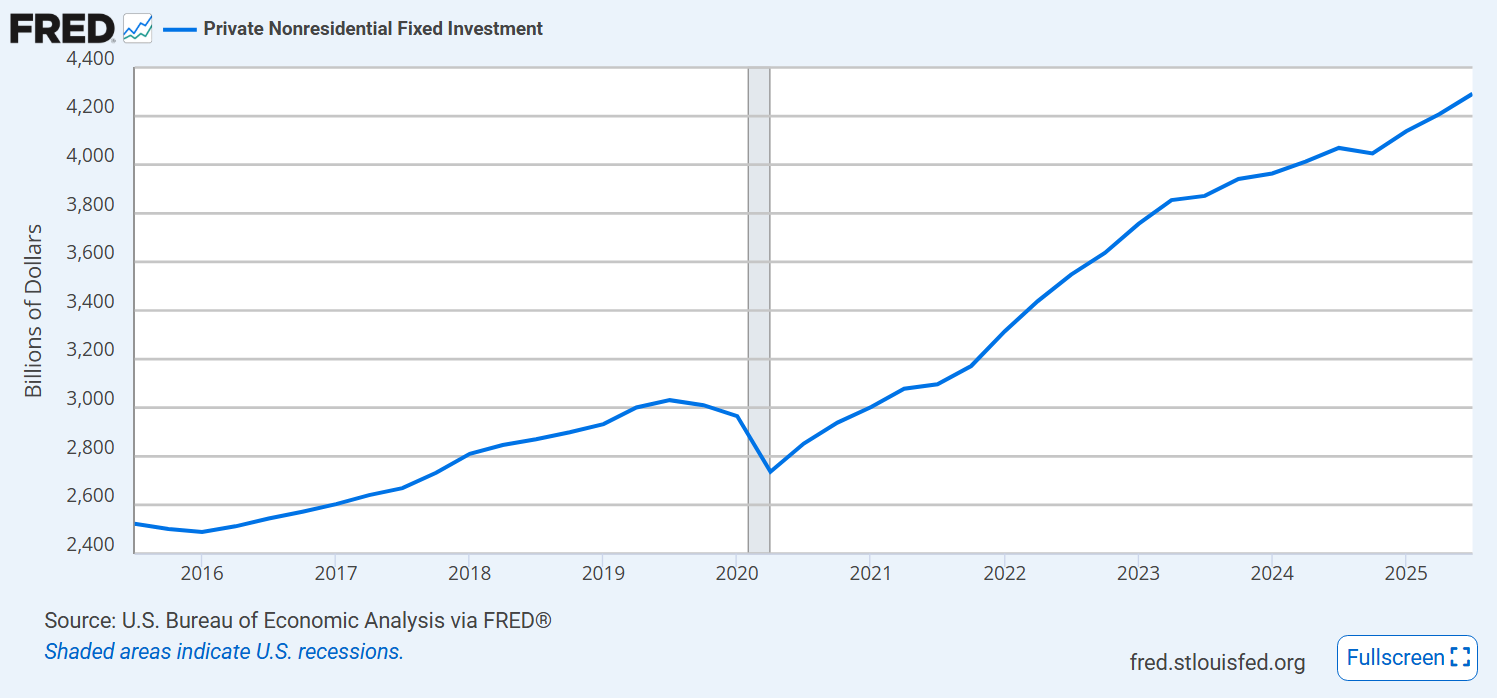
Businesses continue to invest.
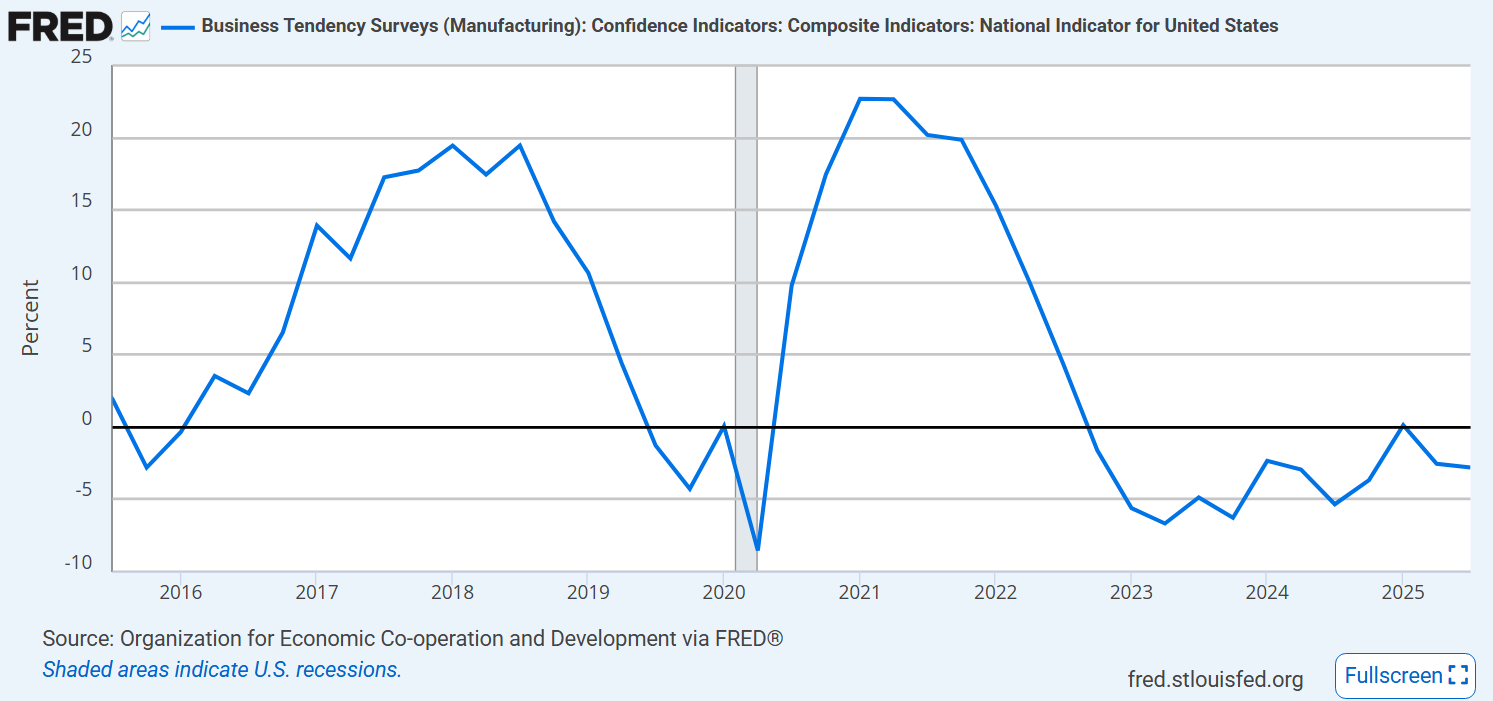
Business confidence remains weak.
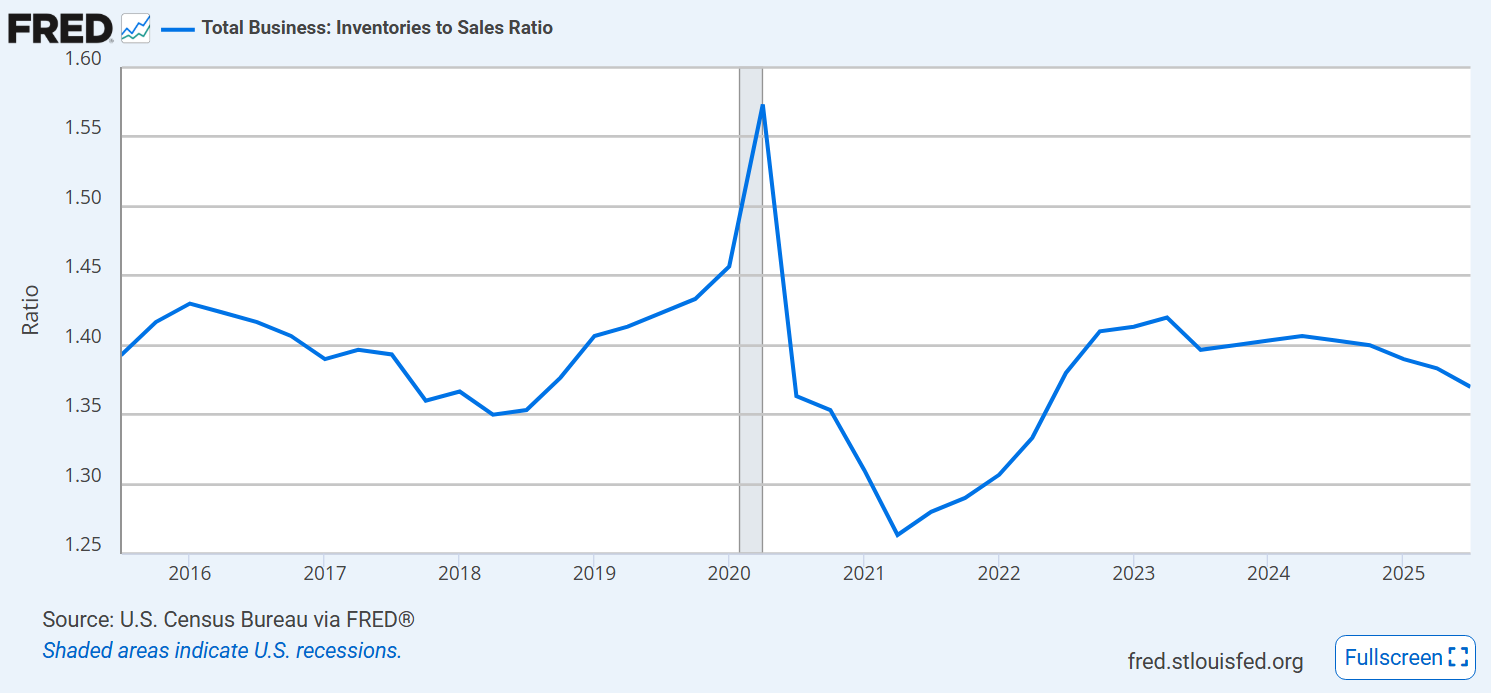
Businesses have maintained their target inventory to sales ratios.
Consumer confidence is down and weak.
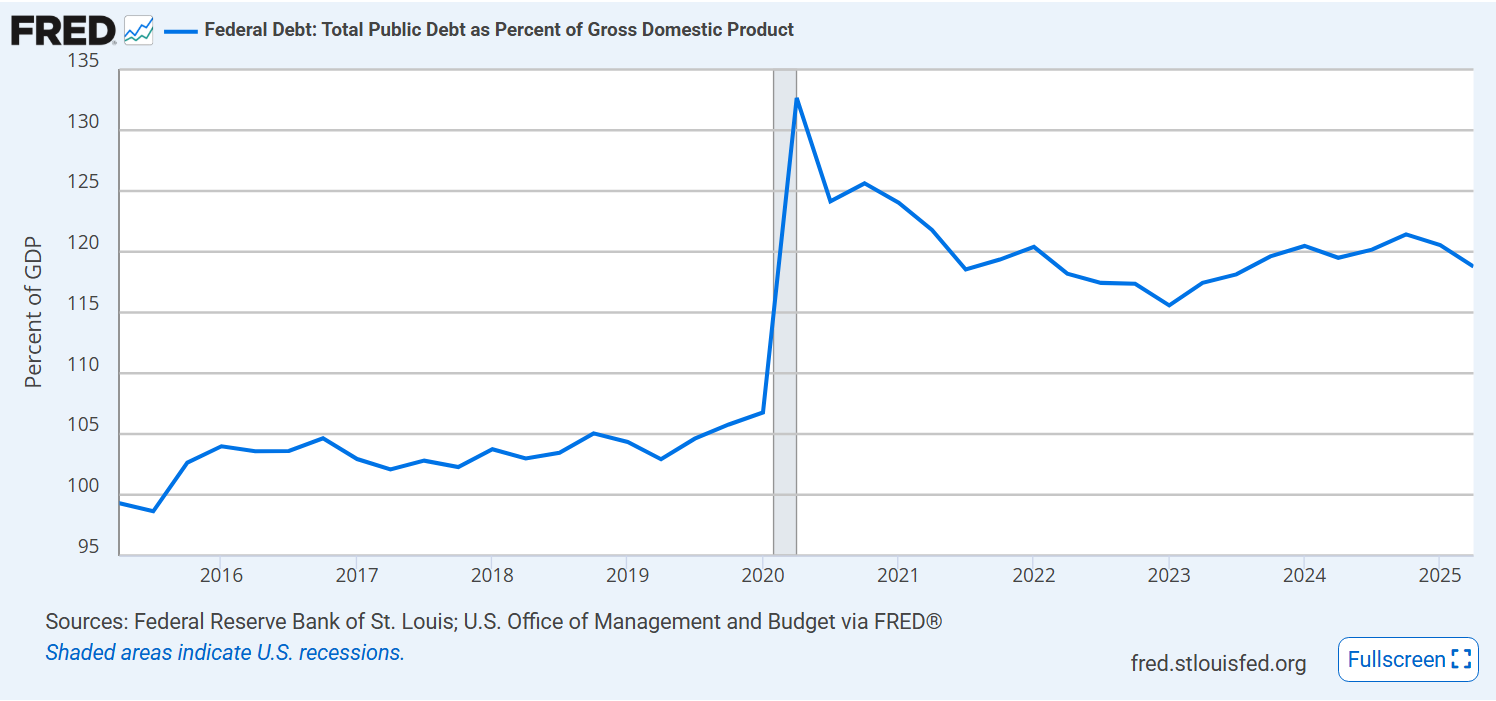
Federal debt % of GDP remains at 120%, up from 105%.
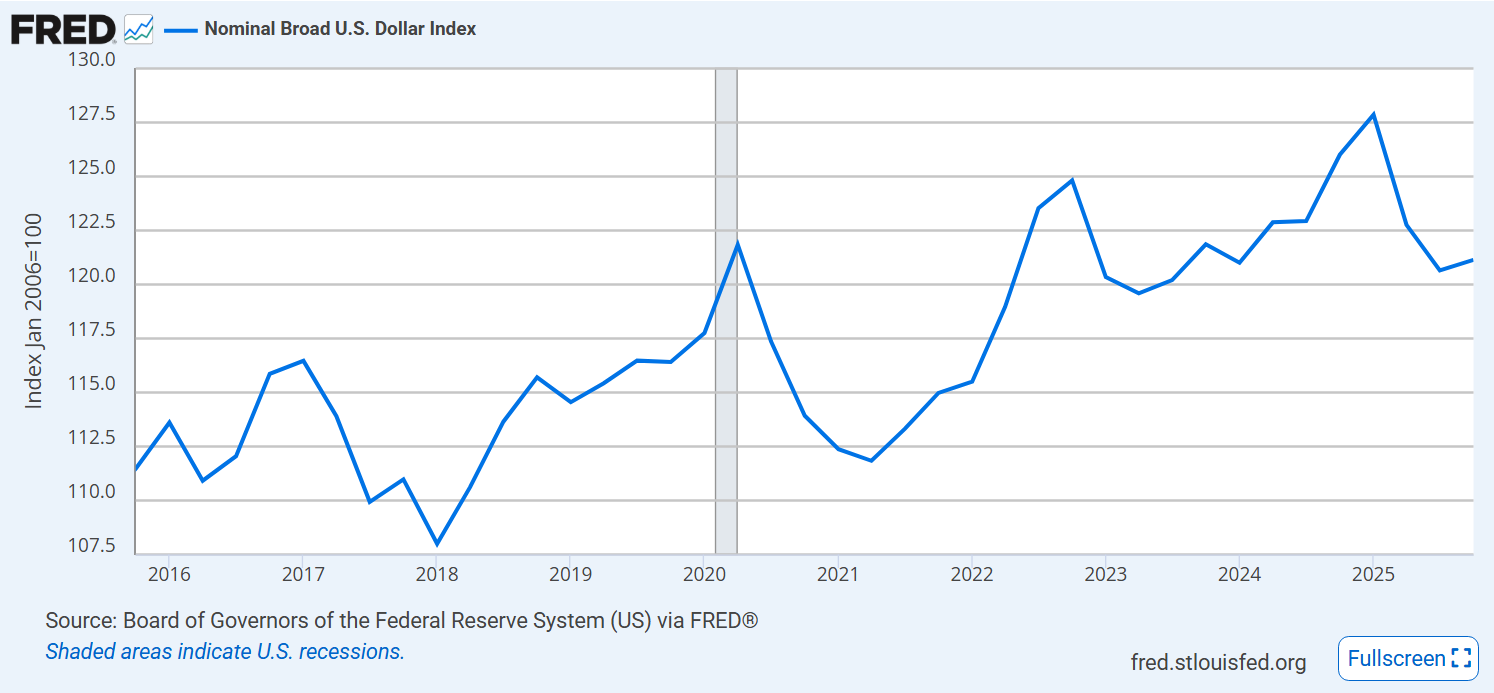
Value of the US dollar increased by 10-12% after the pandemic, but has retreated by 6%.
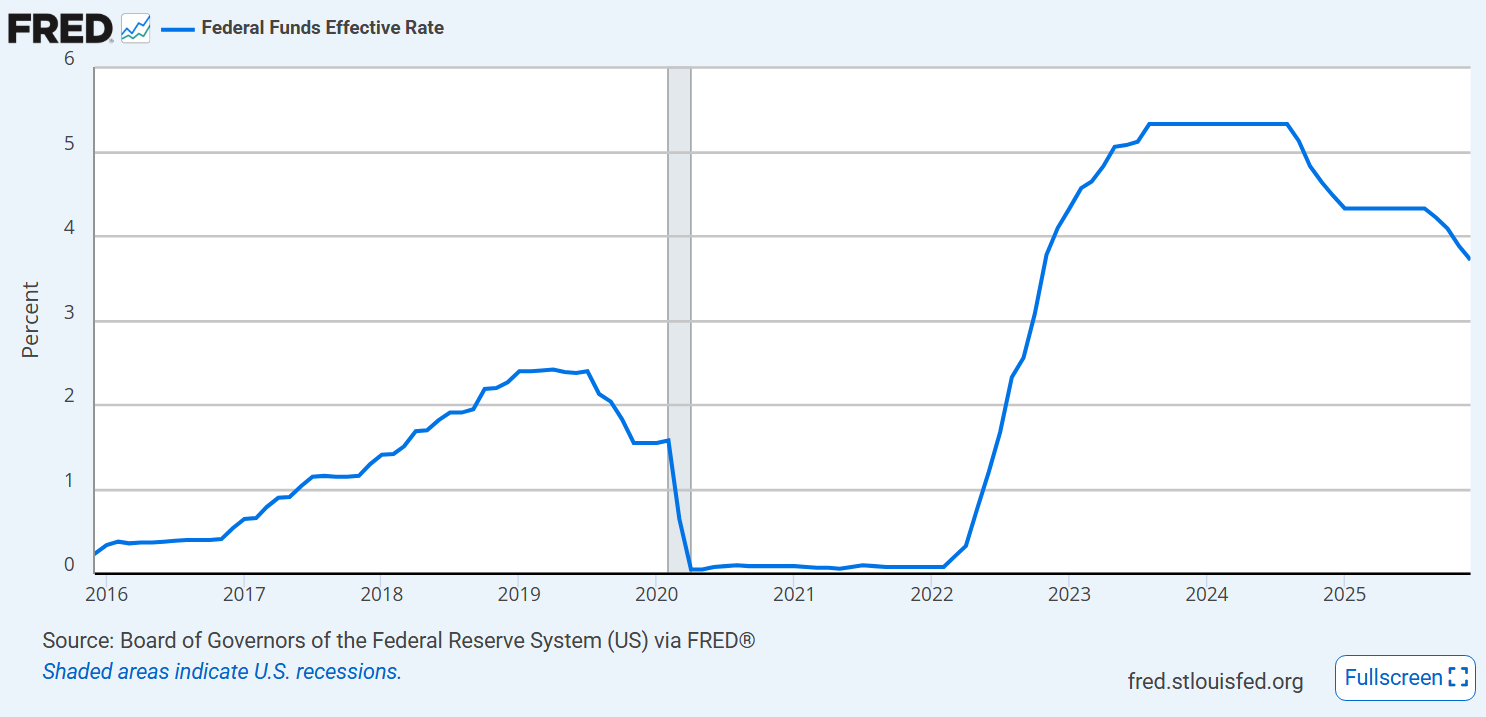
The Federal Reserve Board has reduced interest rates by 1.5%.
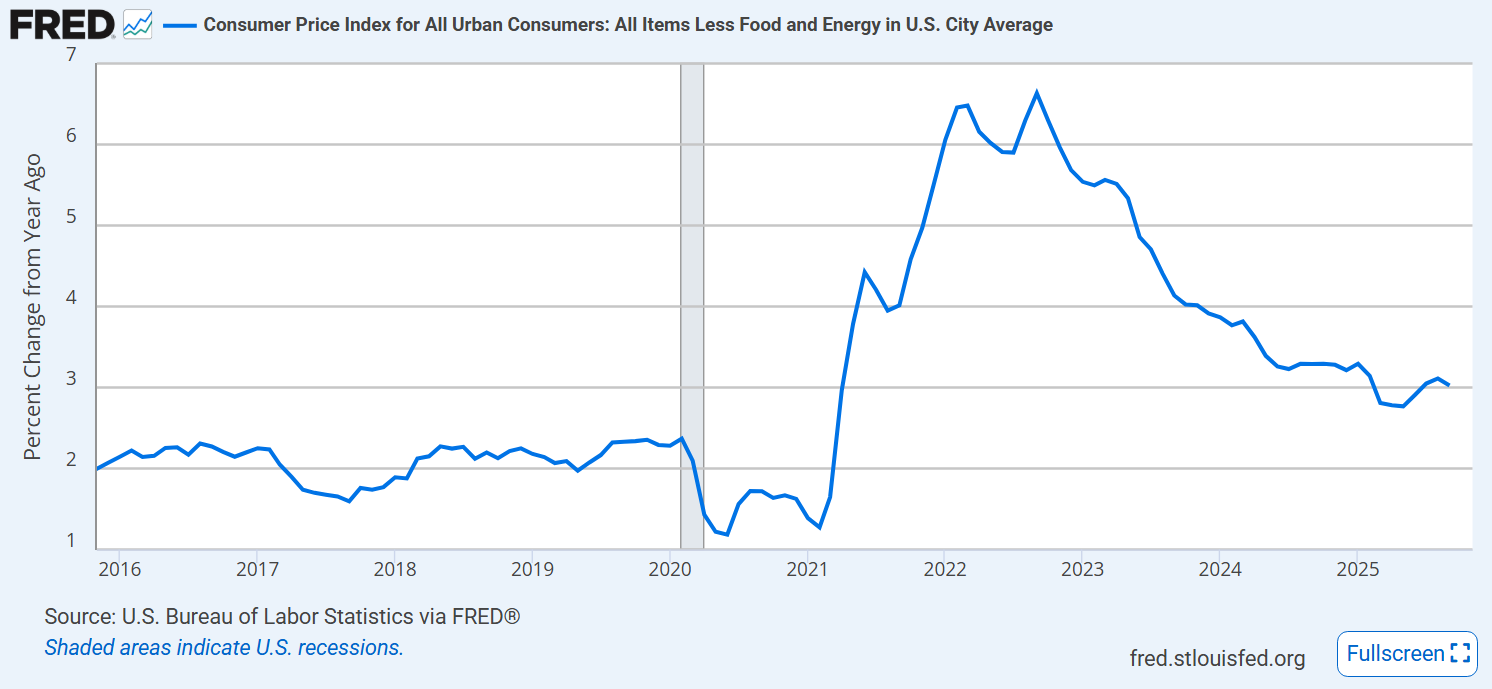
Core inflation rate has levelled off near 3%.
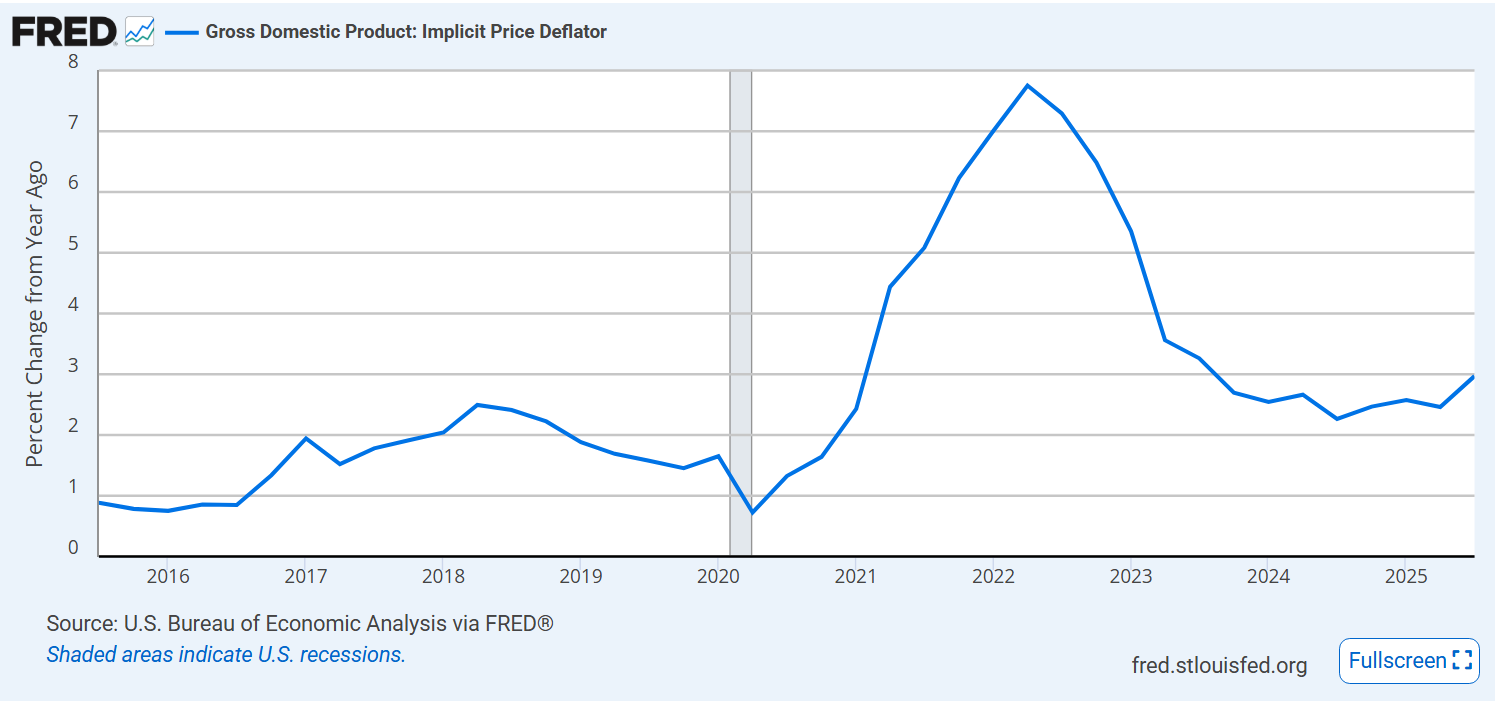
The GDP Price deflator measure of inflation is a little better, approaching 2.5%, but also level or growing.
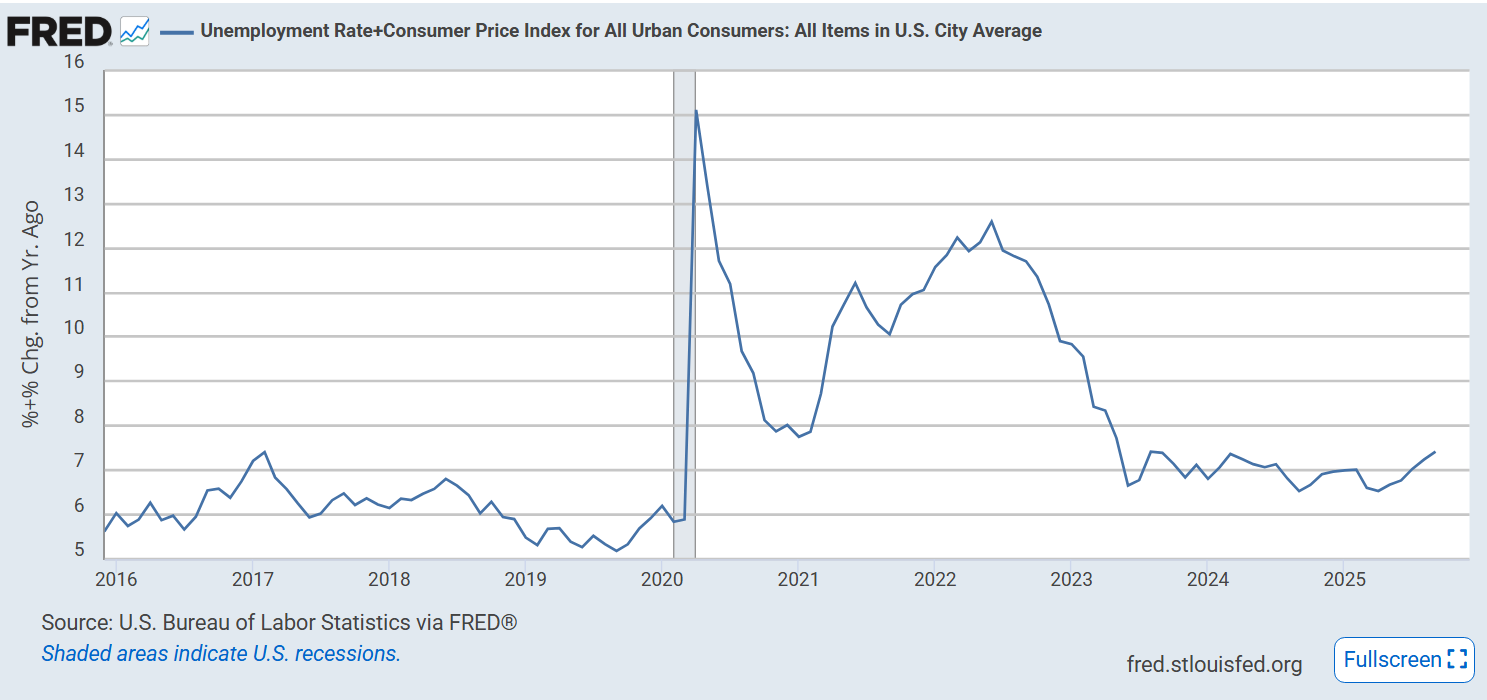
Misery index is up a bit at 7.5%.
Summary
Stock market is solidly up together with corporate profits and business investment.
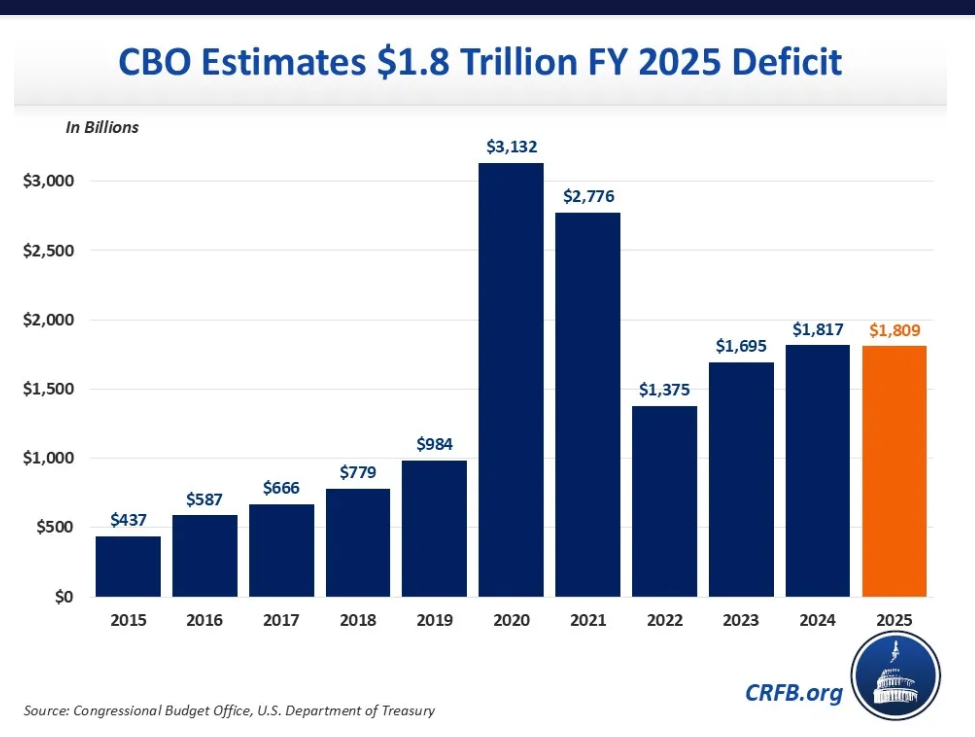
Inflation and unemployment are up. Budget deficits and debt remain high. Dollar value is down. Manufacturing employment is down. Business and consumer confidence is down.
Other measures are comparable to the 2023-2024 Biden economy base; not improving as often claimed.
The US economy is increasingly resilient and not easily changed by small policy choices or “jawboning”.
The Chevy Chevette was the best product of the largest and most successful corporation in 1976. [WOWSER] It was marginally better than the Corvair or the Vega. Major US corporations had taken advantage of the post-WWII opportunity to produce for the world and perfected minor changes each year to further stimulate consumer demand. Functional roles in corporations were largely unchanged since the 1920’s. Japanese competition in the auto and consumer electronics industries in the 1970’s caused American corporations to eventually reinvent themselves and move into a world of perpetual change management.
It’s difficult to describe the size and impact of these changes. They were like a compounded series of paradigm shifts. I worked with many organizations from 1975-1989: Koppers, Avery Label, Sherwin-Williams, multiple S&L’s, United Telephone, AmeriTrust, E&Y, Tandy Radio Shack, EDS, IBM, Microsoft, GM, NASA, Zenith, Allison Transmission, City of Cleveland, McCormick Convention Center, Amway, US Navy, US Health & Human Services, Lorain Community College, Baldwin-Wallace University and the University of South Florida.
I completed a finance MBA at Case Western Reserve University in 1984. I joined Ernst & Young as a junior management consultant and learned from Dr. E. Leonard Arnoff, one of the founders of the discipline of operations research.
FEW of the most important concepts and skills of my 35-year professional career existed or were rarely applied in 1984. The smartest academic and business leaders were aware of some of the changes that would shape the next 50 years, but the typical 1984 manager was still working from a 1930’s view of business.
I’ll group the more than 100 HUGE advances into 6 categories.
Strategy
Strategy really matters. A strategy function is needed.
Competitive advantage is critical (Michael Porter).
Companies cannot be all things to all people.
Strategy is a process to focus and facilitate thinking, not a mainly a means of control.
Market leaders have a better chance of winning. Better to be a leader in a small market segment than a follower in a large one. Long-tail opportunities.
In many markets, leading market share (1, 2 or 3) is essential.
Product differentiation is required to avoid commodity pricing.
Universal customer needs of quality, speed, flexibility, value (price and function), information/transaction costs and personal relations/risk management can all be used for product differentiation. A customer centric strategic view is necessary.
SWOT analysis is essential. Strengths, weaknesses, opportunities and threats.
Mission, vision and values must be articulated. Begin with the end in mind.
Firms must choose between equity alone and multiple stakeholder priorities.
Modelling and simulation tools can be used to identify, understand and prioritize the critical dimensions of every firm.
International and startup competition must always be considered.
Professional functions within each firm are increasingly essential.
A 3-way strategic choice must be considered: low cost, product differentiation or customer intimacy.
Successful firms clearly articulate abstract ends and flex the means of attainment (Collins).
The customer and retail interface may have more power than the manufacturer/service provider.
Smaller firms are available to be purchased in a roll-up strategy.
In the end, dynamic, sustainable [moats] strategies have the greatest value.
China matters.
As firms become more strategically driven, the fixed costs of SG&A rose, requiring firms to prioritize growth and market share.
Intangible assets may be more important than tangible assets.
Marketing
Market size is essential. Market share is next.
Marketing research of customer preferences matters.
Branding is vital.
Focus groups can provide separate insights and validate numbers.
The marketing function exists to create value, not just sell things.
Targeted marketing is essential. Products must match differentiated markets.
Some customers value quality and reliability.
Some customers value timely delivery.
Digital marketing channels supplement analog channels.
In the digital world, search engine optimization [SEO] matters.
E-commerce is a competitor to analog delivery.
Internet promotion is a competitor of traditional media.
Individuals’ identity and social interests can be targeted.
Some customers are better targeted by 2-way communications or influencers.
Politicians, regulators and courts increasingly matter, and firms must invest accordingly.
Tariffs matter. Firms must invest to manage them.
Finance
Access to debt, equity and start-up financing is much easier.
Access to global investors is possible.
More efficient markets through mutual funds, ETF’s, derivatives, and efficient trading markets matter.
Portfolio management applies to investments, projects, product lines, channels and new product development.
Marginal costs/benefits apply to every activity and project.
Cash and management accounting perspectives are best used for making decisions, separated from accrual and financial accounting measures.
Price discrimination is a major opportunity in every market.
The formal discounted cash flow analyses apply to many situations.
Activity based costing helps to identify necessary costs at 4 levels.
Corporate and product level costs are subject to cost reduction just like plant/facility and production costs.
The balanced scoreboard system ensures that all levels of economic activity are planned, measured and managed.
Human Resources
Human resources are productive assets; they are not simply “personnel”. They should be managed accordingly.
Required staff skills must be defined, measured and enhanced.
Clerical support skills must be cost-justified.
Analytical skills can be captured in separate positions.
The general concept of meritocracy matters. Exceptions must be justified.
COO’s and CFO’s are not alone. IT, marketing, risk, merchandise and people managers are equally important.
Legal compliance matters.
The role of “managers” is essential. Managing people, tasks and processes. Developing talents.
Highly skilled MBA’s have important roles to play.
Organizational development is a value added function.
Matrix (cross-functional) management is just as important as functional management.
Project teams play a critical role.
Firms cannot cost-justify employing thought leaders in every function. Management consultants can fill in.
Employees can be outsourced.
HR information systems (HRIS) are essential.
Centralized professional services functions are typically more cost effective.
Corporate culture is a strategic asset.
Clearly defining role requirements, recruiting, hiring and performance evaluation greatly improve performance.
Human beings have personalities, habits, talents and motivations that can be leveraged and improved.
Diversity, equity, and inclusion is a worthy investment today.
Workplace flexibility is highly valued by employees.
Information Technology
Basic financial and operations systems can be automated.
Detailed transactional processes can be automated, controlled and improved.
Processes can be documented, standardized and enforced.
Relational database logic can greatly reduce work and errors.
Detailed functional IT subsystems can be developed to improve operations and feed the financial systems. Warehouse Management Systems (WMS), as one example.
Enterprise Resource Planning (ERP) systems can be used to leverage the universal core processes of firms while customizing the details and integrating functional subsystems.
Critical data can be stored in data warehouses for analysis. Big Data comes later.
Reduced IT costs improve access to various tools and systems.
Staff can effectively use personal productivity tools: word processing, spreadsheets, graphs, graphics, email, databases, queries, report writing.
Personal computers allow local use.
The ongoing reduction of computer costs makes them more effective for more employees.
The internet provides access to information, teams, suppliers, customers, markets and others.
Internet search tools provide smart access to information.
Crowdsourced applications provide zero cost tools.
Social media apps provide the opportunity to connect with others effectively.
Smartphones further reduce the cost and limits of accessing all data, functionality and people.
Artificial intelligence provides tools to greatly leverage personal skills.
Operations
Forecasting and statistical techniques refined and easily applied using personal computers.
Professional logistics profession developed, applying the best options for all types of cargo.
Manufacturing outsourced routinely to lowest total costs sources worldwide.
Distribution, logistics, IT, HR, R&D, product development and all functions outsourced (sometimes globally) to leverage specialized skills and focus internal operations.
Operations research tools routinely applied for optimization problems, especially critical paths.
All fixed-cost capacities set at lower percentages, with secondary capacity options, in order to optimize profits, especially in low and high demand situations.
All processes defined, standardized, refined and optimized in order to apply IT and process engineering.
Multiple feedback loops routinely used to improve processes through time.
Lower communications and transportation costs further increased outsourcing activities.
The value of time to customers was identified and turned into a competitive advantage, from 6-weeks mail order to same day to same hour delivery.
Just-in-time production philosophies implemented, and inventories slashed towards zero intentionally to force improvements.
Production processes re-engineered according to process and final goal needs, displacing functional and “like kind” groupings.
Continuous improvement, kaizen quick fixes and full process re-engineering take advantage of global best practices.
Project management discipline created and refined. Agile project management used. Project management offices created to manage portfolios of projects, project managers and subject matter experts from inside, suppliers, customers and consultants.
New product development managed as a portfolio of projects, each within a standard process framework. Firms adopt the “layer cake” view of value as the sum of annuity returns from a series of new products.
Basic insights of modern Total Quality Management or Lean Six Sigma adopted, focused on activity and process variability with unexpectedly large results. Relentless elimination of waste.
The Quality paradigm shift places the process view on par with the finance view.
The variability of actions within a sequence of events [Goldratt] is seen as the critical driver of final results. Processes, measurements, goals, investments, staffing, operations planning and outsourcing are adjusted for dynamic effectiveness.
Summary
Modern firms have cumulatively adopted and leveraged these interrelated capabilities to become strategically driven, self-aware, well-managed and improving through time. The marginal finance/portfolio view together with the process view allow firms to identify, deliver and monetize customer needs while outsourcing functions that are not deemed strategically essential. Firms generally invest more resources in planning, optimization, new product development and risk management today.
The application of these principles has varied by industry. Government, not-for-profit and health care have great improvement opportunities remaining.
Firms may invest in Joseph Schumpeter’s “creative destruction” or they may optimize within existing market structures if they see higher returns from internal process improvements, incremental product development, supplier squeezing, price discrimination, targeted marketing or regulatory capture. In other words, the capabilities for ongoing world-changing improvements exist but may not be applied for the greater good.
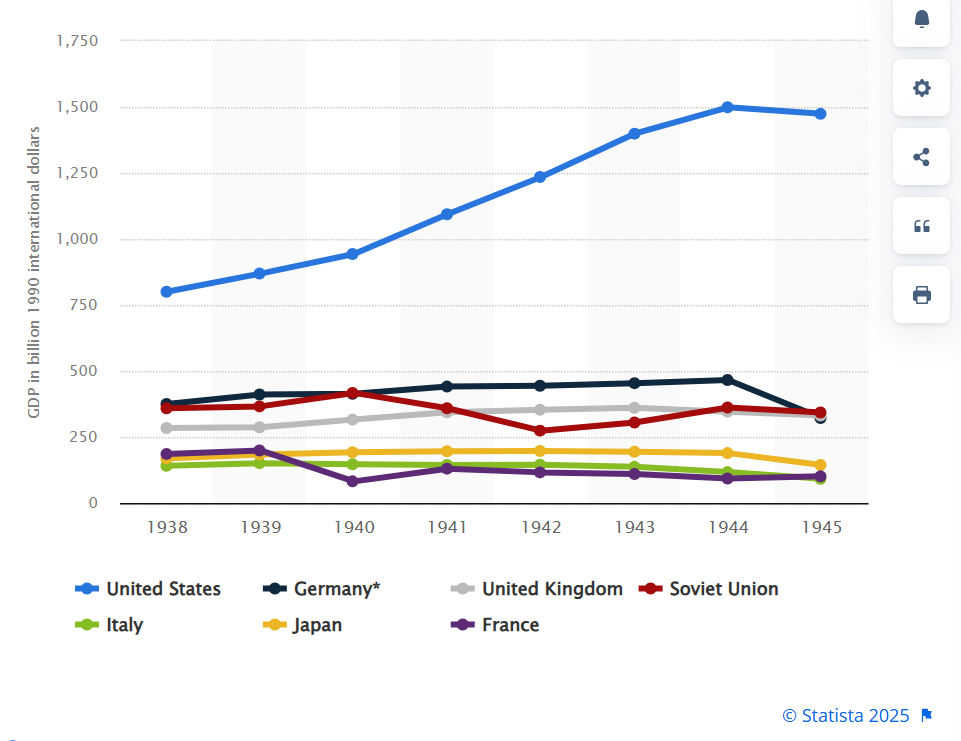
I’d like to focus today on US and global economic growth since 1945 guided by the new economic order of win/win free trade installed by the Bretton Woods conference.
The US economy has grown 11-fold since then in real economic terms. The US economy, which won the war, was just 9% as large as it is today! This is a little less than 3-fold population growth combined with 4-fold per capita production/income growth.
Visually, it is clear that US economic growth has been steady across these 80 years, only interrupted by a few severe recessions.
The US had already doubled its GDP between 1938 and 1945. So, the US economic growth was 22-fold from 1938 to 2025. Other leading countries showed flat total output in the war era.
This chart shows that the US reached its apex as a share of global GDP right after WWII. I think that president Trump mistakenly believes that the US could have maintained its 28% global market share forever. In more realistic terms, the US reached 19% of global GDP in 1913 and properly maintained that share in 2008.
Summary
The post-WW II global institutions drove 11-fold growth for the US and 15-fold growth for the world. The historical benchmark in 3x. The US experienced an extra doubling of its economy from 1938-1945. The mercantilist views of 1880-1920 simply cannot compete with the post-war free trade regime.
I believe that Charles Taylor is correct about the critical role which our background worldview plays in shaping our lives. Our unconscious mind has views of the world and uses them to influence us “all night and all day”. I think that major events and ideas find their way into our paradigms about life, science, religion, philosophy, politics, morality, character, careers, recreation, and communities. Maslow argued that safety and security are at the base of our pyramid of psychological needs. If fear and insecurity is a main feature of modern life, we need to understand why this is so. In a world of educated/acculturated individuals and mass media communications, the abbreviated “history of the world” drills deeply into our minds, shaping its categories, structure and evaluations.
I’ve reviewed dozens of lists about the most important events overall and within various categories of modern (post 1400’s) life. I documented 257 (!) greatest events with Wikipedia references. I’ll use this database to analyze their impact on fear/insecurity today.
The events are roughly equally divided between those which make the world riskier (92), safer (83) or do not have a clear, significant impact (82)
Using 40-year periods to summarize the events, there is no clear trend toward riskier or safer events. From a current perspective, the 1820-1859 period was negative with 7 riskier to 4 safer events. The 1848 revolutions threatened the integrated worldview. Spencerian Social Darwinism, even before Darwin, pointed to “scientific” national, racial and class divides. The “dismal Dane” Kierkegaard defined an existential perspective as an alternative to a confident belief in God. The western powers essentially conquered proud China in the “Opium wars”. Lyell summarized geology as the scientific study of changes in the earth, itself. Marx invoked a Hegelian, materialistic, historical, “scientific” philosophy of class division and revolution required by capitalist ownership of the means of production. Darwin’s “theory of evolution” rocked a world that was deeply invested in a deterministic, structured, certain, law based, deeply unchanging, yet socially, politically and economically changing world, philosophy and religion.
The next 1860-1899 period was also negative with 13 riskier to 9 safer events. Nietzsche’s “God is dead” and William Jennings Bryan’s populist “crucified on a cross of Gold” confronted the progressive spirit of the age. The US Civil War showcased the terrors of modern military technology. Famines, urbanization, agricultural productivity improvements, and religious wars drove millions of young Europeans to leave home for other nations like the USA. Art became abstract and individualistic, disconnected from citizens. New forms of popular music arose from the cultural melting pot of the USA. Nationalism grew. The US became an imperial power. Japan engaged with the West and decided to imitate it. The European powers discovered Africa as a new continent to colonize. These events impacted the nineteenth century and still impact all of us today.
The period from 1980 to today is also more negative, with 15 riskier events to 11 safer events. Populist politicians, including far-right partners and supporters are succeeding. Greater legal and illegal immigration from non-European countries to the US concern many citizens. The economic growth of Asia threatened American factories and workers. The transition from European to local power in South Africa raised concerns. The 9/11 terrorist attacks frightened Westerners. Russia’s invasion of Ukraine threatened the modern military world order. Innovations like “junk bonds” increased the risks in the increasingly integrated global financial system. The Great Recession was triggered by “financial innovations”. Michael Porter’s “competitive advantage” theories caused the most powerful corporations to more ruthlessly pursue success. The Reagan/Thatcher revolution undercut unions as a counterbalance for workers versus owners. ChatGPT passed the “Turing test”, indicating that computers are indistinguishable from men.
By Category
Philosophy/Politics riskier 16, safer 13, neutral 9. The breakdown of the nicely integrated “ancien regime” with certain answers for everything is a major and an ongoing source of insecurity. You either have total belief, or you don’t. Kierkegaard defined the need for a “leap of faith” in the modern world. Fundamentalist Christians redefined a world that maintains the historical certainty.
Society/Religion riskier 14, safer 9, neutral 7. Change is the dominant theme.
International relations riskier 27, safer 7 and neutral 2. WWI, WWII, Cold War dominate.
Business/economics riskier 12, safer 13, neutral 15. Process and efficiency make the world safer, while the unequal distribution of income and wealth drive political conflicts.
Physics/Mathematics riskier 9, safer 7, neutral 8. Scientific rules can be defined numerically. But they change!
Technology riskier 2, safer 12, neutral 15. The world benefits from a series of energy and agricultural revolutions.
Computers/Communications riskier 1, safer 6, neutral 24. Tools are mostly neutral, able to be used for good or bad.
Biology/health riskier 11, safer 16, neutral 2. Medical advances accumulate and promise more in the future. We better understand the concerning true risks of microorganisms, evolution, public health, adaptive threats, pandemics, human changes to genetics, and human impacts on the environment.
Science and technology have a very nice 41 safer to 23 riskier ratio. The social areas unfortunately show a 69 riskier to 42 safer profile. The social sciences, arts, philosophy and religion are not winning the war.
Highest Priorities
Ignoring the 82 neutral events, there are 36 items that are most influential/important within the 92 riskier and 83 safer events.
The 16 most important “riskier” items are not evenly distributed among the 8 categories. 4 philosophical items. Rene Descartes’s radical doubt opened the way to complete skepticism. Karl Marx defined a necessary utopian solution to class conflict. The Russian revolution and Chinese Mao revolution followed. Friedrich Nietzsche explored the logical possibilities of “God is dead”. Fascism was defined as a reasonable form of nationalism. The western cultural revolution of the 1960’s provided a fully secular option where religion and culture do not control the individual. WWI, WWII, the cold war, the atomic bomb, Nazism, and the holocaust. The Great Depression. Darwin’s theory of evolution. The Spanish flu and the 2019 global pandemic. “Things fall apart, the center cannot hold”. These important events point toward a meaningless, self-destructive world.
On the other hand, there are 20 much more positive events in the modern world that surely shape our subconscious thoughts. The progressive era of 1880-1920 created governmental reforms and new non-governmental organizations to meet human needs. The post-WWII set of international institutions thrived for 80 years growing global real dollar GDP 40-fold and preventing WW III. The Cold War ended without a hot war! John Maynard Keynes invented the effective discipline of macroeconomics, allowing nations to roughly control their economies and minimize the damages of the business cycle. Scientists demonstrated that the universe is “regular”. Newton, Pascal and von Neumann defined definite, probabilistic and dynamic laws. Edison made commercial electricity practical. The second and third agricultural revolutions transformed production, society and trade. The internet and Google’s search engine made all information easily accessible. Modern surgery, pharmaceuticals, public health, DNA insights, vaccines and social medical insurance have boosted life expectancies far above 70 years.
Summary
Why do we live in such a fearful, insecure time, despite the 83 big events that make our world permanently safer?
The mass media highlights negative, emotional stories.
Politicians use negative, emotional stories to gain and retain support.
Human nature discounts solved problems and historical events. It focuses on today’s challenges. In a sense, we’re always on a treadmill.
The meritocratic, late capitalist, Schumpeterian “creative destruction” economic system leaves everyone without true financial security.
Individualistic Americans don’t really believe in a safety net or welfare state. Politicians have destroyed rather than upgraded or enhanced the welfare System to deal with the modern challenges.
Religion, a critical source of understanding reality, is losing the war against secularism. It has not found a new structure, motif, concept, killer app, theme, bridge, attraction, rationale, argument, or appeal.
Skepticism is a very powerful worldview. It feeds on the human desire for certainty, authenticity, rationality, explanation, and perfection. It celebrates superior knowledge, history, logic, insights, contrarianism, irony, modernity, and progress.
I think that the misguided belief in scientific certainty in all arenas is also to blame. People misunderstand Newton. He discovered physical laws and mathematics that described the world like no one had done before. Yet, he did not abandon the gods, Christianity or alchemy. He was not a materialist reductionist. He knew better. He recognized Aristotle’s “final causes” as deeply important and accepted that he had no idea how or why gravity functioned.
The “orange one” does not “hold all of the cards”. He is critically threatened by his foreign handlers and the US justice system. He was not elected to promote a trade war. No one expected a trade war. He merely “shadow boxed” during his first term on trade. He has made the “trade war” his first priority because it is a “sure win” politically, in the short-run. He first bluffed exaggerated 50% and 100% tariffs, and the media duly reported these crazy claims that anchor or outline the story. He now claims HUGE victories with 15% tariffs. The self-described GOAT negotiator thereby proves his standing. He claims victory. He uses this temporary bump in support to take over the government.
Citizens need to recognize that this is clearly not a “win” for the country. Import tariffs are simply taxes. They get split between the foreign exporter, the importer and the retail customer. At 15%, the typical payment split is 25%, 25% and 50%. Exporters still want to sell goods and maintain market share. They have fixed costs. They have profits. They can reduce prices in the short-term. Importers still want to sell goods and maintain market share. They can limit price increases in the short-term. Most markets are “sticky”. Brands, supply chains, habits, marketing and convenience matter. Import costs are half to three-quarters of retail prices. The consumer price increase is 5-8%. Some consumers switch to lower priced options, some don’t. The “next best” low price option for an imported good is probably another imported good. The “Trump tariffs” distort markets. They don’t deliver a “victory” for American consumers, producers, labor, finance or government. They merely “gum up the works”.
The “orange one” understands leverage, populism and persuasion. He really doesn’t understand markets, as demonstrated by his dozens of business failures. A 15% import tariff will cause pain for foreign exporters, US importers and consumers. It’s not large enough to cause a domestic firm to invest in expanded capacity. They will use all of their existing capacity and even cut prices a little to win market share. Manufacturing investments require 20-30-40 year timeframes to be viable. They require confidence in government policies on trade, regulations, antitrust, labor, environment, intellectual property, lobbying, property taxes, inventory taxes, corporate income taxes, international taxes, international finance, transportation, supply chains, labor costs, etc. Trump’s policies strongly work against such investments.
US industries don’t import goods to save just 10%. They import goods because the total cost of imports is at least 20% lower and trending in the right direction. Importing always has extra costs for transportation, communications, delays, coordination, property risks, quality control, product development, supplier management, flexibility, tariff risks on both ends, legal risks, capital controls, financial transactions, inventory, obsolescence, etc. There is a “step function” involved here. US firms from 1970-2000 only relinquished their domestic manufacturing because when they completely ignored all fixed costs and only looked at short-term variable costs, they had to outsource production. There will be no overall manufacturing renaissance. There will be some very low labor cost manufacturing that returns to the states. That is, only where labor costs are a small percentage of the total production cost. Hence the “job creation” impact will be tiny, impossible to measure.
So … if they won’t build new factories, what will be the leading responses of domestic importers? They will find ways to import/reroute goods from lowest tariff countries. They will find ways to reclassify goods and avoid tariffs. They will lobby for exemptions. They will import only key components and do “final assembly” locally in highly automated factories. They will hold imported goods in a Free Trade Zone. They will split physical products from services and intellectual property to minimize tariffs. They will lobby for domestic government subsidies. They will offer “service hour models” to customers as in aircraft engines and never sell the physical goods and incur the tariffs.
Will the import tariffs reduce the federal budget deficit? Yes. The US imports 15% of GDP. Tariffs will be applied to about half of the imports. Imports will be reduced and replaced by domestic production, a little. 15% of 5% is about 0.75% of GDP. The federal budget deficit is 6.5% and climbing. This will help a little. Consumers will pay for half of this as in a sales tax.
What are the secondary impacts of the tariffs? Domestic firms will invest management time and money in managing the system instead of developing better goods and services. Lower import competition often leads to higher prices overall. Domestic producers experience higher input costs and attempt to pass them along to consumers. Foreign countries will increase their tariff and non-tariff barriers to US exporters. The US loses its moral advantage as a promoter of “free trade”. The US loses opportunities to reduce trade barriers through global and regional “free trade” agreements. The US loses the opportunity to drive global labor and environmental standards. The US loses the opportunity to expand free trade in services, the industries of the future. The US’s “unfair advantage” as the manager of the US dollar as the global currency will be challenged. The US’s soft power in language, arts, education, language, culture, and global leadership will be questioned. The US’s role as a stalwart ally will be undermined, leading to merely costlier and unreliable transactional relations with former allies. Foreign citizens will choose to not consume US goods and services. The US will have to pay directly for its global military bases. The US will have to pay for allies’ support on the “war on terror”. The US will have to pay for all global initiatives. The US will have to directly control “rogue states”. The indirect costs are HUGE and unappreciated.
Why did the US pursue the post WW II new world order? Ending imperialism and colonies. Forming the United Nations and trying to use it to manage some conflicts. Principles of political self-determination and human rights. Global bodies for better health. Investments in Germany, Italy, Japan and Europe instead of reparations. International Monetary Foundation and World Bank to support developing nations and manage currencies. GATT and WTO to promote lower trade barriers and multilateral deals. NATO and other alliances rather than colonies and protectorates. The win/lose approach of the 1800’s, WWI and WWII had failed. The world was ready to try a win/win approach. The US, with its history of isolationism, exceptionalism and national independence, chose to not pursue “world dominance”. The post- WWII institutions were not perfect, but they demonstrated that they were much better than those that had governed international relations for the prior 500 years.
Again, put everything in perspective. The US imports 15% of GDP. 15% import tariffs on half of goods. Consumers adjust and substitute domestic and lower total price imports. US consumers pay a 1% sales tax on imported goods. US military and influence costs rise by much more than 1% of GDP. Consumers pay higher prices. The US has less global influence. Where is the win? Marginal manufacturing plants and jobs are not returning to the US, no matter what the “orange one” says unless they are subsidized by the local, state or national government.
This is just another “con” by the “orange one”. We want to believe that American jobs have been unfairly stolen by government subsidized factories and low-cost labor without environmental protections in foreign countries. There is a grain of truth in each claim. Foreign governments do subsidize export firms. They try to maintain low currency values to support exports. They accept low total labor costs and environmental damages. Every country tries to be globally competitive.
No “magic wand” exists to force or entice everyone into embracing win/win institutions or deals naively. There is always an incentive to be a “free rider”, taking advantage of the global deals and quietly not really complying, just like some oil producers in OPEC. There is always an advantage for a single country with enough power to “hold out” or bluff or play “chicken” to extract a better deal for that country than for the others. This is the real world of bargaining, negotiations and deal-making. No system, philosophy, institutions, social pressure, or trump card easily delivers win/win results without overcoming the win/lose incentives of the game’s players.
There was a time when “Republicans” were supposedly the party of realism, pragmatism, common sense, business, efficiency, logic, finance, trade, capitalism, science, industry, proof, objectivity, best practices, and elite opinion. “Democrats” allegedly appealed to emotions, wishes, utopias, fairness, justice, perspectives, hopes, possibilities, oppression, victimhood, persuasion, popular opinion, populism, and ideals. The post-WWII institutions were supported on a bipartisan basis for more than 50 years. In 1992, President Clinton and the Democratic party embraced the “third way”, fully supporting these policies, capitalism and limited government, despite criticisms from the progressive, new, far left. The post – WWII system of international institutions has been criticized as “globalism” and “neo-liberalism” by the left wing of the Democratic party.
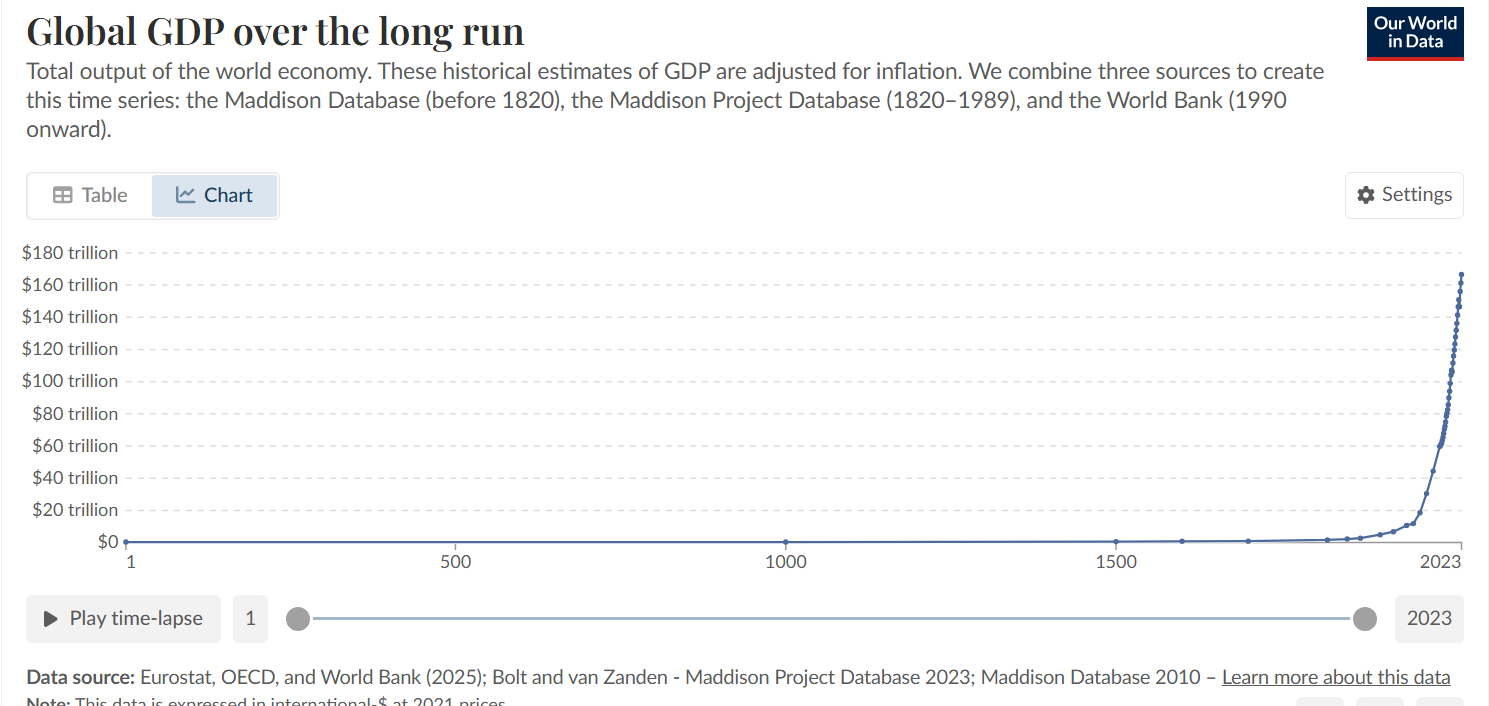
The post-WWII institutions were not perfect for Democrats, Republicans, the USA or the global community. But they worked incredibly well. Real global GDP has increased by 40 times since 1945, from $2.5 trillion to $100 trillion!!!!! That is 4.72% real growth compounded year after year after year for 80 years, coming out of a world war, encompassing a cold war, the Vietnam War, the Korean War, a global pandemic, the collapse of birth rates, business cycles, financial panics, energy crises, Middle East wars, and terrorism.
A comparable 80-year period before the Great Depression shows just 4-fold global real GDP growth, not 40-fold. Of course, much of this difference is due to differences other than the post-WWII institutions. This was a time of 1.75% annual growth rather than the modern 4.72%. The 3% annual difference compounded across 80 years delivers 10 times greater growth. This is not a marginal advantage. This is an UNBELIEVABLE advantage. This is difficult to communicate. Small percentage differences across a lifetime.
The “bottom line” is that the “orange one” only believes in “win/lose” and rejects any form of “win/win”. The post-WWII institutions are win/win, so they must be rejected. Capitalism, alliances, partnerships, joint ventures, corporations, modern supplier relations, families, communities, nations, treaties, fraternities, sororities, ecosystems, clubs, cooperatives, unions, study partners, mentors/mentees, credit unions, mutual insurance companies, social enterprises, not-for-profits, churches, service organizations and many others are win/win. The “win/lose” framework supports the “orange one’s” desired position as a great leader needed to save the people.
Free trade has provided truly amazing benefits for the US and the world. The post-WWII cooperative institutions have reduced wars and conflicts. The “Trump tariffs” will slow global economic growth. They will not provide any material benefits for the US.
The US has enough economic, social, political and military power to force country by country “deals” that appear to benefit the US, when considered in a short-term win/lose framework. These deals will harm the US and the global economy.
From 1945-2000 “free trade” was Republican economic orthodoxy. “Free trade” benefitted US multi-national corporations which had the ability to take advantage of global markets. The US economy and labor markets were flexible enough to manage the changes. Capitalism was supported as the best economic system versus communism, fascism, socialism, protectionism, imperialism, colonialism or mercantilism. US financial institutions were well positioned to facilitate trade. US universities were ready to educate the world. Imported goods and immigrant labor drove lower US wages.
Trump is appealing to his populist base to oppose the “others” of immigrants, non-whites, non-fundamentalist Christians, criminals, thieves, rapists, sweat shops, subsidized factories, polluters, underpaid workers, etc. “We should produce everything we need in America. We have the factory capacity, finances and skills to do so.” He appeals to nationalism while ignoring the critical principle of comparative advantage. Countries export only what they are very best at growing, producing or serving. They do not produce everything themselves just like states, firms and individuals that are not fully self-sufficient.
1984 – Eli Goldratt offers a “theory of constraints” as a way to understand and manage complex systems effectively, leading to true “lean manufacturing” and “lean operations”.
Process standardization. Financial innovation. Highly focused strategies. New business forms. Markets and international trade deliver desired products, lower prices and competition. A role for government regulation remains. The macroeconomy can be managed to reduce the impact of business cycles and shocks.
Colonization and de-colonization. Opening of Asia. World Wars. Nuclear threats. International integration. Economic progress. Bipolar, superpower, multipolar world.
















 Good News