AI will take over the universe. At a minimum it will eliminate 10% of jobs, really important skilled jobs, leading to a downward spiral of joblessness and economic decline. The experts say so. AI has clearly shown exponential growth in performance. Do the math. It is unavoidable.
We have experienced so many “revolutions” that we can’t keep track of them. Electricity, railroads, telegraph, radio, tv, Marxism, existentialism, globalism, free trade, colonialism, skepticism, environmentalism, feminism, Freudianism, behavioralism, racial equality, women’s rights, gay rights, sexual experience, cold war, energy crises, terrorism, modern finance, lean six sigma, meritocracy, media, computer, communications, cell phone, biotechnology … Few have had material long-term impacts upon national or global economies.
Economies today are comprised of components. They are not just farming. They are not just basic manufacturing. Financial and real. Raw materials, component suppliers, manufacturers, logistics, wholesalers, retailers, installers, returns. Various industries. Various functions. Goods and services. Domestic and international. Importers and exporters. This complexity means that no one technological, process, regulation or other change is likely to have a HUGE impact.
Labor is only one input component. It combines with land/natural resources, capital/facilities, technologies/processes and financial resources to produce outputs. Total compensation is 54% of the US economy. Even the elimination of 10% of all jobs would only result in a 5.4% reduction in the total costs of production. In the short run, this would disrupt labor markets. In the medium-run, profits and rents would increase from the cost savings. The loss of incomes would reduce demand for goods and services, reducing profits, rents and compensation. Disruption, yes. Disaster, no.
The US economy today is less subject to the high fixed cost operating leverage that drives business cycle booms and busts. This reduces the frequency and depth of depressions. It improves the US economy’s ability to recover from exogenous shocks like an oil crisis, mortgage meltdown, pandemic or possible decrease in labor demand.
AI requires a human to initiate, fine-tune, launch and implement it. Only a small slice of the workforce can use AI tools. These individuals will be cautious when applying tools that threaten their personal employment.
Historically, “analysts” have employed newly available productivity improvement tools. There are only so many analysts with available time to evaluate and apply AI tools directly.
We have a history of analysts/STEM/creative class professionals adopting personal productivity tools. None of these situations resulted in significant/quick reduction in the demand for labor. They made these individuals more productive leading to the continued growth in these job categories for 40 years. Consider spreadsheets, query tools, report writers, database management software, ERP systems, statistics packages, CAD/CAM, engineering graphics workstations, desktop publishing, simulation software, project management software, warehouse management systems, EDI, internet search tools, forecasting software, shop floor modeling, activity-based costing, balanced scorecard, credit analysis tools, insurance underwriting tools, marketing research/survey tools, product development tools, logistics optimization tools, event planning and management tools, reverse logistics software, repair depot software, agriculture crop planning, the list is endless.
IT and process improvement projects are well structured today. These project teams will evaluate all dimensions of AI technology, considering direct and indirect costs, benefits, risks and off-ramps. They will act as a brake on the speed of adoption.
The jobs where “thinking” is the critical/90%+ requirement are few. Most jobs have thinking, feeling and doing dimensions. They employ local workers. Most “thinking” jobs combine inductive and deductive reasoning, multiple intelligences, hard and soft skills. AI focuses on the pure logical thinking dimension.
Many jobs require analog, travel and emotional physical interaction. AI cannot help.
Most corporate advances reply upon “matrix management” and project team skills. AI does not fit easily except as a tool for solving technical problems.
There are some research, logistics, analysis and customer service jobs that will be mostly replaced by AI. A human evaluator and quality control will remain.
Some scientific jobs will be quasi-automated, reducing employment.
The adoption rate across industries varies greatly. Manufacturing, distribution, logistics, electronics, IT yes. Others, much more slowly.
The “lump of labor” fallacy must be overcome. Individuals have a variety of employable skills. “Next skill up” applies. Individuals who lose positions find “next best” positions in America’s dynamic labor market. That is, job holders at all levels have packages of general purpose, professional, technical, industry and firm specific skills and experiences. AI tools reduce the opportunities to use some of their skills in some industries and firms. They still retain other marketable skills and experiences. A tight labor market will result in unemployment, some long-term unemployment, some avoidable long-term unemployment and a ripple effect that drops generally higher skilled candidates into previously lower paid roles. There will be a lowering of compensation throughout the labor market.
The “automation” of jobs in the physical, clerical and professional world has proceeded for almost 50 years. Employees have adapted effectively, adding skills or moving industries or locations.
Some positions rely upon “tribal knowledge” or individual/personal relations. They are buffered from AI.
At the macroeconomic level, the substitution of capital (AI computers) for labor is well understood. Firms reduce their costs and improve their competitive positions. They earn greater profits for a while. Slow to adapt firms die. Owners receive the profits. Owners consume more of the goods and services with a high marginal income elasticity. Personal services, professional services, travel, hospitality, leisure, tax, investment, security, charities, and construction grow. Total demand for goods and services remains the same or increases. The adoption of productivity increasing technology increases the supply side (capacity) of the economy. “Say’s law” ensures that in the long run that capacity will be used because the factor returns (rent, labor, profit) create new demand. In the short run we can have recessions and depressions. If we don’t use known fiscal and monetary policies to increase demand to use capacity we can stay in a recession, but we have 75 years of experience in dozens of modern economies to guide us.
This is not intended to diminish the potential role for AI. It will eliminate some jobs and complement others, making them more productive. It will solve problems faster than humans and hence open the door for new goods and services. It may reach superintelligence and seek to take over the world, but I’m not addressing that possibility.
Summary
AI is a tool that can replace some of our existing labor force. It may impact a significant share of the labor force in the next decade. Our economy is large, complex and dynamic. History indicates that some positions will be eliminated but many more will be boosted by the new man/machine capabilities that make them even more productive. There still appears to be no limit to the demands of individuals for goods and services, so it is very likely that this will improve the economy’s productive capacity and that we will consume all of this increased capacity, adding new goods and services to our menu of consumption.
I’m not saying that the labor market, goods and services markets or macroeconomic transitions will be smooth or pain free. Professional workers will have to find new “next best” roles that leverage other new or existing skills. Personal services industries are likely to grow while goods and resources industries decline. Fiscal and monetary policy makers will have to supplement aggregate demand without causing inflation or spooking bond buyers.
The modern advanced economy is truly a miracle. Without central planning or control, it produces the goods and services that are demanded. It adapts to changes in demand, technologies, suppliers, labor markets, resources, finances, regulations, etc. It will effectively adapt to the impact of AI on the demand for labor.
I encourage you to listen to the economics profession on this topic. It is not a new topic. It fits within existing conceptual models and measurements.
IT/AI leaders are not economists. They are subject to the same kinds of irrational thinking that economists have corrected for more than a century. Economic systems seem to be “too good to be true”. There are times when claims are exaggerated for political reasons. Economic systems are not perfect, but their overall functioning is well understood. In theory and in practice, our economies are very well positioned to digest the productivity improvements of AI for the benefit of total capacity and individual consumption.
The Chevy Chevette was the best product of the largest and most successful corporation in 1976. [WOWSER] It was marginally better than the Corvair or the Vega. Major US corporations had taken advantage of the post-WWII opportunity to produce for the world and perfected minor changes each year to further stimulate consumer demand. Functional roles in corporations were largely unchanged since the 1920’s. Japanese competition in the auto and consumer electronics industries in the 1970’s caused American corporations to eventually reinvent themselves and move into a world of perpetual change management.
It’s difficult to describe the size and impact of these changes. They were like a compounded series of paradigm shifts. I worked with many organizations from 1975-1989: Koppers, Avery Label, Sherwin-Williams, multiple S&L’s, United Telephone, AmeriTrust, E&Y, Tandy Radio Shack, EDS, IBM, Microsoft, GM, NASA, Zenith, Allison Transmission, City of Cleveland, McCormick Convention Center, Amway, US Navy, US Health & Human Services, Lorain Community College, Baldwin-Wallace University and the University of South Florida.
I completed a finance MBA at Case Western Reserve University in 1984. I joined Ernst & Young as a junior management consultant and learned from Dr. E. Leonard Arnoff, one of the founders of the discipline of operations research.
FEW of the most important concepts and skills of my 35-year professional career existed or were rarely applied in 1984. The smartest academic and business leaders were aware of some of the changes that would shape the next 50 years, but the typical 1984 manager was still working from a 1930’s view of business.
I’ll group the more than 100 HUGE advances into 6 categories.
Strategy
Strategy really matters. A strategy function is needed.
Competitive advantage is critical (Michael Porter).
Companies cannot be all things to all people.
Strategy is a process to focus and facilitate thinking, not a mainly a means of control.
Market leaders have a better chance of winning. Better to be a leader in a small market segment than a follower in a large one. Long-tail opportunities.
In many markets, leading market share (1, 2 or 3) is essential.
Product differentiation is required to avoid commodity pricing.
Universal customer needs of quality, speed, flexibility, value (price and function), information/transaction costs and personal relations/risk management can all be used for product differentiation. A customer centric strategic view is necessary.
SWOT analysis is essential. Strengths, weaknesses, opportunities and threats.
Mission, vision and values must be articulated. Begin with the end in mind.
Firms must choose between equity alone and multiple stakeholder priorities.
Modelling and simulation tools can be used to identify, understand and prioritize the critical dimensions of every firm.
International and startup competition must always be considered.
Professional functions within each firm are increasingly essential.
A 3-way strategic choice must be considered: low cost, product differentiation or customer intimacy.
Successful firms clearly articulate abstract ends and flex the means of attainment (Collins).
The customer and retail interface may have more power than the manufacturer/service provider.
Smaller firms are available to be purchased in a roll-up strategy.
In the end, dynamic, sustainable [moats] strategies have the greatest value.
China matters.
As firms become more strategically driven, the fixed costs of SG&A rose, requiring firms to prioritize growth and market share.
Intangible assets may be more important than tangible assets.
Marketing
Market size is essential. Market share is next.
Marketing research of customer preferences matters.
Branding is vital.
Focus groups can provide separate insights and validate numbers.
The marketing function exists to create value, not just sell things.
Targeted marketing is essential. Products must match differentiated markets.
Some customers value quality and reliability.
Some customers value timely delivery.
Digital marketing channels supplement analog channels.
In the digital world, search engine optimization [SEO] matters.
E-commerce is a competitor to analog delivery.
Internet promotion is a competitor of traditional media.
Individuals’ identity and social interests can be targeted.
Some customers are better targeted by 2-way communications or influencers.
Politicians, regulators and courts increasingly matter, and firms must invest accordingly.
Tariffs matter. Firms must invest to manage them.
Finance
Access to debt, equity and start-up financing is much easier.
Access to global investors is possible.
More efficient markets through mutual funds, ETF’s, derivatives, and efficient trading markets matter.
Portfolio management applies to investments, projects, product lines, channels and new product development.
Marginal costs/benefits apply to every activity and project.
Cash and management accounting perspectives are best used for making decisions, separated from accrual and financial accounting measures.
Price discrimination is a major opportunity in every market.
The formal discounted cash flow analyses apply to many situations.
Activity based costing helps to identify necessary costs at 4 levels.
Corporate and product level costs are subject to cost reduction just like plant/facility and production costs.
The balanced scoreboard system ensures that all levels of economic activity are planned, measured and managed.
Human Resources
Human resources are productive assets; they are not simply “personnel”. They should be managed accordingly.
Required staff skills must be defined, measured and enhanced.
Clerical support skills must be cost-justified.
Analytical skills can be captured in separate positions.
The general concept of meritocracy matters. Exceptions must be justified.
COO’s and CFO’s are not alone. IT, marketing, risk, merchandise and people managers are equally important.
Legal compliance matters.
The role of “managers” is essential. Managing people, tasks and processes. Developing talents.
Highly skilled MBA’s have important roles to play.
Organizational development is a value added function.
Matrix (cross-functional) management is just as important as functional management.
Project teams play a critical role.
Firms cannot cost-justify employing thought leaders in every function. Management consultants can fill in.
Employees can be outsourced.
HR information systems (HRIS) are essential.
Centralized professional services functions are typically more cost effective.
Corporate culture is a strategic asset.
Clearly defining role requirements, recruiting, hiring and performance evaluation greatly improve performance.
Human beings have personalities, habits, talents and motivations that can be leveraged and improved.
Diversity, equity, and inclusion is a worthy investment today.
Workplace flexibility is highly valued by employees.
Information Technology
Basic financial and operations systems can be automated.
Detailed transactional processes can be automated, controlled and improved.
Processes can be documented, standardized and enforced.
Relational database logic can greatly reduce work and errors.
Detailed functional IT subsystems can be developed to improve operations and feed the financial systems. Warehouse Management Systems (WMS), as one example.
Enterprise Resource Planning (ERP) systems can be used to leverage the universal core processes of firms while customizing the details and integrating functional subsystems.
Critical data can be stored in data warehouses for analysis. Big Data comes later.
Reduced IT costs improve access to various tools and systems.
Staff can effectively use personal productivity tools: word processing, spreadsheets, graphs, graphics, email, databases, queries, report writing.
Personal computers allow local use.
The ongoing reduction of computer costs makes them more effective for more employees.
The internet provides access to information, teams, suppliers, customers, markets and others.
Internet search tools provide smart access to information.
Crowdsourced applications provide zero cost tools.
Social media apps provide the opportunity to connect with others effectively.
Smartphones further reduce the cost and limits of accessing all data, functionality and people.
Artificial intelligence provides tools to greatly leverage personal skills.
Operations
Forecasting and statistical techniques refined and easily applied using personal computers.
Professional logistics profession developed, applying the best options for all types of cargo.
Manufacturing outsourced routinely to lowest total costs sources worldwide.
Distribution, logistics, IT, HR, R&D, product development and all functions outsourced (sometimes globally) to leverage specialized skills and focus internal operations.
Operations research tools routinely applied for optimization problems, especially critical paths.
All fixed-cost capacities set at lower percentages, with secondary capacity options, in order to optimize profits, especially in low and high demand situations.
All processes defined, standardized, refined and optimized in order to apply IT and process engineering.
Multiple feedback loops routinely used to improve processes through time.
Lower communications and transportation costs further increased outsourcing activities.
The value of time to customers was identified and turned into a competitive advantage, from 6-weeks mail order to same day to same hour delivery.
Just-in-time production philosophies implemented, and inventories slashed towards zero intentionally to force improvements.
Production processes re-engineered according to process and final goal needs, displacing functional and “like kind” groupings.
Continuous improvement, kaizen quick fixes and full process re-engineering take advantage of global best practices.
Project management discipline created and refined. Agile project management used. Project management offices created to manage portfolios of projects, project managers and subject matter experts from inside, suppliers, customers and consultants.
New product development managed as a portfolio of projects, each within a standard process framework. Firms adopt the “layer cake” view of value as the sum of annuity returns from a series of new products.
Basic insights of modern Total Quality Management or Lean Six Sigma adopted, focused on activity and process variability with unexpectedly large results. Relentless elimination of waste.
The Quality paradigm shift places the process view on par with the finance view.
The variability of actions within a sequence of events [Goldratt] is seen as the critical driver of final results. Processes, measurements, goals, investments, staffing, operations planning and outsourcing are adjusted for dynamic effectiveness.
Summary
Modern firms have cumulatively adopted and leveraged these interrelated capabilities to become strategically driven, self-aware, well-managed and improving through time. The marginal finance/portfolio view together with the process view allow firms to identify, deliver and monetize customer needs while outsourcing functions that are not deemed strategically essential. Firms generally invest more resources in planning, optimization, new product development and risk management today.
The application of these principles has varied by industry. Government, not-for-profit and health care have great improvement opportunities remaining.
Firms may invest in Joseph Schumpeter’s “creative destruction” or they may optimize within existing market structures if they see higher returns from internal process improvements, incremental product development, supplier squeezing, price discrimination, targeted marketing or regulatory capture. In other words, the capabilities for ongoing world-changing improvements exist but may not be applied for the greater good.
Google AI offers this interesting summary. The “world” is predisposed to see “civility” as a “soft” subject. Proponents of civility must work to overcome this preconception while leveraging the insights, commitment and support of those who “naturally” know that civility is needed for all.
Google AI Answer
The personality types most passionate about civility, politeness, and social harmony tend to be those with strong Extroverted Feeling (Fe) or Introverted Feeling (Fi) functions, which guide them to prioritize others’ emotions, social order, and strong moral values.
Key types that embody this passion include:
ESFJ (Consul/The Most Polite): Considered the most polite personality type, ESFJs highly value good manners, tradition, and maintaining social balance and harmony. They are warm, welcoming, and deeply care about the emotional well-being of those around them, actively working to create harmonious situations and avoiding conflict.
ISFJ (Defender/The Nurturer): ISFJs are driven by a strong sense of duty, integrity, and honesty, conducting themselves with the utmost decency. They value cooperation and consensus, and are often very sensitive to other people’s feelings, finding it frustrating when people engage in needless debate.
ENFJ (Protagonist/The Giver): Known for their optimism and ethical nature, ENFJs are highly aware of the needs of others and are naturally polite. They are motivated by helping people and communities meet their potential and strive to make a positive impact, often acting as “moral guidance”.
INFJ (Advocate): Thanks to their ability to intuit others’ emotions, INFJs are usually very polite and sensitive, with a strong focus on fairness and justice. They are often moved by social problems affecting society and work to address the suffering of others by focusing on authenticity and personal growth.
INFP (Mediator): As compassionate and caring types, INFPs are sensitive to the feelings of others and careful with their wording. They have a strong internal moral compass and are typically nonjudgmental when approaching someone in need, focusing on emotional comfort and inspiration.
In contrast, other types might prioritize efficiency, logic, or directness over social pleasantries, which can sometimes come across as less “civil” in the traditional sense, though they are not necessarily impolite deliberately.
The common criticisms are not overly persuasive. The real issue is that this became part of the “culture wars”. Corporations didn’t invest in DEI because they suddenly became “woke”, they did so because DEI was beneficial for recruiting, retention and marketing. We live in a diverse world. Commercial enterprises recognized this and adjusted their activities accordingly.
Affirmative action is a step beyond “equal opportunity”. It says that our society systematically discriminates against minority groups and individuals and that we should take steps to offset this. This is a political issue that “Civility” chooses to not address in order to be actively nonpartisan.
Also missing above is the claim by postmodernists, professors, influencers, politicians and many progressives that society is inherently unfair, dominated by incumbent powerful forces, requiring revolutionary insight and reaction to overcome their power. Critics say that DEI is used as a political tool. Many disagree with the critics. “Civility” does not take a stance on this dispute. It is “above our paygrade”.
Definitions of Diversity
The presence of differences within a group, which can include race, gender, ethnicity, age, sexual orientation, religion, physical ability, and other aspects of social identity.
Embracing the differences everyone brings to the table, while acknowledging the benefit of the multiple perspectives, ideas, and solutions provided when individuals with different backgrounds, identities, and views collaborate and are heard.
The presence and participation of individuals with varying backgrounds and perspectives, including those who have been traditionally underrepresented.
Embracing the differences everyone brings to the table, whether those are someone’s race, age, ethnicity, religion, gender, sexual orientation, physical ability or other aspects of social identity.
Diversity ensures that a variety of perspectives are represented, whether they come from different races, genders, ages, sexual orientations, or cultural backgrounds.
Creating an environment where every individual feels respected, supported, and has a strong sense of belonging.
Encouraging all people to express their ideas and perspectives freely.
Creating an environment where people of all backgrounds can thrive and contribute to their fullest potential.
A sense of belonging in an environment where all feel welcomed, accepted, and respected.
Respecting everyone’s voice and creating a culture in which people from all backgrounds feel encouraged to express their ideas and perspectives.
Civility Supports Inclusion (Acceptance)
Diversity and inclusion fit into the Civility value labelled “accepting” or “acceptance”. They are clear priority components of Civility.
Definitions of Equity
Providing fair and just treatment to all individuals, regardless of their differences.
Ensuring everyone has the resources and opportunities needed to succeed, rather than giving everyone the exact same thing.
Treating everyone fairly and providing opportunities for everyone to succeed, considering their traits, including resources, support, and potential accommodations to help those with disabilities thrive in the workplace.
Equal access to opportunities and fair, just, and impartial treatment.
Treating everyone fairly and providing equal opportunities.
Civility Supports Equity (Partially)
Equity is not exactly one of the 8 core values of Civility. Civility is based upon human dignity, respect for each other, responsibility, public-spiritedness, acceptance, intentionality, interactivity and constructiveness. Equity is a form of the value “fairness”. According to Jonathan Haidt, fairness is a widely held political value, but it is described in different ways by different people and considered much more important by liberals than by conservatives. “Civility” is not opposed to “equity”, but “equity” is not essential for the practice of “Civility”.
The highly influential human resources professional society SHRM removed “equity” from their historical support of DEI programming. Many opposed this change, arguing that equity is an essential component of DEI.
“Typical” DEI programs lean left. Civility, per se, does not support the more partisan views. “Unconscious bias” may be important, but it is not a civility value, behavior or skill. Civility does not take a stance on activist “equitable” HR processes. Every person has human dignity and is worthy of respect, check. Extra investment in mentorship and sponsorship of “underrepresented” employees is also optional from a Civility perspective.
Corporate Human Resources Professionals Generally Lean Left and Strongly Support DEI
Diversity and inclusion are part of the key Civility value of acceptance. Each person has human dignity and should be respected and accepted by others in their individuality. Civility is based upon commonly held values and promotes personal development and responsibility for being a good person, interacting with others and considering community needs. Like DEI, it promotes a subset of values to make our lives together safer, more pleasant and more effective. It focuses on how we interact with each other constructively, despite our differences.
Civility’s nonpartisan stance takes no position on the stronger claims of DEI providers or their critics. Civility recommends that they both engage in meaningful dialogue to better understand where they can work together and where they must accept that they have different social, political and moral perspectives that cannot be reconciled today. Civility actively opposes the angry outbursts, attacks, emotional appeals, insults, blaming, bullying, shaming, disrespect, blind loyalty, ignorance, prejudging, stonewalling and demonization sometimes seen in these interactions.
It’s difficult to describe the complete revolution in the behavioral sciences that occurred around 1956 as practitioners began to experience a “paradigm shift” 6 years before Thomas Kuhn’s wildly influential “philosophy of science” description of this phenomenon.
Psychology was dominated by the behaviorist approach of BF Skinner. Only observable scientific results mattered. In second place were Freud’s insights into the differences between the conscious mind and the unconscious struggles between the id, ego and superego. Psychologists, social psychologists, communications theorists, philosophers, linguists, and computer scientists rejected BOTH the philosophy-free behaviorist approach and the philosophy-entangled Freudian approaches. The “cognitive scientists” recognized that the mind, mental, consciousness, rationality, perception, memory, attention, will, drives, social influences, choice, morality, feelings, fears, instincts and many other constructs were “real” in some sense. Non-material concepts and structures were important complements to the material and observable world.
They embraced the scientific method to investigate these concepts. They began to combine experimental psychology, information theory and biology. Their work led to many breakthroughs in theory and in practical advice for how humans behave, where they fail/struggle and what they can do to improve. These scientifically based theories have accumulated to the great benefit of mankind in the last 70 years.
I want to highlight the key cognitive science / behavioral science breakthroughs that are relevant to practicing civility. I will limit references to a single work for each category.
This above list only scratches the surface. Consider corporate organizational development, counseling, cognitive behavioral theory, college residential life, community development, neutral DEI programs, listening, peer counseling, couples counseling, co-dependency, adult children of alcoholics, anxiety, negotiating, facilitation skills, strategic planning, game theory, risk management, project management, influence, thinking hats, personality styles, talents, etc. The list is almost endless.
We now understand how humans behave. We are imperfect and amazing. We have the ability to balance the individual and the other, the individual and the community, the individual and spirit/God.
Civility is based upon the human dignity of each individual. The modern “cognitive science” approach embraces this insight. It offers tools to make our lives more effective, meaningful and satisfying. Civil individuals should invest time to master these subjects.
As Civility begins to be embraced as a vital answer to our challenges, we’re starting to hear from the skeptics, the professional critics, the haters, the perpetually ironic, special interests, politicians, media interests, fundraisers, political consultants, the powerful, influencers, extremists, technologists, literalists, nativists, nationalists, environmentalists, talking heads, artists, postmodernists, materialists, therapists and humanists. Some struggle with Civility’s claim to represent everyone in addressing core human challenges. Instead, they say that the modern Civility project is really for elites only, too soft and emotional, too far left, too righteous, too far right, too simple/surface or too impractical/abstract.
Civility attempts to define a set of values, skills and behaviors that are “fully adequate” to support the required economic, social, religious and political needs of our society. Civility addresses the eternal conflict between the individual and “the other”; between the individual and communities considering the “common good”. It provides a subset of moral values adequate to support these dimensions of life while allowing individuals and groups to debate and negotiate the remaining political, social, personal, religious and economic options. As such, it is a “classical liberal” approach, embracing individual freedom while necessarily tolerating others and their opinions.
Just for Elites?
Civility has a long history in America of being embraced by all. City and country. North and South. East and West. Religious diversity was a key driver historically. The Catholic versus Protestant wars in Europe were seen as ridiculous for modern people. The great diversity of Protestant denominations promoted religious tolerance.
Civility applies to all domains. Family, neighbors, unions, civic clubs, not-for-profits, schools, universities, professions, religious organizations, interest groups, small businesses, big businesses, cooperatives, political parties, candidates and community groups. There is no “elite” preference here.
Civility begins at the local level. Family, neighbors, friends, local commerce, HOA’s, block watches, parishes, local schools, local sports, civic organizations, libraries, community centers, social welfare services, third meeting places, pubs, porching, volunteering, block parties, volunteer fire fighters and emergency services. Rural, agricultural, expanding America was founded on these voluntary organizations. It was re-founded around 1900 with political reforms, social services, scouts, civic organizations, YMCA’s, Chautauqua institutes, civil rights, labor unions, temperance, public libraries, public secondary education, etc.
Civility is an eternal challenge. The individual faces other individuals and other groups, communities and society. We’re each wired to be fully individual oriented. “It takes a village” to civilize us and make us productive members of society. Civility applies to all social classes and geographies.
Civility focuses on human dignity, respect and empathy. These are universal human values and experiences. They represent a radical view of human equality, indifferent to rank. These values are anti-elite and countercultural. They support the needs of all and constrain the [alleged] tendency of elites to construct exploitative structures and philosophies.
Civility focuses on practical skills for interacting with others, communicating and making good decisions. It is applicable for everyone.
The Civility Project is purposely taking a “bottoms up” approach to recapturing our institutions as responsible to the people.
The current social, political and economic institutions [often] primarily serve the interests of the privileged (the 1% and the 20% professional classes). The “tea party” was founded to challenge this situation. This wise populist insight has been captured by one political party for its sole benefit. Civility attempts to make clear the benefits to any political group of effective institutional structures.
Civility’s focus on human dignity ensures that individual freedom will be preserved. It is a “classical liberal” approach that recognizes that humans are imperfect and that many will attempt to capture political, social and economic institutions for strictly personal benefits. [In modern America, this is considered a “conservative” insight]. It accepts that some constraints must be placed upon individual “rights” to preserve the “common good”. There is often no obvious solution to these competing interests. Every society must find “reasonable” ways to protect both individual rights AND the common good, while allowing representative democracy to wrestle with the issues in the middle. We’re stuck with an uncomfortable “both/and” rather than a more satisfying “either/or”.
Civility is a “public good” which benefits everyone. The more that civility is practiced, the more that everyone benefits. Non-elites, who have lesser assets, benefit disproportionately from increased civility.
Investments in improving civility create a “virtuous cycle” which benefits everyone.
Elites have a much greater share of assets, so they have a greater interest in establishing and maintaining civility in any society. They need a supermajority of society to buy into “the rules of the game”. They could once rely upon ideas like divine providence, tradition, kings’ rights, land rights, the ancient regime, property rights, class rights, papal infallibility, social Darwinism, eugenics, racial supremacy, national rights, etc. Modern history and communications undermine these crude approaches. Elites need Civility to underpin support for representative democracy, regulated capitalism and international trade.
Too Soft?
Critics argue that “Civility” is based solely on feelings, weakness and conflict avoidance.
Civility encourages individuals to be “dead serious” about their political and religious views. It does not take a position. It encourages individuals to engage in the political process and to develop deeply felt religious beliefs and practices [without becoming righteous and rejecting others’ rights].
Civility requires the “hard” virtues of respect and responsibility.
Civility requires the development of mature character in adults.
Civility promotes positive and constructive approaches to interpersonal relations and problem solving.
Civility is focused on results, not just ideas.
Project Civility is focused on actionable steps, not just a belief system.
Too Left?
Civility embraces the “little platoons” of classic and modern conservative thought. High commitment local organizations are essential for social life and forming moral character.
Civility is actively non-partisan. It requires no position on the historical debates. Central/decentral. Tradition/innovation. Risk/safety. Religious/secular. Individual/community.
Civility requires a limited moral foundation to support society. It rejects a purely individualistic basis for society. It rejects a purely community, organic, spiritual, religious basis for society.
Civility embraces the role of institutions, trust, productivity and growth in society.
The 8 civility values are nonpartisan. Respect, acceptance, public spiritedness and interactive lean left. Responsibility, intentionality and constructiveness lean right. Human dignity is equally left and right.
Too Right?
Human dignity is a radical idea opposed to domination by elites and structures.
Civility is inherently open, liberal and tolerant.
Civility does not embrace any dominant religious or cultural view.
Civility embraces positivity. It does not prioritize “no”.
Civility acknowledges conflict as an inherent part of life and embraces modern technologies.
Civility acknowledges power as a real force in life. It believes that personal and community beliefs are equally important.
Too Righteous?
Civility attempts to find the “common ground” of political debate. It tries to find the “least common denominator” or values, practices, beliefs and habits necessary for society to succeed, or at least muddle through.
Like all political, social, religious or philosophical belief systems, it tries to find the essence, the most important beliefs or assumptions needed for success.
It focuses on communications and interpersonal skills that are neutral.
It focuses on conflict resolution skills.
It promotes organizations like the “braver angels” that encourage interaction between individuals with different views.
It embraces the problem solving and personal growth results of cognitive behavioral therapy and modern organizational development.
Civility promoters believe that tolerance is essential.
Too Simple?
Critics say that civility is too simple, too surface, too obvious. Civility is an approach based upon 500 years of the Western modern era.
Civility accepts the complex validity of modern politics and religion.
Civility embraces a required subset of values in the Western religious, philosophical, economic and social traditions. It requires respect, human dignity, acceptance, responsibility, public spirit, intention, interactivity and constructiveness.
Civility requires thinking, feeling and doing.
Civility accepts that individuals have deeply felt individual perspectives that do not align easily.
Civility promotes the development of individual character based upon philosophical, religious and political perspectives.
Civility combines a set of values with a set of practical skills to be applied in all domains of life.
Civility actively rejects oversimplified versions that are just politeness, magic wands to end disagreement, purely emotional, utopian, partisan, overreaching or merely supporting the status quo.
Too Impractical?
One definition is that “civility is a set of behaviors that recognize differences and build mutual respect.”
Behaviors are the primary focus, even though they are based upon widely agreed-upon values.
Individuals recognize differences between individuals and groups, and seek to understand and bridge them. This is a level-headed approach to recognizing and managing reality.
Individuals constructively take actions to build mutual respect. They work in the right direction, even though the steps don’t always work to resolve differences, solve problems or build relationships. They take steps forward because this is hard, necessary work, not because it is destined to succeed.
The communications, problem-solving, interpersonal, change and personal management tools used in implementing civility are practical insights, techniques and habits that can be taught to everyone.
The Civility Project roll-out strategy is “bottoms-up”, relying upon a broad cross-section of our nation learning, perfecting, applying and sharing these tools and values.
The Civility Project emphasizes actionable steps: education, interactions, commitments, teaching, porching, greeting, encouraging, joining, volunteering and engaging politically.
Civility offers personal benefits such as conflict management, stress reduction, self-management, better relationships, improved image, influence, acceptance and productivity.
Civility undermines the attraction of extreme individualism by emphasizing the shared humanity of all individuals and the necessity of constructive interactions. It helps individuals to find a balanced perspective that includes others, communities and values as complements to the individual alone.
Civility is similar to approaches like the “golden mean” and the “golden rule”. It attempts to combine a small number of values and skills into a practical tool kit that can be used and improved.
Summary
Civility is easy to caricature and dismiss. Simplistic “straw man” versions are easy to attack. They are inadequate to be helpful or embraced as a shared community asset. But Civility defined as a set of behaviors that combines values and tools and strives to both build relationships and manage differences is not simplistic or ineffective. It is a critical set of habits needed to promote effective interactions, engagement, trust and results in a complex society.
It is a moderate and moderating approach, so some might call it conservative. It values interactions, feedback, process, learning and growth, so some might label it liberal. We think that the Civility values are nonpartisan and that the tools are clearly neutral ones that can be used to be more effective in all walks of life, irrespective of politics or values.
Civility can overpromise and become righteous. We think that these values and tools are a solid combination for delivering personal, interpersonal, process and community results. But they don’t work miracles. We have different sets of values, perspectives, experiences, habits, talents, personalities and expectations. We can learn to listen, empathize, seek the common good and compromise effectively. This will help, but it won’t make any of us perfect people or negotiators.
Our goal in the Civility Project is to re-establish community expectations that promote these kinds of interactions and personal growth. We are confident that creating new norms of expected and taboo behaviors will help individual lives and our communities. In the modern world of complexity, uncertainty, insecurity and skepticism we need some help. Civility offers a nonpartisan common framework to rebuild a constructive, trusting, productive background for all of our interactions. Imperfect, but very powerful.
“This was first conceived as a book about cognition and decision making … it became a book about morality and the inner life”.
0. Introduction: Adam II and the “Eulogy Virtues”
Contrast the Adam I “resume virtues”: job market, external success, career, ambition, building, creating, producing, discovering, status, victory, how things work, venture forth, utilitarian logic and success with the Adam II “eulogy virtues”: kind, brave, honest, faithful, relationships, moral, serene, right and wrong, love, sacrifice, truth, soul, why things exist, return to roots, charity and redemption.
We all live these two selves, but there is an inherent tension between their competing claims.
Adam II logic is inverted: give to receive, surrender to gain, conquer desire to get what you crave, failure leads to the success of humility and learning, forget to fulfill yourself, confront your weaknesses, not just leverage your strengths. [Nietzsche’s “weak religion” claims echo here]
American culture today prioritizes the “resume virtues”. School and career competition. Product marketing. Fast and shallow communications. Self-promotion, elevator speech, LinkedIn. [These are not new criticisms. See Daniel Bell’s 1976 “The Cultural Contradictions of Capitalism”.] The emphasis and power of the “transactional” virtues have grown since 1945 or 1976 to make the modern world almost unrecognizable from earlier times.
Brooks describes this imbalance producing merely a “shrewd animal”, capable of playing one game, with a vague anxiety about lack of meaning, boredom, missing love and unattached to any moral purpose making life worthwhile. Inner consistency, confidence and integrity are missing. Without developed morals, the achievements of Adam I are undercut.
Brooks promises to deliver an “older moral ecology” for modern times by sharing biographical essays. This is the “broken timber” tradition, emphasizing human weakness, brokenness, sin, moral drama and development. He admits that no simple outline or list of principles is adequate. Moral development requires an individual journey, experiences, feelings, intuitions, awareness, a community, principles, choices, feedback, small steps and habits. Each person’s journey is different.
Those who are further along on the moral journey have certain characteristics: inner cohesion, calmness, ability to face adversity, persistency, consistency, dependability, reservedness, reticence, humility, kindness, cheerfulness, restraint, respect, temperance, balance, dignity, centeredness, service, comfort, quiet action, receptivity, reflection, support and depth. These are the classical moral virtues. They are less common, but no less important today.
1. The Shift
The central fallacy of Adam I life is that accomplishments and the pursuit of happiness will produce deep satisfaction. The Adam II view is that desires are infinite, fleeting and an inadequate basis for a meaningful life. The ultimate joys are moral joys pursued by living a moral life, in spite of our flawed nature. Brooks argues that our culture since WW II has lost the experience, language, norms and habits to encourage most people to pursue the moral life rather than just the surface-level materialistic life.
V-J Day celebrated the end of the war, the second “war to end all wars”. News coverage highlighted the views of politicians, celebrities and regular people. The tone was one of self-effacement and humility. This is it. What can you say? Thank God it’s over. We won because our men are brave and many other things. I hope we are more grateful than proud. Joy, yes. But solemnity and self-doubt too.
Brooks inserts the disclaimer “in so many ways, life is better now than it was then”. Racism, sexism, anti-Semitism, conformity, limited cultural options, cold culture, hierarchy, rigid parental roles, etc. His vignettes and text highlight the benefits of “the moral journey” without claiming that any formula, church, culture or person were perfect. His deepest point is that humans are flawed (sinful), but in spite of that nature, they can lead a morally worthy journey. He is concerned that today we don’t emphasize this dimension of life, reducing opportunities for individuals and society as a whole.
The “greatest generation” displayed humility. Even most of the celebrities shared these characteristics. Bragging was considered gauche or “out of place” by every class. People were more grounded, skeptical, balanced and aware that everyone has challenges and demons to face. The “hardness” of life in the generation after the “roaring twenties” had impacted habits and culture. Cabinet members served; they didn’t write memoirs.
The “Big Me” view of life, focused on child development started immediately after the war with self-help, get ahead and parenting books all aiming to apply the “humanistic” psychology that contrasted with Freud’s much darker view of humans and humanity. Rock and roll and the “swinging sixties” receive more press, but they were part of an overall change in popular culture rooted in an individual oriented psychology that gave less emphasis to the non-individual dimensions. Human nature did not change. People did not become more evil. But their focus started with the individual and often simply stayed there.
Brooks cites data showing that individuals today consider themselves more important, display more narcissistic traits and pursue fame more often. Popular culture reinforces the parenting and schooling changes. “You are special. Trust yourself. Follow your passion. Don’t accept limits. Chart your own course. You are so great”. Part of this was a reaction to the “conformity” of “mass society” in the 1950’s. But the reaction swung to an extreme rather than finding a new and better balance.
Brooks outlines why the Adam II, eulogy virtues path of a moral journey is “better”. Self-effacing people are aesthetically pleasing. That is, Brooks simply likes this style. Self-promoters are fragile and jarring. Humility is intellectually impressive. It takes great effort, insight and discipline to offset our natural tendency to embrace ignorance. Humility leads to wisdom, not merely knowledge. The path of wide-awake “trial and error” supported by a community develops insights and confidence. Wise people have learned to see things from multiple perspectives and broader perspectives, to know their own limits, to integrate pieces, to reach tentative conclusions, to deal with issues, accepting that others may make better choices in the future. Humility has a direct moral value, avoiding pride and hubris.
Wise, humble, moral individuals approach life as a journey. They start with the same broken human nature and grab-bag of talents and weaknesses. They experience highs and lows. But they learn from the lows as they are open to learning, feedback, looking inside, restarting and taking small steps forward in hope of improving. This self-awareness allows them to not become distraught by their repeated brokenness, but to embrace the human condition, the opportunity for grace, help from others and always another opportunity. This apparently “negative” or “pessimistic” view of life leads to a tempered optimism, a confidence that these small steps are the essence of a good human life and that despite the backsliding, the journey is good. They also accept that the demand for moral perfection remains but cannot be fulfilled. In spite of this, they move ahead graciously and positively.
Brooks emphasizes the complementary side of the semi-sweet, bittersweet, self-disciplined path he has outlined. Austerity and hardship play a role, but love and pleasure are required too. The experience of nature, people, love and art are required to be humble, wise and human. There is a balance again. Devotion to a cause, service and mystical wonder are essential ingredients of the journey. This journey has an “everyman” quality, encouraging individuals of all classes, professions and backgrounds to join in and support each other.
The author reiterates that “human nature” has not changed in the last 3 generations, but our culture has moved to an “individualistic” extreme that encourages parents, children and adults to focus on the “success” dimension of life above the “moral” dimension. We are losing the habits, language, examples, understanding and beliefs needed to maintain the “moral” dimension as an important part of our civilization.
2. The Summoned Self: Frances Perkins
Brooks uses the life of Frances Perkins, FDR’s multiple-term Secretary of Labor, to develop the ideas of a moral journey, a calling or vocation and the tension between different aspects of a person’s self and their environment. In thumbnail terms, Perkins was one of the first liberal, feminist pioneers, advocating for women’s, children’s and worker’s rights. She reflected her stern and religious New England upbringing and the special guidance of Mount Holyoke at the turn of the nineteenth century.
Perkins’ “calling” arrived when she experienced the horrific Triangle Shirtwaist Factory fire in 1911, when she was 31. Dozens of eighth through tenth floor workers died from a fire where the exits had been blocked. New York City reacted with mourning, outrage and shame. Working conditions had been highlighted by a strike two years earlier, but management had prevailed, and society had ignored the ladies’ plight. Prior to this time Perkins had worked in her field of social service in a conventional manner, but now knew that she would truly have to devote her life to improving working conditions, even at personal cost to herself in terms of time, methods, dress and relations.
Brooks describes today’s commencement calls to individuals to “follow their passion, to trust their feelings, to reflect and find their purpose in life”. Their best role is to be found by looking inward. It is to be shaped in Adam I terms: what is my purpose? what do I want? What do I value? Inventory my talents. Set some goals and metrics of progress. Map a strategy and go. Apply your self-determination achieve self-fulfillment.
In prior times, highly talented, driven and aware individuals like Perkins approached these questions from the opposite side: what does life want from me? Servants don’t create their lives; they are summoned by life to meet the needs of their time and place.
Brooks highlights Victor Frankl’s 1942 experience in Nazi concentration camps where he was positioned with “no choice”, but was able to identify his one remaining choice, to focus on the gap between stimulus and response, to decide what response could be made in the worst environment. Frankl could choose to not surrender, to focus on the wishes of others, to serve, to educate, to preach, to work out a means of survival. Most people try to avoid suffering. Frankl embraced it and survived. Lived experience and the condition of society can (and should) play a role in determining one’s vocation, not just personal reflections.
The author describes a vocation as a “calling” versus a job or a career. Some are called by God, indignation, nature, literature, or a personal experience. The vocation chooses the individual. A vocation is not chosen on a utilitarian basis to maximize happiness. The person becomes an instrument of the cause, religion, movement, industry, tradition or profession. They are part of something larger than themselves that applies across time. Such a vocation is serious, but not burdensome. The rewards of professionalism, craftsmanship and service are fulfilling even if conventional success is not assured or achieved.
Perkins’ background was nineteenth century New England Yankee. Dead serious, parsimonious, earnest, brutally honest, focused, reticent, self-reliant, egalitarian, and emotionally tough. Yet the social conservatism was combined with communal compassion, local government action and a faith in education. There was a balance, or sorts. Mount Holyoke existed to help teenagers become adults by shaping their moral character, identifying weaknesses, building discipline skills, wrestling with religious obligations, connecting themselves with life, identifying opportunities to serve, tempering idealism, pursuing heroic causes with humble steps. Perkins selected a I Corinthians verse for her class motto: “Therefore my beloved brethren, be ye steadfast, unmovable, always abounding in the work of the Lord”.
Perkins “career” included roles as a teacher, social worker, manager, lobbyist, leader and public policy analyst and influencer. She served in New York State commission roles before becoming Secretary of Labor. Her views were shaped at Hull House in Chicago which directly involved women with the local poor and immigrants, offering a wide variety of services in a cooperative environment. Staff were taught to serve God and the cause rather than individuals, so that they would retain their motivation.
Perkins was effective in promoting her causes, using her knowledge and passion to sway legislators, owners and journalists. She embedded herself into every needed political environment to become influential, going where ladies had not gone before, playing real politics, compromising as required, even dressing to look older and appeal to the “maternal instincts” of her audience. While Perkins’ career looks like a linear success, her personal life was difficult and cold, at best. Her husband and daughter suffered from mental illness. She managed them and kept this separate from her public life. She retired to live in a dorm and teach at Cornell.
Perkins believed in reticence. She kept her private life private. She did not feel a need to use her inner feelings, passions and desires as tools for public policy. They belonged in private. Brooks notes that Perkins had her weaknesses. She was not best at emotions, intimacy, public relations, introspection or softness. As a woman in a man’s world, especially the epitome of labor relations, she was “all business”. On the other hand, Perkins’ “all business” approach was successful and she was humble about her style, pioneering status and results. Anyone else with the same opportunities would have done the same things, she said.
Perkins was an astute observer of people, managing FDR and writing a biography about him. She appreciated FDR’s adopted style of humility and interactions with people. She saw that his incremental, probing, seeking, improvising, balancing decision-making style was successful, even if it was difficult for his colleagues, opponents and the world. She noted that he crafted policy as an instrument of the process, not as an engineer himself.
Brooks summarizes her great political results in defining, supporting and delivering the New Deal. He contrasts her insignificance as a Mount Holyoke student, shaped by a system that chipped away at her weaknesses of laziness and glibness to then pursue idealistic goals as a servant of mankind. She set aside her own image and family to pursue this calling. She met each new challenge and steadfastly pursued objectives. She combined activism with reticent traditionalism, hesitancy and puritanical sensibility. How unlikely a career path. But, not so unlikely as a calling for a young lady enrolled at Mount Holyoke in 1900.
3. Self-Conquest: Dwight Eisenhower
Dwight Eisenhower is another leader of the FDR era, born in 1890 and raised on the frontier prairie around Abilene, KS. Brooks uses Eisenhower’s life to illustrate self-conquest and moderation.
Ike’s father David had limited career success, was quiet, somber, solitary and difficult. He married Ida Stover and raised 5 boys, each remarkably successful. Ida was born in the Shenandoah Valley of Virginia in 1862, lost both parents of her large family by age 11, and worked as a cook for a family as a teen. She moved away, finished high school, joined a westbound caravan and settled in Kansas. She studied music in college, married David Eisenhower and joined the River Brethren church, which believed in plain dress, temperance and pacifism (!). While Ida adopted the strict faith of her church, she maintained her warm, joyful, optimistic, vibrant, gregarious personality and belief that each person must make their own faith choices.
The boys were raised in this economically marginal, but psychologically mixed home. No drinking, card playing or dancing. Plenty of Bible study and verses. A focus on thrift, self-discipline, chores, manual labor, temperance, self-restraint, self-wariness and natural risks. The prairie was an unforgiving atmosphere that emphasized prudence, hard work and endurance.
“Sin” remained an important enemy in the Eisenhower home. Ida and Dwight were both schooled in Bible verses and skilled at applying them to real world situations. The need to “conquer sin and your soul” was obvious. Developing character was a central part of life. Brooks shares that we don’t speak of “sin” today, even though human nature has not changed, and we still experience a dual nature of being selfish, deceiving and self-deceived while also showing God’s image and seeking transcendence and virtue. The darkest Puritanical obsession with sin lies in our historical past. The Victorian commingling of “sin” and pleasure is mostly gone. The use of “sin” as a catch-all term to ensure that no one has fun is less common. The use of “sin” as a tool for strict parenting, irrespective of moral development, is also fading away. So, we are left with the downside of human nature, but no vocabulary to describe it.
Brooks argues that the moral concept of sin cannot be ignored because it is so central. Despite the materialistic scribblings of some scientists and philosophers, life cannot be reduced to atoms and forces. People make moral decisions. Bad choices are not simply errors or mistakes. They are choices made within competing moral forces and shortcomings. Sin is a social term. Our decisions impact others. Their expectations impact us. We recognize the universality of sin in our neighbors and seek help and forgiveness. Sin is real. Individuals “know” right from wrong. We still do the wrong thing. We don’t want to be hard-hearted, cruel or ignore situations, but we do. Our talents drive complementary shortcomings from exaggeration or pride. Sin is large and small, mostly small. The habit of avoiding small sins helps to avoid large sins. Small sins lead to large sins. We face moral choices every day. Moral character is built upon the control of our partially sinful nature.
Ida Eisenhower lived a “both/and” life. She was funny and warm-hearted but demanded compliance with her rules. She required work and offered freedom. She demanded that her family cultivate the habit of small, constant self-repression. Etiquette, attending church, deference, respect, plain food, avoiding luxury, keeping the Sabbath. Practice the small outward disciplines to build character. Work hard. She also used love as a character-building tool. Love of children, country, the poor, giving and neighbors. Strict and kind. Disciplined and loving. Sin and forgiveness.
Dwight always had a temper. Ida helped him learn to control it. At West Point he excelled at demerits. Although he mostly controlled his temper, Ike’s colleagues and subordinates learned to read his face, watch his neck arteries bulge, observe his moods, and avoid him on brown suit days. Ike was aware of his challenges. As a staff officer, he adapted to his superior. He focused on the details and processes to produce results. He identified and studied the habits of his most effective colleagues. He guided disagreements and complaints into the trash or his diary. He bought into the military’s hierarchical culture and accepted that his best place was where the military assigned him. Ike was happy to assume a persona as a staff leader, general or president. He used the persona to his advantage.
Ike was slow to fully blossom. He entered full service after WW I, behind thousands with higher ranks and experience. He remained a lieutenant colonel for two decades. His brothers gained early career success. Yet, Eisenhower continued to serve his country and develop his craft, earning honors and attention for the performance of his duties and his school record. He was attached to Generals Connor and MacArthur for a decade, mastering politics, management and leadership. When his time arrived, he delivered. He was able to bridge between competing factions and earn the respect required to make critical decisions and win support. Ike kept the focus on the team, praising victories and embracing defeats closely.
Ike was not a saint, a visionary, a creative thinker, a brilliant strategist, a leader of human rights or a warm human being. He was comfortable with himself. He was comfortable with his second self, the persona required to achieve his objectives. Brooks notes that this inauthenticity is often criticized today. Being true to oneself is seen as a supreme value. Ike put this in perspective.
Brooks praises Ike’s moderation. Once again, we have a flavor of both/and rather than either/or. Moderation is not compromise, average or equanimity. It is the ability to identify conflicting perspectives or dimensions and use the best of them to make practical decisions. Conflict is inevitable. A fully harmonious person does not exist. A single coherent philosophy cannot guide all choices. Various political goals are incompatible. In politics, philosophy and personality things don’t fit together neatly. Passion and self-control. Faith and doubt. Security and risk. License and liberty. Equality and achievement. Order and liberty. Individual and community. The key is to recognize that clean solutions do not always exist. Good solutions require balance, long-term and short-term, practical and ideal considerations, action and calm. Like FDR, Ike saw that incremental decisions may be the best choice.
The “moderate” instinctively considers options, accepts compromises, considers goals and values, incorporates multiple perspectives, separates means from ends. He or she is wary of simple solutions, single truths, zealotry, and unbridled passion.
Brooks does not say this, but this is the historical basis for “conservatism” from Edmund Burke forward. The accumulated wisdom of history, tradition and society is a valuable counterweight to the latest progressive insight, breakthrough or revolution. The conservative is wary of risk, especially the biggest risks. This approach reduces those risks.
Dorothy Day is less well known than the others featured in this book and perhaps the most difficult to summarize, categorize, explain or relate to. Born in 1897, she was a radical Catholic social worker. Her life was shaped by a seeker’s need to know, to connect, to understand, to matter. She delivered results for millions of people and inspired millions more. She challenged orthodoxy and promoted versions of the Catholic faith and social practices. She is a feminist hero. She is recognized as a “servant of God” by the Catholic Church and may become a saint someday. I’m guessing that Brooks included her to provide a left leaning example in his pantheon of heroes, to explore conversion and suffering as virtues.
After a challenging first 30 years of life, Day joined the Catholic Church because she saw the practical and ideal effects it had on poor immigrant workers in the city. She was rebounding from a series of disappointments but had discovered romantic love and experienced childbirth and motherhood. She needed a new and better answer to her striving for truth, beauty, justice and meaning. Initially, she was drawn mostly to the orderliness of the religion, but she saw that its doctrine of radically true equality of individuals could be the basis for real, transformational service.
She built upon her previous radical politics and journalistic experience to found a newspaper advocating for workers. This evolved into a newspaper that served the working people, soup kitchens, food pantries, group housing and political activism. Brooks notes that she wanted to demonstrate the ideal of true human service to others, partly to address human needs, but also to set a radical example to challenge individuals to read and reflect upon the church’s teachings.
Throughout her life, Dorothy Day was a seeker, a feeler, a maximizer, a searcher, a dramatist, unbounded, fearless, driven, experimental, focused and testing. She wanted to know truth, beauty and justice. She burned with a passion for this wisdom. She deeply felt the virtue of unity and the pain of separation. She looked for new perspectives and understood that there are many layers of depth in our journey. She lived day to day, but honored history and eternity. In the end, she knew that she could not fully achieve this kind of mastery or certainty as a human but was grateful for her life and her religious experience.
In her youth and young adulthood, she actively sought but did not find. She began writing at a young age. She was a voracious reader from a young age of philosophers and “deep” novelists. She learned about the conflicts between the spirit and the flesh at a young age and explored this tension into her thirties. She explored alternative lifestyles, living arrangements, work, drinking, drugs and sex. She was attracted to radical politics, especially addressing injustice. Brooks interprets this as her heart was in the right place, but without a proper structure there was no ability to connect with the infinite, the eternal, the transformational until she was a practicing member of the Catholic Church.
Day was “wound so tight” that she never experienced the deep serenity which many other saints have been claimed to find. She pursued service and community and practice, but retained a doubt if she was “good enough”. Was her action pure or prideful? How could one know? She served the community, but did she do enough for her family? She chose to remain celibate after losing her partner and father of her daughter due to irreconcilable religious and political differences. This human longing was never refilled. She innovated, served, lectured, lead others, wrote, lobbied and impacted millions, but was this enough? Was it the best course? She lived in community with the poor and colleagues but still felt alone.
Day embraced suffering. She was hard on herself. She accepted small windows of relief. But she was relentless. What else can I do? Brooks outlines the potential good of this kind of radical suffering. Suffering can help the seeker to find a new dimension, a deeper reality that leads to a better world. Suffering is a natural byproduct of an honest complete search for holiness, divinity and the perfect life. Suffering connects us with others who need help and who share our universal experience. Suffering allows an individual to “hit bottom” as in a “12 step program” and surrender to a higher power. Suffering can help us to empathize with others as they actually live their lives, different from our experience. Suffering jolts us away from our everyday, surface, bourgeoise, Adam I life. Suffering ensures that we understand that we are not in control, we are not self-sufficient. Suffering exposes layers and dimensions that we had tried to hide. Suffering teaches gratitude. We gain perspective on the “highs and lows” of life. Suffering can connect us to history, providence and God. Suffering can lead individuals to their vocation or calling, or at least scare them away from false gods. Individuals can respond to deep suffering with magnanimous responses of community service.
In the end, Day found enough to satisfy her longings. Her experience was “good enough”, adequate, but still not perfect. She continued on her journey, adapting, improving, adjusting and praying. She embraced order, routine, service, communion, motherhood, community, prayer, writing, reading, discipline, practices, and much progress that was made for the poor, the community and the world. She was gracious and thankful for her life’s experiences. That was enough.
5. Self-Mastery: George Marshall
The memory of General George Marshall is fading from public consciousness with time. As an Army general, he led the overhaul of training and prioritization of senior officers to prepare the US military for WW II. He served as Army deputy and chief of staff for FDR, advising the president, managing relations with Congress and the press and preparing for the D-Day invasion. After the war he served as ambassador to China, Secretary of State, Secretary of Defense and leader of the “Marshall Plan” to rebuild Europe.
Other American leaders considered him the very best in a time filled with heroes. Towering intellect, unnatural genius, integrity, selfless devotion to duty, beyond all influences, telling the truth, immensity of integrity, terrific influence and power, no politics involved, trying to win the war the best way.
Marshall was born in 1890 and raised in a small Pennsylvania coal town. His father was a successful small businessman who risked everything on a real estate venture and lost. Marshall experienced childhood poverty in a proud family distantly related to Supreme Court Justice John Marshall. George was an unengaged elementary school student but “buckled down” in high school when he heard his brother say he did not want George to follow him to the Virginia Military Institute (VMI) and embarrass the family.
Marshall enrolled at VMI and found the school’s history, tradition and military culture to be a good fit. VMI had produced many Civil War generals and considered itself like West Point despite the Confederacy’s unfortunate outcome. VMI was part of an older military tradition that intended to shape the character of young men bound for future public leadership. It combined ” a chivalric devotion to service and courtesy, a stoic commitment to emotional self-control, and a classic devotion to honor”. It believed that leaders were made, not born. VMI taught reverence for the heroes of the past as a way to define, form and motivate self-discipline and build character. Marshall blossomed at VMI where he “excelled at drilling, neatness, organization, precision, self-control and leadership”. He graduated without a single demerit and was the unquestioned leader of his class.
Brooks emphasizes that this training to be a “great leader” does not fit with today’s “find yourself” and “express yourself” model of personal development. Leaders are public servants. They should strive to be magnanimous, to rise above the passions of mere mortals. Holding power, they will be subject to the risks of abusing that power, exaggerating their own weaknesses and strengths. They will need to rely upon their own good judgment as they are subject to the pressures of politics. Hence, they must develop a core sense of “right and wrong” and habits that allow them to work alone as necessary, seeking advice but not relying upon coalitions. They must develop complete self-control to attract and wield power and influence, for others and upon themselves.
This style highlights the role of institutions, society and traditions versus the individual self. The self is weak and subject to influence and emotions. A stoic self-reliance is needed. This is built from the outside in by practicing self-control in the small things of life; drill, decorum, etiquette, language, erect posture, shiny shoes. By building and applying the habit of self-control to daily routine, the leader is able to apply it in the great decisions, where it really matters.
Like Eisenhower, Marshall was caught in the after WW I period with more experienced officers holding the higher-ranking positions, preventing his promotion for two decades. Marshall did serve in WW I as a logistics officer and caught the attention of General Pershing who moved him to his general staff office. Marshall served mainly as a staff officer, managing things like ordnance, logistics and training. He excelled in these roles but only won his promotion to general at age 58.
Marshall applied and exemplified the military virtues. As an aide to others, he subordinated his views to theirs, applying extra energy to ensure that their wills and orders were delivered. He was loyal to the military as an institution. It came before him and would follow him. He was honored to participate in the institution, gaining from it and contributing a bit. Brooks highlights the role that professions and institutions can have in counterbalancing self-centered individualism. Through participation an individual is shaped and molded to think like the group, to serve, to mirror the culture and ethics of the group. The connection between an individual and the group is more than transactional. It is more like a solemn commitment to support, learn, serve and honor the wisdom of the collective whole and those who had served before. In return, the group connects the individual to a meaningful something that is larger, and which lives on. Some might call this a conservative viewpoint while others would describe it as a balancing force.
Marshall’s picture could appear in the encyclopedia under the entry for soldier or general. He looked and acted the part. Stoic, reliable, dead serious, private, attentive to details, focused on victory, impatient with politics or frivolity. He was a reserved person with few close friends. Personable but not garrulous. Devoted to duty and his two wives, but not interested in “club life”, he filled key roles because of his talents, trustworthiness and history of delivering results. He was a natural leader, a revered leader, but not an inspirational leader in today’s terms of public speaking, charisma and emotional impact.
Despite his slow academic start, Marshall learned to apply himself academically. He developed an outstanding memory for details. He learned to connect mission, vision and values with strategy, tactics and logistical details in the most complex situations. He was an innovator, willing to overhaul procedures to make them more effective. He was willing to set aside emotions and potential consequences and “speak truth to power” as required. He refused to ask FDR for the D-Day leadership role because he honored the president’s role in making such a decision based upon all factors, including personal and political ones.
Marshall was not perfect. He could be cold, rigid and aloof. His distaste for the frivolous part of politics and journalists sometimes leaked through. He didn’t have a large group of friends or allies. In the end, he was a “magnanimous” leader as VMI sought to create. He pursued a leadership role in a public institution where it was best for him to be “above the fray”. Society needed someone to lead, advise and deliver reliably, without second guessing their motives. Society needed some individuals to look and act like “heroes”, hiding the doubts and shortcomings of the leader and society. This leader was made of marble, qualitatively different from others but committed to his nation. This leader earned great honors because he was worthy of them based on achievement and character. In the post-sixties, post-Watergate, post-Clinton era we struggle to truly “look up” to any leaders. We prefer irreverence.
Marshall died just shy of his 80th birthday. He ensured that there was no big ceremony, no grand eulogies, just a soldier’s honorable burial.
Brooks next chooses two civil rights leaders who are not as well-known as Martin Luther King, Jr., but who had the same level of impact on the African American community and the US between 1940 and 1970. “Dignity” is an ironic title for this chapter. There is clearly great dignity in the cause of civil rights, the dignity displayed by these two leaders and the dignity mastered by civil rights action participants. I am a man. We are men. We belong. We are morally strong. We have God and history supporting us. However, Brooks’ main message, in my reading, is not about simple human dignity. Rather, it is that the greatest achievement of the post-war, modern “liberal”, secular, individual rights world view, real civil rights, was achieved by self-doubting radical conservatives.
Randolph was born in 1899 in Jacksonville and moved to New York City in 1912 after completing high school. Rustin was born in 1912, raised and educated in Ohio and Pennsylvania before moving to New York City in 1937. Both were deeply influenced by the African Methodist Episcopal (AME) church and the norms of the emerging Black middle class. Both were good students with strong interests in the humanities. Both mastered the precise speaking skills and manners required for Blacks to hope to advance in a still racist world.
Randolph pursued “dignity” as a goal. He was taught that he could and should “transcend” his social environment. Son of a minister, he was a student of the Bible and familiar with the roles of ancient and modern heroes. He adopted a formal, polite, dignified approach to life, emphasizing self-control, self-mastery, renunciation and self-discipline. He accepted being poor and considered luxury as a temptation or even a moral failing. He understood that he would need to be a moral leader in all of his work, eliminating any signs of corruption or self-dealing in order to attract followers and participants in his political, union and civil rights efforts.
Like Marshall, he looked at the big picture and saw a need for public leaders who would be “different” from regular people, held to a higher standard, relied upon as solid and ethical, aware of their own potential faults but self-aware and self-correcting. He would need to be “public-spirited”, working to identify a common core of beliefs, policies and actions that met the public’s needs and were effective, even if they weren’t his own exact beliefs.
Randolph started as a radical leftist, promoting Marx and the Russian Revolution. He became more pragmatic in his work and as a married man and Harlem socialite. He worked as a union organizer, earning some victories. He worked with the Pullman Car porters for a dozen years, attracting union members and union recognition, followed by a breakthrough contract in 1935, giving him a high national profile.
With the build-up to WW II, the country needed more war production but failed to employ the Black workforce in large numbers. Randolph was able to persuade FDR to issue an executive order prohibiting discrimination in war factory production. Randolph used the threat of a “march on Washington” to achieve this goal. FDR blinked, perhaps reconsidering his statement that “You can’t bring a hundred thousand negroes to Washington, somebody might get killed”. Other civil rights leaders urged Randolph to use the threat of a march to push for greater victories, but he chose to not push any harder at that time. Randolph used his public standing, charisma and moral integrity to promote civil rights in the 1940’s.
Randolph adopted Gandhi’s nonviolent resistance model in the late 1940’s, opposed by many other civil rights leaders who subscribed to the “arc of justice” view that education, prosperity, communication and modernity would slowly persuade Americans to drop their prejudices and advantages and offer equal opportunities and equal rights to all. Brooks emphasizes the “ironic” nature of nonviolent resistance. It is designed to use weakness to build leverage against the powerful oppressor by forcing him to act and expose his worst side and thin excuses. It requires extreme self-discipline to embrace the suffering required for effectiveness. It is rooted in the biblical prophecy tradition, calling upon higher principles, demanding justice, forcing confrontation rather than simply hoping for good-will and time to prevail. It embraces a religious view of broken man, requiring strong forces to move him out of his sinful thoughts and habits.
Rustin was shaped by the AME church and the Quakers. A scholar, poet, speaker and athlete, Rustin had many talents and many interests. He began as an organizer in a Christian pacifist organization. Linking religion and politics, Rustin tried to combine a path to inner virtue with a strategy for social change. Rustin became a speaker and organizer for the civil rights movement, risking his life in various civil disobedience acts. He chose to go to jail for his pacifist beliefs rather than do service as a conscientious objector during the war. Even within prison he promoted desegregation. Following his 3-year prison term, Rustin resumed his civil rights activism.
Rustin accepted his gay self during college and found some support from his tolerant family and a Harlem subculture, but America at that time did not tolerate this personal option. Despite Rustin’s attempt to fill the role of a morally solid, dignified, respected leader, he was tempted by promiscuity. This caused him and his organizations problems leading him to back out of any public leadership role in 1953. He remained engaged as a civil rights leader, training, organizing and promoting activities, events and other leaders.
In 1962 Randolph and Rustin revived the idea of a massive “march on Washington” as a way to pressure president Kennedy to act rather than just study or discuss civil rights legislation. The more progressive and traditional civil rights leaders initially opposed this escalation, concerned about the risks and the potential reduction of their political influence. The Birmingham marches and police responses raised the temperature and convinced most to support the “march on Washington”. Randolph and Rustin organized and led the march. King served as the headliner. It attracted attention and served as a “tipping point” for civil rights.
Brooks emphasizes the active nature of the civil rights movement based upon a “crooked timber” view of man. This was not a more radical “Black Panthers” approach, but it was radical nonetheless. The participants were willing to invest their lives into a cause, an institution, greater than themselves, on behalf of their ancestors and descendants. The leaders understood that extreme action was required. They understood that their own actions were subject to the same human weaknesses. Action required leadership. Leaders quarreled and indulged their own weaknesses. Yet, these leaders prevailed.
Mary Anne Evans was born in a small central England community in 1819, as the Victorian age was digesting “cracks in the faith”. Her father was a carpenter and middle-class land agent/manager. Her mother struggled with severe medical challenges and died when Mary Anne was 16. Mary Anne and her siblings attended boarding schools. She received a superior education for a young woman of her time but was required to return home and become the female head of household when her mother died. Biographers contrast this extremely intelligent and well-educated young woman with an emotionally deprived young woman.
Evans began her fiction writing career at age 37 and was soon world famous. She adopted the pen name George Eliot to shield her personal life from public attention and to ensure that she would not be pigeonholed as merely a woman writer. Silas Marner, Adam Bede, Middlemarch and her other works are considered classics of Victorian, British, Western and World literature.
She is considered one of the first to truly describe the inner self. (Freud’s influential writing began a quarter century later in 1890). D. H. Lawrence wrote “It was really George Eliot who started it all. It was she who started putting the real action inside”. She is considered a master of “realism”, describing local worlds, characters and times as they fully exist. Her work is prior to “depth psychology” or purposely making characters represent or illustrate abstract philosophical, psychological, scientific, artistic or political viewpoints. She introduces women as deeply real characters, on par with men, emphasizing their real-world interactions, not just romantic fantasies. Her novels are written bottom-up, inside-out, organically or holistically, connecting the pieces as in real life, allowing readers to see multiple levels and perspectives. She is considered a perceptive and empathetic author, highlighting the real character development of ordinary people. Her work is noted for its excellent plots, descriptions, dialogue and character development, especially moral development.
In 1840, when Evans came of age, the Enlightenment, Protestant Reformation, Counterreformation, Scientific Revolution, Colonialism and Deism were old news. The Industrial Revolution and rapid urbanization were causing problems in Europe and the United States. The philosophy of Locke, Hobbes, Voltaire, Hume, Diderot and Kant was widely understood by intellectuals. Hegel was seen as a leading new voice. John Stuart Mill was consolidating the Utilitarian perspective. Fichte, Schiller, Feuerbach, Kierkegaard, Emerson, James and Spencer were attracting attention. While the Victorian Age was socially conservative, this was a pivotal period in intellectual history with increasing challenges to the “received Christian tradition”.
As an intellectually precocious youth and young adult, Mary Anne digested the newer views in the context of her “lived experience”. At 21, she encountered Charles Hennell’s early “historical Jesus” work and agreed that there was little evidence to support the claimed miracles. She befriended Charles Bray who proposed a combination of a watchmaker God/Deism and Social Gospel activism based on deeply understanding the rules God provided. She translated Feuerbach’s “The Essence of Christianity” from German. Feuerbach proposed that the essence of Christian morality could be preserved through love. Love was the highest power and truth, capable of triggering transcendence. Her husband, George Lewes, was freethinking and romantic. He was knowledgeable about French and German life and writers. He was witty and effervescent in a British society that valued dour self-importance.
Brooks outlines Eliot’s journey of character development. She began as a very needy individual, intellectually advanced but emotionally handicapped. She sought love, acceptance and affirmation, but did not find them. She smothered her brother, father and a series of men, but failed to win their affection. Biographers say that her neediness and plain appearance were equally damaging in not reaching her goals. At age 23, she informed her father that she could no longer practice a religion which she did not believe in. This led to a dramatic separation and reconciliation. Evans began to learn that intellectual principles must be applied, weighed, compared and balanced with other human, familial and social considerations. Brooks notes that her intellectually driven need to pursue “the truth” helped her to apply the same principles to herself, seeing that she was selfish and narcissistic.
Mary Anne applied her intellectual talents as a writer and editor with some success. She pursued men and failed to win them. She developed intellectually and emotionally through her twenties. She was romantically attracted to the young philosopher Herbert Spencer, but this did not work out. Evans was disappointed at age 32, but was incrementally developing her worldview, self-confidence, dignity and agency.
Mary Anne met George Lewes in 1851 at age 32, and they agreed to “marry” in 1854. Lewes brought much baggage. He had been married to a woman for 11 years who had a long running affair with another man and children. Lewes adopted the children and never divorced his wife. Mary Anne and Lewes moved to the Netherlands, Germany and other continental countries to escape the inevitable rejection from British Victorian society.
Brooks describes Evans’ relationship with Lewes as based upon “intellectual love”. Evans continued to seek someone who would affirm, support, accept, embrace, value, engage, understand, and love her. Brooks asserts that she found this. They shared a world of ideas, the pursuit of moral and intellectual truth, common acquaintances, intellectual experiences and a vocation.
Brooks views “love”, however derived, as an even larger force than mere agency and sees it applied in Evans’ life with Lewes and her remarkable literary career. Love is described as reorienting the soul, losing control, falling, irrational, surrendering, vulnerable, naked, weak, broken, fused, affirmed, growing, giving, receiving, poetic, losing mind, magical, submissive, embracing, local, specific, narrowing, transcendent, awakening, enlarging, energetic, softening, serving, amazing and caring. Whew! He claims that Evans and Lewes were transformed and ennobled by their mutual claims and commitments to each other. Evans viewed marriage as a spiritual rather than a legal connection and observed the conventional dimensions of married life with her new husband.
Evans and Lewes continued to learn on their European journeys. She started writing fiction at age 37. Her works were quickly well received. She had leveraged her inherent talents of observation and empathy with her position as a “marginal” person in society, carefully watching her interactions with others skeptical of her status as a member of society. Eliot never achieved a self-confident state. She wrestled with anxiety and depression. Writing was a struggle. She had to feel the experience of her characters in order to translate them into words.
In the end, Eliot was a radical, innovative, breakthrough author much at home with the intellectual developments of her time. Yet she was a traditionalist honoring the ways and values of her time and her father. She was a realist about life, most famous for describing the reasons for unsuccessful marriages. In her writing and her philosophy, she adopted no grand schemes. Her successful characters worked within their own limits, trades and neighborhoods. They lived incremental, practical, cautious lives, reflecting who they were. They were humble, tolerant, sympathetic and decent. They grew practically and morally by making small decisions. They were honest men and women pursuing their lives within a social fabric.
Like many coming 19th century philosophers and novelists, Eliot points to day-to-day life as the answer or meaning of life in a disenchanted world. Local experience. Practical institutions like marriage. Small decisions of self-control, duty, sacrifice and service. Daily work in a vocation. Tolerance and acceptance of neighbors. Embracing the ugly, stupid and inconsistent people in life as they are. Cherishing all possible hopes.
Brooks summarizes Eliot as a “both/and” inspiration. “Tolerant and accepting, but also rigorous, earnest, and demanding. She loved but she also judged”. I think Brooks chose to highlight Evans/Eliot because she considered the intellectual forces rejecting Christianity, agreed with the detailed criticisms, but remained focused on the need for a society based upon broken human nature and practical possibilities within a set of familiar local experiences and institutions.
8. Ordered Love: St. Augustine of Hippo
Brooks attempts to condense Augustine’s life, journey, conversion, theology and impact into 16 short pages! He focuses on the contrast between an upwardly mobile rationalist and skilled rhetorician and the passionate tugs of his own heart and his mother.
Brooks highlights irony, contrast, tensions, complements, duality, evolution and journeys throughout this book as he seeks to illustrate, teach, inculcate and build character. Augustine’s conversion story is familiar to many who have read it in church, Western Civilization, political theory, theology or psychology classes. He was one of the first authors in the western tradition to look deeply inward. He was already knowledgeable about several religions and highly skilled as a teacher of rhetoric before his conversion to Christianity. He was a seeker, a searcher, ambitious, advancing, proving, learning, and enjoying. He was successful, but he felt a void, a gap, something missing.
Looking inward, he found brokenness, crooked timber, original sin, a self which was unmanageable and inconsistent. He knew what was right, but he did otherwise. Repeatedly, passionately, with self-awareness. His self-awareness and emotional depth made this contradiction a big problem. He tried to ignore it, but once he was aware of this gap it continued to grow. He tried to delay confronting it, but as a “seeker of truth”, he had to consider its meaning.
He also found that the void in his core pointed towards the infinite, the eternal, to God. He was unable to find the “answers” in himself, in his daily activities and success, even in his seeking. The base of life had to be in God, not in his self.
Augustine contrasted the shortcomings of the dualistic, good and evil, Manicheans with the Christians who also had idealistic principles, but who focused more on the individual person or soul, who worshipped this “son of man” and “son of God”. The Christian faith both pointed towards the awesome God and to the individual man, made in the image of God. As part of the Judeo-Christian tradition, this religion emphasized personal responsibility and wrestled with man on earth and man in spirit. It provided a richer tapestry for faith.
Augustine focused on the concept of Grace, the forgiveness of sins and embrace of man by God solely due to God’s choice, not earned by man. This would later play a key role in Luther’s thinking. For Augustine it provided a way to undercut the deeply felt desire of a seeker of wisdom, truth, control and pleasure to manage his own life. The individual by himself was unable to make true progress in life. Without a framework, order, principle, crutch, lever or basis, he was condemned to flail, to dig his hole deeper with every action. With this intuitively felt God, expressed in the historical story of Jesus on earth, an individual could start with a reliable context of meaning and spirit. Most importantly, it meant giving up control of the journey, method, way or approach.
The individual needed to surrender to the graciously given Love of God, the embrace of God, the acceptance from God in order to turn away from selfishness. The goals, passions, methods, and failures of the self could be replaced by a simpler way. The failures of achievement could be replaced with responsive service. The individual was not then made perfect, but the gnawing disappointment and anxiety of striving could be calmed. The balance between the ineffective self and the most effective God could slowly but consistently improve.
Some of this path is closely tied to Augustinian Christianity. Brooks argues that the broader journey and components are more universally applicable. Connecting with a philosophy or community that is broader than yourself. Managing selfishness. Wrestling with pride. Honestly observing human behavior. Honestly looking at your own psychology, habits, tensions, motivations and shortcomings. Considering the full effects of your behavior, habits, goals, passions, and priorities. There are no “easy” solutions. The journey remains a journey with suffering, hope, happiness and thanksgiving.
Brooks emphasizes the paradoxical nature of Augustine’s journey. Seeking builds skills, talents, knowledge, experience and desires. Roadblocks inevitably fill the path. Progress is made in some places but not in others. The pain of unfulfilled progress drives courageous self-assessment. Augustine uses his best skills to find a “compromise” solution. “Make me chaste, but not yet”. Like Rene Descartes, Augustine searches for what he “cannot doubt”. He identifies his own imperfection and the mysterious call of God. He wrestles with these maxims and everything else he “knows”. He seeks help. His friend, God or the spirit point him to a Bible passage. This verse helps Augustine to more clearly see the human predicament. His personal striving is inadequate, no matter how hard he tries to find an answer. The solution is to “let go and let God”, to accept grace, to listen, and to hush. This diminishing of the human mind allows the self to be connected with God and then confidently embrace a path chosen by God. This path does not lead to earthly achievement but does provide a way for life today and for eternity.
The meek shall inherit the earth. Paradox is an appropriate response to man’s condition.
9. Self-Examination: Samuel Johnson
Samuel Johnson was born in 1709 in a small England town to undistinguished parents. At age 37 he contracted to write an English dictionary, which he completed in 8 years, defining 42,000 words and documenting 116,000 appropriate quotations. He wrote scientific and legal texts for others. He wrote a book of 52 biographies. He created the purported words of speakers in parliament for two years based upon an informer’s summary. He wrote thousands of essays on diverse subjects. He was a leading figure in British letters, a noted conversationalist and friend to dozens in all classes.
Johnson suffered from early medical issues that made him partially blind, deaf and lame. From an early age he recognized that his handicaps constrained him and made others interact with him in various ways. He chose to actively engage in the battle to live his life. Johnson had diverse interests and a short attention span. He learned from his solid primary and secondary classical educations. He took advantage of his father’s books and read widely. He was basically self-taught. He attended Oxford for one year without learning much due to his attitude and the more conventional approach to learning which it required. He did show glimpses of outstanding work and learned that he could function at the highest level.
Johnson left the university after one year. He tried teaching but failed. He continued to learn on his own. He married a woman 20 years his senior. He started a school which failed. His health deteriorated further, developing behavioral tics and fighting depression. He continued to engage with life and people and devour his food and live “hand to mouth”. At 28 he departed for London and supported himself as a freelance writer on the edge of poverty.
His career and life began to blossom when he started crafting his imagined versions of parliamentary speeches at age 29. Johnson built upon his talents. He leaned into his problems and “managed” his suffering. He interacted and engaged broadly even though others mostly rejected him. He developed his craft of reading, discussing, observing and writing. He remained a generalist at a time when specialists were starting to prevail. He was pragmatic, skeptical and determined. He was a social person despite his rejection by most. He decided to be proud and to leverage his pride as a way to combat his feelings of envy. He had an outstanding memory for details and an ability to link memories to context. He was comfortable with details and particulars, aware of general theories but more comfortable drawing smaller lessons. He chose to see the world as a moral place and was motivated to engage and make the world better. He saw the world as it was and was intellectually honest about himself, his acquaintances and men in general.
Johnson had great gifts and major handicaps. He was motivated to engage and improve despite the many headwinds he faced in his first 30 years of life. He was temperamentally a fighter. He was persistent and displayed grit or what the Finns call sisu. He had the ability to digest mountains of material, observe people and synthesize any situation into a summary that included the essence of the situation and some broader implications, including moral implications. He could clearly express his thoughts, integrating his broad learning into his expression. He benefitted from his interactions with people of all walks of life and some of the greatest thinkers of his time.
In addition to suffering, pride and envy, he emphasized charity and mercy in his writings. He disdained pity for handicapped individuals and sufferers, but he empathized with the human condition and believed that individuals were worthy of care and support. As an essayist, he addressed “despair, pride, hunger for novelty, boredom, gluttony, guilt and vanity”. In his breadth of important topics addressed, he compares with Shakespeare.
Brooks argues that Johnson was able to assemble a consistent view of man and morality even though he naturally remained interested in so many different topics and was skeptical of general theories and philosophies. He was a keen observer of himself and others. He was self-critical. He created and tested his ideas about life and morality. He became fearless in addressing difficult situations. He knew his own experience interacting with a difficult world and many different people. He was able to combine this breadth and depth into a practical set of mini generalizations. He was noted for his many insightful maxims about human behavior. Based on his struggles he gradually grew more confident in his ability to manage any situation.
Once again, Brooks encourages the reader to walk away impressed by the subject’s conflicting (dual) attributes. Johnson’s insights were driven by his suffering and his capacity for sympathy. He could see deeply, and he could express what he saw. He combined thinking and feeling. He moved between details and generalizations. He quotes a biographer saying that Johnson was “a mass of contradictions: lazy and energetic, aggressive and tender, melancholic and humorous, commonsensical and irrational, comforted yet tormented by religion”.
10. The Big Me
Brooks contrasts quarterbacks Johnny Unitas and Broadway Joe Namath in 1969 to illustrate the commonly held view that “the revolution” in American culture took place after the “swinging sixties” replaced the self-effacing Greatest Generation with the narcissistic Baby Boomers. Brooks argues that the loss of “moral realism” as the predominant worldview began after WW II when society simply couldn’t handle a future of “dead serious” compliance with strict rules of behavior after 16 years of economic and existential challenges.
Brooks defines “moral realism” as emphasizing “how little we can know, how hard it is to know ourselves, and how hard we have to work on the long road to virtue” … “limited view of our individual powers of reason … suspicious of abstract thinking and pride … limitations in our individual natures”.
He considers romanticism to be the main alternative. Romantics trust the self and distrust the conventions of the world rather than vice versa. Man is inherently good, distorted by social pressures. The individual needs to find himself and develop that self. Nature, the individual, sincerity and identity matter most.
A flurry of positive thinking, self-help, parenting and positive psychology works were embraced after WW II. Be positive, nice, kind, especially to yourself. Break free from the constraints. Carl Rogers urged people to be “positive, forward moving, constructive, realistic and trustworthy”. Pursue self-actualization. “Self-love, self-praise, and self-acceptance are the paths to happiness”. This singularly positive, idealistic and individualistic perspective has shaped schools, curriculums and human resources training. Brooks accepts that this countercultural movement helped to unlock large groups of constrained people (women, minorities, the poor) from socially imposed limitations on life, morality, career and vocation..
Brooks argues that these changes have gone too far. A simplistic romanticism has been turbocharged by faster and more frequent communications, options to personalize each individual’s media consumption and a social media environment that promotes “brand me”. An increasingly meritocratic work world has also pushed individuals to devote more time, talent and effort into competition for apparently limited rewards of money, power, goods and status. Work success has replaced vocation, profession or craft. Work has pushed aside the competing eulogy virtues of Adam II. A tendency to frame all decisions in utilitarian, cost-benefit frameworks has devalued the whole idea of character, sin, ethics, virtues, vices, love, poetry, God, idealism, grace, wisdom and a moral journey. Busyness, status based social invitations and social media status fill the remaining time as a pseudo road to character.
As in his earlier “Bobos in Paradise”, Brooks levies his sharpest criticism upon the upper middle class professional parents who “ought to know better”. Their children are more materialistic. They have unreasonable expectations. Their time is carefully organized by helicopter parents to deliver additional success status to the parents, undercutting the true unconditional love of good parents. Surveys show that we have fewer friends and less intimacy, that we show less empathy. The frequency of use of character terms has declined drastically. Individuals rarely frame decisions in moral terms. Since they rely upon their inner feelings rather than some received or constructed moral framework, they are moral relativists and choose to not judge the character or character journeys of others. A downward spiral continues.
Brooks asks those who believe in moral realism and the overreach of simplistic romanticism to push back. He is not perfectly clear in this final chapter, but the rest of the book emphasizes the notion of pairs of values held in tension. A moral world view is not just positive and idealistic or negative and skeptical. It is a method to consider these conflicting perspectives. We have lost the skills, experience, language and frameworks to consider moral choices and to purposely develop character as a meaningful way of life.
Brooks offers 15 solutions. Live for holiness. Fight selfishness. Use your heroic capacity to struggle against external and internal challenges. Humility is the first virtue. Pride is the central vice. Struggle against sin and for virtue. Purposely build character skills, habits, experiences and preferences. Focus on the long-term, permanent attributes of life. Seek help in building character. Recognize the U-shaped pattern of falling, evaluating, feeling and accepting grace and recovering. Quiet the self enough to listen and defeat weaknesses and temptations. Aim for a practical wisdom built upon experience and history rather than a perfect ideology, theology or philosophy. Organize work around a “vocation” and do your best. Define leadership as finding “a just balance between competing values and competing goals”. Embrace the path of becoming better in your vocation and better as a person. That is the opportunity we are given.
Many people complain that the US economy does not create enough new jobs or soon won’t create enough jobs or won’t create enough good jobs or … People worry about employment. Writers and politicians cater to that worry. Fortunately for us, the US economy creates jobs year after year after year, only briefly interrupted by increasingly less frequent and brief periods of economic recession. I’ll share the core numbers on healthy firms and new jobs and provide some context and history which indicates that this is inherent in the modern US economy. The economy is not relying upon any major political change or special insight to continue adding jobs. It just happens.
For 9 straight years, from 2011-2020, across 3 presidential terms and 5 congresses, the US economy added 2 million new jobs each year. In the 1980’s, it added 2-4M per year. In the 1990’s it added 3M per year. In the “oughts”, it added 2M per year. 30 years of expansion, 7 lesser years that averaged more than zero. 4 strong years for every 1 weak year..
The recovery since the pandemic has been even stronger, starting at 8M new jobs per year in 2021 before sliding to 6M per year and most recently 4.5M per year.
The total number of firms in the US grew slowly in the last 40 years, from 3.5 million to 5 million. The growth rate was much faster prior to the Great Recession (2007-9). Much of this growth was accounted for by single employee firms. Despite this tame 1% growth per year, the economy was able to add more than 2 million jobs per year.
The US economy requires some growth in the number of firms or establishments each year to drive job growth. Fortunately, it does not require heroic growth rates.
The number of new establishments added per year is remarkably consistent, averaging about 700,000 per year on a base of 5-7M. Of course, this means that the RATE of new establishments is shrinking, from 14% to less than 10%.
Establishment exits have increased from 500K to 600K to 700K before returning back to 600K per year. Big picture, 700K new establishments and 600K lost establishments each year across 4 decades.
Firm deaths have also been consistent at 450,000 per year.
Data calculated from BDS data. Direct graph not available.
Firm births have also averaged about 450,000 per year but present a different pattern. Firm births were much lower in the troubled time around 1980. Births ranged from 450-500,000 per year in the next 25 years. The Great Depression destroyed businesses, access to capital, personal net worth and aggregate demand. Hence, new firm creation dropped back to the 400,000 level. It recovered back to the 450,000 per year rate by 2015. As with firm deaths, the rate has fallen from 14%+ to less than 10%. Most importantly, the birth and death rates have been relatively consistent and have both been relatively flat, leading to a slow increase in the number of US firms.
The BDS database shows that job gains and job losses generally move together, but that in a recession job gains fall and job losses increase. This is a very important result. Without active government or policy intervention, the economy creates 12-14M jobs each year and destroys 11-13M jobs each year. There is no guarantee that net jobs will be created in any given year, but overall that is the normal result.
Writers who wish to emphasize the decline of entrepreneurship focus on firms instead of establishments because of the slower growth rate. They emphasize the growth rate rather than the growth numbers because this is less positive. They don’t compare the growth and death rates or numbers, which move together. They focus on the aftermath of the Great Recession which did greatly slow firm creation, resulting in slower than historical numbers and rates of job creation from new firms. Nevertheless, the economy created 2M new jobs per year for 9 years. During that period, existing firms captured a larger than usual share of the job growth required to provide demanded goods and services.
New establishments have driven 5-6M new jobs each year. The late nineties to early “oughts” reported the higher 6M per year figure.
Existing (continuing) establishments have added 10-12M gross new jobs each year.
Establishment deaths (including firm deaths) resulted in 4-5M jobs lost each year.
Continuing establishments trimmed 8-9M jobs each year, and many more during recessionary times. Although there are many moving parts, continuing firms eliminate more jobs than they create, especially during recessionary periods when they are adapting to lower demand. Firms die and they close locations, removing 4M jobs each year. New firms and new establishments add the new jobs required to fill the 2M net new jobs each year. This does not happen automatically or precisely, but overall, through time, the pattern is clear.
The US job market has grown from 90-150M positions during the last 40 years.
Firms hire 75M people each year. The typical job tenure is just 2 years.
Separations and hires generally move together. The net 2M jobs added annually is a small fraction of employment, hires, separations, gross job adds and gross job losses.
Establishment births exceed establishment deaths except during deep recessions.
New firms have high failure rates. Fortunately, firms that survive their first year have high percentage rates of new hires. They start with a small number of employees (4) and grow rapidly. The survival rate improves with the age of the firm and the employment growth rate of surviving firms tends to decline as they grow. The combined effect is that 80% of the new employees added by startup firms remain after 10 years. This employment survival rate has been improving in the last 15 years, partially offsetting the reduced number of start-up businesses.
The share of “new employer businesses” dropped after the Great Recession and has not fully recovered.
The number of application for new business tax ids increased significantly after the Great Recession and jumped by 50% after the pandemic.
The Census Bureau also tracks a subset of the total new business applications based upon industry classification that is a better predictor of actual businesses eventually started. This measure shows modest growth after the Great Recession and a 30% spike after the pandemic.
About 10% of new business applications become new businesses. Hence, the rate of new business formation to be reported for 2022 is expected to be very high.
About 80% of new businesses are formed based on opportunity and 20% based on necessity. Kauffman estimates that 2020 business formation was 30% based on necessity.
Summary
The US economy continues to generate 2 million new jobs in each non-recession year, even more in boom periods like the last 2 years. Firms and establishments are born, grow and die. The net employment growth rate for established firms is less than zero in their first 5-10 years and then slightly positive. The annual death rate of existing firms and establishments is relatively low, but on a 150M employee base it is 4M per year. The new jobs added by startup firms and new establishments allow the total number of employees to grow in normal years.
There is no “iron law of employment” that requires new firms or establishments to be created in numbers greater than the job losses. There is no law that requires surviving young firms to nearly offset job losses by young firms that die at a high rate. There is no law that requires mature firms (10 years old+) to add new employees or to die at slow rates. But these results have been consistent or improving for the last 40 years. I look forward to continued success.
15 of the 50 states have unemployment rates in the TWO’s!
The Great Plains region has 7 states with 2% unemployment rates: MN, SD, ND, Mo, KS, NE and IA.
Utah (2.1%) and Idaho (2.9%) standout in the Rocky Mountain states.
In the Southeast, Alabama (2.6%), Florida (2.7%) and Georgia (2.9%) enjoy minimal unemployment.
New Hampshire (2.4%) and Vermont (2.3%) represent New England and Virginia leads the Middle Atlantic (2.7%).
Another 20 states report 3% unemployment rates, for a total of 35 (70%) at 2-3%.
The remaining 15 states and the District of Columbia (4.8%) enjoy 4% unemployment, historically considered better than “full employment”. Illinois (4.6%) and Nevada (4.6%) have the highest unemployment.
A plurality (40%, 149) of the 370 US metropolitan areas report employment rates of 3%, consistent with the 3.5% overall national rate.
More than one-third (34%, 124), enjoy rates in the 2% range!
About one in seven (14%, 51) reflect better than classic “full employment” rates in the 4% range.
24 metro areas (6%) enjoy astonishingly low 1% unemployment rates.
22 metro areas (6%) are outside of “full employment” at 4.9%. 17 are in the 5% range. 5 exhibit 6%+ unemployment rates.
The statistics for just the top 100 metro areas show the same pattern. The distribution of unemployment rates weighted by population shows less dispersion, with just 3% each in the 1% and 5%+ ranges and a heavier 47% in the central 3% range.
22/370 Metro Areas Not at Full Employment (5-7% Unemployment Rates)
California: Yuba City, Madera, Fresno, Hanford, Merced, Bakersfield, Visalia
Texas: Corpus Christi, Brownsville, Beaumont, McAllen
Illinois: Danville, Kankakee, Decatur, Rockford
Michigan: Muskegon, Saginaw, Flint
Pueblo, CO, Rocky Mount, NC, Farmington, NM and Las Vegas, NV
42 of the 50 states enjoy having all of their metro areas with full employment.
24 Metro Areas with Far Better than Full Employment (1% Unemployment Rates)
Missouri: Columbia, Jefferson City, Springfield, St Joseph, Joplin, Cape Girardeau
Lincoln, NE and Ames, IA
Minnesota: Mankato, Rochester, St Cloud, Minneapolis-St Paul
Dakotas: Fargo, Grand Forks, Bismark, Sioux Falls, Rapid City
Utah: Provo, Logan, Ogden, Salt Lake City
Burlington, VT, Columbus, IN and Bloomington, IN
Summary
The labor market stands out as a very positive measure of the health of the US economy in October, 2022. A general, prolonged, material decline in economic health is difficult to see on top of this broadly very positive economic base. A slow-down? Highly likely.
This is a follow-up article to my recent post on “A Very Robust Long-term US Labor Market (1970-2021). Rather than focus on total growth or the “skill-level” of jobs in the labor market, I want to focus on the roles or functions (like career clusters, similar to industries) played by the 150 million US workers in 2021. I’ve grouped the 500 detailed occupations into 17 categories so that we can look at subtotals ranging from 1% to 20% of the total, with an average of 16%. Enough detail to highlight the very significant changes in the last half-century.
Let’s start with the 1970 data. 75 million employees. Manufacturing was the “big dog”, with almost 14 million workers, 18% of the total, a little less than one out of five.
Administrative workers, including clerical, HR and accounting staff at all job levels were the second largest group, with 10 million people and 13% of the total, one out of eight jobs. These two traditional categories accounted for 31% of the total, not quite one-third.
The next three groups each accounted for 9% of the total, one of every eleven employees. Sales workers, at managerial, professional and retail/clerical levels. Members of the logistics industry broadly defined, including both transportation and distribution staff. Employees of the construction industry. Once again, classic job functions in 1970 that would have been familiar in 1930.
The narrowly defined “service sector”, combining staff in the food service, travel and personal services industries contained 5.5 million workers, or 7% of the total. These six together included 70% of all workers.
Six other categories were each a much smaller 4-5% of the total: Education (KG-post secondary), Cleaning and Groundskeeping, Health Care, Analysis (finance, IT, operations, engineering and marketing), Ag/Mining and Repair/Installation/Maintenance.
The final five categories each averaged just 1.5% of total jobs: Finance/Insurance/Real Estate, Managers/Supervisors, Protection/Legal, Entertainment/Arts and Relating/Counselors.
By 1970 production agriculture had already declined to an immaterial share of the economy. The historically male and blue collar dominated Manufacturing, Logistics, Construction and Repair categories combined to account for 40% of all jobs; two out of five. The historically more female friendly Administration and Sales functions held 25% of all jobs, one in four. Education was the largest “information industry” at 5%, largely dominated by traditional elementary and secondary school teachers. A more broadly defined service group of food service, travel, personal service, cleaning/grounds and health care summed to 17% of the total, or one in six jobs.
Six categories changed very significantly between 1970 and 2021. Manufacturing dropped from first place to tenth place, from 18% to just 5% of employment, from 14 to 8 million employees. US firms improved labor and overall productivity throughout this period, keeping the most productive firms and factories open, while closing and outsourcing work from the others. This was a tremendous change in the labor market, completed in just two generations of workers.
The Administrative category also declined markedly, from second place to fifth place, shrinking from 13% to less than 9% of total employment, but increasing slightly from 10 to 13 million staff. Process, computer and telecom changes drove improved productivity. Some administrative jobs were outsourced. While the Manufacturing sector lost two-thirds of its labor market share, the Administrative sector lost one-third.
The Ag/Mining group was the third losing category, dropping by nearly two-thirds from 3.9% to 1.4% of all employment. When politicians talk about “reviving” manufacturing, mining or production agriculture they are working against very strong long-term trends.
The largest growth was in the “Analysis” category, which grew by two and one-half times as a share of the total, from 4% to 10%. There was incremental growth in the existing Engineering sub-category, adding 2 million roles. The IT category grew added almost 6 million roles from a base near zero. The operations, finance, marketing analysis group added another 6 million positions to its base of 1.5 million. The “Analysts” category rose from tenth place to first place as firms became more complex and found ways to better employ the talents of individuals with high level analytical skills. At 11% of the economy, one out of every nine jobs falls into the analysis category.
Health Care increased from ninth place to second place, moving from 4.4% to 10.3% of all jobs (2.5X). The number of jobs grew by 13 million, from 3 to 16 million.
The Managers/Supervisors category climbed from fourteenth to ninth place, rising from 1.8% to 5.2% of the economy, adding almost 7 million jobs. The 1970 detailed coding was somewhat different from the modern approach, with many supervisors and managers grouped with other professions or industries. My best guess is that on a comparable basis, the 1970 category would have been closer to 2.5 million than the reported 1.4 million managers and supervisors. This would have put this group in thirteenth place in 1970. Hence, the growth as a share of the total market would be smaller, from 3.3% to 5.2%, but still quite significant. Once again, larger firms with more complexity demanded more managers and supervisors.
In total, we have 20% (1/5 workers) leaving the Manufacturing, Administration and Ag/Mining sectors and 16% (1/6 workers) joining the Analysis, Health Care and Managers sectors.
Comparing the millions of employees in 1970 to 2021 by sector clearly shows the massive changes in the labor market. The Health Care and Analysis sectors leapt from a small 3 million workers each to 16 million workers each. Manufacturing fell in absolute terms from 14 to 8 million workers. The Sales and Service sectors began as large sectors, so their relatively normal growth still added about 8 million roles each. Construction and Administration began as larger sectors and were able to add 3 million employees each, despite slower than average growth rates. Logistics grew slightly slower than the market, but added 6 million workers. Education grew faster than average, adding 6 million colleagues.
Relative growth rates as a percentage of the 1970 base or as a percentage of the total mostly tell the same story. Manufacturing, Administration and Ag/Mining have declined sharply. Analysis, Health Care and Management have grown materially.
The 152 largest detailed occupations and those with the greatest change in employment are documented below. They account for 91 million jobs, 59% of the 2021 total.
Economists assert that the principles of comparative advantage drive national economic activity. In essence, nations, firms and individuals rationally do what they are “relatively” best at, which changes through time. We see this reduction in the role of agriculture, manufacturing and mining across long periods in the US.
Economists assert that consumers’ tastes change as they have higher income and the relative prices of goods change. Once basic “food, clothing and shelter” needs are met, people turn to other “needs” and “wants”. These tend to be “services” and we also see this transformation.
Economists assert that profit maximizing firms will employ labor that provides a return on the investment based on the marginal or incremental value added by the labor resource. In a more complex economy, professional and managerial skills are in greater demand. Firms (and not-for-profits and governments) have adapted very well to these major changes in the last 50 years.
These changes are not without major pain to individuals, firms and local economies. The general trends in the economy (more automation, greater trade/outsourcing, more services, more personal care, greater role for analytical skills) are clear. Nations, firms, individuals and regions that adapt to the trends will be relatively successful. This requires wise individual and political choices and investments.



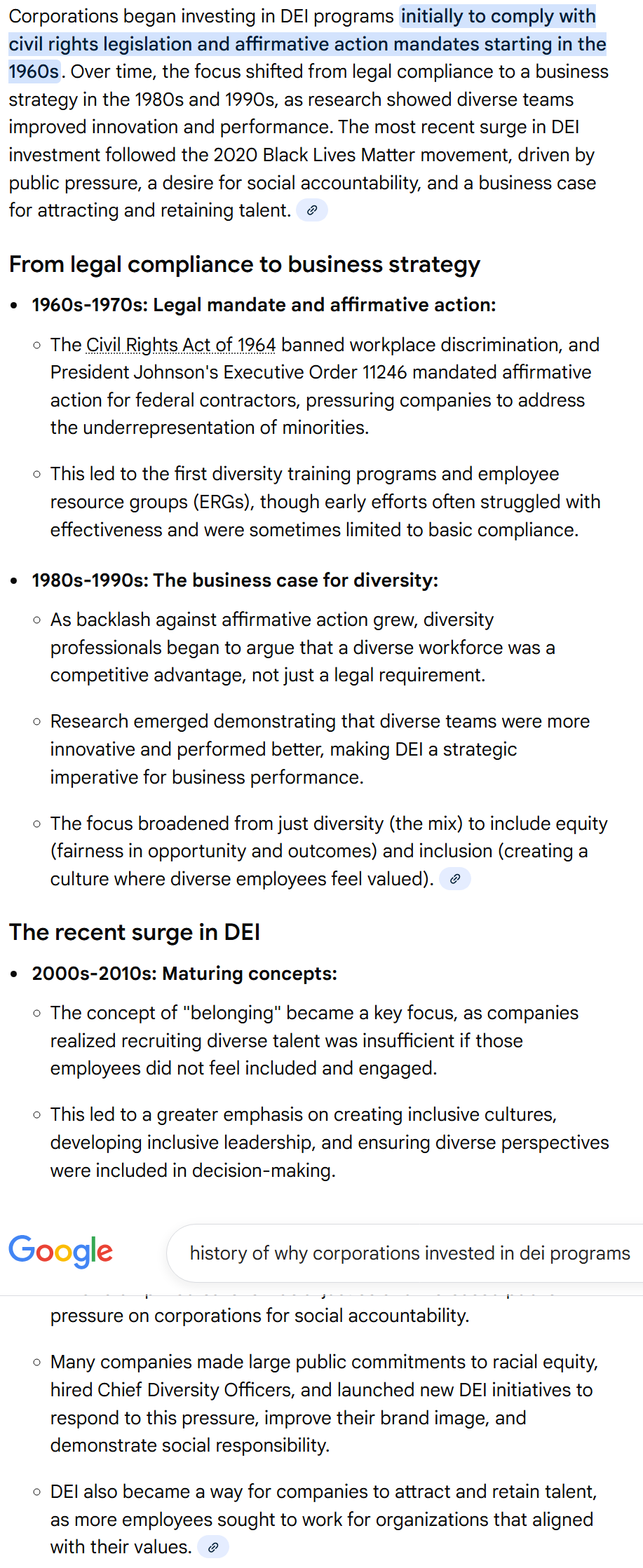


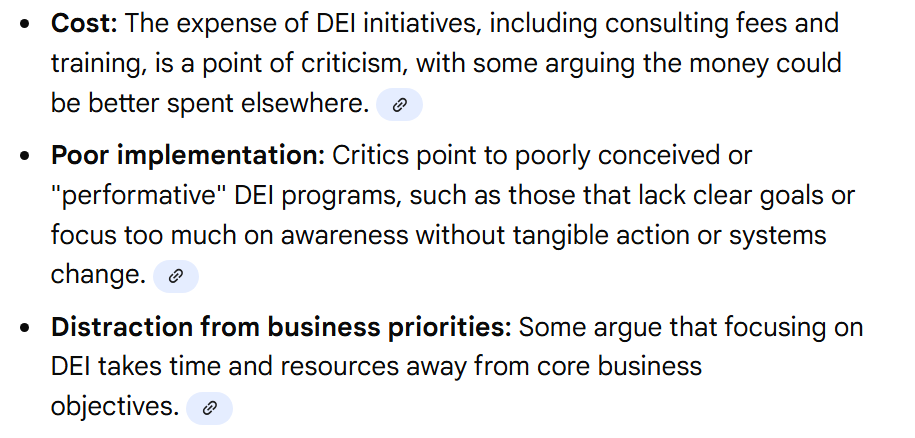


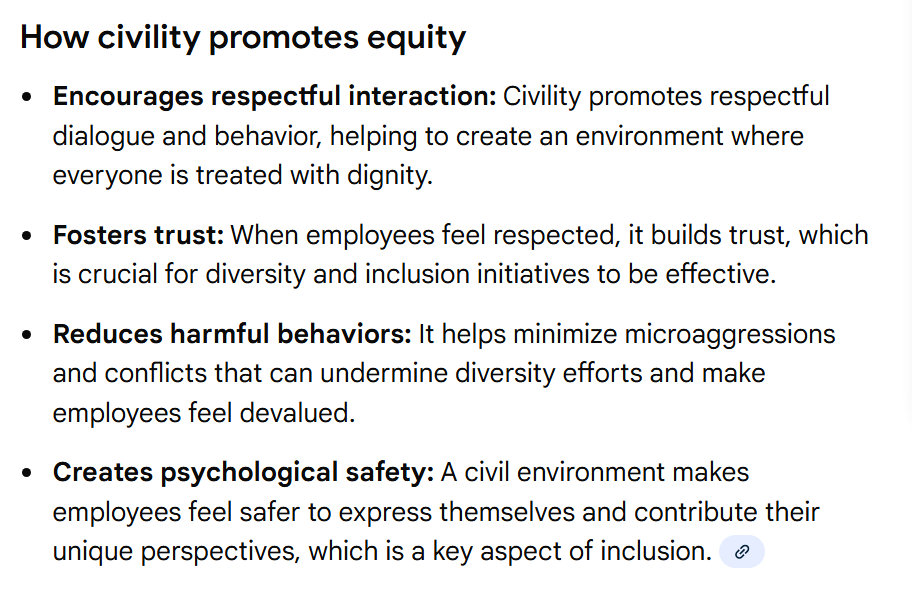
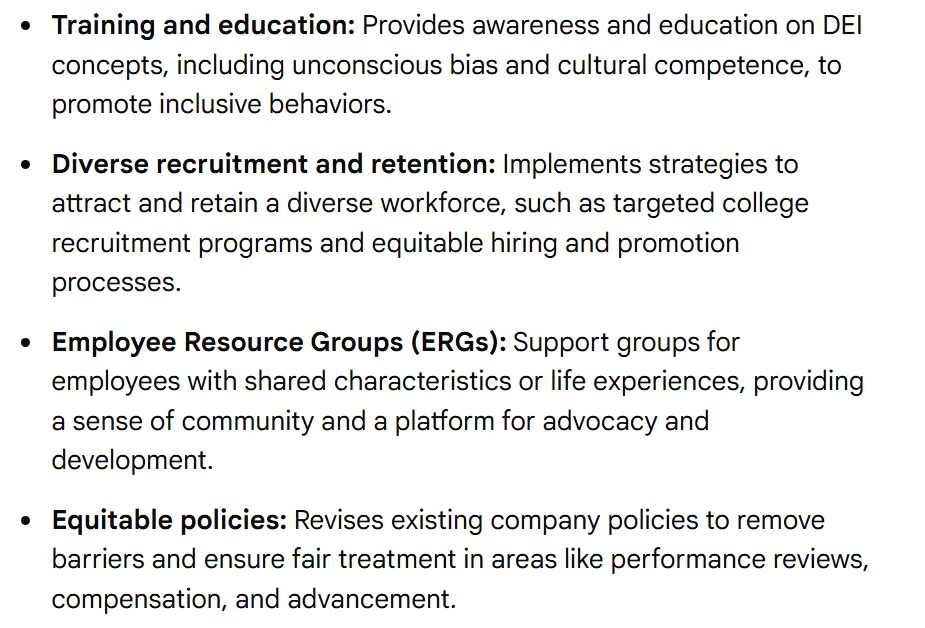




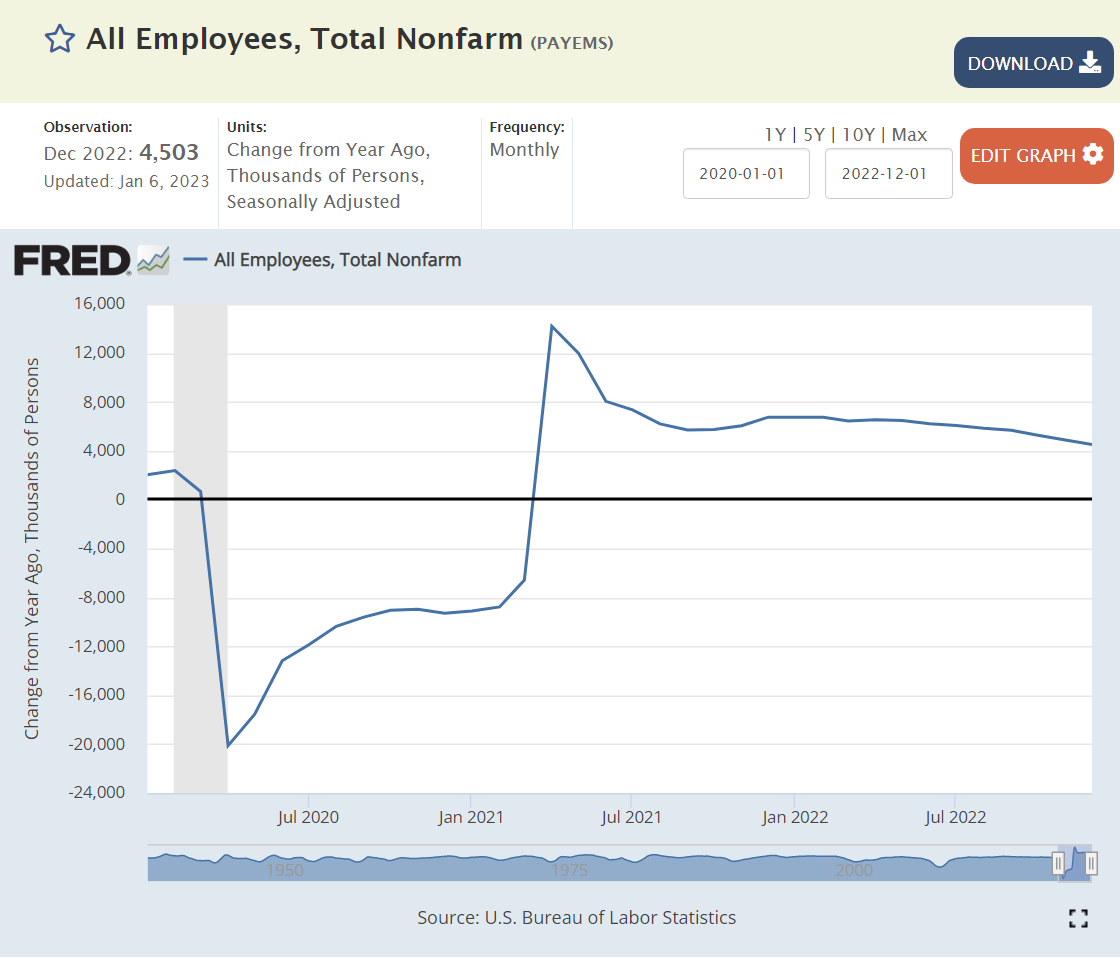


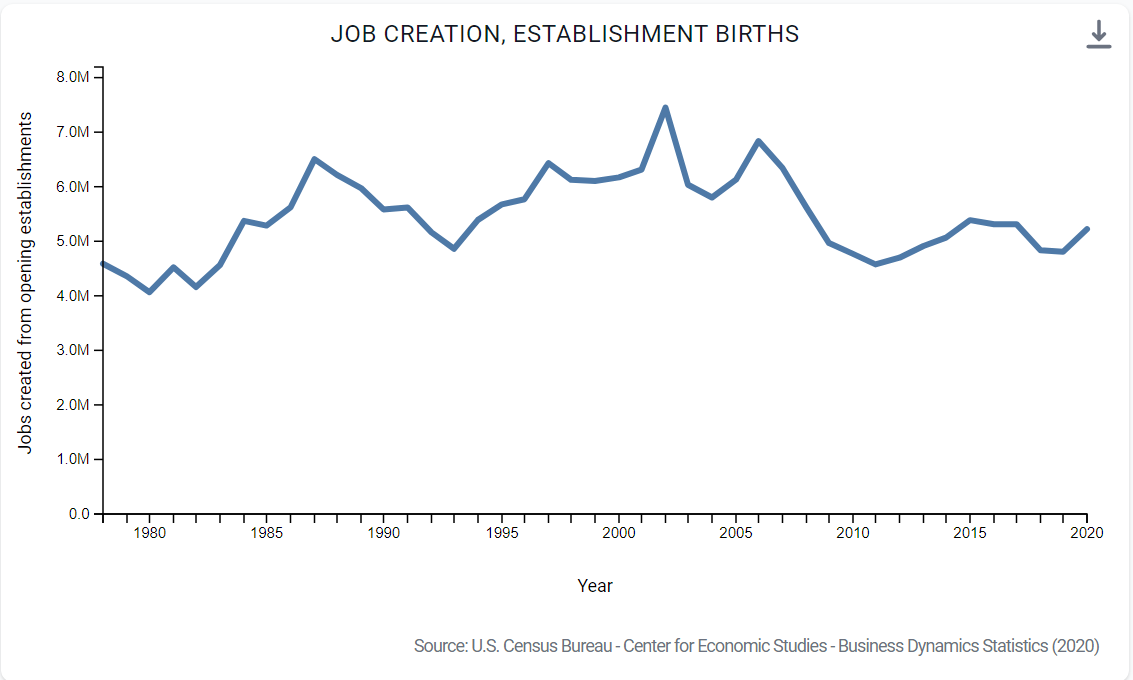
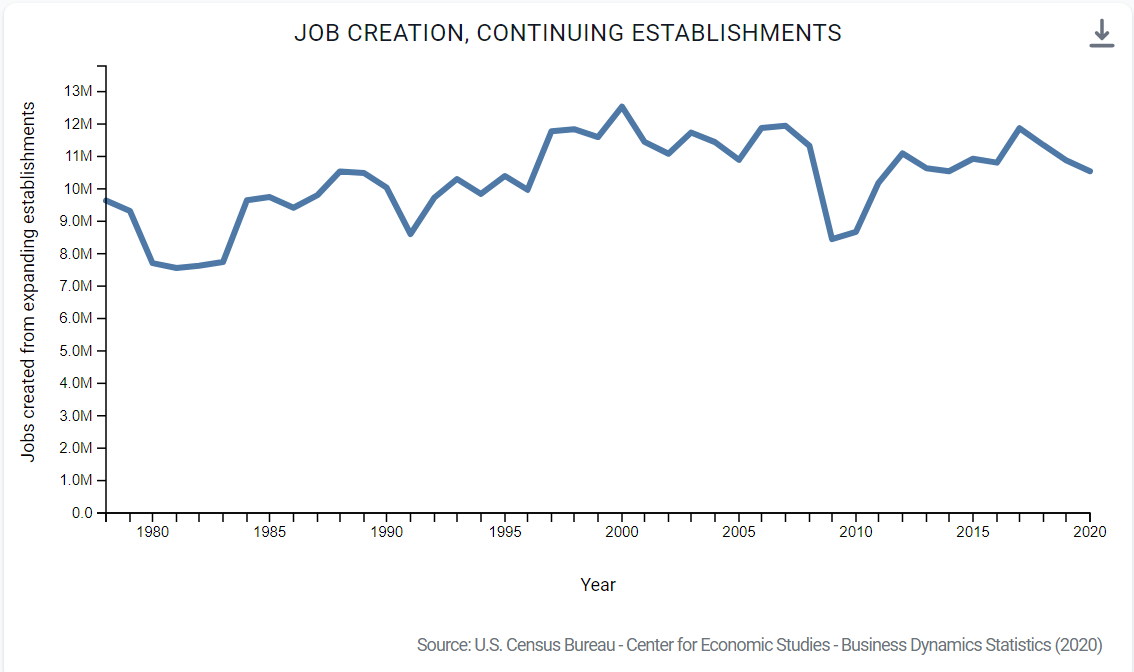

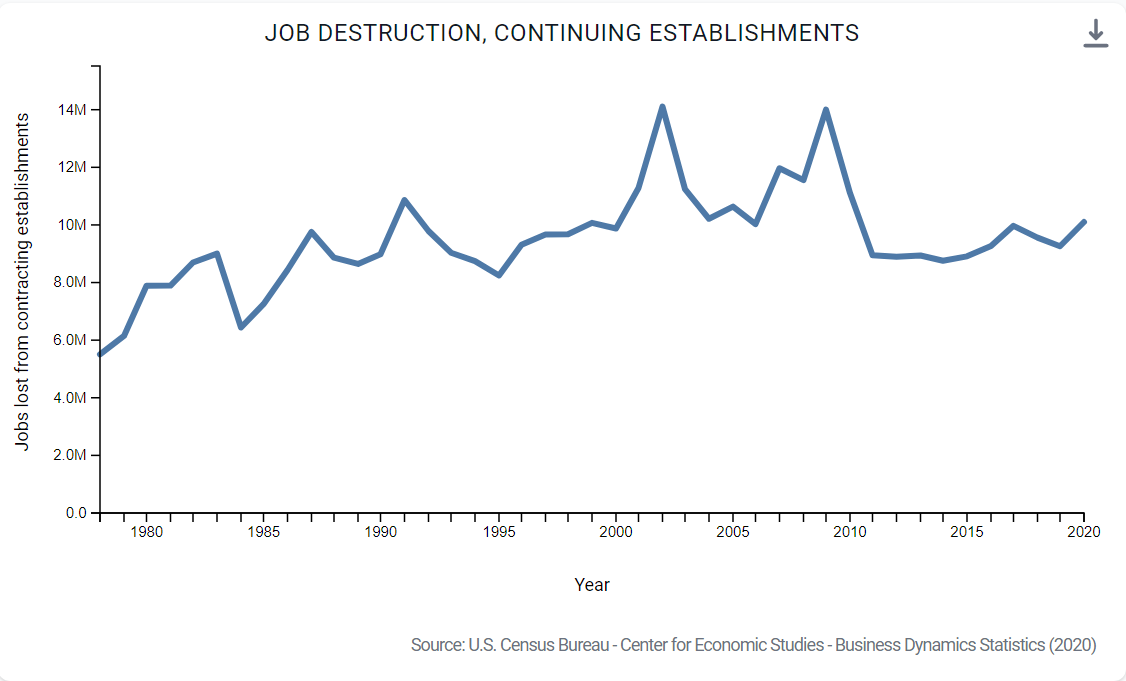


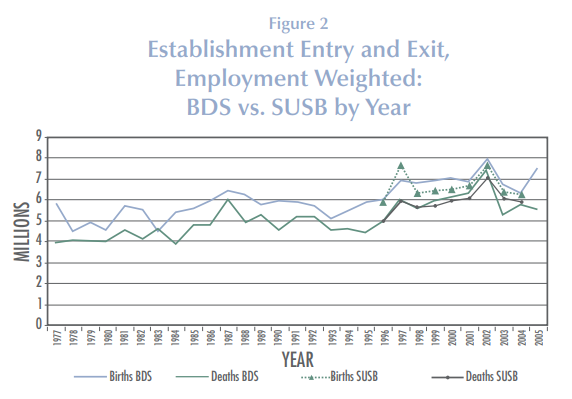


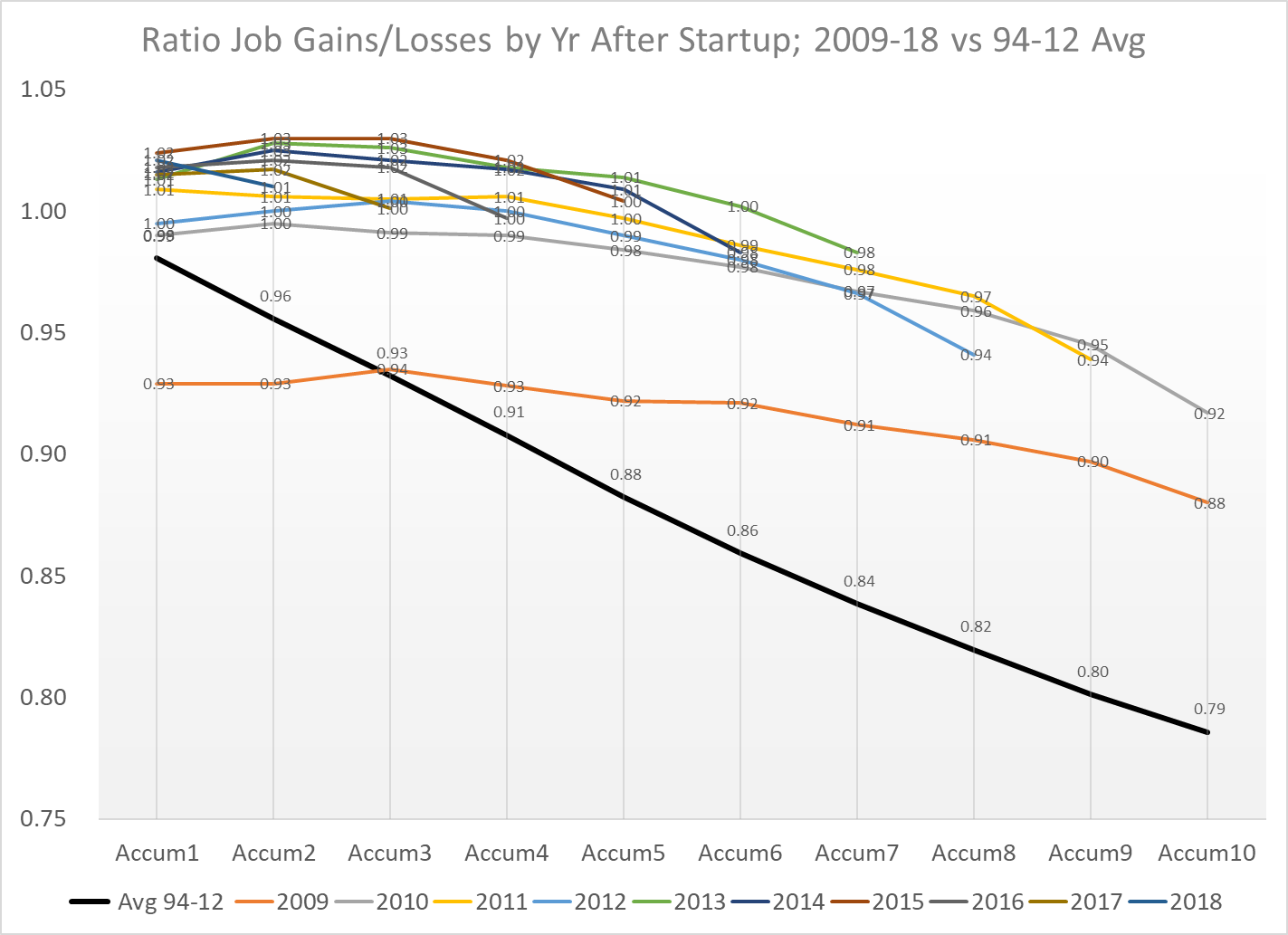


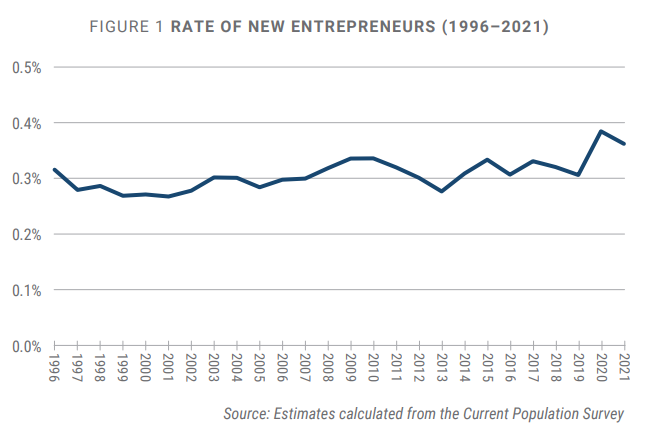


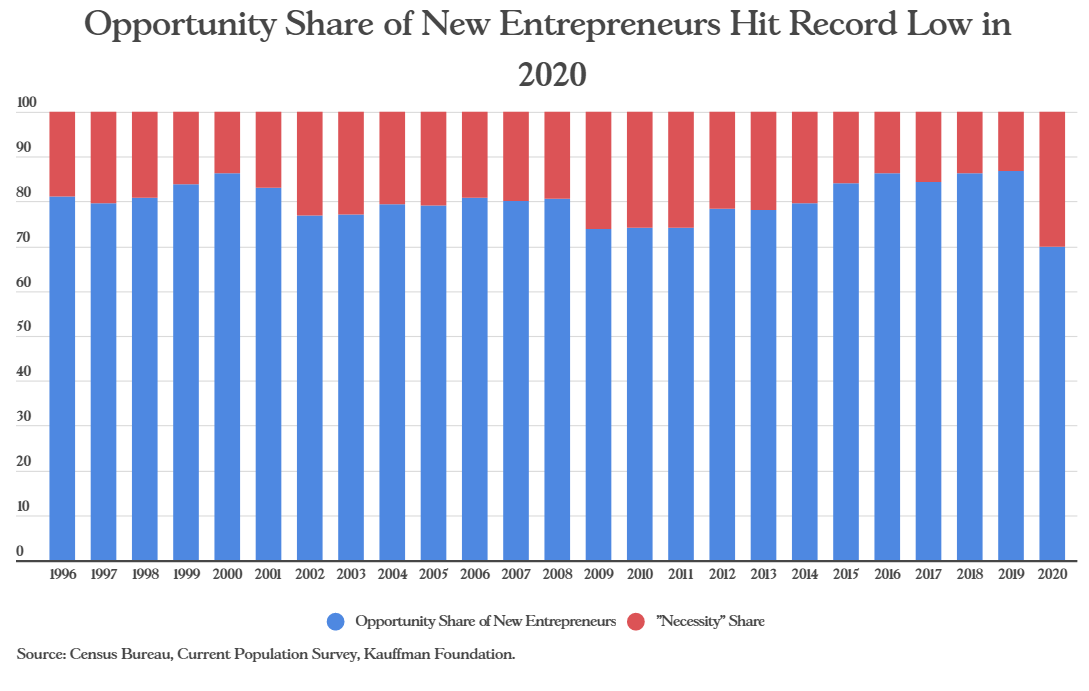



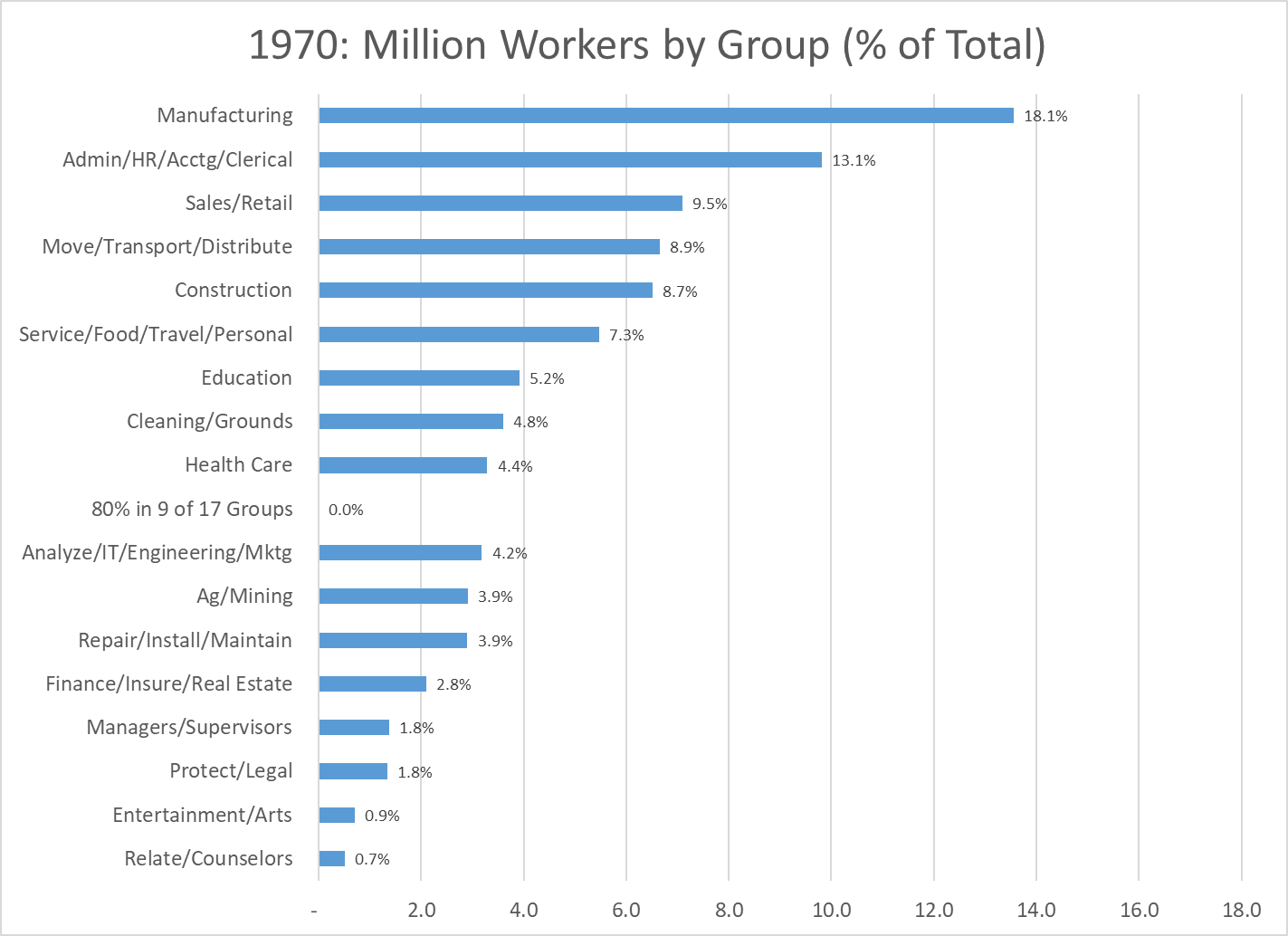
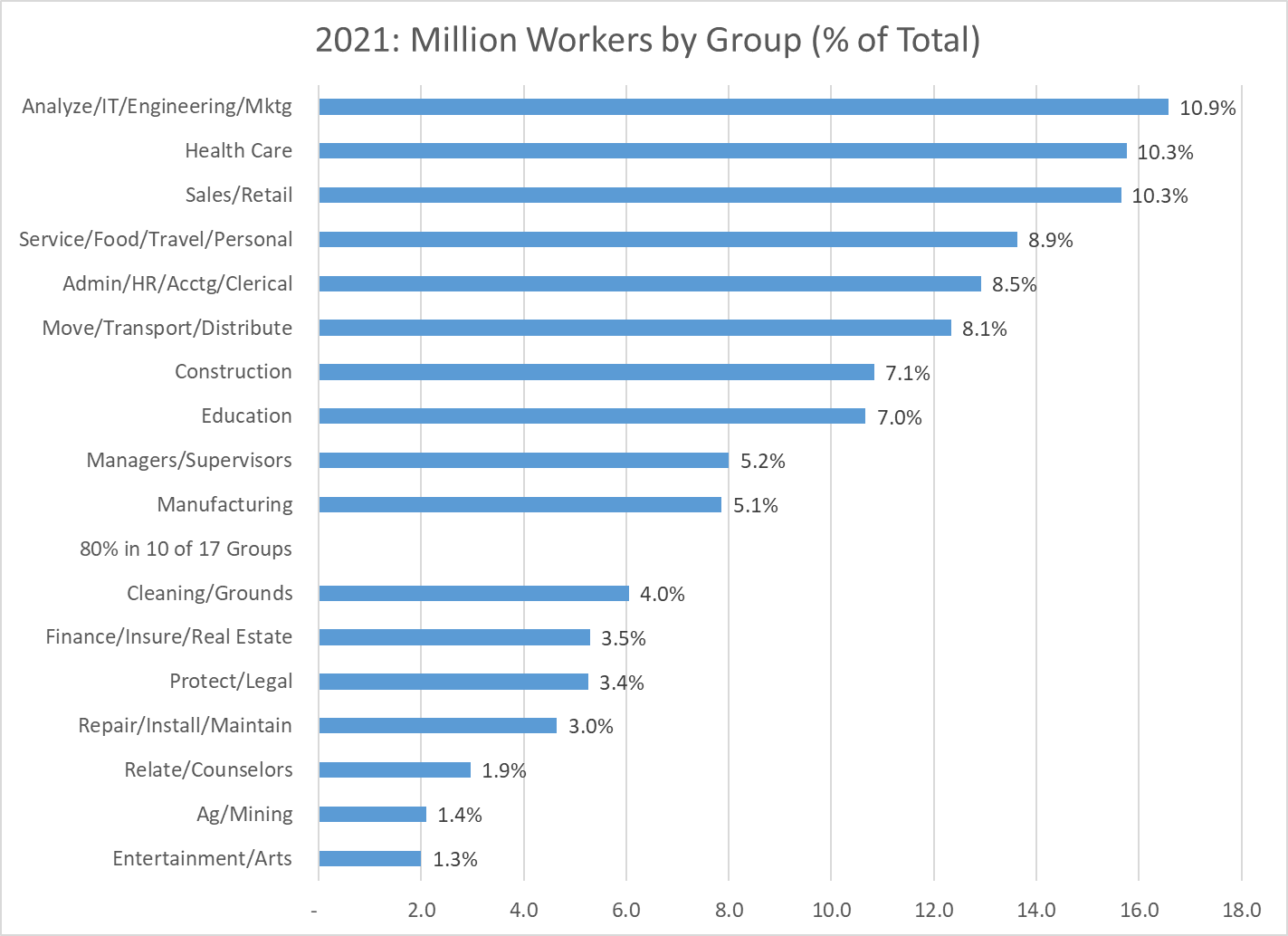
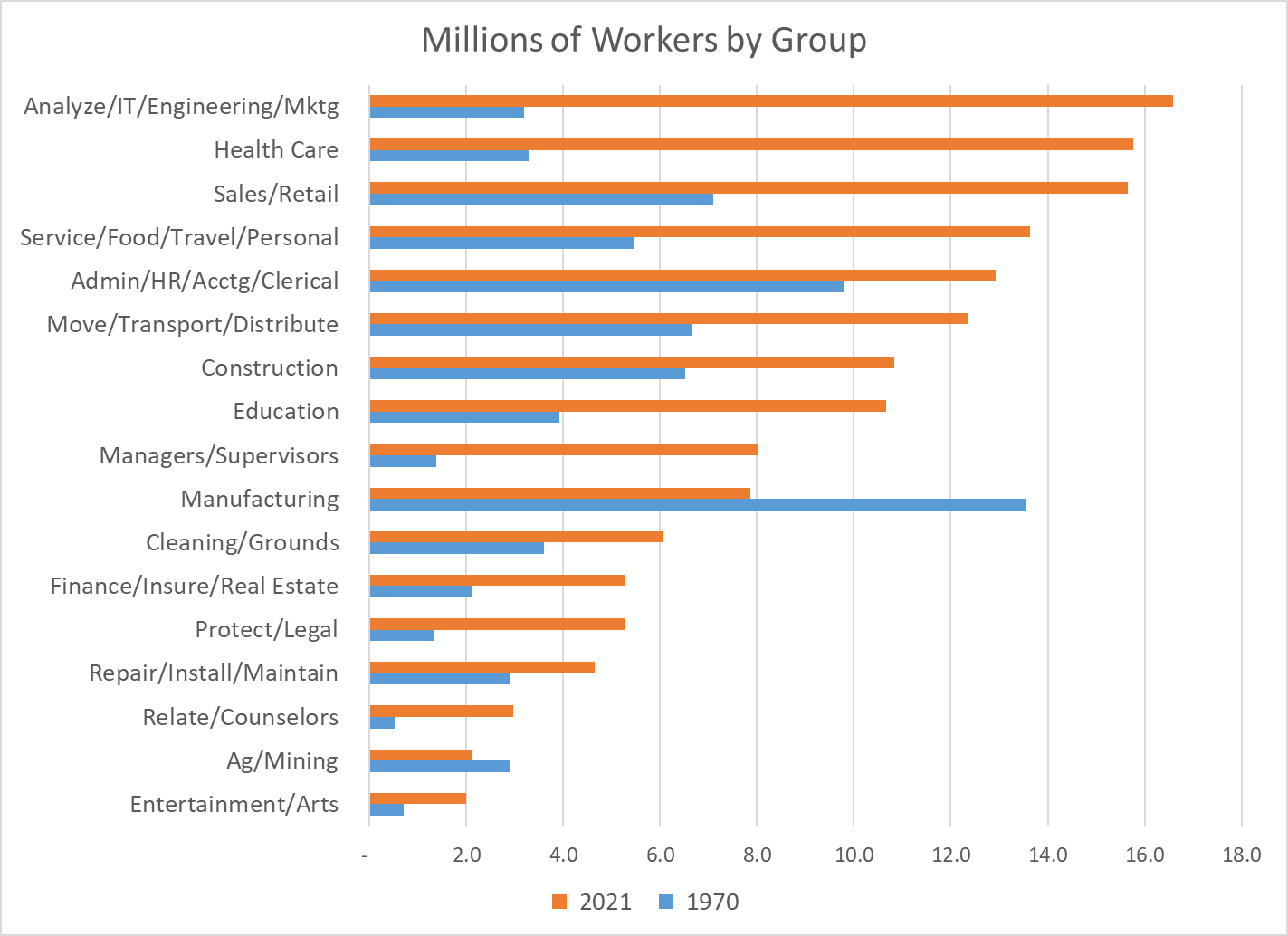
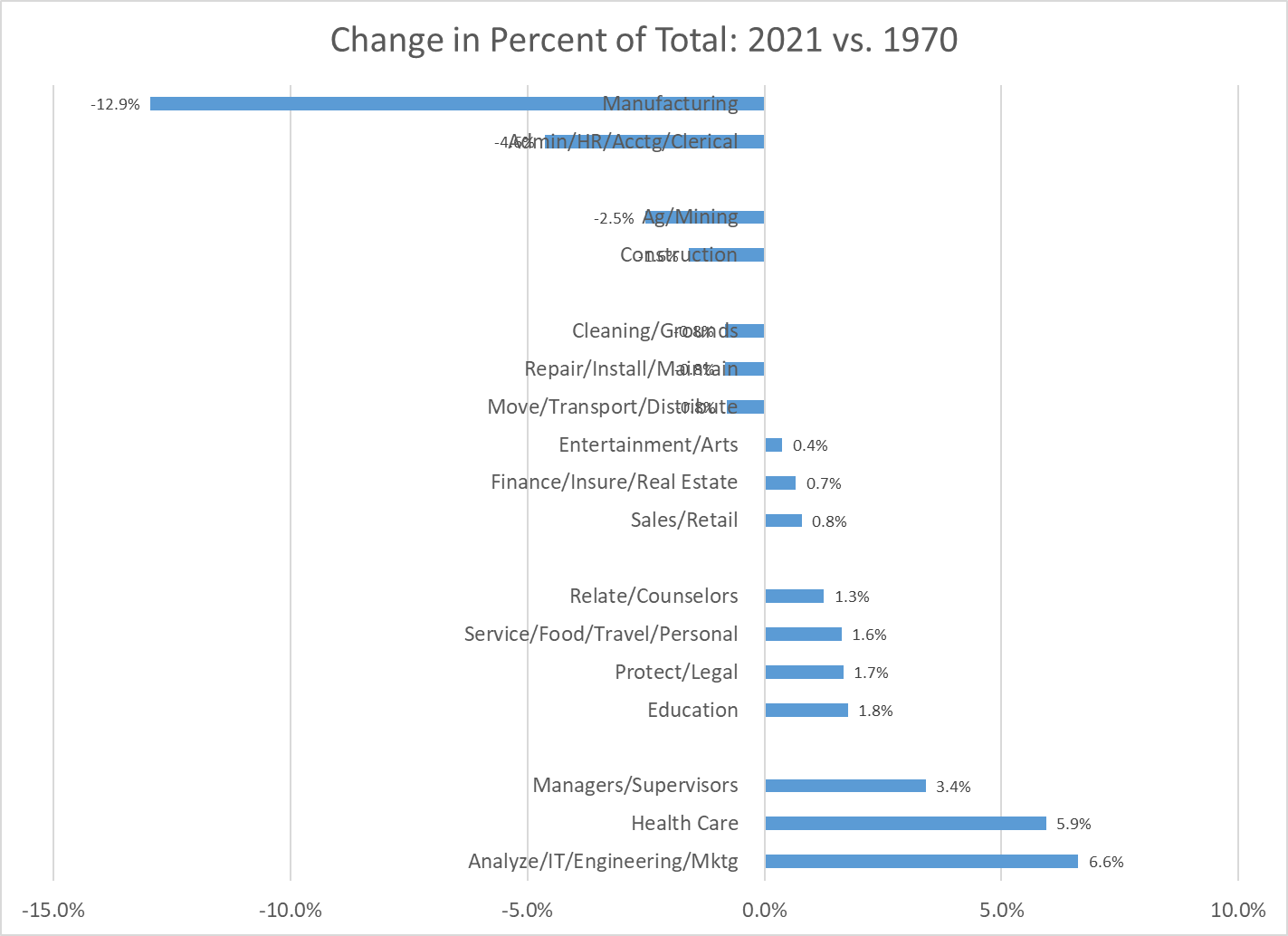
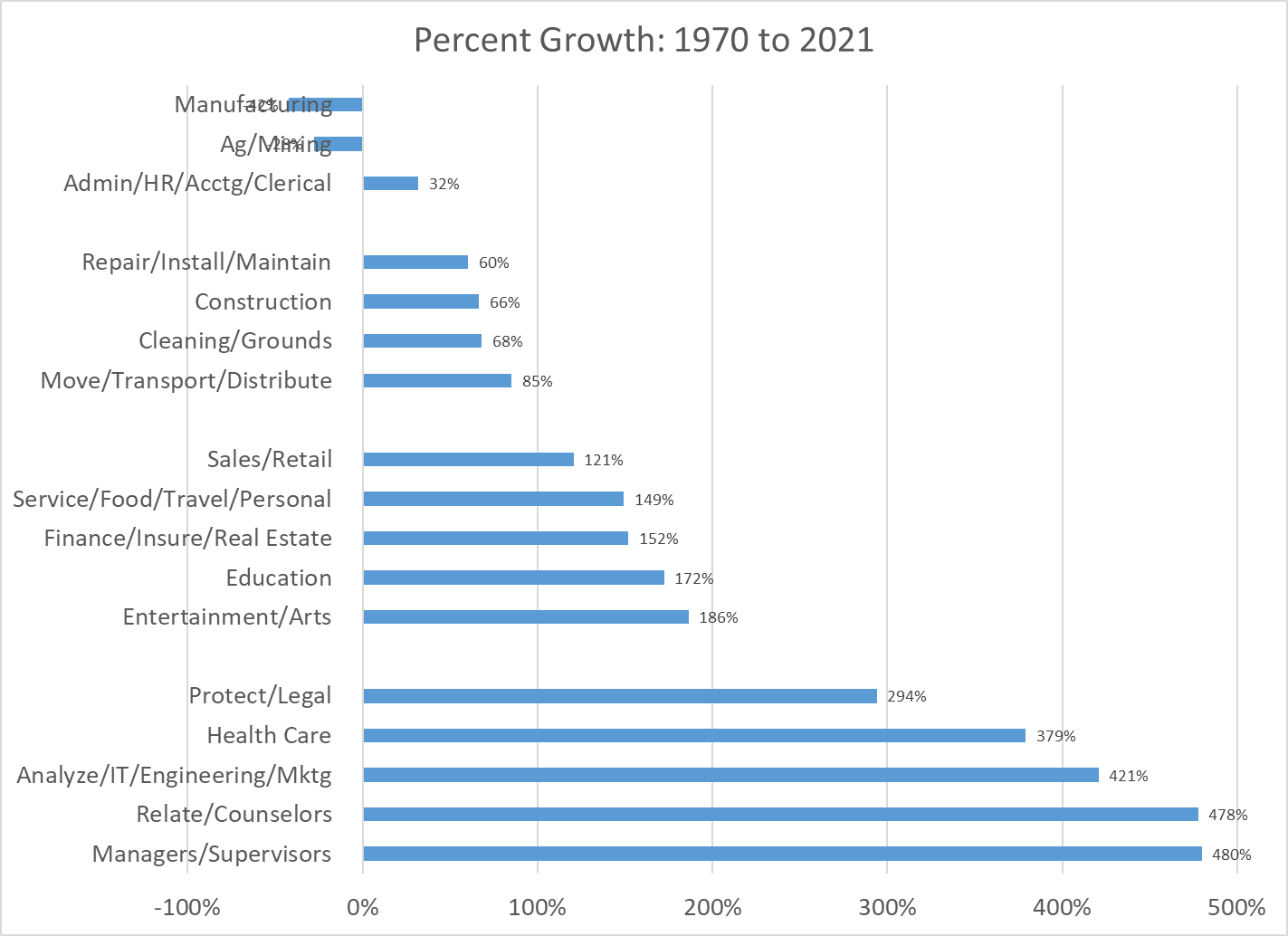
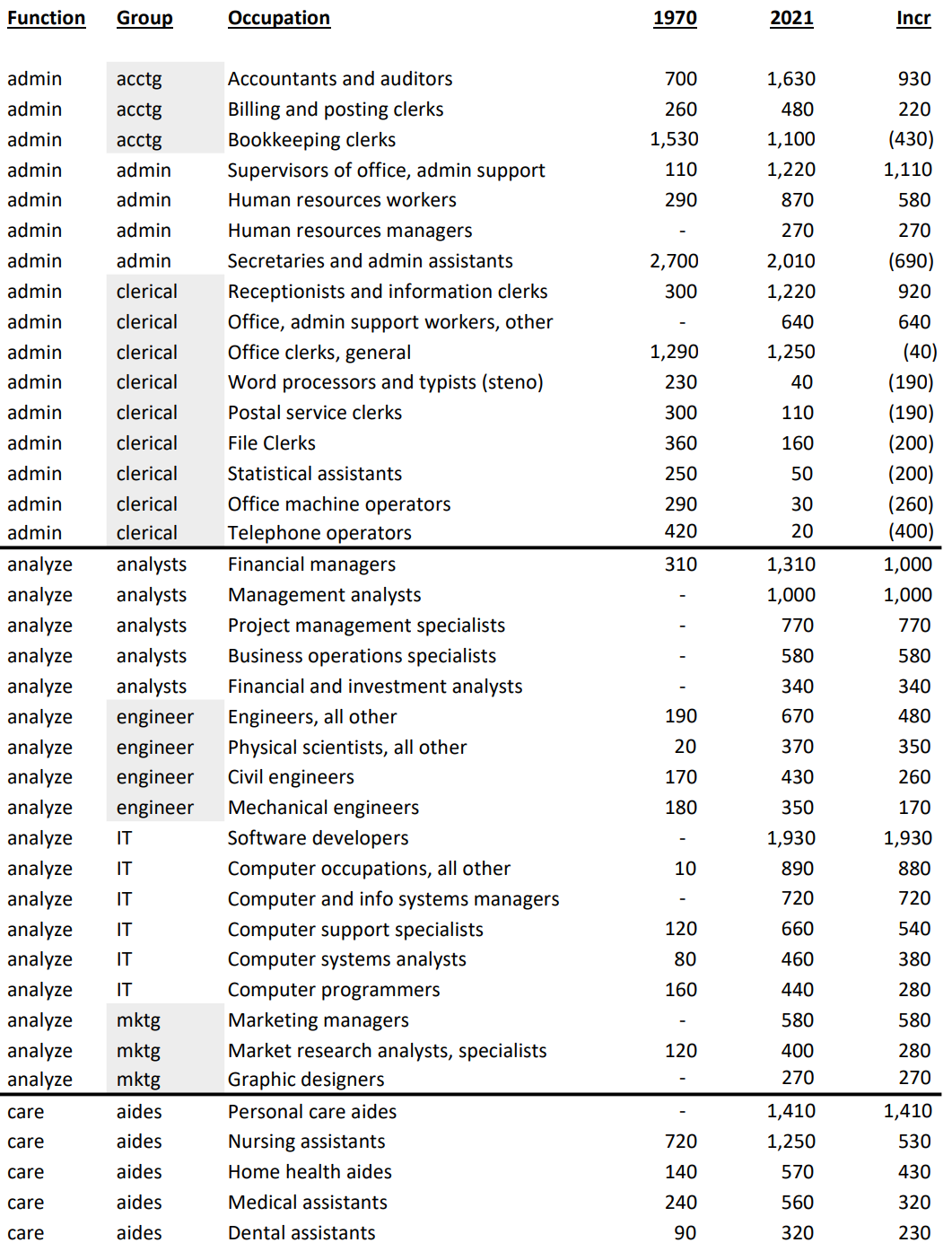
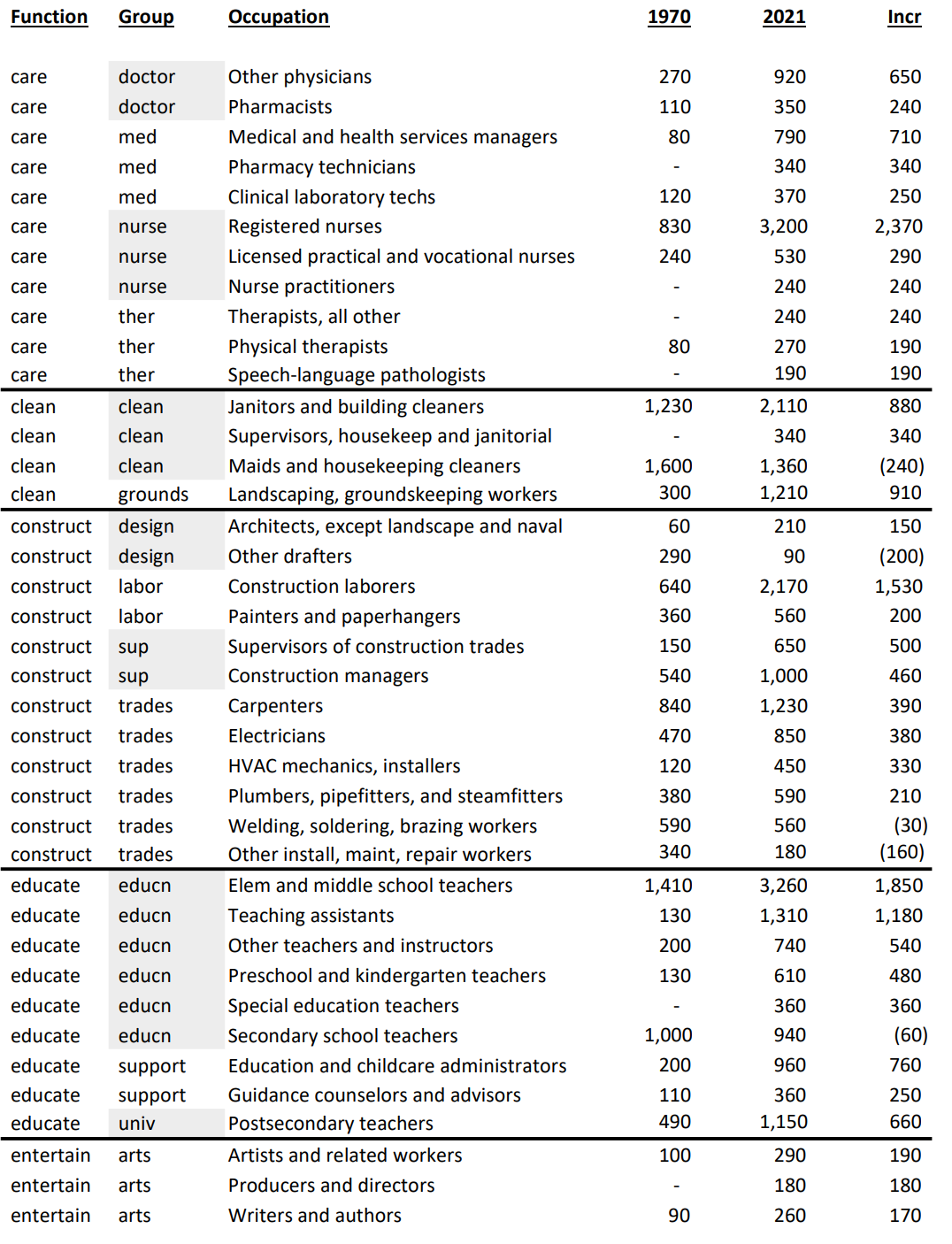

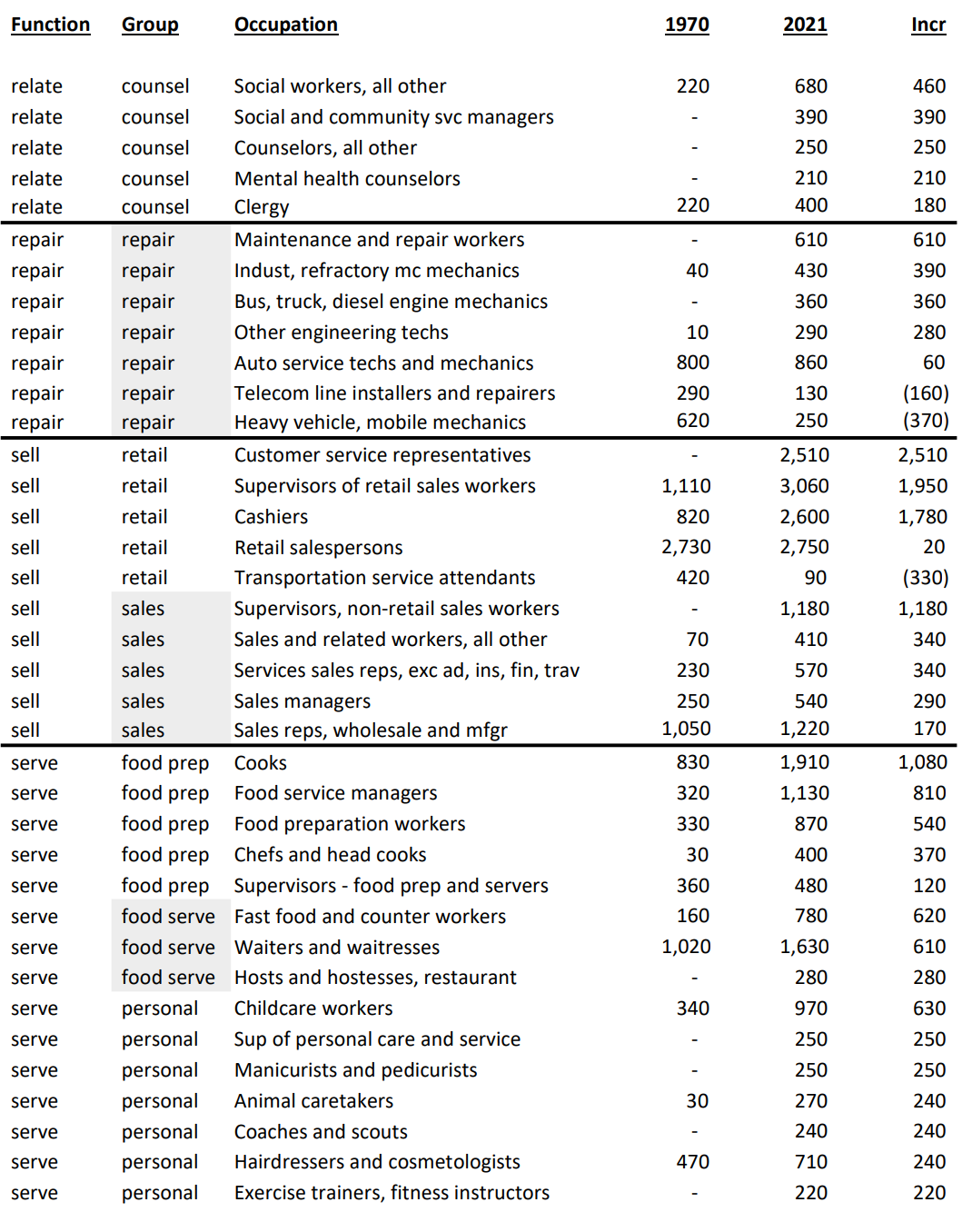
 Good News