Real mortage interest rates can be calculated as the difference between nominal mortage interest rates and the 10-year Treasury Bond interest rate. Although nominal interest rates have ranged from 3% to 16%, the real, after expected inflation, interest rates are remarkably consistent, averaging just 1.7% and ranging between 1.3% and 2.1% in 70% of the last 52 years. The peak real rate was 3.0% in 1982 following the unexpectedly high and remaining high nominal rates of the prior 4 years.
Banks, mortgage-backed securities investors and mortgage borrowers all take risks when they complete mortgage transactions. Lenders are betting that their present and future borrowing interest rates are and will be low enough to fund their mortgages at a profit. Each lender locks in funding commitments for a reasonable share of the loan life and counts on the consistency of interest rates over the business cycle to fund the remaining portion. Lenders that experience a mismatch put their stockholders’ equity at risk and face bankruptcy. Investors in mortgage-backed securities are subject to valuation change risks throughout the period in which they are invested. Most such investors hold diversified portfolios of mortgages (region, amount, riskiness, urban vs suburban vs rural) and non-mortgage assets to ensure that any investment decision will not be too damaging.
Fixed-rate mortgage borrowers are betting that inflation will not fall too much lower than the expected inflation rates when they borrowed. If so, they will be paying back the mortgage in higher real value dollars than expected. If inflation and mortgage rates drop by more than 2%, most borrowers will seek to refinance their mortgages at the new, lower market rates, paying another round of closing costs for this privilege. Fixed rate borrowers are also hoping that inflation will be higher than the expected inflation rates at the time they borrowed, allowing them to pay back their debt with cheaper real dollars. Mortgage originators do not generally have the legal right to “call” the debt and require a change in the rates and terms as many commercial lenders and bond issuers do.
The “good news” is that the US mortgage market is very efficient and the real interest rate premium for borrowing to own a home is just 2% more than what the US government pays for borrowing. Borrowers face interest rate change risks, especially being caught with a high interest rate mortgage when inflation rates fall if they are unable to refinance.
The market has been tested through 7 business cycles and held up very well. The “Great Recession” exposed excessive risk taking by mortgage originators and funders. They lost money and many went out of business. Riskier mortgages are rarely issued today, and government regulations provide some added protection against any future overreach.
For higher income households that itemize deduction on their federal tax returns, the nominal interest rate paid is a tax-deductible offset to earned income. These individuals typically pay 22%, 24% or 34% marginal tax rates. A 5% nominal tax rate can provide a 1%, 1.25% or 1.65% reduction in the effective interest rate, thereby making the 2% real mortgage rate less than 1%. Higher income households can benefit greatly from this tax benefit.
Real, after inflation, Gross Domestic Product is up by one-third, despite the pandemic. That’s 2% annually, despite the Great Recession and the pandemic. The US economy is very solid.
A 21% increase in per capita income during this time. Quite solid and constant growth.
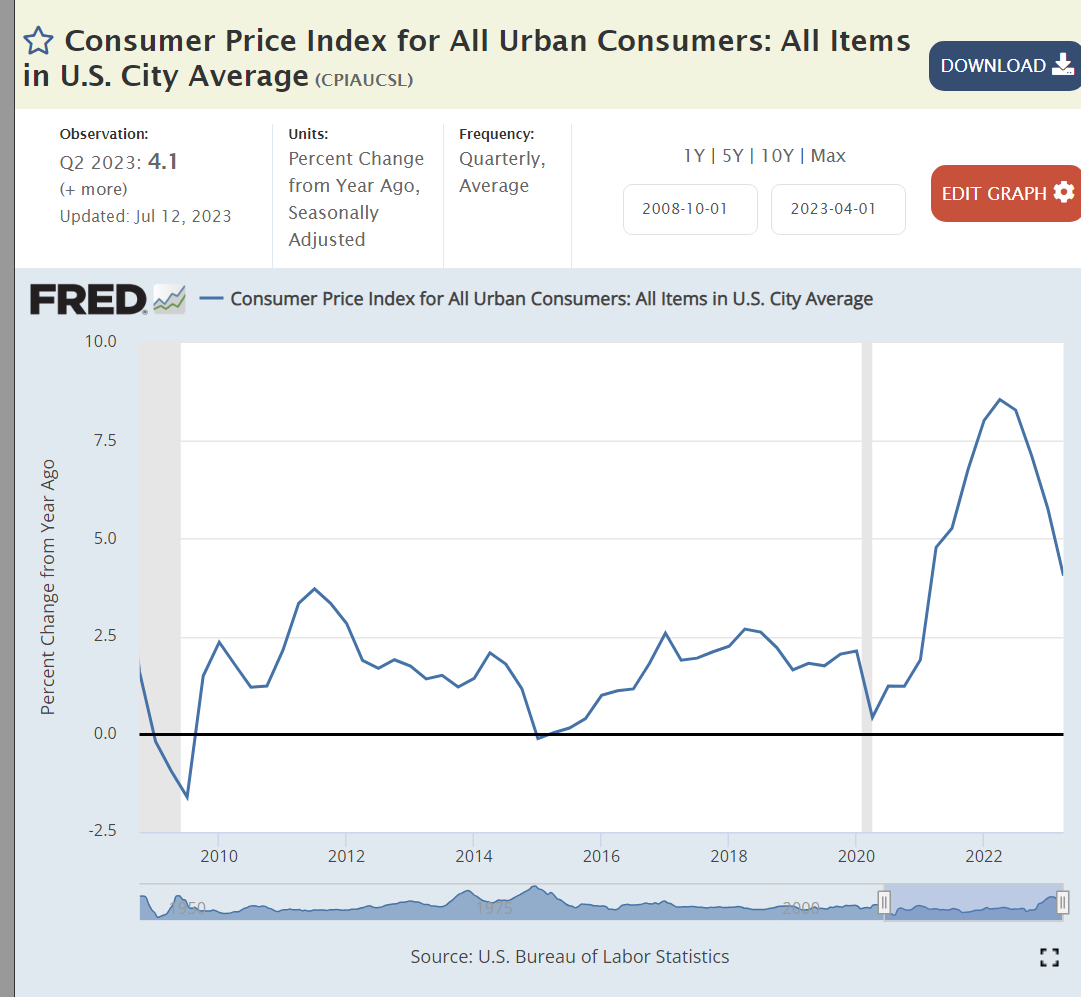
Inflation averaged a bit less than 2% before the pandemic, spiked to 8%, and has since declined to 4%. Experts disagree on whether it will return to 2% soon.
Gas prices are the most obvious component of inflation. They are largely driven by global supply and demand. Prices today are the same as in 2011-14, despite the general inflation increase of more than 20% since then.
Despite the pandemic, US unemployment is at a 50 year low!
Job seekers today encounter 3 times as many job openings.
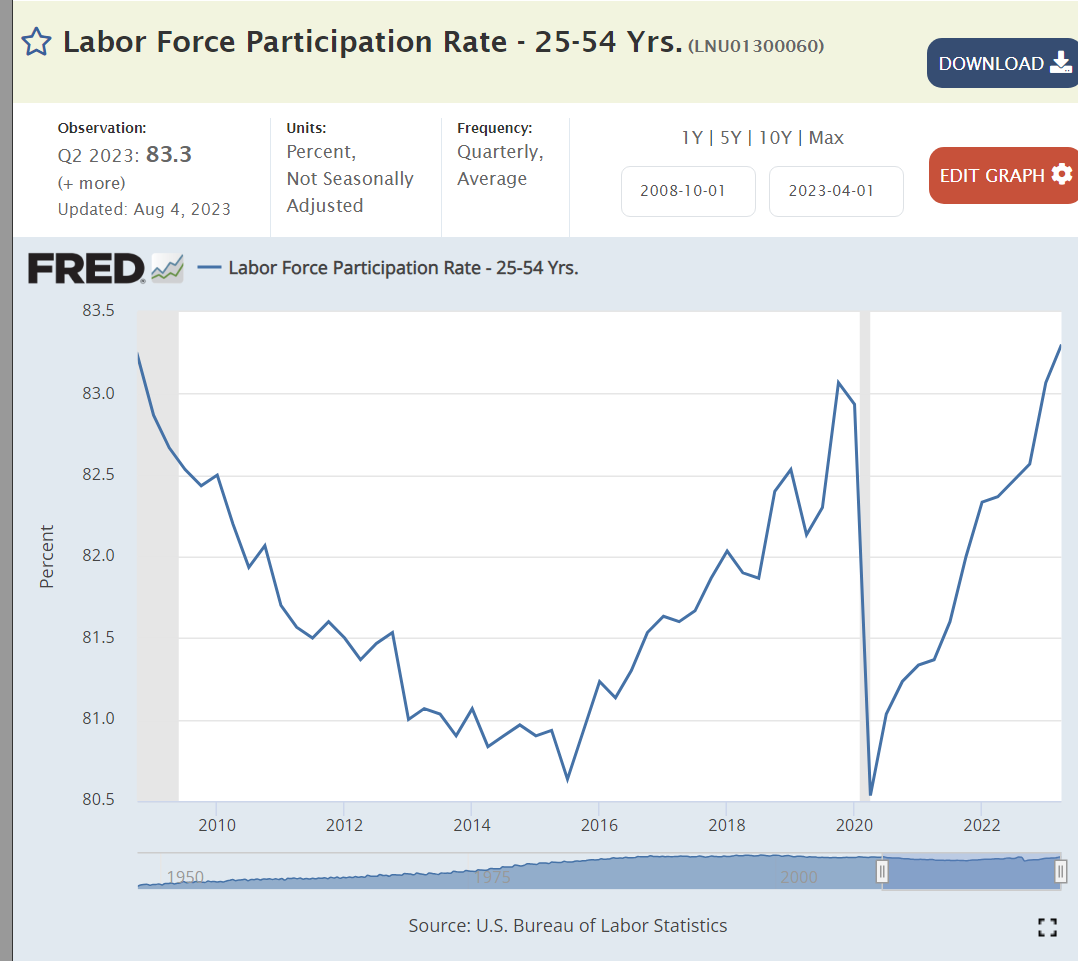
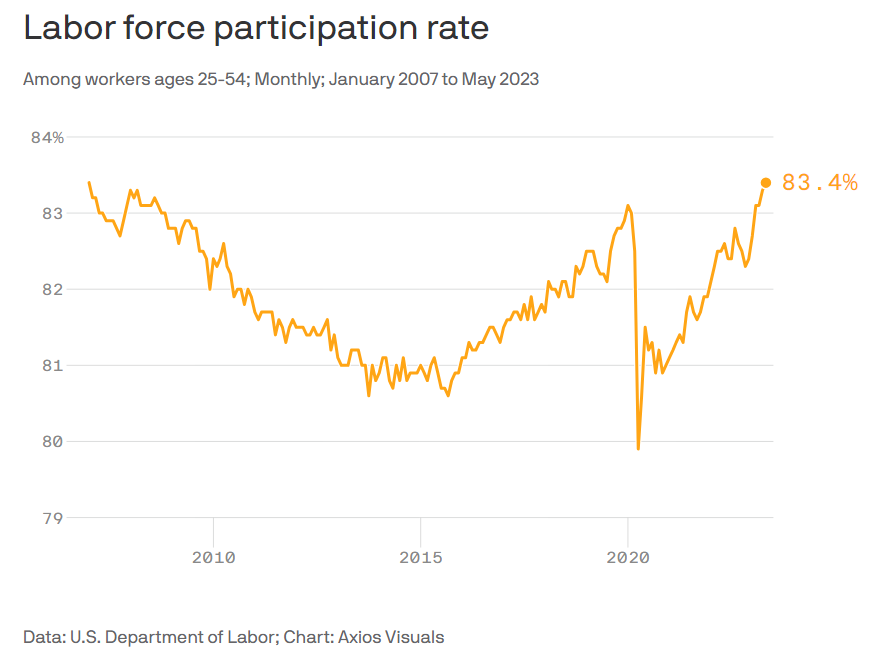
Core age labor force participation has snapped back after the pandemic.
Investment values have doubled.
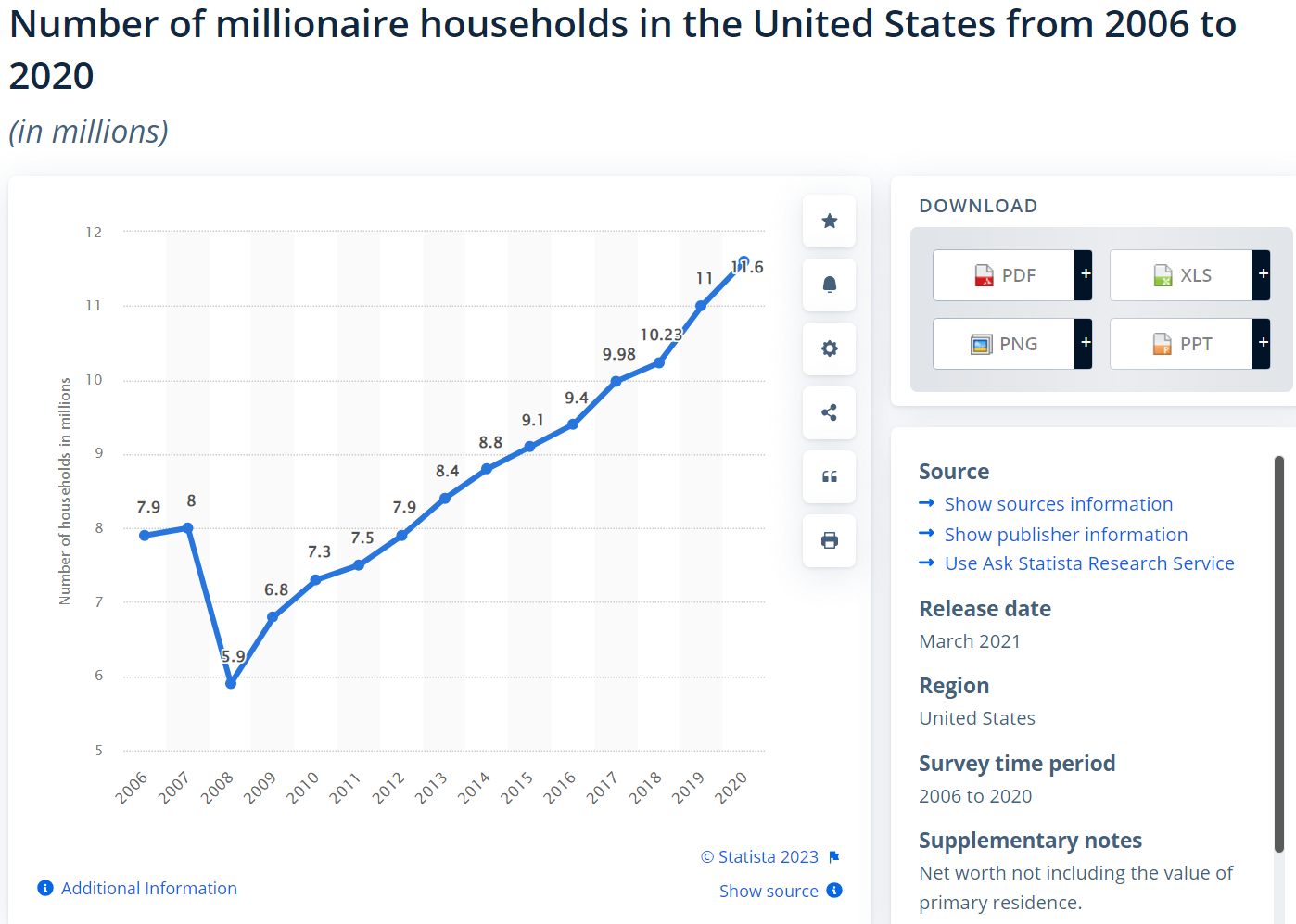
The number of millionaires and billionaires in the US has continued to increase.
Personal savings rates rose from 6% to 9% before the pandemic, shot up and fell back down to just 4% recently.
Housing values have doubled since the Great Recession.
Mortgage rates averaged 4% after the Great Recession, dropped to 3% and then increased to 6%+ as the Federal Reserve raised interest rates.
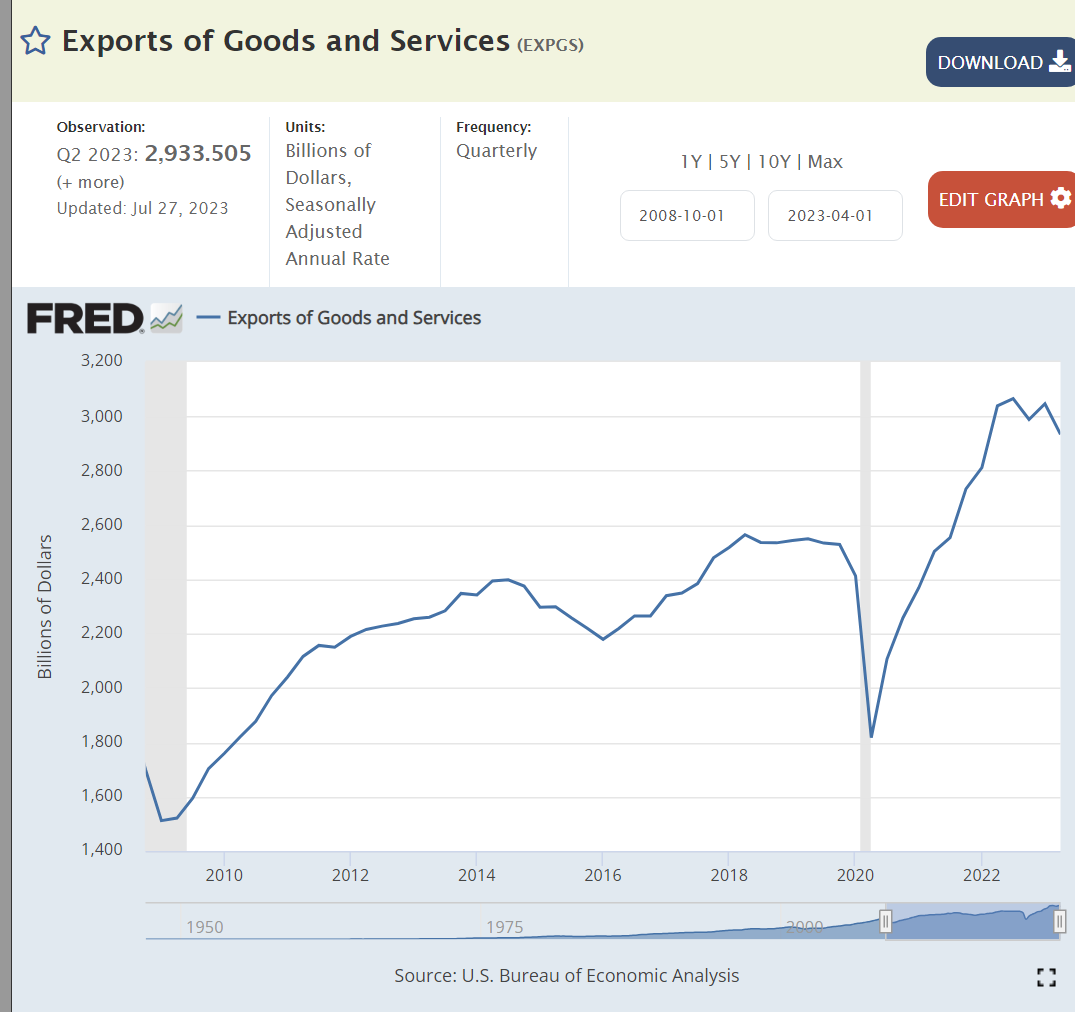
US exports have nearly doubled in 14 years.
Despite the Trump tariffs, which Biden has maintained, imports have also nearly doubled.
Despite historically slower growth rates, higher budget deficits and looser monetary policies, the US dollar is more highly valued today than in 2008.
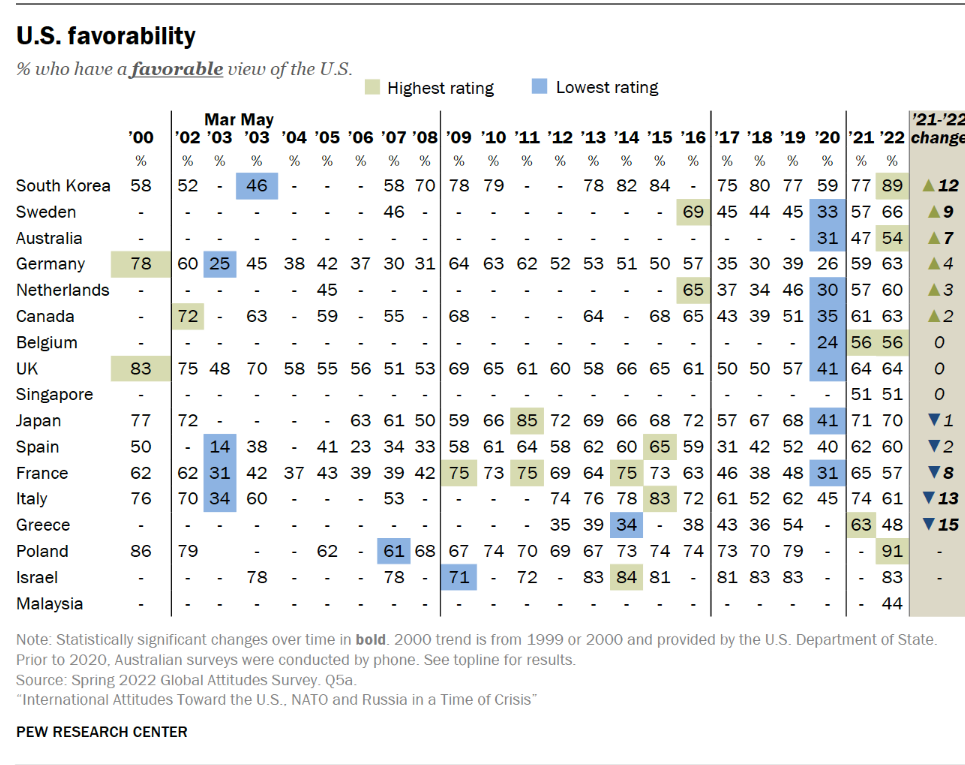
Foreign countries still see the US as a positive ally, despite their concerns during the Trump era.
Obama returned the budget deficit to a “reasonable” 3% by 2016. Trump expanded it to 5% and then 15% as the pandemic struck. Biden drove some recovery to 5% by 2022, but has not driven further reductions.
US coal production is in a long-term decline.
Natural gas production has nearly doubled in 14 years.
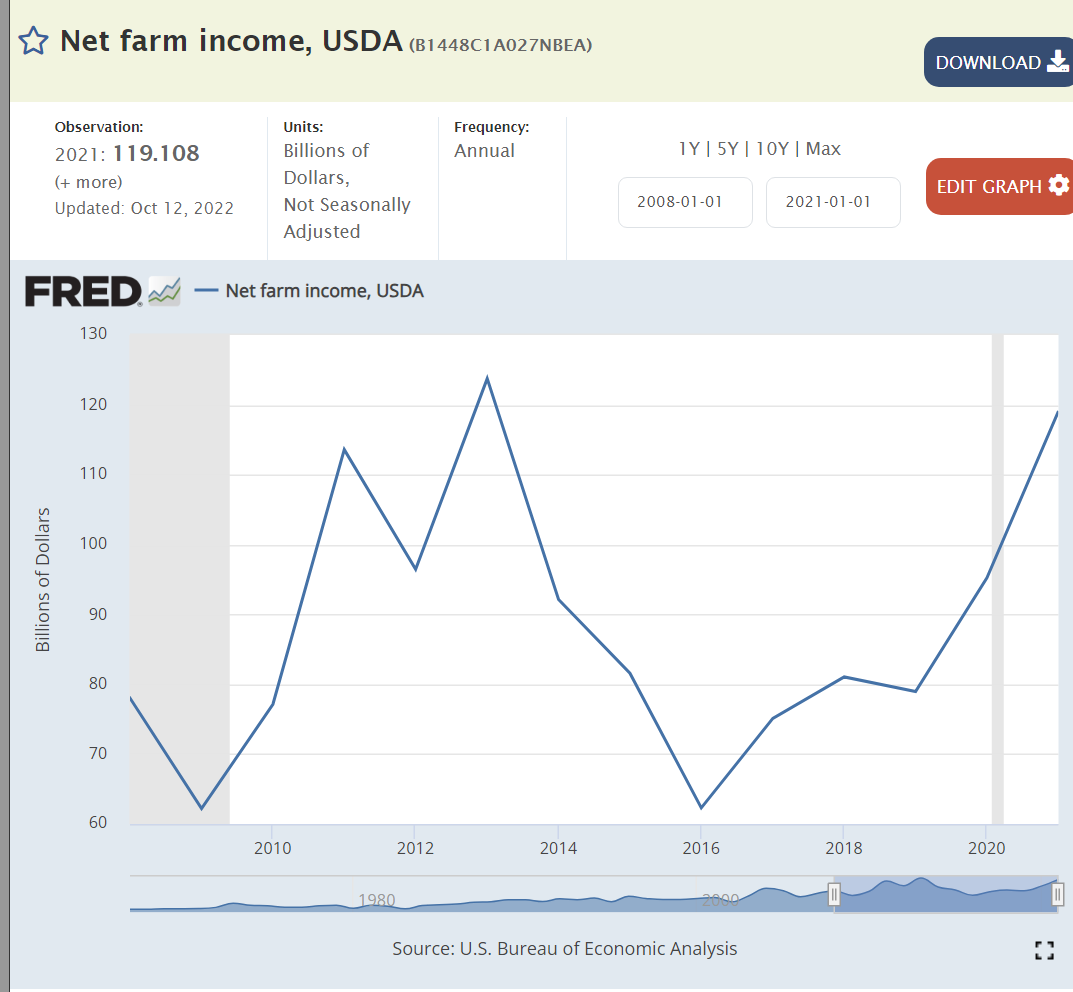
Net farm income has been significantly above the base for 6 of the last 14 years, despite lavish Trump farm subsidies.
Manufacturing employment has continued to rise slowly in the last 14 years against the headwinds of international competition.
It’s difficult to put the pandemic in perspective, but here we see a 2-year reduction in expected lifespans. Opioid deaths and so-called “deaths of despair”, alcohol, drugs, suicide, also play a role.
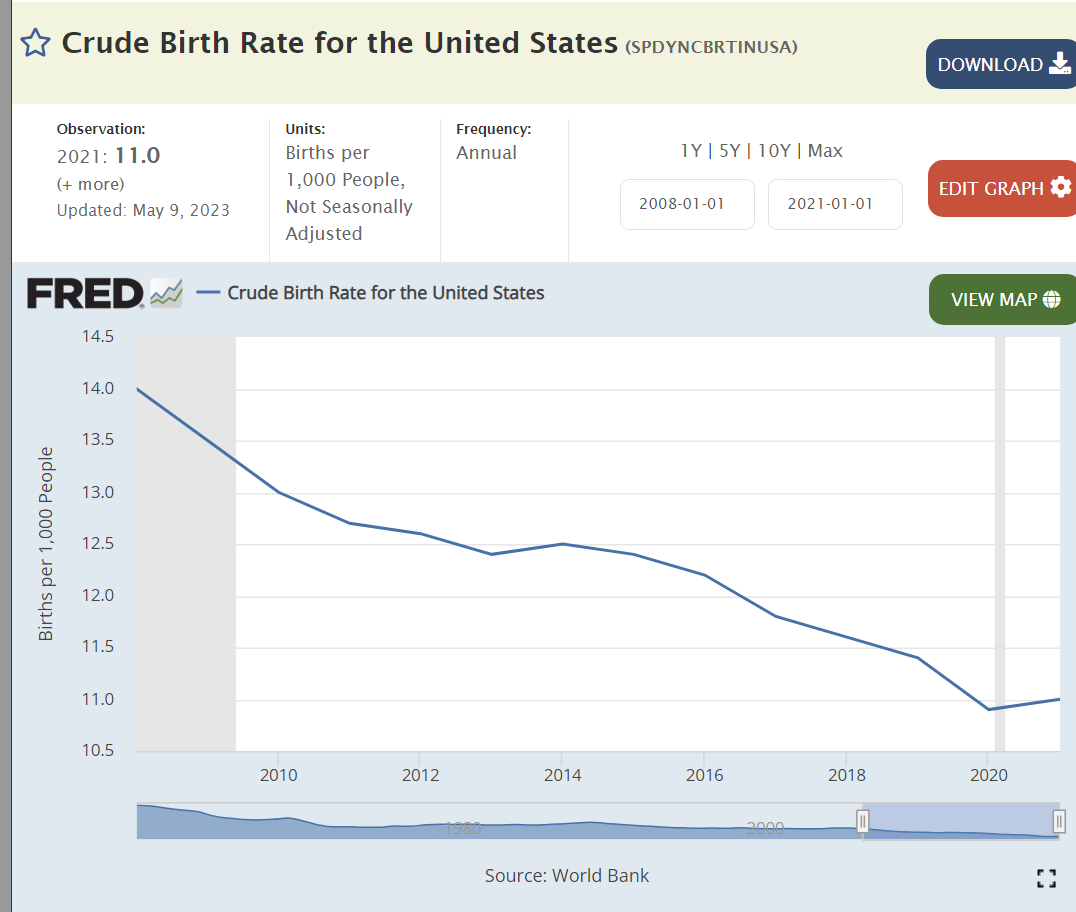
Birth rates continue to drift lower as seen in all regions of the world.
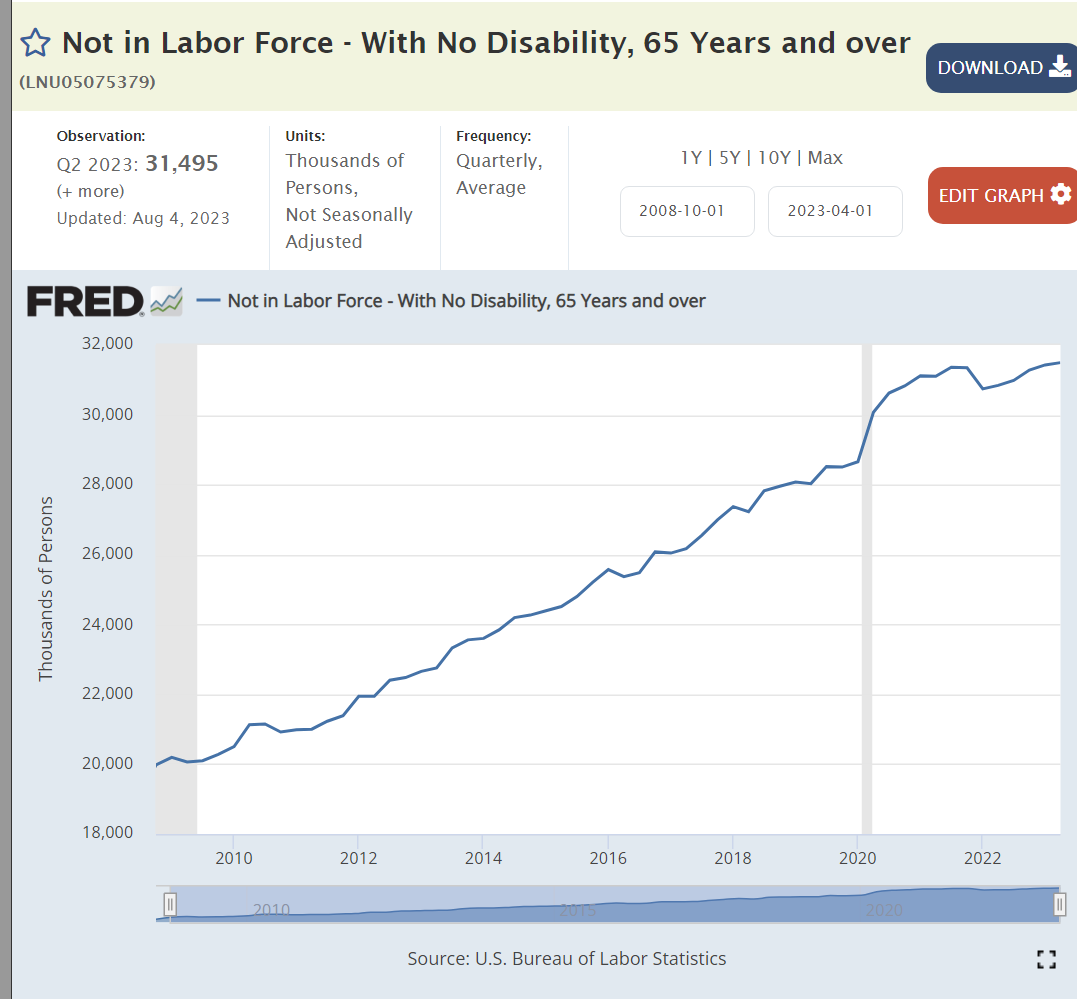
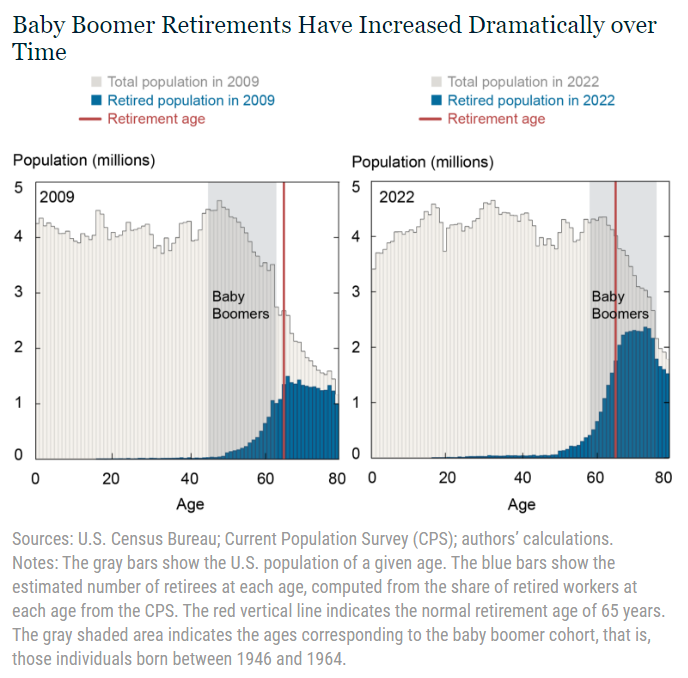
The number of retirees has increased by more than 50%.
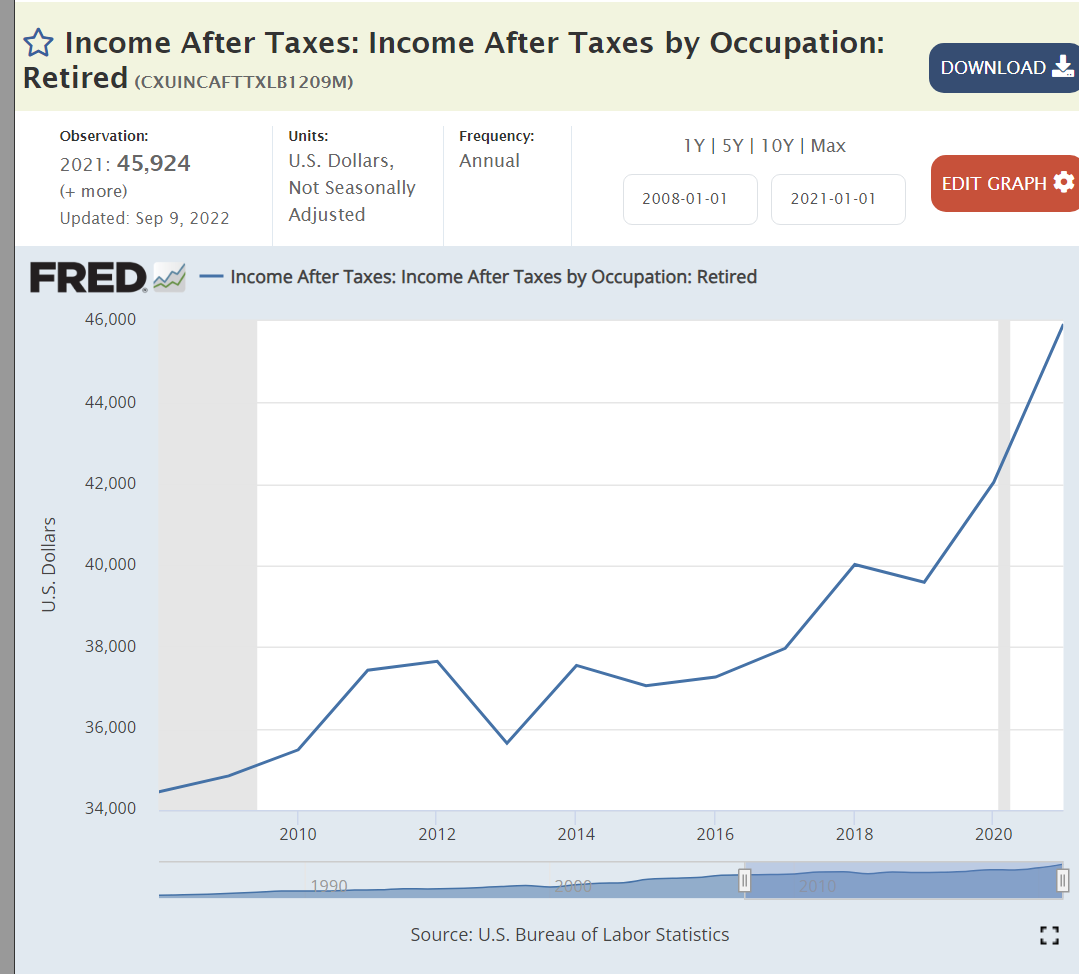
Retiree incomes are up by one-third, matching inflation.
Prospective retirees have doubled their cumulative savings.
The abortion rate has continued to fall in the last 30 years.
Church attendance has dropped from 40% to 30%.
Summary
The US economy recovered slowly after the Great Recession and then very quickly after the pandemic. Real, after inflation, output and per capita output increased. The labor market became very tight. Asset prices (investments and housing) rose for intrinsic and monetary reasons. The US remained a competitive international producer. The federal budget deficit was better at the end of the Obama period but worse for Trump and Biden. The pandemic reduced life expectancy and households had fewer children. Successful retirements grew and will grow. Social trends continue, uninterrupted by political positioning and policies.
Perceptions of the country and the economy are increasingly shaped by partisan political party views. Nonetheless, the US economy continues to grow and thrive.
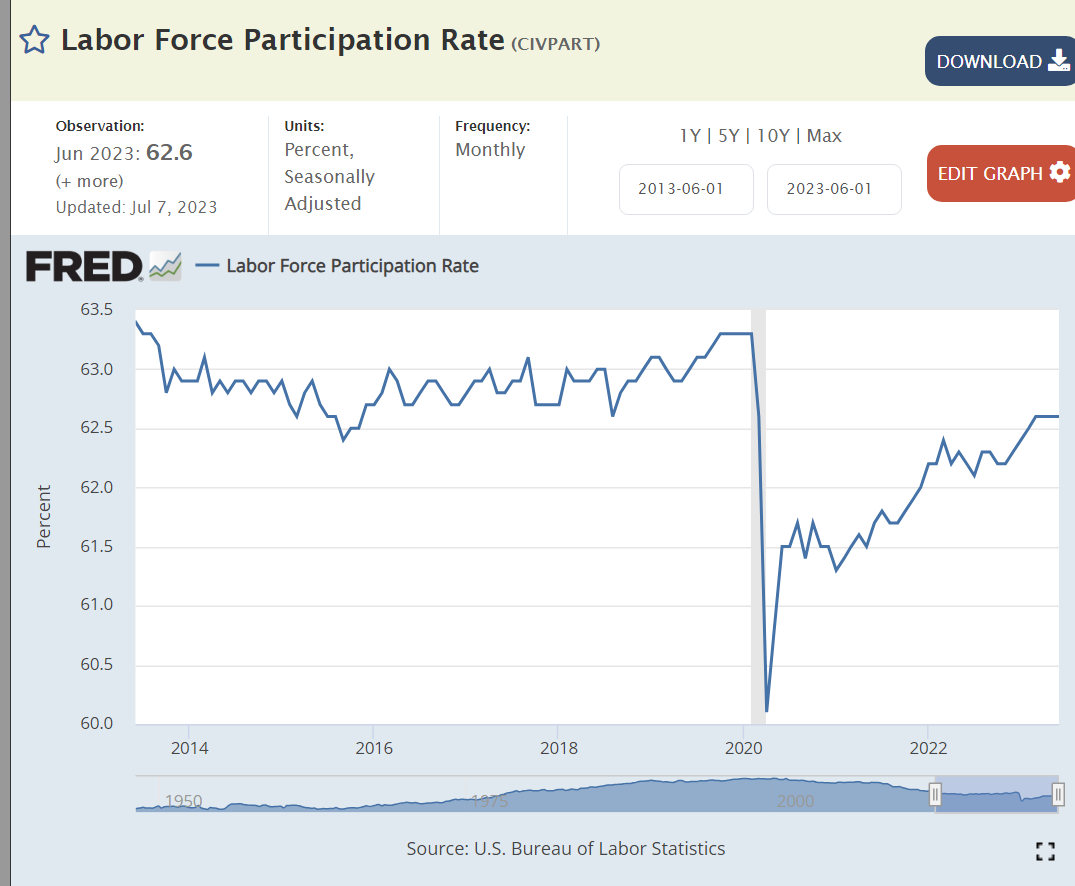
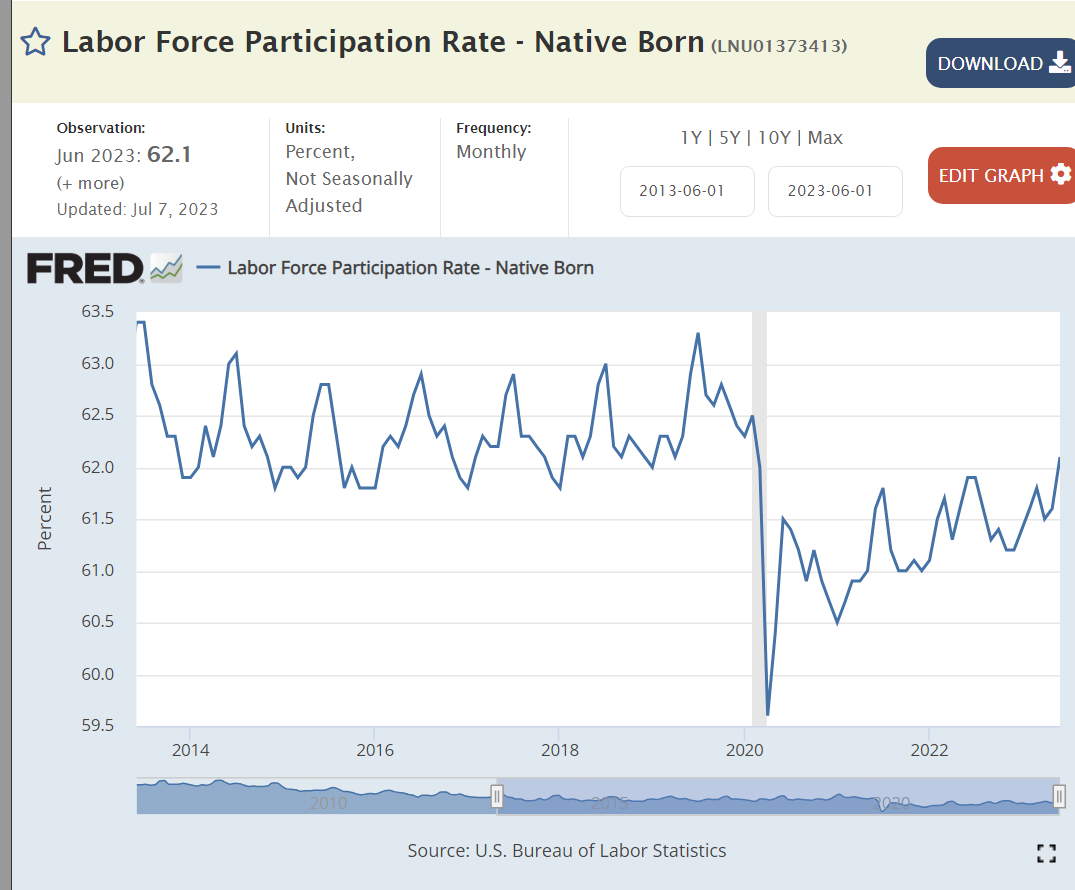
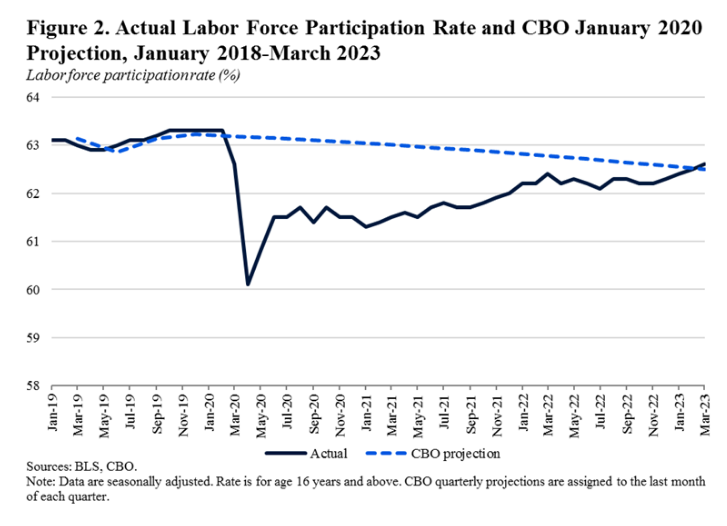
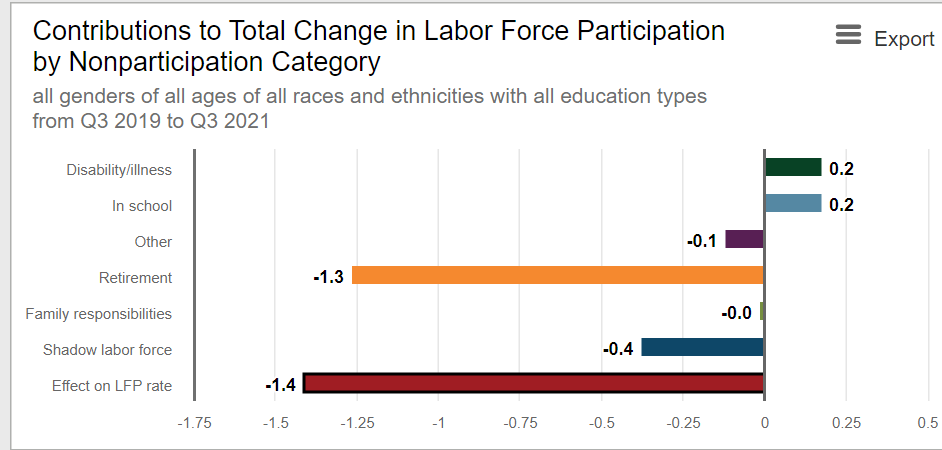
Overall labor force participation rate dropped by 1.5% in the pandemic and has recovered by 1%, still 0.5% below the recent history. However, the prime age category and several market segments no meet or exceed their pre-pandemic levels. Many details to consider.
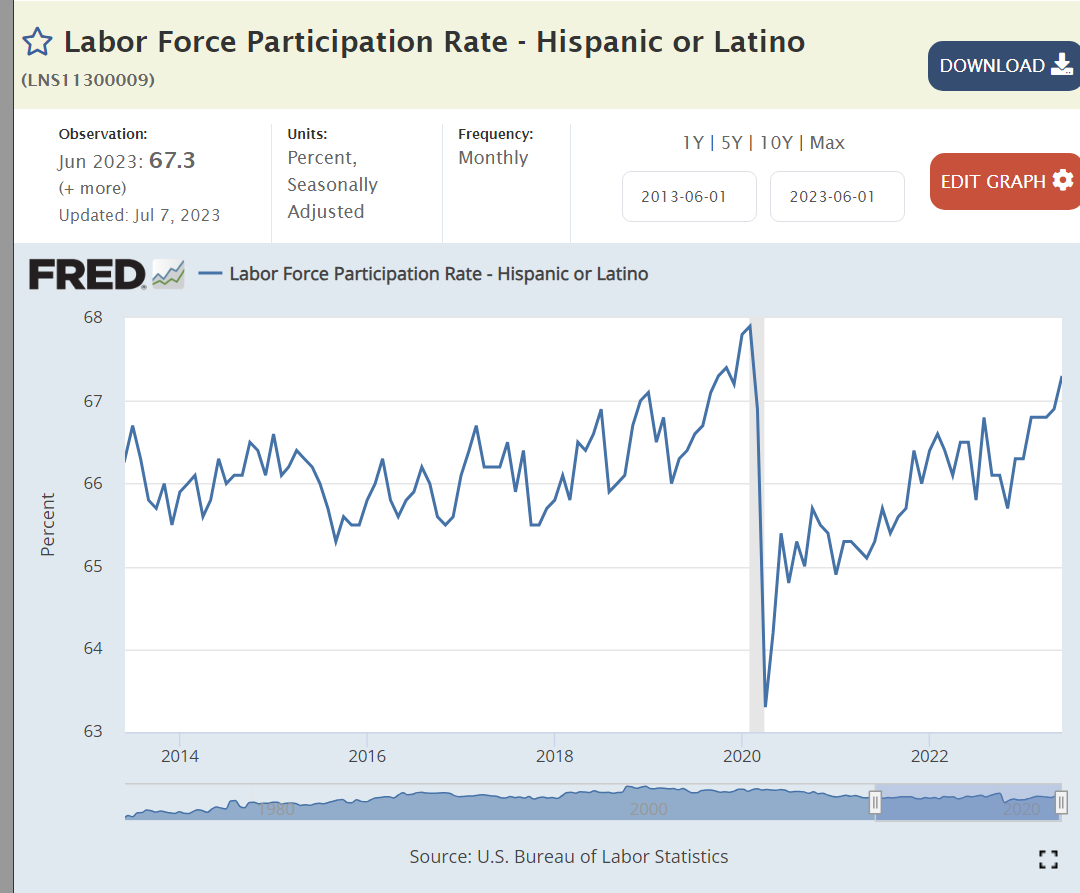
Hispanic participation is now 1% higher than the 2018-19 average before the pandemic.
The Asian participation rate is up 1%.
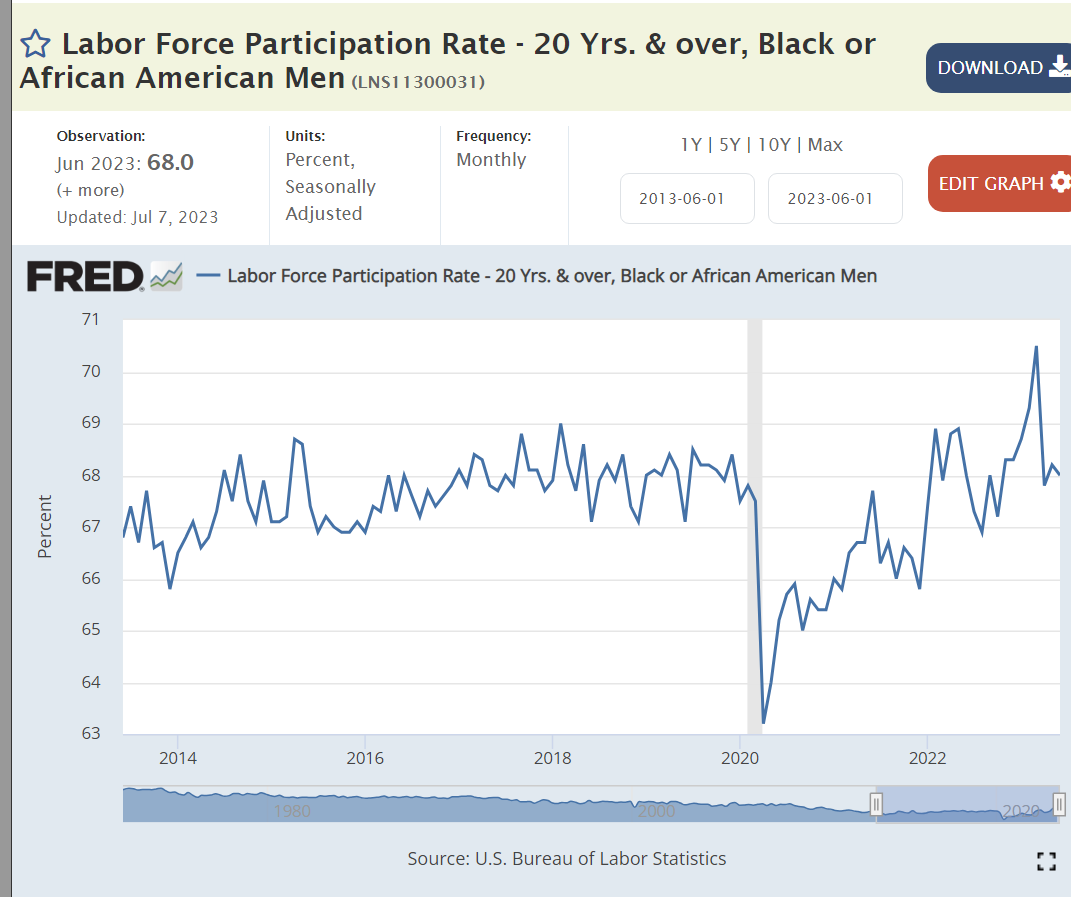
The Black participation rate is up 0.5%.
The White participation rate dropped by 1.5% and has recovered by half: 0.75% better but 0.75% below history.
The Women’s participation rate has essentially recovered to the 2018-19 average but is a half point lower than the peak levels seen just before the pandemic.
The male participation rate dropped by 1.5% but has only recovered by 0.5%, a major 1% below pre-pandemic times. Part of this is due to the long-term downward trend. Part of this is a “mix variance” driven by the very high number of “baby boomers” moving into normal retirement age or retiring early.
Black men are back to their pre-pandemic participation rate.
Black women are more active labor force participants.
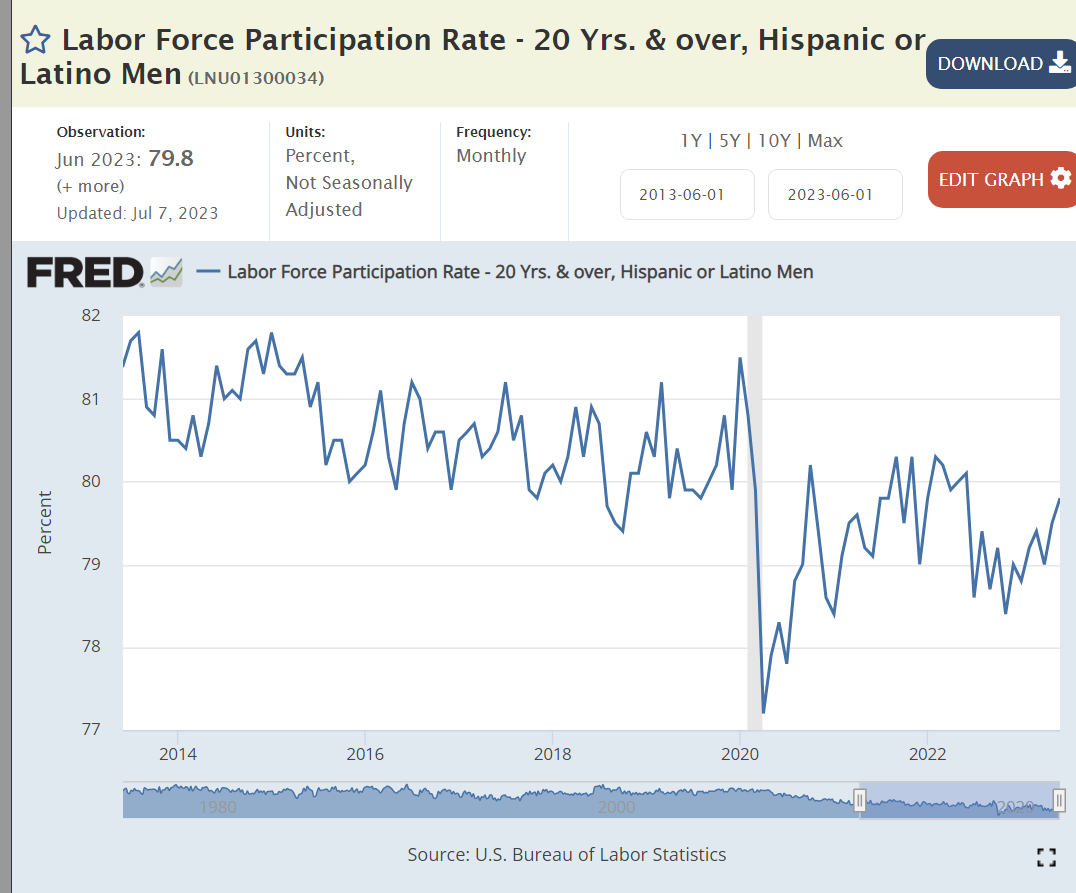
Hispanic men remain 1% below their pre-pandemic labor force participation rate.
Latino women have recovered to their historically high 61% participation ratio.
The White male participation rate dropped by 2% and has not recovered. Again, part is due to the long-run downward trend. Part is the aging of baby boomers into retirement. The remainder appears to be a response to the pandemic experience. “I’m not working unless you make it worth my while.”
White women remain a little below their 2018-19 average and three-quarters of a point behind their pre-pandemic peak level.
Teenage work participation has increased by 1.5% as entry level wages have risen.
College grad age participation rate has mostly recovered but remains 1% below the pre-pandemic high.
The retirement age workforce reduced its participation rate by 1.5% and has stayed there after a brief pseudo-recovery.
The prime age work force is now above even the elevated pre-pandemic level and a full one percent above the 2018-19 average. This is very good news, reflecting a strong economy an labor market.
Prime aged men have returned to the workforce.
Prime aged women are the “rock stars”, increasing their participation by 2% from 2019.
Brookings has combined all of the race and age data. Major declines for white men in all 3 age groups and for white women aged 65+. Major improvements for prime age white, black and other women and for prime age black men.
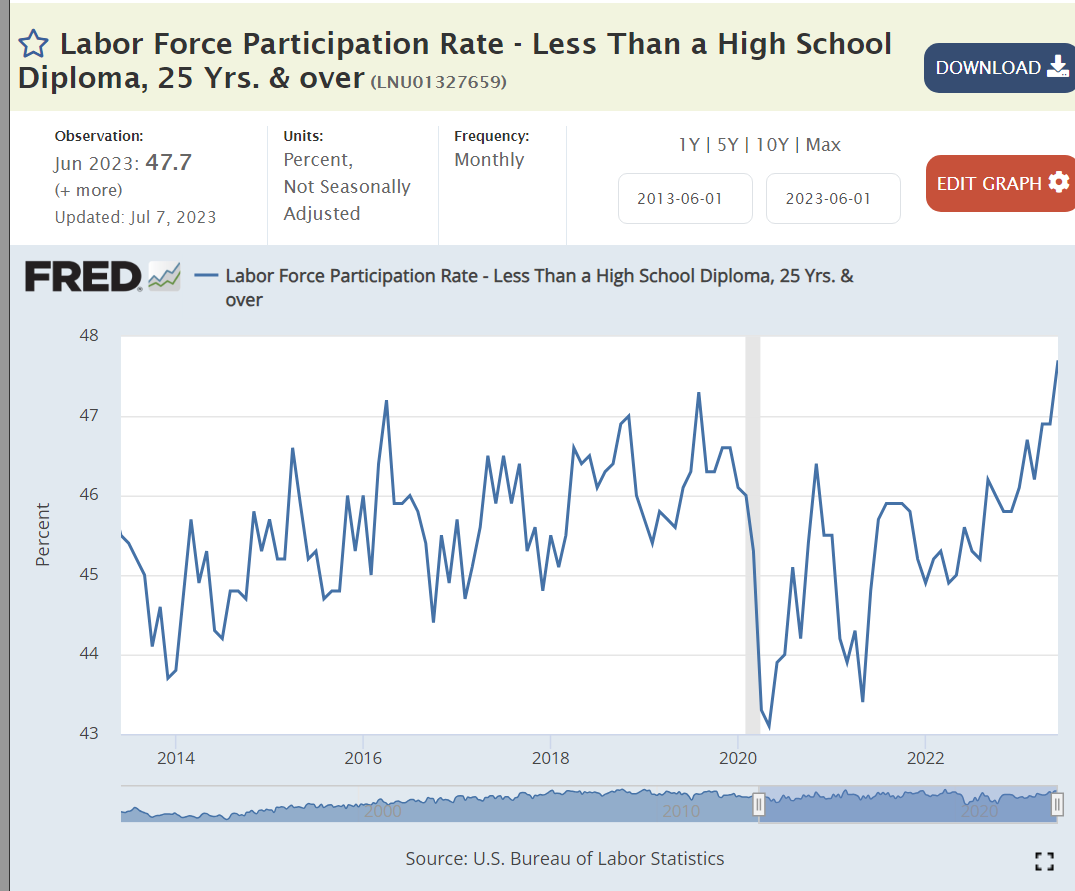
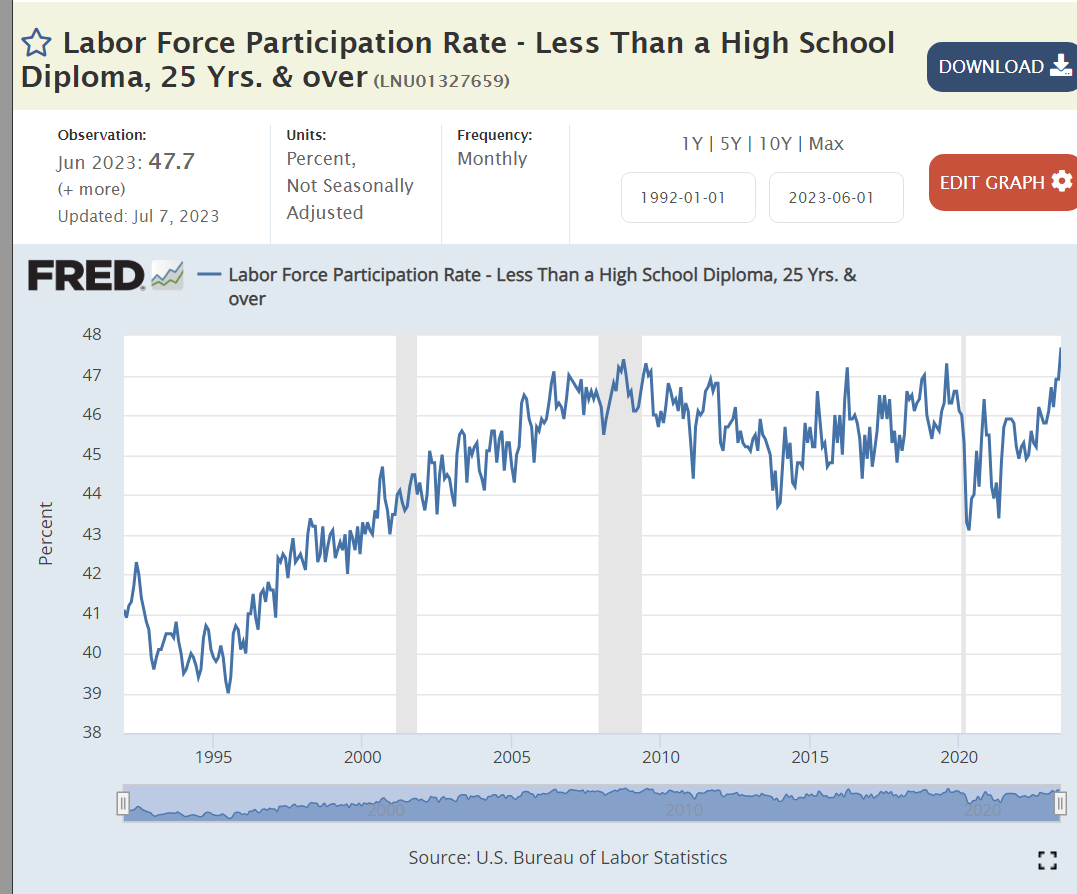
Non- high school graduates have added 1% to their labor force participation as real wages have increased.
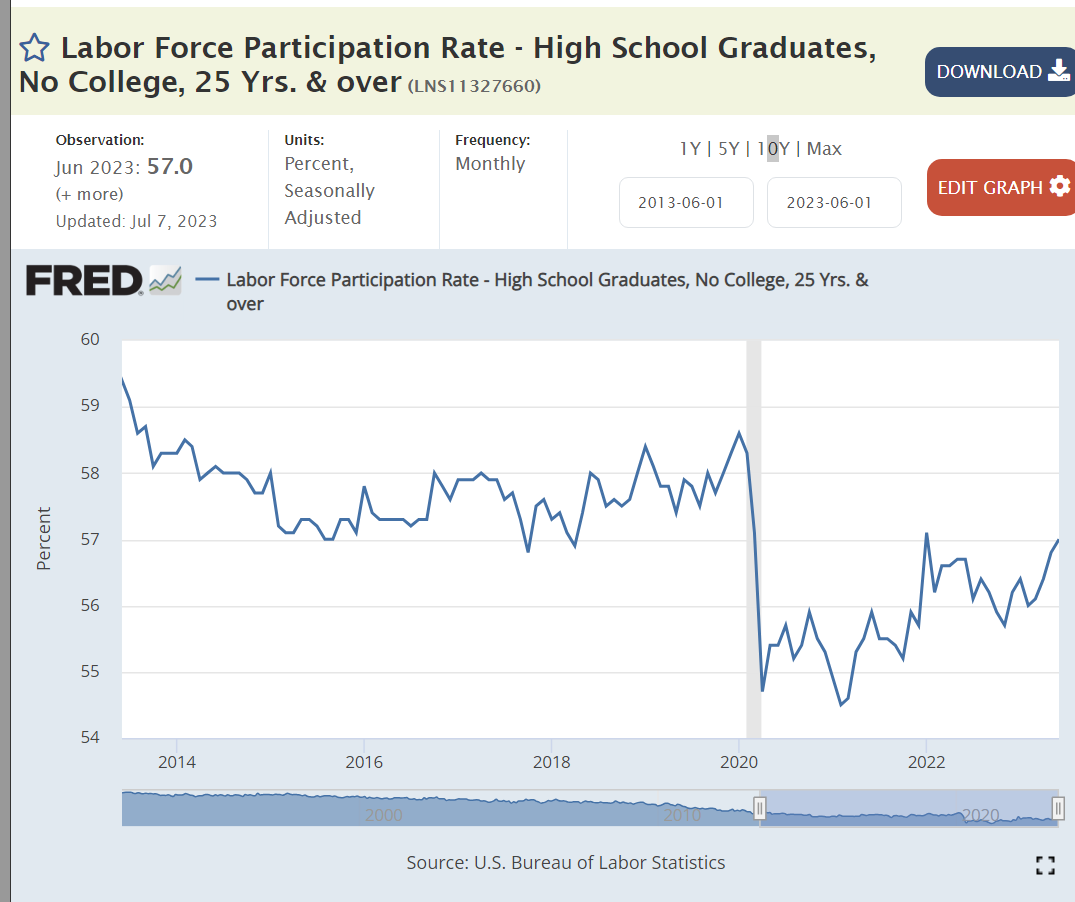
High school graduate participation dropped by three points before recovering by two points.
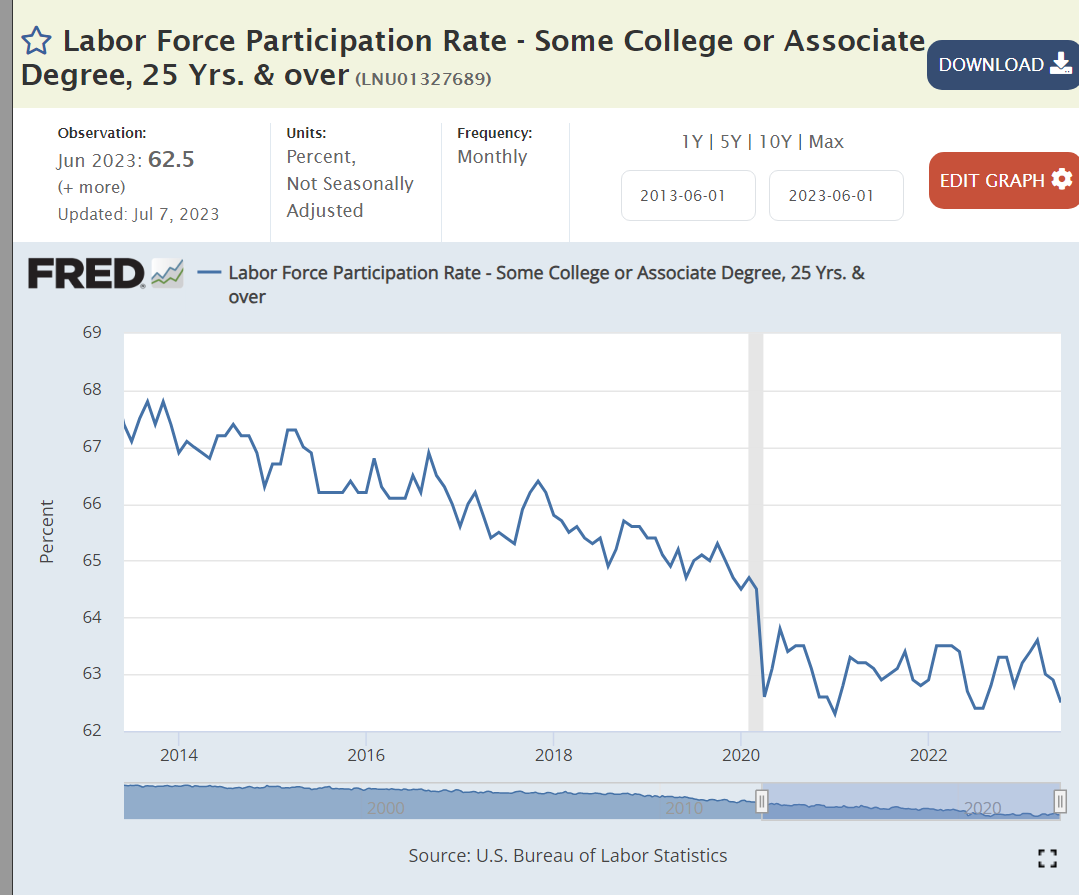
Individuals with some post-high school education, but not a bachelor’s degree, are in the middle range of US educational attainment. Their labor force participation rate had declined by almost 3 points in the 6 years before the pandemic, dropped by another 2 points during the pandemic and has not “recovered”.
Labor force participation by bachelor’s degree holders was stable before the pandemic, then dropped by 2 points and has since recovered by a little more than 1 point, remaining about one-half point below the prior average.
Individuals with a high school degree or higher have displayed drops of 10 points in labor force participation across the last 30 years. Most of this change is due to the “mix variance” of lower participation by an increasingly older and retired population, but some reflects other causes.
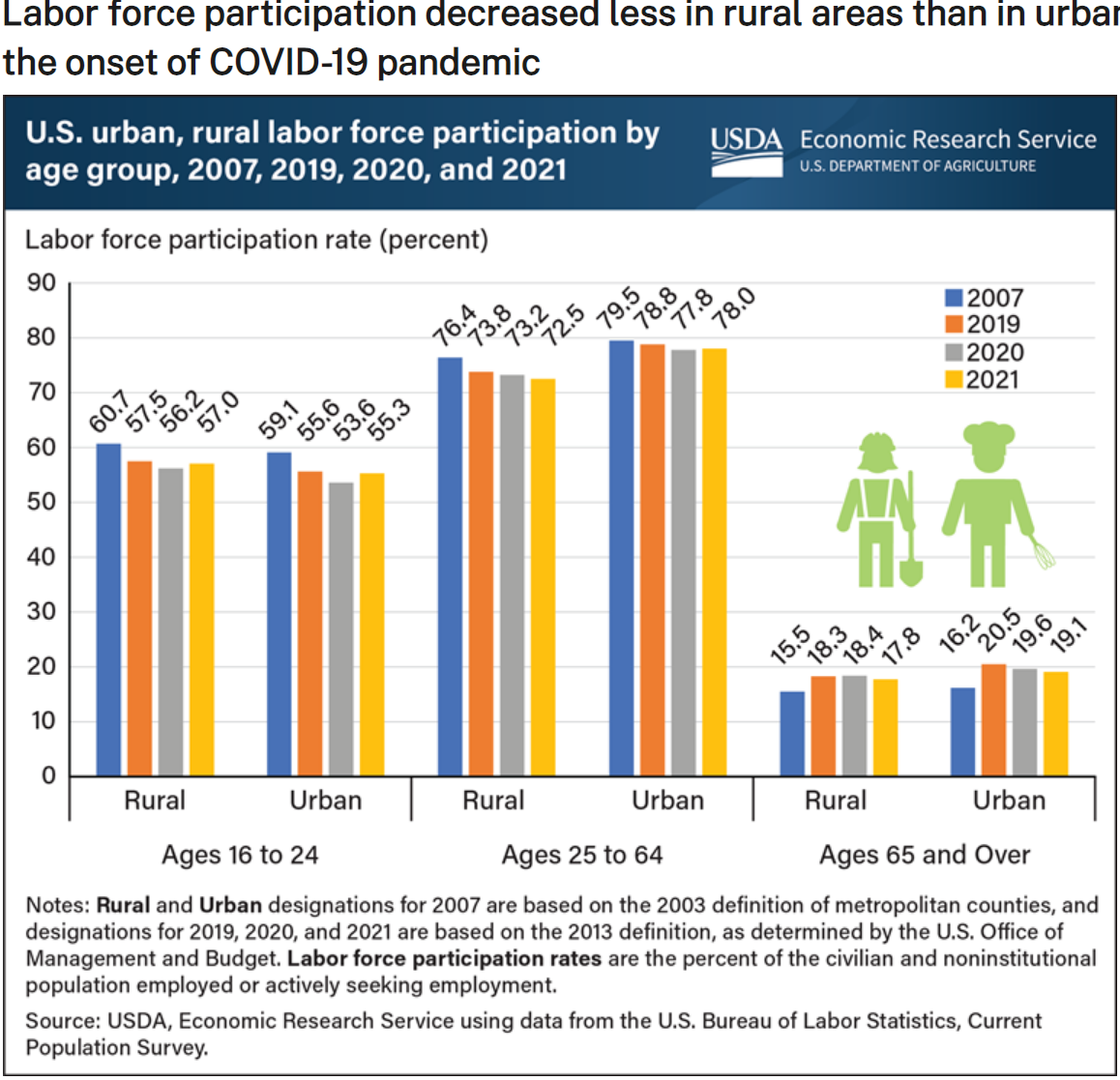
In general, rural labor markets have grown more slowly in the last 15 years and shown greater reductions in labor force participation. Some of the increased labor force participation in the last 2 years may reflect a recovery from these declines.
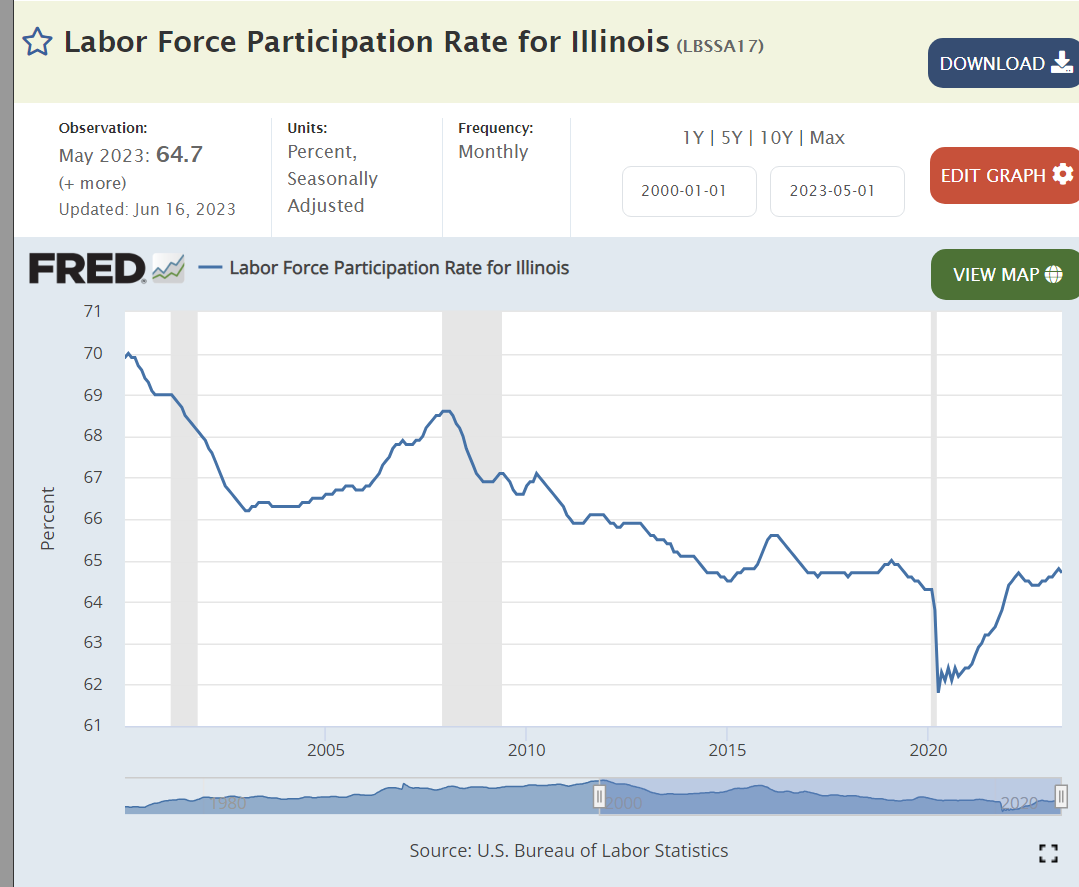
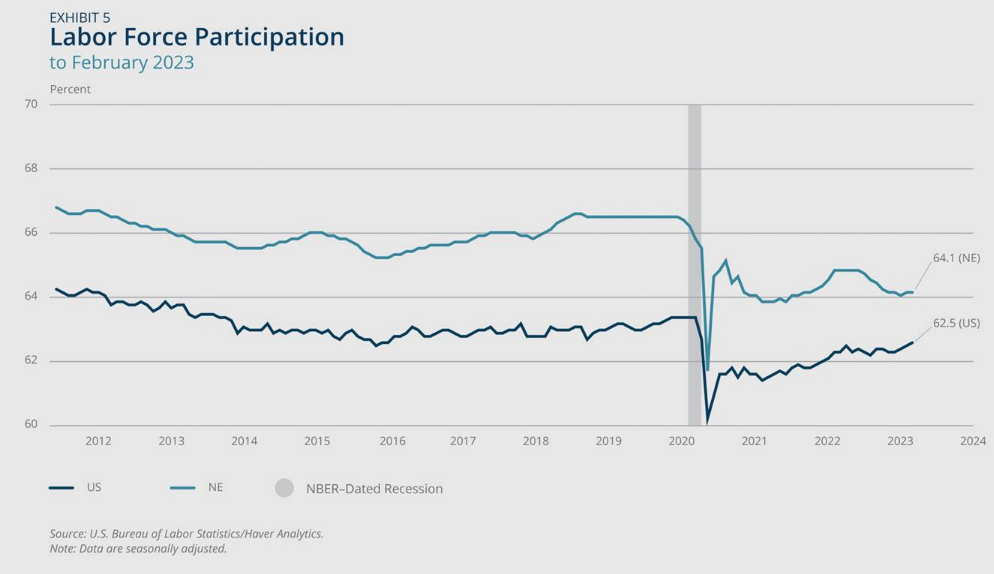
Most states show a similar pattern of labor force participation in the years before the pandemic, declining by 2-4% and afterwards recovering to their pre-pandemic level. California’s recovery has been slower. The New England states had an unusual increase in labor force participation before the pandemic and have not seen a major recovery after the pandemic.
Summary
Several sources decry the decline in the number of workers and the labor force participation rate, noting that it holds back the economic recovery and taints the 3.5% unemployment rate.
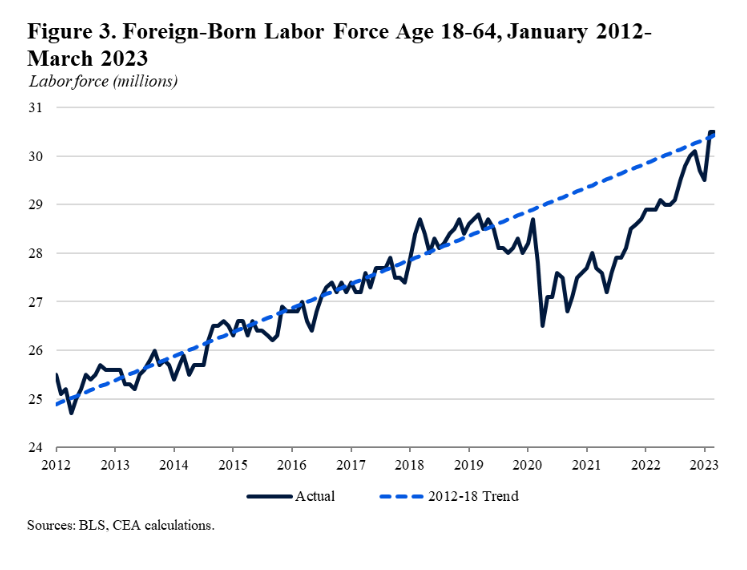
Other sources point to the long-term downward trends in participation as the biggest factor, mostly driven by an aging workforce and recent higher than normal retirement rates. Pre-pandemic forecasts showed a one-half point decline in participation, matching the actual 2023 data. Detailed analysis shows that the age adjusted participation rate is a little higher. The core group, aged 25-54 population, also shows labor force participation recovery to relatively high pre-pandemic levels. So … there are demographic, racial, education, birth country, rural/urban, location and state differences in participation. There are opportunities for higher participation in a strong economy and labor market. However, the recovery from the pandemic is complete, reflecting this strong economy and labor market.
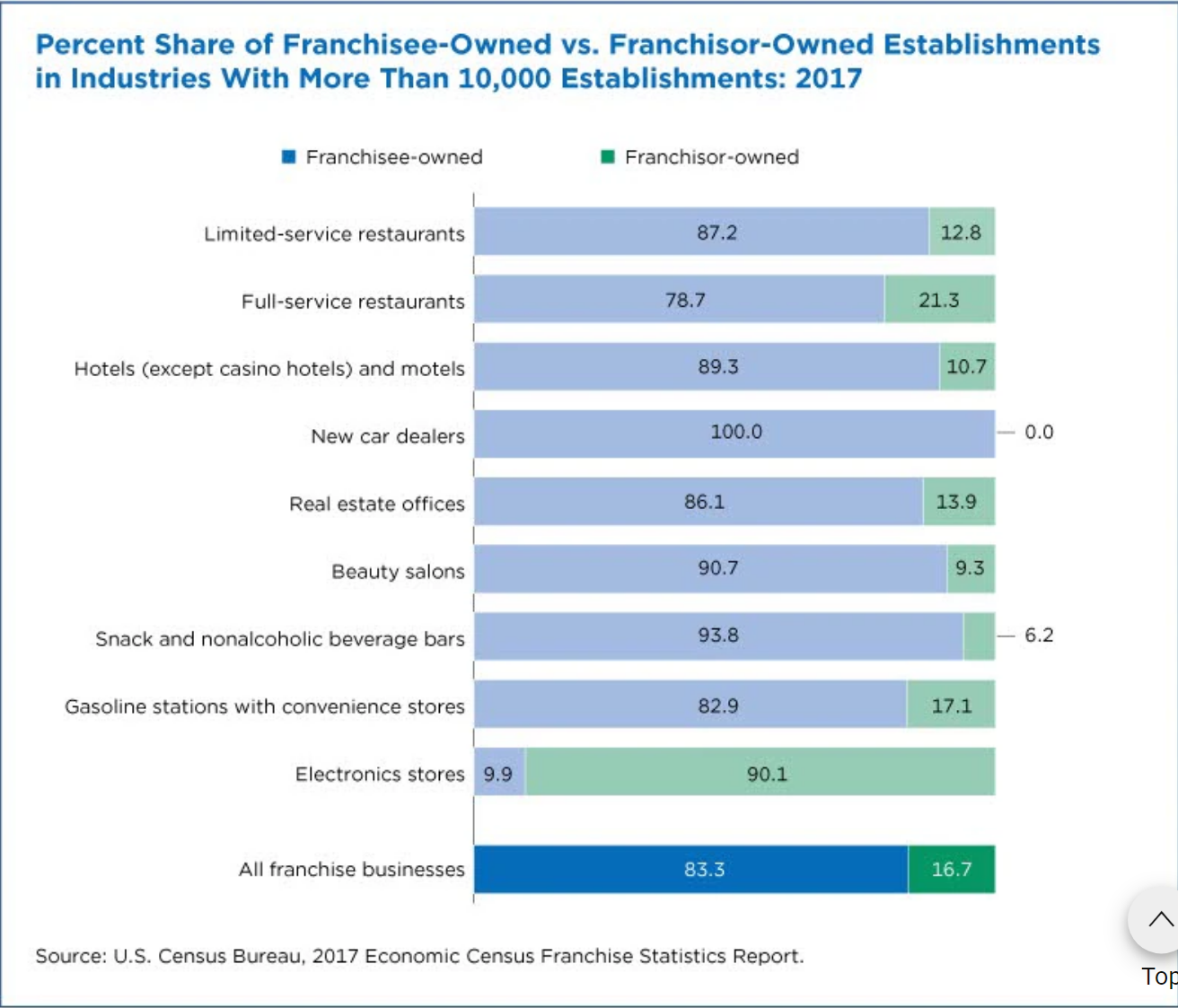
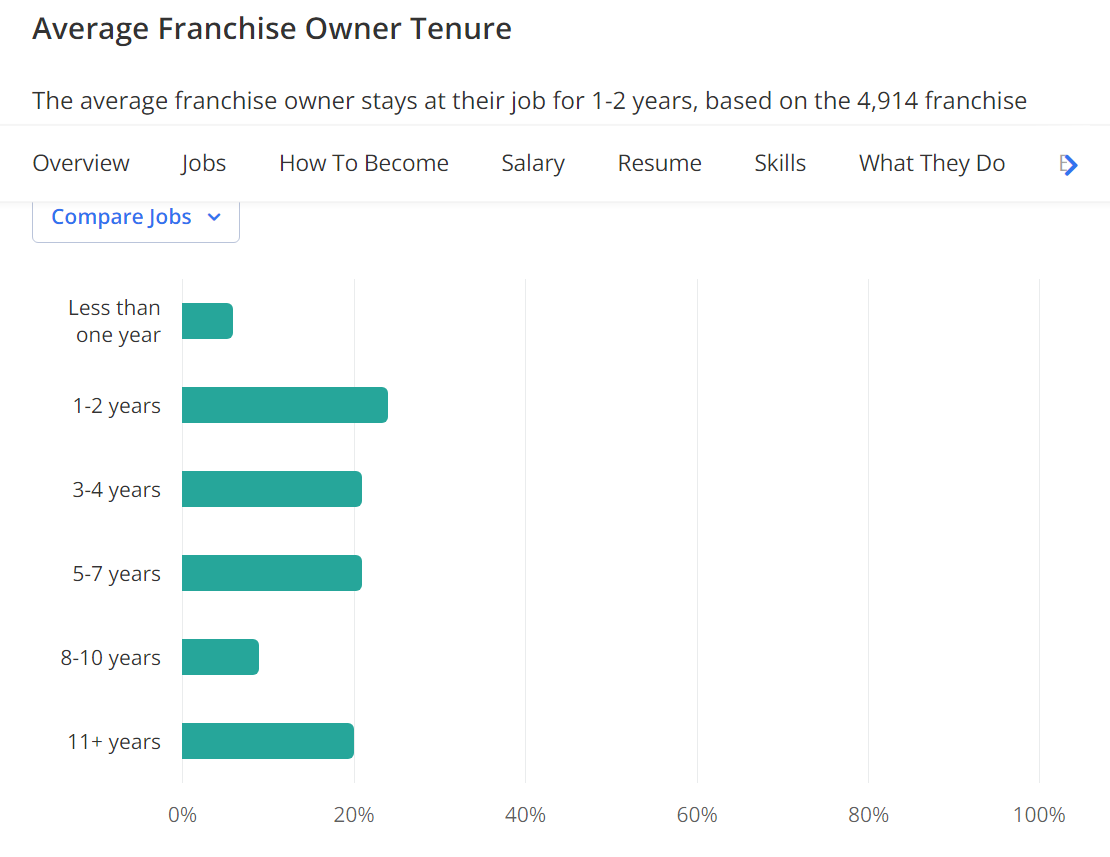
Franchising provides an opportunity for qualified individuals to own a business and earn equity-like rewards, without outstanding industry expertise, with lower business failure risk, requiring relatively modest equity investments and the opportunity for advantageous bank and small business loans.
Franchising provides the owner of a product or service concept with the opportunity to expand using “other people’s money”. It facilitates geographic and international expansion leveraging locally knowledgeable managers/investors. It allows differentiated products, services and systems to be replicated quickly and consistently. It provides legal agreements that ensure that the franchisor’s brand is enhanced and not damaged by the franchisee’s operations. It provides a system that strongly aligns the interests of local managers/owners with those of the central business.
History
Franchising has experienced several “boom and bust” periods, fraudulent deals and changing relations between franchisors and franchisees through time. Initial growth began in the 1850-1920 period together with the growth of the manufacturing and transportation industries. Automobiles, farm equipment, sewing machines, service stations, auto parts, pharmacies, soft drinks and train stop/car hop restaurants lead the way originally using the product franchising model. The depression interrupted the growth of franchising. Automobile dealers, service stations and soft drink distributors accounted for 80% of franchising before the depression.
Franchising accelerated again after WWII with fast-food restaurants leading the way, accompanied by a diverse set of laundry, hotel, rental car, real estate and convenience stores. These businesses were often still tied to products or patented equipment. However, McDonalds (1955) offered the first business format franchises which provided greater opportunities in a growing, travelling society.
Business format franchising “includes not only the product, service, and trademark, but the entire business format itself: a marketing strategy and plan, operating manuals and standards, quality control, and a continuing process of assistance and guidance.”
With rapid growth came accounting fraud by franchisors, one-sided contracts, overlapping deals, pyramid schemes and conflicts between franchisors and franchisees. The Energy Crisis of the 1970’s bankrupted a large share of service stations. State and federal regulations enacted in the 1970’s ensured that standard disclosure agreements were used, allowing potential franchise owners to work with their lawyers to ensure that they understood the deals they were making.
Data on the franchising industry is not standardized. Two industry associations and the US Census Bureau provide somewhat inconsistent data. Nonetheless, the growth of franchising after the “bust” in the 1970’s is amazing. The number of establishments has grown from 375,000 (1973) to 420,000 (1988) to 530,000 (1990) to 775,000 (2021). Total employment has grown more slowly, from 7 million (1988) to almost 10 million (2017). Sales has grown much faster from $160 billion (1975) to $350 billion (1980) to $530 billion (1985) to $1 trillion (2004) to $1.3 trillion (2007) to $1.5 trillion (2012) to $1.7 trillion (2017).
Leading sectors by annual earnings include senior care ($155K), real estate ($153K), personal services ($126K), business services ($122K) and pet services ($119K).
The overall US unemployment rate at 3.6% remains at a 50-year low. The metropolitan area rate is a shade lower. I summarized metro area unemployment rates for those which have a city in the top 100 of population. Only 73 metro areas remain, since 27 cities are the second or smaller city in their metro areas. The average metro area unemployment rate for these top 100 areas is 3.4%. The median metro unemployment rate is 3.3%.
Democratic mayors led the main cities in two-thirds of the largest metro areas. Republicans, independents, nonpartisans or split results led in the remaining one-third (24/73).
Democratic mayor lead metro areas have median and average unemployment rates at 3.2%, significantly below the national 3.5-3.6% rate. The Republican+Other metro areas show 3.4% median and 3.9% average unemployment rates, just slightly higher.
The claim that Democrats are “bad” for the economy is not supported by this data.
Republicans and independents/nonpartisans/split mayors lead 8 metro areas with unemployment in the historically unheard of 2% range:
Denver, Colorado Springs, Omaha, Tulsa and Oklahoma City in the prairie states. Miami, Virginia Beach and Honolulu complete the set.
Non-Democratic mayors also lead 8 southwestern cities with higher-than-average unemployment (4%+): Reno, Las Vegas, Laredo, Corpus Christi, Riverside, Stockton, Fresno and Bakersfield.
Only 5 Democratic lead cities, versus 8 Republican/Other cities, had 4%+ unemployment rates in May, 2023: New York and Los Angeles, Houston, El Paso and New Orleans.
31Democratic mayor lead metro areas had strong 3% unemployment. 13 boasted amazing 2% unemployment rates: Boise, Lincoln, Nashville; Madison, Minneapolis-St Paul; Jacksonville, Tampa, Orlando; Richmond, DC, Boston, Baltimore.
Summary
Metro area unemployment is even lower than the 50-year low national average.
Democratic led metro areas have slightly lower unemployment rates.
We have 6 large metro areas with 2.5% or lower unemployment: Lincoln, Madison, Omaha, Boston, Baltimore and Miami.
Our very worst metro areas (of 100) are El Paso, Corpus Christi and Laredo at 4.5% and Las Vegas (5.6%), Stockton (5.9%), Fresno (7.5%) and Bakersfield (8.6%).
The American economy is delivering truly amazing results.
“Americans today have little trust in government; household income lags behind our usual middle-class expectations … the alienated are mobilized afresh by changing demography, by broadening conceptions of identity, and by an economy that prizes Information Age brains over manufacturing brawn.”
Gunnar Myrdal described the American Creed as “devotion to the principles of liberty, of self-government and of equal opportunity”. “The war between the ideal and the real, between what’s right and what’s convenient, between the larger good and personal interest is the contest that unfolds in the soul of every American”. “We cannot guarantee equal outcomes, but we must do all we can to ensure equal opportunity. Hence a love of fair play, of generosity of spirit, of reaping the rewards of hard work and faith in the future”. “The United States has long been shaped by the promise … of forward motion, of rising greatness, and of the expansion of knowledge, of wealth, of happiness”.
“Our greatest leaders have pointed toward the future – not at this group or sect.” “The president of the United States has not only administrative and legal but moral and cultural power”.
Fear: feeds anxiety and produces anger, about limits, points at others, assigning blame, pushes away, divides. Hope: breeds optimism, about growth, points ahead, working for a common good, pulls others closer, unifies.
One: The Confidence of the Whole People
America began with dreams of God and Gold. In 1630, John Winthrop said “For we must consider that we shall be as a City upon a hill”. Meachem argues that we must understand the dynamic between the presidency and the people at large, between a powerful chief and a free, disputatious populace. The presidency was defined in the shadow of the ineffective Articles of Confederation and the hatred of monarchy. Walter Bagehot in 1867 contrasted the dignified and the efficient parts of British parliamentary system. We have no king, so the US president must fill the dignified, symbolic, honorary, universal, ideal, inspiring, cohering role. “Our past presidents have unified and inspired with conscious dignity and conscientious efficiency”.
LBJ: “the moral force of the Presidency is often stronger than the political force”. Jefferson sought “to unite himself with the confidence of the whole people”. “Jackson believed in the nation with his whole heart. To him, the nation was a sacred thing”. Jackson: “The president is the direct representative of the American people”. Lincoln moved from a compromising, tentative early tone to exerting moral leadership for the country in the Gettysburg address, defining America ever after in terms of democracy and equality, followed by appeals to the “better angels of our nature” and binding the wounds of war.
Teddy Roosevelt coined the term “bully pulpit” to describe the president’s unique opportunity for moral leadership. Woodrow Wilson wrote of the president: “His position takes the imagination of the country. He is the representative of no constituency, but of the whole people”. Character and temperament clearly matter in such a president. FDR perfected the “fireside chat”. Meacham notes “A leader’s balancing act, then, was the education and shaping of public opinion without becoming overly familiar or exhausting”.
The character of the country is as important as the character of the president. It’s inclinations, aspirations, customs, thought and the balance between the familiar and the new. The Declaration of Independence introduced “the pursuit of happiness” to the world stage, not as individual self-interest but the joint pursuit of private and public good, the good of the whole.
Even by 1750, commentators noted the strong American belief in progress. Reason, religion and capitalism all contributed to forming this hopeful view. Actual progress “does not usually begin at the top and among the few, but from the bottom and among the many”. Referring to civil rights and Womens’ rights, Meacham says, “It took presidential action to make things official … but without the voices from afar, there would have been no chorus of liberty”.
Two: The Long Shadow of Appomattox
Robert E Lee’s surrender to Ulysses S Grant was a solemn, respectful, muted, balanced, even hopeful event, but it did not mark the end of America’s struggle with equality between the races. Grant fought against the Klan, but Andrew Johnson tried to prevent progress and Rutherford B. Hayes ended Reconstruction in 1877, allowing the Confederate States to return to “home rule”.
The decades before the Civil War had been intensely fought off the battlefield. The war killed one-fourth of the Rebel soldiers. The war resolved the question of union (sort of) and emancipation (sort of), but the path forward was uncertain and debated at the national and state levels. Northerners and Southerners debated the cause of the war (states rights or slavery) and the cause of the Union’s military victory (industrial and military capacity, leadership, tactics, bravery or God). Even the great American hero, Abraham Lincoln, held mixed, moderate, evolving, tactical and ideal values and positions about slavery and the equality of the races. He didn’t have a clear plan because he was not sure about actual equality, he recognized that a majority of citizens did not believe in true equality or intermixing, and he understood that social institutions don’t change quickly or easily.
Virginian Edward Pollard published the “Lost Cause” in 1866, outlining a defensive and proud Southern position that did not embrace defeat, but triggered a new war for the preservation of Southern culture. “The war has left the South with its own memories, its own heroes, its own tears, its own dead”. The war “did not decide negro equality; it did not decide negro suffrage; it did not decide states’ rights … the Southern people will still cling to, still claim, and still assert them in their rights and views”. This was couched as a holy war against the oppressors.
The Ku Klux Klan was formed in 1866. It terrorized blacks and “others”. It worked to undermine Reconstruction. It supported the political actions required to completely disenfranchise blacks from voting and to segregate all services and social relations.
The “voice of the people” initially drove the federal government to pass the historic constitutional amendments, the Civil Rights Act of 1866 and the Reconstruction legislation of 1867 despite President Johnson’s opposition. He was impeached but escaped removal by one vote.
President Grant leaned into further steps towards racial equality but found that northern support for significant change was weak and that Southern opposition to any legislation, or compromise discussions, was consistent and universal. He was able to pass the Enforcement Act of 1870 that gave the federal government powers to pursue the Klan. The Klan’s public face disappeared, and its private actions faltered for some time, but violence and the threat of violence were used to complement the Jim Crow laws and establish a one party, dictatorial state throughout the “solid South” for decades into the future.
Three: With Soul of Flame and Temper of Steel
Womens’ suffrage, immigration and labor protections joined civil rights as major issues by the turn of the 19th century, epitomized in modern, progressive, reformist politicians such as Teddy Roosevelt.
Israel Zangwill’s play “The Melting Pot” celebrated the positive interactions of various races, religions and ethnic groups in teeming New York City. Teddy Roosevelt approved of the message as he interpreted it. America welcomes foreign groups if they embrace their Americanness and downplay their roots. Roosevelt employed logic and morality to conclude that it is “a base outrage to oppose a man because of his religion or his birthplace”. On the other hand, Roosevelt held no such accommodating views regarding native Americans. Like his contemporaries, he was influenced by Herbert Spencer’s social Darwinism, scientific eugenics and apologetics for Britain’s imperial rule (White Man’s Burden). He believed that the progress of the Anglo-Saxon nations in the last 100-300 years reflected some form of superior readiness for the modern world.
Teddy Roosevelt was born in New York City in 1858 to a prominent family and benefited from their wealth, perspective and social standing. Teddy decided at an early age to be a “muscular”, driven individual, embracing the outdoors, adventure and change, especially when driven by himself. His “Citizen in a Republic” or “Man in the Arena” speech summarizes his view of a fully engaged life well lived. Roosevelt said, “Like all Americans, I like big things; big prairies, big forests and mountains, big wheat fields, railroads and herds of cattle, too, big factories, steamboats and everything else”.
Roosevelt’s progressive politics were influenced by Jacob Riis’ 1890 illustrated book “How the Other Half Lives”, which showed real urban living and working conditions. They were also influenced by Jane Addams’ Hull House initiatives to support the acclimation of immigrants to the United States.
Roosevelt crusaded against machine politics, monopolies, poor working conditions, and for conservation, railroad regulation, food safety, Womens’ suffrage and political reform.
Roosevelt invited Book T. Washington to dinner at the White House, a small step forward, which was criticized by many and elevated by many Southern journalists and politicians as an unremovable stain.
In each Roosevelt situation, we see a heroic man of privilege making decisions and taking actions to move his country forward. In hindsight, he was shaped by the views of his society, for good and for bad. He believed in progress, rationality, betterment and action. He was a Republican, a representative of the powerful Northeastern region, interests and his social class. He was idealistic, confident in the ability of individuals and governments to make things better. “We have room for but one flag, the American flag, for but one language, the English language, for but one soul loyalty, and that is loyalty to the American people”.
Four: A New and Good Thing in the World
The teens and twenties provided the 19th amendment for Women’s suffrage, but also a rebirth of the Ku Klux Klan opposed to blacks, Catholics, Jews and foreigners. Meachem reviews Wilson, Harding and Coolidge on these issues and finds just lukewarm support for “equal rights” a century ago.
In 1918 Wilson reversed his long-standing opposition to Women’s suffrage as it had become politically more favorable in the 70 years since the movement’s founding in Seneca, New York. The leaders had adopted a strategy of civil disobedience: lectures, protests, marches, lobbying, arrests for trespassing, and starvation pledges.
Wilson maintained his Virginian view of the Civil War, Reconstruction and negro rights. He met with black leaders at the White House but did not listen or engage, emotionally walking them out the door. Wilson denounced lynching and purged two racist senators from the Democratic party in 1918. Seeking support for his progressive economic policies in a 50th anniversary Gettysburg speech, he spoke of “the people themselves, the great and the small, without class or difference of kind or race or origin”, but also indicated that the combatants were morally equal.
A North Carolinian, Thomas Dixon, published a series of three novels between 1902 and 1907 reviving support for the “Lost Cause” version of the Civil War. One of the novels was filmed by D. W. Griffith in 1914 as “The Birth of the Nation”. It celebrated white supremacy and attacked African Americans. Wilson showed the film at the White House but later distanced himself from any formal support. In 1915 the new Klan was re-founded near Atlanta based upon “unease about crime, worry about anarchists, fear of immigrants flooding in from Europe desolated by war, and … anxiety about Communism”. The Klan promised racial solidarity and cultural certitude as the transition from an agricultural to an industrial and urban world accelerated. Klan Imperial wizard Evans claimed, “we demand a return of power into the hands of the everyday, not highly cultured, not overly intellectualized, but entirely unspoiled and not de-Americanized average citizens of the old stock”.
The first world war led to the Espionage Act of 1917 and the Sedition Act of 1918, restricting free speech. Dissident groups, including labor unions and socialists, were pursued, charged and imprisoned. Eugene Debs was imprisoned for his opposition to the war. The Postal Service was used to restrict the dissemination of publications. Anarchist bombs exploded in 1919, leading to greater federal investigation of “threatening” sectors. Socially, politically and journalistically Americans were pressured to become more patriotic and completely support American institutions.
The pendulum started to swing back after 1920 when the New York legislature tried to unseat 5 duly elected Socialist party members. Leading voices remembered the core principles of democracy, confident that the system could survive a small amount of dissent.
The Klan reached a peak of influence in 1925, with 2 million members and strong political representation and influence at the state and national levels. A Democratic Party plank criticizing “secret organizations” like the Klan failed to be adopted in 1924. The Klan’s 1925 march on Washington attracted 30,000 participants. The Klan’s extreme positions were later rejected in many states and by national politicians and the Supreme Court and its influence once again faded by the end of the 1920’s. Harding was a leader in opposing the extra-legal actions of the Klan. Coolidge also took steps in the mid-1920’s to oppose the Klan. Yet, the National Origins Act of 1924 greatly restricted immigration.
The teens and twenties witnessed some progress for women, threats to free speech or nonconformity, and an expanded opposition to “others” by race, ethnicity or religion. Economic progress in the twenties softened the edges of opposition to “others”. The US, like most other nations, became more nationalistic or patriotic in the shadow of the Great War. The general positive attitude towards scientific, business and government progress continued, leading most politicians to reject extremist, irrational positions even if they were not quite ready to fully embrace the implications of “equality” expressed by Lincoln 50 years earlier.
Five: The Crisis of the Old Order
The Great Depression threatened the US as it threatened Europe. 20% unemployment. In 1932, FDR saw army chief of staff, Douglas MacArthur as a threat to democracy, leaning towards a military government. Louisiana governor and senator Huey Long posed a leftist populist threat. Father Charles Coughlin’s radio broadcasts stirred populist, nativist and anti-Jewish sentiments. Charles Lindbergh inspired the isolationists who wanted to leave Europe to its intramural squabbles. Novelists such as Nathanael West and Sinclair Lewis highlighted the attractions of fascism and populism to a suffering public. A group of Wall Street investors conspired to overthrow FDR in a military coup in 1933.
Business and political leaders understood the nation’s challenges. They were unsure about FDR’s policies, political judgements, character and ability. Columnist Walter Lippman wrote, “Franklin D. Roosevelt is no crusader. He is no tribune of the people. He is no enemy of entrenched privilege. He is a pleasant man who, without any important qualifications for office, would very much like to be president”.
Roosevelt exceeded expectations. His themes of “the salience of hope, the dangers of fear, and the need for open American hearts” were effective. He prioritized the most important topics and mostly won his battles. He used his communications skills to speak with the nation, each small town, neighborhood and person. He believed in idealism and pragmatism. He promoted plans but adapted and adjusted quickly. He moved quickly but didn’t preach revolution. He overreached and then reset. He courageously faced situations as they were, not how he wished them to be. He delayed decisions when he could. He played off advisors against each other. He used his wife for political advantage. He was self-aware, knowing that he was leading in an extraordinary time, that his decisions effected civilization and that he was surely making some mistakes. Yet, he maintained a sense of hope and a spirit of optimism.
Despite the country’s strong isolationist leanings, FDR prepared the nation for war. He found ways to support the UK, such as the lend-lease program. He fought against the isolationist views of many important political and banking leaders.
FDR took small steps to reduce racial discrimination. With A. Philip Randolph’s Pullman Car Union threatening a march on Washington, he opened up employment in the defense industries to African Americans. Eleanor Roosevelt promoted racial progress, including resigning from the DAR when it prohibited Marian Anderson from performing at their Constitution Hall. Anderson garnered national publicity with her concert on the steps of the Lincoln Memorial. FDR signed the executive order that moved 120,000 Japanese Americans from their West Coast homes to internment camps further inland away from the potential war zone.
FDR took some early steps to promote greater emigration of Jews from Europe to the US and elsewhere. However, by 1940 he had concluded that preparing for war and winning the war was the best way to save the most Jews from Naziism.
As Allied troops were landing in northern France in 1944, FDR was at his idealistic best, praying for the world, “Almighty God: Our sons, pride of our Nation, this day have set upon a mighty endeavor, a struggle to preserve our Republic, our religion, and our civilization, and to set free a suffering humanity. … Help us to conquer the apostles of greed and racial arrogancies. Lead us to the saving of our country, and with our sister Nations into a world unity that will spell a sure peace — a peace invulnerable to the schemings of unworthy men”.
Six: Have You No Sense of Decency?
The post-war world in the US offered a contrast between widespread prosperity plus political moderation and the emergence of a new strain of anti-establishment conservatism fueled by the power of the mass news media.
Harry Truman won a surprise presidential victory in 1948 on the coattails of FDR’s New Deal and war victory. Eisenhower cruised to victory in 1952 and 1956, nominally as a Republican, but truly as a moderate centrist eager to preserve the peace and gains of the last decades. The growing prosperity, baby boom and suburbanization prompted recognition of the wonders of a growing middle class.
Economists, journalists and politicians had all worried that the end of the war would lead to a recession or depression due to lack of aggregate demand, hiccups from war production transitions and Europe’s slow recovery. Instead, pent-up demand and increased American production capacity led to a boom period. The business cycle had not been tamed, but it was less threatening. Business and labor fought over contracts but settled their differences as the US increased its production for the world. Per capita income, birth rates, employment rates, college education, home ownership, women’s opportunities, farm incomes and life expectancy all grew rapidly.
Meachem notes that the “middle class” became a more recognized term and a larger group as many earned greater incomes, formed businesses and joined professions. There was a pride in the “bourgeois” class as the US competed with the USSR for world leadership. He also highlights the role that government has played in spurring economic success (despite the popular emphasis on individual effort), noting the earlier railroad, infrastructure, homestead and land-grant college investments; regulatory and labor changes of the progressive era; the various New Deal safety net programs and the continued post-war investments in highways, GI’s, aerospace, R&D, defense, etc.
With the economy humming and fascism defeated, politicians turned to the Cold War, excess government, socialism, welfare and liberty to win attention, votes and power. Eisenhower easily won elections, but his moderate positions did not help the Republican Party to distinguish itself from the Democrats or to greatly increase its state or national powers.
Robert Welch, a Massachusetts business owner, founded the John Birch Society in 1954 focused on a conspiracy among American elites, including Ike, to cooperate with the communists. Welch and his followers saw the world in “black and white” terms, contrasting secular communism with a Christian-style western civilization. The nuclear weapons race and threats of the Cold War provided an existential survival context for this world view. The “loss of China” to communism raised the specter of a global communist state. The US did have several high profile and damaging espionage cases. There were communist “fellow travelers” in the media, entertainment, university and international affairs worlds.
Wisconsin Senator Joseph R. McCarthy exploited these worries. Beginning in 1950 he promoted this “conflict of civilizations” view, pushed the limits in alleging conspiracies and traitorous acts and managed to attract and keep attention from the growing mass print, radio and TV media. Although the State Department had implemented a loyalty program and cleared out “marginal” staffers, McCarthy was able to use his alleged “list of 205 members of the Communist Party” for several years to build political power.
Most politicians ignored him. Eisenhower chose to not respond to his claims, even though they were addressed at him, George Marshal and John Foster Dulles in his cabinet. Eventually, in Spring, 1954, an Edward Morrow investigative report, Eisenhower speech and US Army counsel Joseph Welch’s congressional committee testimony undercut McCarthy. Morrow: “We must not confuse dissent with disloyalty”. Ike: “We are worried about Communist penetration of our country … the need that we look at them clearly, face to face, without fear, like honest, straightforward Americans, so that we do not develop the jitters or any kind of panic, that we do not fall prey to hysterical thinking.” Welch: “Until this moment, Senator, I think I never really gauged your cruelty or your restlessness. You have done enough. Have you no sense of decency, sir, at long last? Have you no sense of decency?”
Meachem contrasts the 1955 conservative revival of William F. Buckley with that of the John Birch Society and Joe McCarthy. He considers Buckley’s philosophy and media-based opposition to be more legitimate. Opposing the flow of power to the state following 20 years of New Deal and liberal orthodoxy is described as a valid perspective. On the other hand, Meachem shares Richard Hofstadter’s description of “pseudo-conservatism” as “incoherent about politics”, “largely appealing to the less educated members of the middle classes”, “feels that his liberties have been arbitrarily and outrageously invaded”, reflecting “status aspirations and frustrations”. Political philosophy and material interests are subordinated to personal views, feelings, loyalties, interests, status and projections in this form of political attraction.
Seven: What the Hell is the Presidency For?
The Civil Rights Act of 1964 and the Voting Rights Act of 1965 are widely seen as the most important steps in securing individual rights in the last century. Their passage relied upon prior political steps, Supreme Court decisions, JFK’s legacy, the civil rights movement, Martin Luther King’s actions and ideas, American ideals and the unique qualities of Lyndon Baines Johnson.
In 1948 Hubert Humphrey and other progressives urged Americans to “get out of the shadow of states’ rights and walk forthrightly into the bright sunshine of human rights.” Strom Thurmond walked out of the Democratic convention to form the Dixiecrat Party, winning 4 states. Truman took steps to integrate the US military in 1948. The Civil Rights Commission and the Civil Rights section of the Department of Justice were created in 1957. The Civil Rights Act of 1960 strengthened the federal government’s ability to enforce voting rights and enforce judicial decisions. The Warren Court’s 1954-55 decisions rejected the “separate but equal” principle for public education.
President John F. Kennedy observed the civil rights movement. He protected the federal government’s rights. He enforced court rulings. He nationalized state troops. His Department of Justice monitored Civil Rights. Kennedy spoke with civil rights leaders. In June 1963 he addressed the nation and introduced legislation that became the Civil Rights and Voting Rights Acts.
The South fought against desegregation. In 1960, the South was 21% non-white while the rest of the country was 7% non-white. Georgia (29%), Alabama (30%), Louisiana (32%), South Carolina (35%) and Mississippi (42%) had the largest minority populations. Southern congressmen and Senators held the “swing vote” in the Democratic Party and used their seniority to block legislation. A leading public intellectual, Robert Penn Warren, wrote in 1956 about two curses on the nation. Southerners used the “Lost Cause” version of the Civil War as a “Great Alibi” to excuse any behavior. Northerners rejoiced in the “Treasury of Virtue” from their war victory, secure in their moral superiority for all time. Lynching and threats from the Klan were real. Blacks could not register or vote. Violence was a constant presence, especially in response to the civil rights actions.
George Wallace became governor of Alabama in January 1963 declaring “segregation now … segregation tomorrow … segregation forever” from the state capitol steps. Wallace was a gifted politician and populist. He lost the governor’s race in 1958 to a more racist Democratic candidate and vowed “never again”. He said “I’m gonna make race the basis of politics in this state … and I’m gonna make it the basis of politics in this country”. He blocked desegregation of the University of Alabama. Meachem emphasizes his personal style. “A visceral connection to crowds”. “Simply more alive than all the others”. “He made those people feel something real for once in their lives”. “He provoked devotion and rage”. Kennedy was able to desegregate the university. Meachem comments, “He [Wallace] savored the hour, however hopeless it was. The very hopelessness of it all was in fact part of the defiance, for Southerners loved tragic stands against the inevitable”. LBJ was able to pass civil rights legislation over Wallace’s opposition. Wallace won 5 states in the 1968 presidential election, providing Nixon with a victory over Humphrey.
The civil rights movement worked relentlessly from 1955 to 1965 to prepare the American public for this change. Non-violent, civil disobedience. Persistence. Strategic confrontations. Leveraging the media. Visual images. Dignity and discipline. Daily life. Buses, education, church, lunch counters, voting, jobs, soldiers, workers. Integrated partners. Patience. Courage. Numbers. Messaging. Patriotism. Rights. Citizens. Justice. Tired. The Founders. Persistence.
Martin Luther King supercharged this with his rhetoric. “Stand up for righteousness. Stand up for justice. Stand up for truth”. “I have a dream”. “Judged not by the color of their skin but by the content of their character”. “Work and fight until justice runs down like water and righteousness as a mighty stream”. “I have a dream that one day every valley shall be exalted, every hill and every mountain shall be made low”.
LBJ had a large view of himself, history and the presidency. Note the chapter title. “Now I represent the whole country and I can do what the country thinks is right”. “The president is the cannon”. “I want you guys to get off your asses and do everything possible to get everything passed as soon as possible”. “The job of the President is to set priorities for the nation, and he must set them according to his own judgment and his own conscience”.
Lady Bird Johnson said, “Lyndon acts as if there is never going to be a tomorrow.” “Lyndon is a good man to have in a crisis”. Despite the political risks of moving ahead with Kennedy’s progressive legislation, LBJ courageously decided to proceed quickly, leaving a legacy to the fallen leader. LBJ was a Texan, a southerner, a politician, a Democrat, a New Dealer, a deal maker and a bully. He became the “master of the Senate” by using his talents and being re-elected in a rural, conservative Texas district. He used all of these skills, especially his legislative skills, to buttonhole individual members of Congress and overcome the 33-vote filibuster.
LBJ, like JFK and other civil rights proponents of the last 30 years, mostly used relatively practical messages to appeal to the American public. “I’m going to fix it so everyone can vote, so everyone can get all of the education they can get.” “Who among us would be content to have the color of his skin changed and stand in his place?” “Helen Williams, an employee of the vice-president … would squat in the road to pee. That’s just bad. That’s wrong”. “We’re all Americans. We got a Golden Rule”. Meachem wrote, “The key thing, LBJ believed, was to make the moral case for racial justice so self-evident that the country could not help but agree”. Johnson was mainly pragmatic. How to get preachers to help. How to get politicians to see their own interest in equal rights.
His speech in support of the Civil Rights Act was more elevated. “I speak tonight for the dignity of man and the destiny of democracy. Our lives have been marked with debate about great issues. Rarely in any time does an issue lay bare the secret heart of America itself … to the values and purposes and meaning of our beloved Nation. The issue of equal rights for American Negroes is such an issue. For with a country as with a person, ‘what has a man profited, if he shall gain the whole world, and lose his own soul?’ It is the effort of American Negroes to secure for themselves the full blessings of American life. Their cause must be our cause too”.
LBJ knew that these Acts were historic but still just steps along the way. “It is difficult to fight for freedom. But I also know how difficult it can be to bend long years of habit and custom to grant it. There is no room for injustice anywhere in the American mansion. But there is always room for understanding toward those who see the old ways crumbling”.
Conclusion: The First Duty of an American Citizen
Teddy Roosevelt: “The first duty of an American citizen, then, is that he shall work in politics; his second duty is that he shall do that work in a practical manner; and his third is that it shall be done in accord with the highest principles of honor and justice.” The citizen should be like his “man in the arena”, fully engaged in important matters.
Eleanor Roosevelt: “Great leaders we have had, but we could not have had great leaders unless they had a great people to follow”.
Harry Truman: “I’m everybody’s president. Those – the Bill of Rights – apply to everybody in the country”. American scripture. Equal opportunity.
Meachem: “America of the twenty-first century is, for all its shortcomings, freer and more accepting than it has ever been.” Apply the historical perspective.
“Every advance must contend with the forces of reaction”. An eternal struggle. “The perfect should not be the enemy of the good”.
The better presidents do not cater to the reactionary forces. Reagan recalling the virtues of other presidents and outlining his shining city on the hill, “teeming with people of all kinds living in harmony and peace”. Clinton healing the nation after the Oklahoma City bombings and Bush, Sr resigning from the NRA when they tried to fundraise from the disaster. Bush, Jr clearly distinguishing Muslims and Arabs from terrorists after 9//11. Obama eulogizing the Bible study victims of a white supremacist, invoking God’s freely given grace and its potential to heal individuals and countries.
Some “equal rights” changes happen quickly: LGBTQ.
Resist tribalism.
Respect facts and deploy reason.
Find a critical balance.
Maintain a free press.
Truman’s description of Lincoln: “He was the best kind of ordinary man … he’s one of the people and becomes distinguished in the service that he gives other people. I don’t know of any higher compliment you can pay a man than that.”
In my adult lifetime, the minimum possible sustainable unemployment rate was said to be 5%. It could be a little bit lower without driving inflation much higher, but not much lower. Well … in 2018-2019-2020 we reached a solid sub-4% rate and stayed there, without triggering accelerating inflation. In a short 2 years after the pandemic shock, we returned to sub-4% unemployment.
At the state level, we have 19 states with less than 3% unemployment, a previously unimaginably low level. We have 40/50 states below 4%.
At the metro area level, the results are even more amazing. A majority of the 389 areas have unemployment rates of 2.9% or lower. 3 New Hampshire areas have unemployment rates of 1.1%. Seven Alabama metro areas show 1.6% unemployment!
45 presidents. 36 great biographies. Just 20 presidents qualify. 9 presidents hog 24 of the 36 places with multiple entries. Washington, Jefferson, Lincoln, Roosevelt, FDR, LBJ, Nixon, Reagan and Clinton won multiple spots in my ranking. Grant, Adams, JQA, Jackson, Wilson, Hoover, Kennedy, Ike, Truman, Bush, Bush and Carter claimed a single entry each.
As Americans, we demand and deserve the very best. We must demand this level of greatness now and in the future. We have 330 million fellow citizens. The “1%” is 3.3 million residents! So may qualified and experienced people. The Fortune 500 has 500 CEOs, 500 presidents, 500 CFO’s, 500 CIO’s, 500 CMO’s. 50 governors. 3,000 university presidents. 500 hospital system presidents. 100 national law firm managing partners. 50 national CPA managing partners. 100 large national NFP presidents. 1,000 large privately held firms. 100 big city mayors. 500 medium sized city mayors. 50 religious organization leaders. 100 media firm leaders. 100 generals. 1,000 college and pro head coaches. 100 major think tank leaders. 100 investment bankers. 100 venture capitalists. 100 community organizers. 100 ambassadors. 500 Nobel prize winners. 100 senators and 365 congress persons. 500 large school superintendents. 1,000 award winning performing artists. 500 elite athletes.
We live in a meritocratic society. There are 10 to 100,000 people clearly qualified to be the American president. We should never, ever settle for anything less.










































 Good News