Good News: US Housing Market

Real Interest Rates Remain at Record Lows

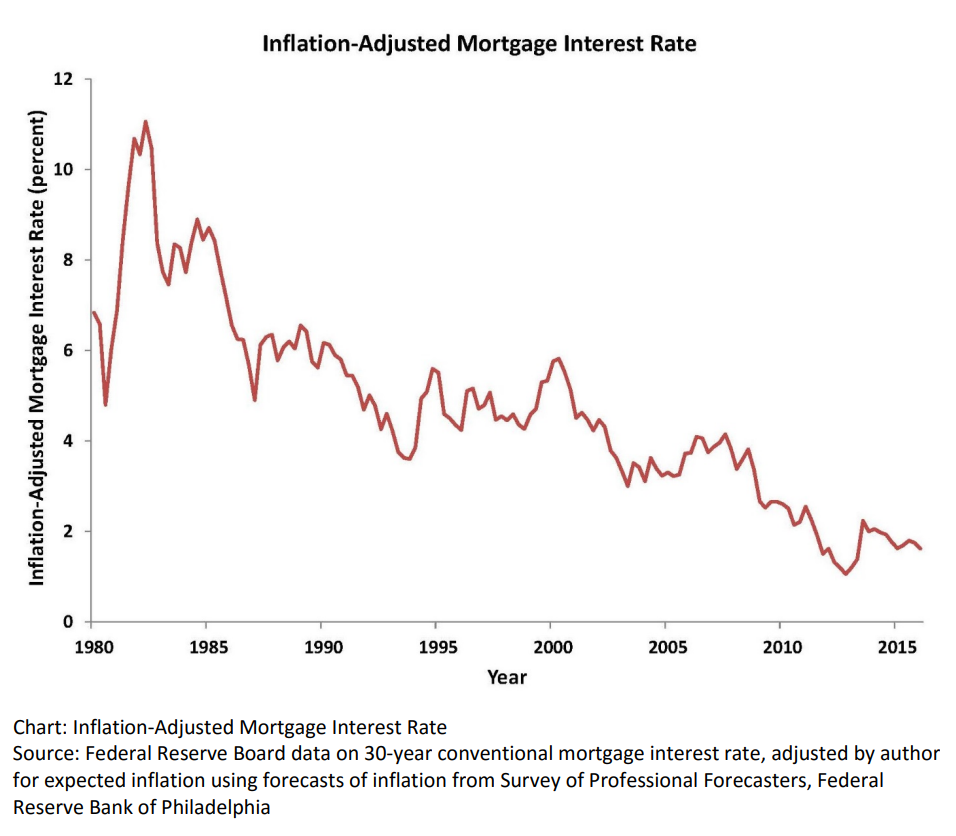
Real, inflation-adjusted, interest rates have declined greatly since 1980. At that time, with the risks of variable inflation and surging oil prices, the real mortgage interest rate was 8%. It declined to 5% in the 1990’s and 4% in the 2000’s before falling to 2% in the 2010’s. The financial cost of owning property has rarely been lower.

House Values are Up, Way Up

House prices grew relatively consistently from 1970 through 2000, with a spike in 2005-9 and a return to trend values in 2010-12. In the last 10 years, house prices have increased by 6% annually in nominal terms, or 4% annually in real terms.

Home Ownership Rate is Rebounding, Up 2%

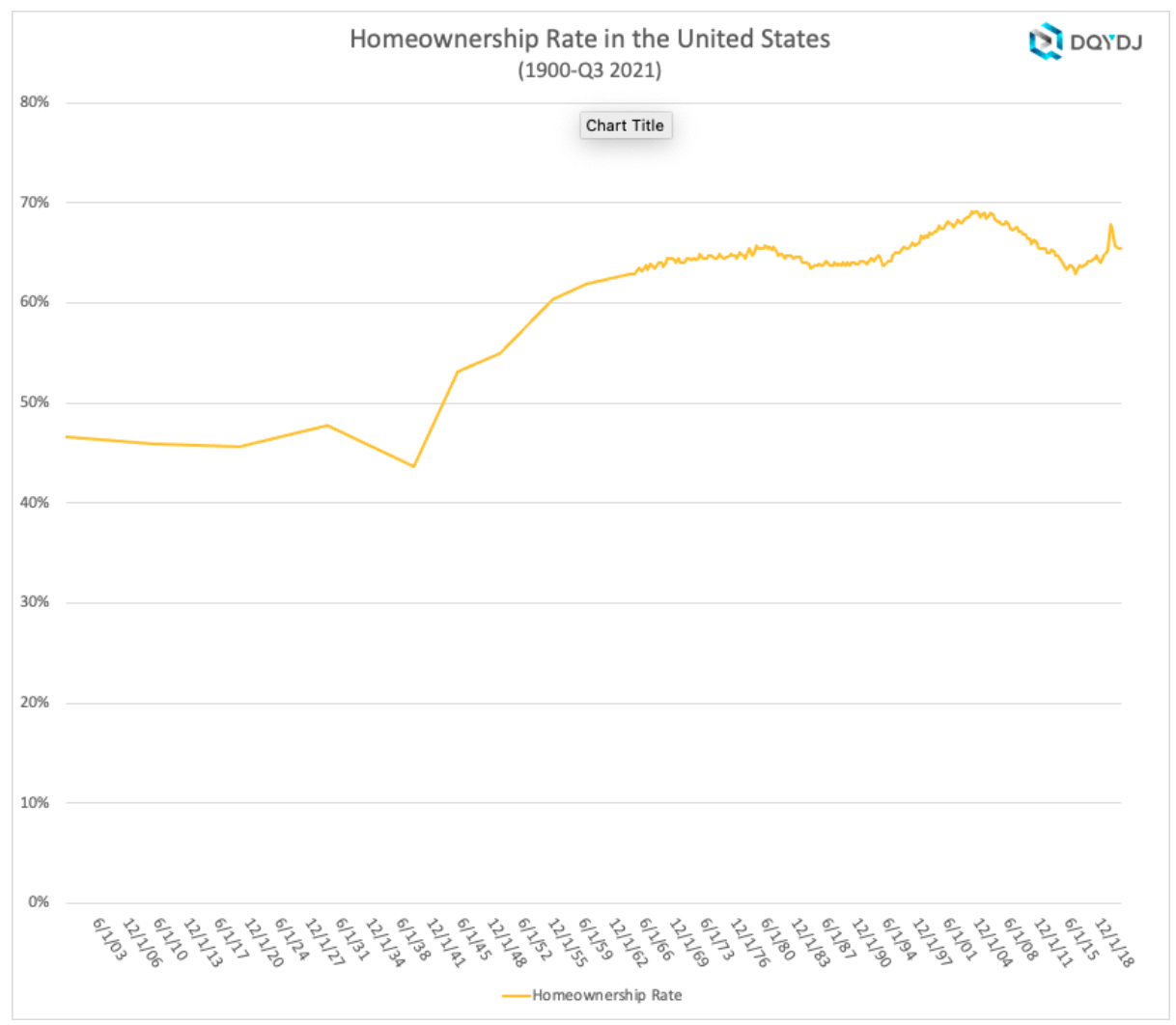
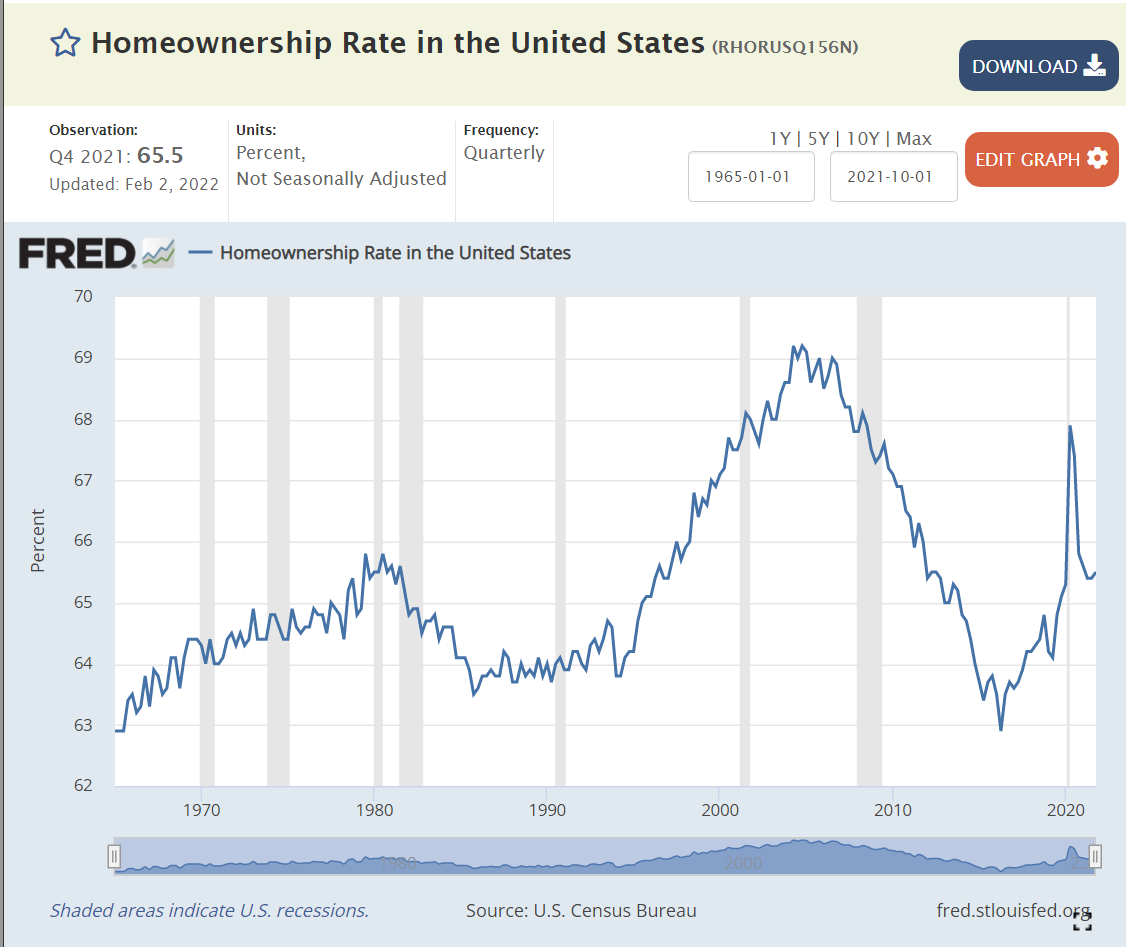
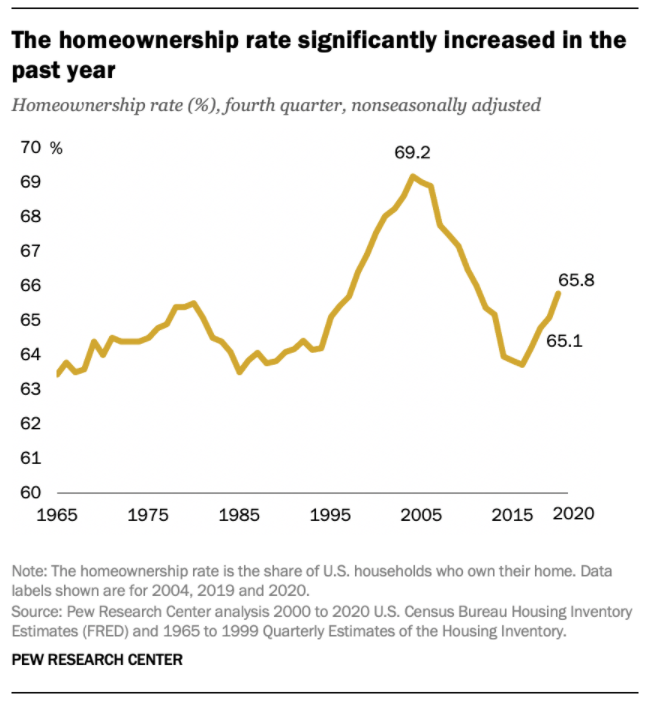
The US homeownership rate averaged 47% from 1900-40. It increased smartly in post WWII times to 60% by 1955 and 64% by 1965. Homeownership averaged 64%+ for the decade of 1969-78. It increased by 1% during 1979-81. In the midst of a difficult depression, homeownership rates dropped back to 64% by 1985, about the same for the last 20 years, setting a “normal” level. Homeownership rates stayed at 64% for the next decade. Ownership rates increased from 64% to 69% in the next decade before declining right back to 63% by 2015. In the last 7 years, despite many headwinds, the home ownership rate has increased by 2%.

Number of Homeowners has Jumped by 7 Million

In 2000, there were 69M owner-occupied homes in the US. This increased by a solid 7M to 76M by 2005. The housing market hit a lull and the number of owner-occupied homes essentially stayed flat for a dozen years, through 2017. The supply of owner-occupied homes then rose by a strong 7M in the next 4 years to 83M!

International Comparisons

https://en.wikipedia.org/wiki/Home-ownership_in_the_United_States

https://www.urban.org/urban-wire/us-homeownership-rate-has-lost-ground-compared-other-developed-countries

US homeownership rates are similar to other developed economies.

Housing Supply

https://www.mercatus.org/bridge/commentary/what-are-homeownership-rates-telling-us


The housing market is inherently volatile, typically rising by 2 times the trend and then falling to one-half of the trend. Annual housing starts averaged 1.6M from 1960-2008. They declined by a severe 75% to just 0.5M in 2009. Housing starts have subsequently grown 3-fold to 1.6M annual housing starts, but the accumulated lack of new supply is impacting housing markets today.

Housing Market by Segments

By Age Group

https://www.mercatus.org/bridge/commentary/what-are-homeownership-rates-telling-us

The period from 1982-2000 showed homeownership rates by the 5 age segments remaining relatively constant; 65+ 78%, 55-64 80%, 45-54 76%, 35-44 67% and <35 40%. The 65+ group increased homeownership from 75% to 80%. During this time, the overall US homeownership rate increased from 65% to 69%, mostly due to the aging of the population, now more heavily weighted towards the groups with 76-80% homeownership versus the 40-67% younger groups.

Homeownership rates grew from 2000 to peak rates in 2004, before declining significantly for all groups except for the 65+ cohort which essentially held it’s own. The adjacent 55-64 class fell 4%. The middle 45-54 group dropped 7%. The typically homeownership growing 35-44 group cratered by 9%. The young <35 group fell by 5%. Hence, the overall rate fell dramatically during this time.

https://www.bloomberg.com/opinion/articles/2021-04-15/home-ownership-for-millennials-may-finally-be-within-reach

This difference in home ownership experience is reflected in generational wealth summaries.

By Marital Status

https://en.wikipedia.org/wiki/Home-ownership_in_the_United_States

There is a 30 point gap between married couples and other groups, with 84% of married couples owning homes versus about 55% for other family structures.

By Location Type

https://www.census.gov/library/stories/2017/09/rural-home-ownership.html#:~:text=Rural%20areas%20have%20higher%20homeownership,holds%20in%20all%20four%20regions.

https://www.census.gov/newsroom/blogs/random-samplings/2016/12/homes_on_the_range.html

https://www.freddiemac.com/research/insight/20210602-rural-home-purchases

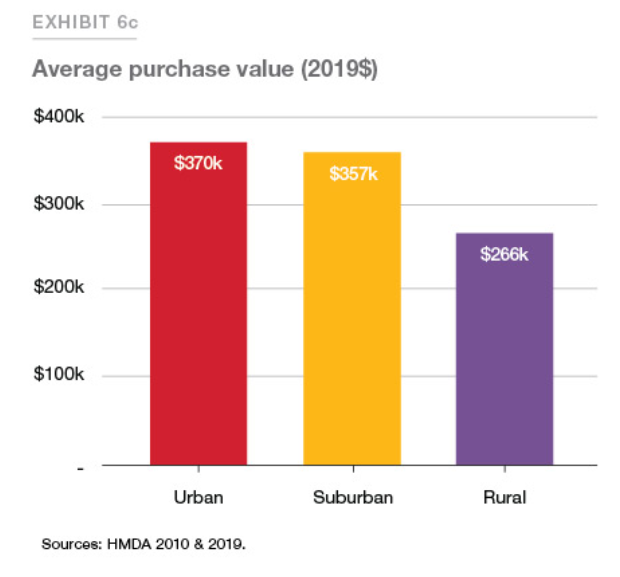
81% of rural households own their homes versus just 60% for urban households.

By Income Group

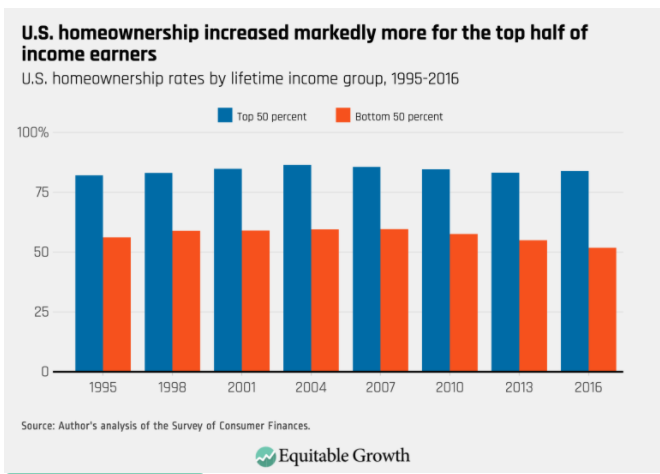
Historically, 80% of the top half of household incomes have been homeowners, while in the bottom half, just 50-60% have owned their homes.

By Racial Group

The US shows dramatically different homeownership rates by racial category. The differences between the 1995 non-Hispanic White rate (70%) and Others/Asians (50%), Hispanics (42%) and Blacks (42%) remain large in 2021 where we see White (74%), Other (57%), Hispanic (48%) and Black (44%). The groups homeownership share gain from 1995 to 2005 were similar, ranging from 6-10%, but the decline from 2005-2015 was only 3-4% for Whites and Hispanics, but 7% for Blacks and Others. The improvement from 2015 to 2021 has been 2% for 3 groups and 4% for the Other/Asian group.

Summary

The Great Recession flattened the housing market. The number of owner-occupied homes in the US remained level at 76 million from 2006 – 2017. The number of housing starts plummeted from 2.0M to 0.5M per year, compared with an historic average of 1.6M. New home construction first exceeded 1.2M units (75% of historic average) again only in 2020, a dozen years later. New home-owning households have increased by 7M units in the last 4 years! The homeownership rate is up 2 points, from 63.5% to 65.5%. Supply is responding to increased demand and higher home prices. Homeownership rates will increase with the economic recovery, but be constrained by higher home prices.
Good News: Consumer Debt Payments at Record Low

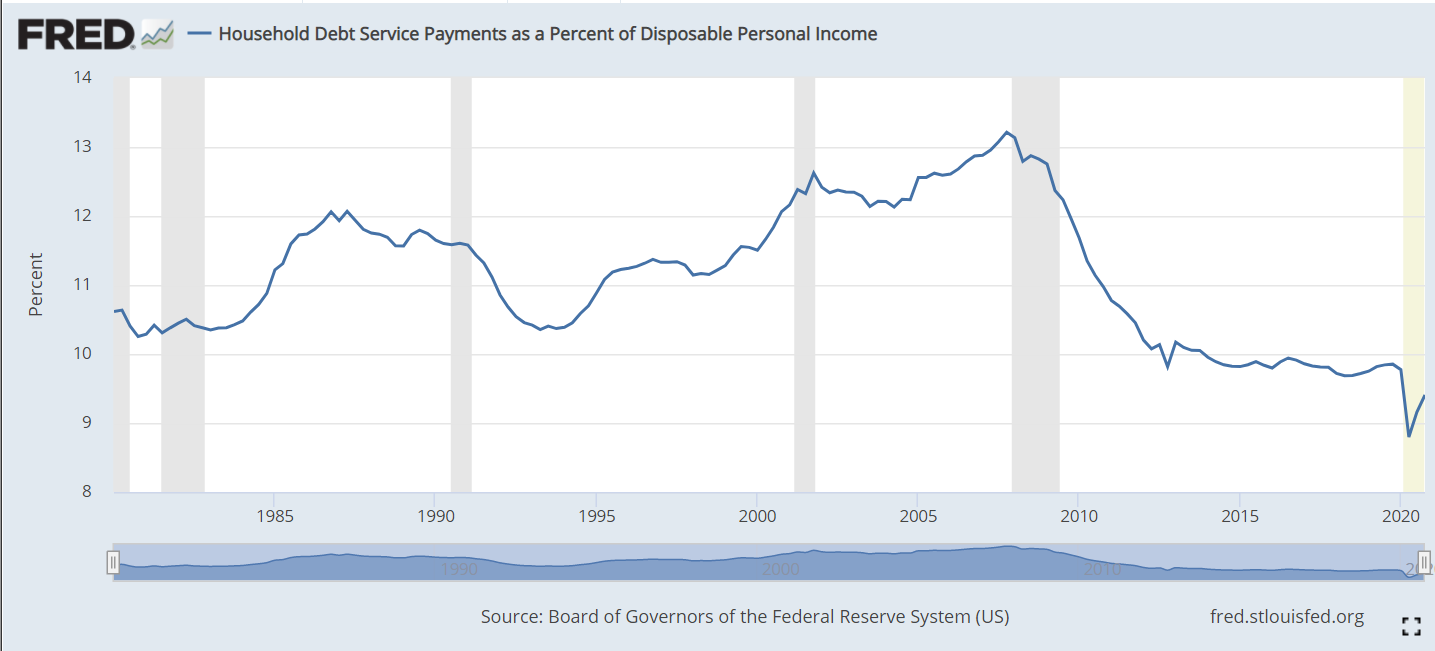
Household Debt Service Payments as a Percent of Disposable Personal Income (TDSP) | FRED | St. Louis Fed (stlouisfed.org)

The ratio of household debt service (loan payments) to disposable personal income includes both mortgage payments and consumer debt payments. From 1980-2000 it fluctuated between 10.5% and 12%. Following the 2001 recession it increased to more than 13% before falling steeply to 10% in 2012. During the long recovery from the Great Recession it remained just below 10%. During the pandemic time it fell as low as 9% as personal incomes were boosted through stimulus payments. In total, this is a healthy situation. American families worked through an unsustainable runup of debt and payment during the “ought” decade, the Great Recession and the pandemic. They are well positioned at les than 10% to either save or spend, depending on their preferences. This is good news for the economy, the housing market and risks to financial markets. This is often called the Debt Service Ratio (DSR).

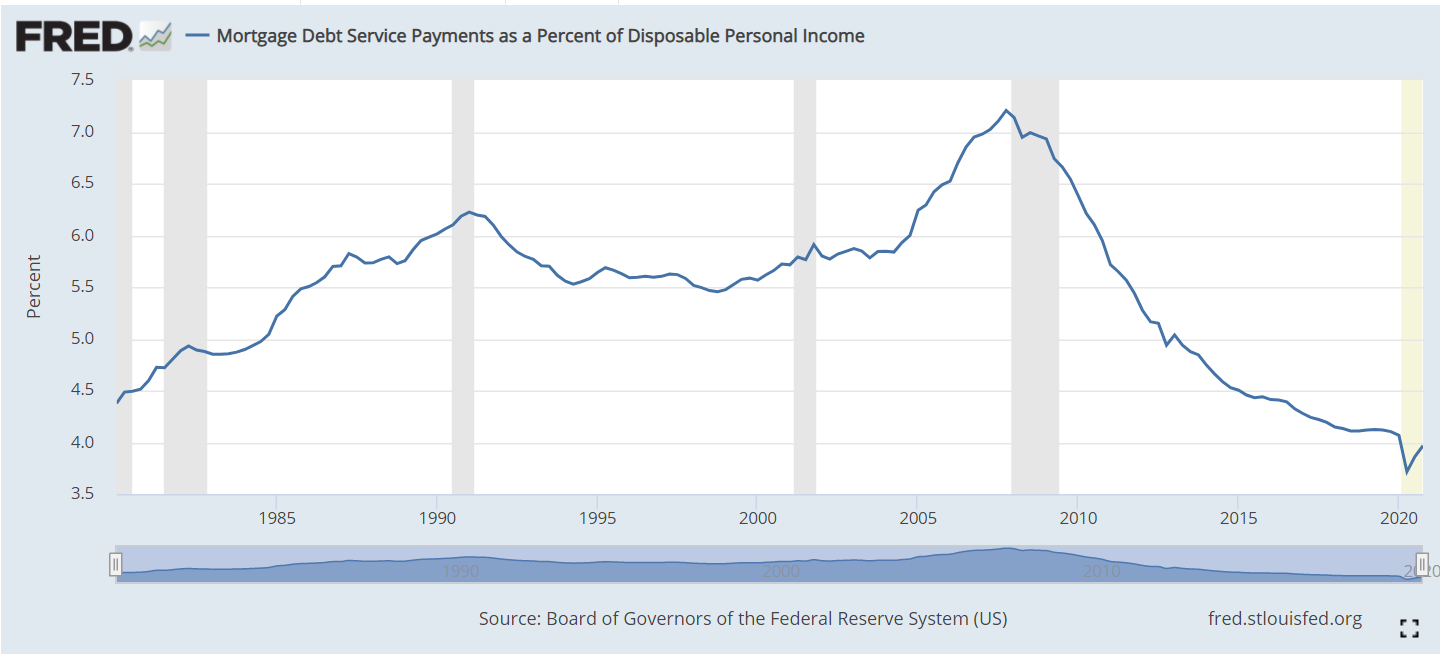
Mortgage Debt Service Payments as a Percent of Disposable Personal Income (MDSP) | FRED | St. Louis Fed (stlouisfed.org)

The mortgage component averaged 5.5% of personal income from 1980-2000. It remained below 6% through 2004, before increasing quickly to 7% in 2007. This was unsustainable. Mortgage foreclosures and revised lending standards reduced mortgage lending balances quickly. The Fed reduced interest rates and kept them low. Mortgage payments as a percent of disposable personal income fell to just above 4%. This is a 40% drop (3/7). Even compared with the 5.5% average, this is a 27% reduction in debt service expenditures. This ratio is threatened by future interest rate increases, but current mortgage holders will benefit from years of low mortgage rates and refinancing for decades to come.

Consumer Debt Service Payments as a Percent of Disposable Personal Income (CDSP) | FRED | St. Louis Fed (stlouisfed.org)

Consumer debt has also fluctuated across these 40 years, reaching an early peak of 6.4% in 1986 during the confusing era of stagflation. In the next 6 years, families reduced their debt percentage by 1.7% to a safe minimum of 4.7%. Consumers were more confident through the 1990’s and took on more debt, allowing the payment ratio to rise to a new record of 6.6% before the 2000-2001 recession triggered less borrowing. Although mortgage payments increase during the 2000’s, consumer debt payments eased back to just 6.0%. Families were scared by the Great Recession and reduced their debt levels (and helped by lower interest rates) and payments to just 5% in 2010. The ratio remained low for 2 years, before resuming a familiar optimistic climb to 5.8% of disposable income before the pandemic.

Household Financial Obligations as a percent of Disposable Personal Income (FODSP) | FRED | St. Louis Fed (stlouisfed.org)

The Household Financial Obligations Ratio (FOR) follows the same pattern as the Debt Service Ratio (DSR). It is a higher percentage as it includes other “fixed” obligations such as rent. We see relative stability between 16-17% through 2004. The mortgage driven increase to 18% by 2008 is evident, followed by a very rapid fall to 15% in 2012. This broader ratio has remained flat since then. The pandemic drop is due to extra stimulus income.

File:Total US household debt and its composition over time.png – Wikimedia Commons

The composition of total consumer debt for the last 20 years highlights the rise and fall and rise of mortgage debt and the increase in student loan debt.

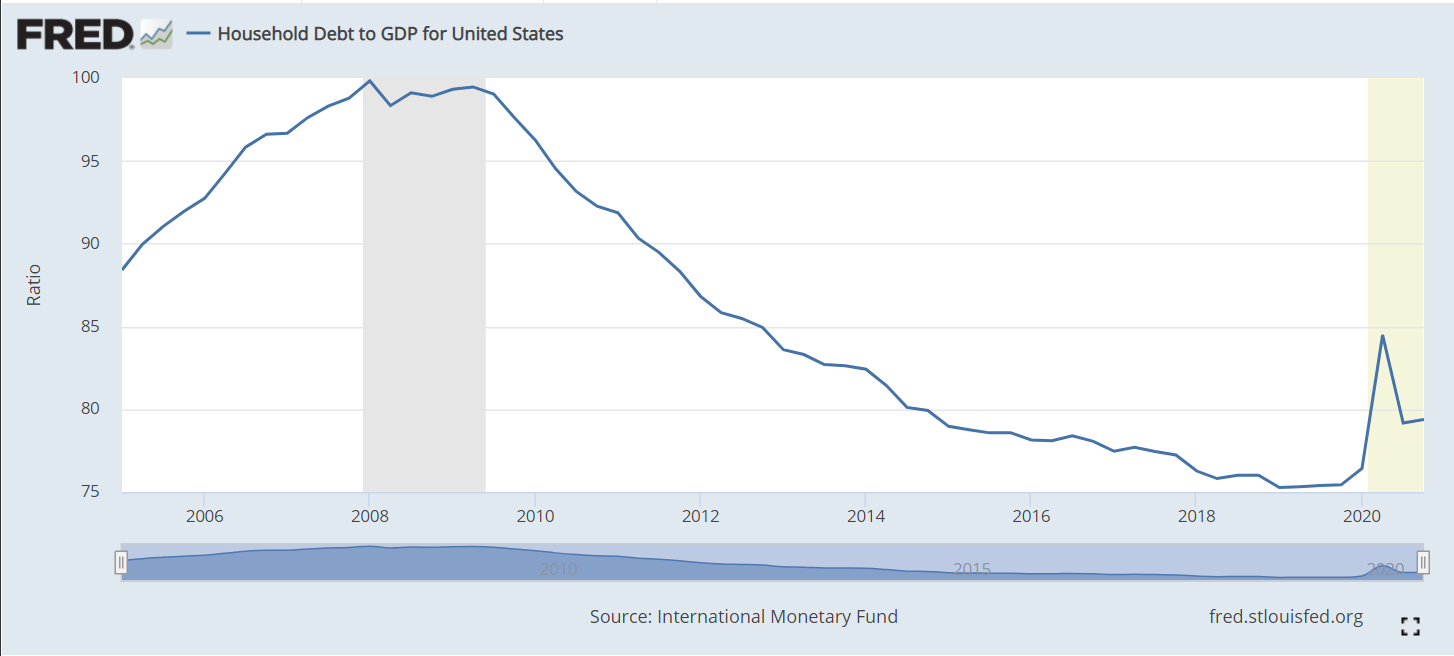
Household Debt to GDP for United States (HDTGPDUSQ163N) | FRED | St. Louis Fed (stlouisfed.org)

Household debt to GDP peaked at 100% before the Great Recession and has fallen by one-fourth in the next 10 years. Unpaid mortgages and other consumer debt have begun to accumulate in the last year.

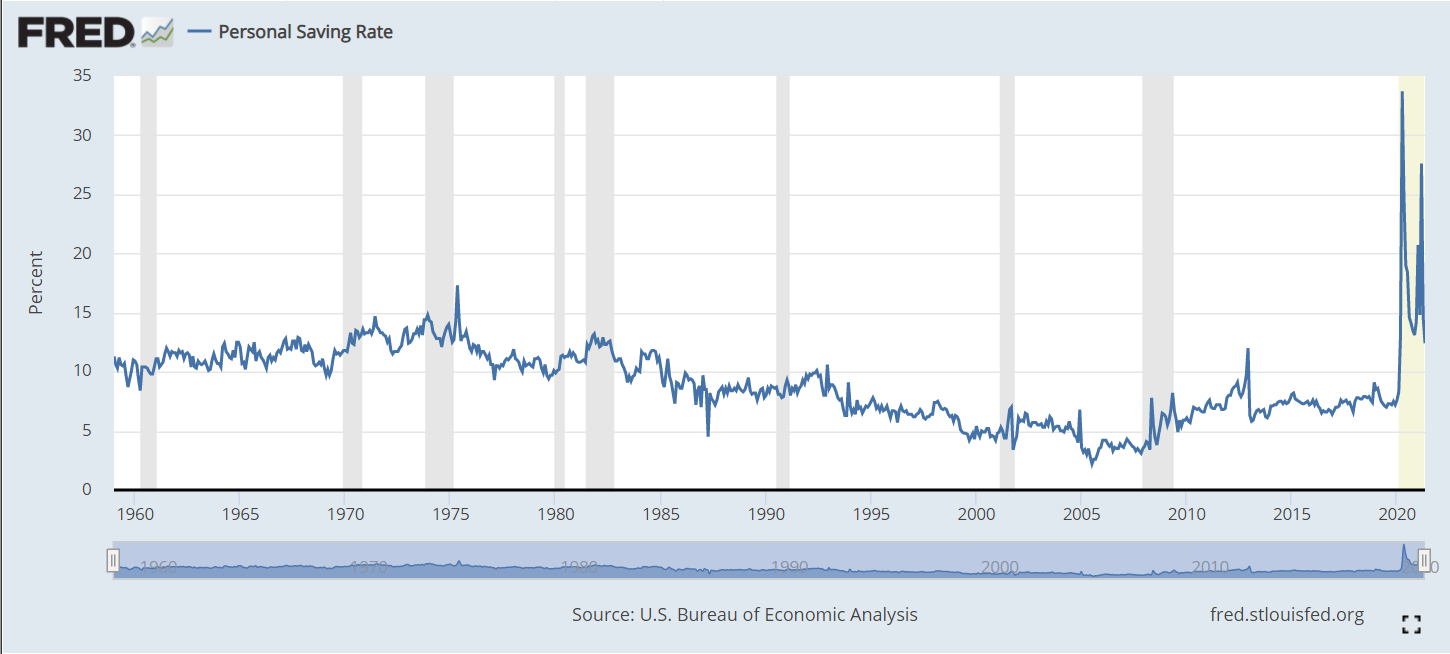
Personal Saving Rate (PSAVERT) | FRED | St. Louis Fed (stlouisfed.org)

The personal savings rate averaged 10-13% from 1960-1985. The country’s economic challenges lead families to save less to maintain their standard of living, falling in half (5%) by 1999. It remained in the 4-5% range through the next expansion. The Great Recession triggered families to replenish their savings, with a 7-8% rate. The pandemic period shows a 15% savings rate. In all likelihood, this rate will fall back below 10% soon.

Education | How has the percentage of consumer debt compared to household income changed over the last few decades? What is driving these changes? (frbsf.org)

How Stretched are Today’s Borrowers? Debt Service Levels in Fourth District States (clevelandfed.org)

Not Every Household Feels Relief amid Our Record-Low National Household Debt Service Ratio | Urban Institute

Household debt jumps the most in 12 years, Federal Reserve report says (cnbc.com)

Household Debt Service Drops to a Record Low – AIER

Household Debt Rising, but Payments Remain Under Control | LPL Financial Research (lplresearch.com)

We Are All Specialists Now

Apologies to Richard Nixon for paraphrasing his famous Keynesian quote.

Two years after starting a mid-career search, I remain impressed by the greatly increased emphasis on perfectly matching an individual’s professional and industrial experience to an open position.  Hiring managers, recruiters and HR managers have all adopted this approach.  This is partly because of the abundance of candidates and partly due to the risk averse environment caused by the slow economic recovery.  It is also due to the improved results of the “fill the bucket” approach to hiring where specific requirements are listed and then proven from actual experience and multiple interview responses.

However, I think there is something deeper involved.  Professional and industry specialization has continued to increase through time.  The discussion of outsourcing, virtual project teams and individual agents has died down, but these innovations have become a growing reality.  Successful firms increasingly focus on smaller niches of product, geography and comparative advantage.  Increased industrial and professional fragmentation is required for success.  The trend will continue.

How did I miss this?  As usual, paradigms act as blinders.  In high school in the 1970’s I was taught it was important to be “well rounded”.   At a liberal arts college, I learned that great minds and thoughts were academic, abstract and universal.  In business school, I learned that an MBA provided the necessary skills for a lifetime of career success.   I later discovered the competitive advantages of being a “general manager” from John Kotter’s influential work.

My teachers were correct in promoting the personal and professional value in developing broad knowledge, thinking skills and a professional base.   They did not foresee the modern world of global competition, where firms are forced to specialize and make economically rational decisions far beyond those envisioned by Adam Smith and David Ricardo who outlined these principles long ago. 

“General Managers” are now merely a declining specialization.   Some top-end MBAs with broad consulting experience can move from industry to industry and be successful.  A few individuals can specialize as “strategic advisors” to presidents.  But even in these fields, the trend is toward specialization.  Firms will pay for experts in a narrow tax, legal, technical or IT field only when in-house experts do not exist or others cannot complete a project well enough. 

Professional services firms have always paid lip-service to industry focus.  In the last two decades, led by IT firms, they now specialized by industry and technology equally.  Clients expect staff to understand their business.

Industrial and professional specialization will be required for future employment.   Individuals, firms and universities will adapt to survive.

Functional Specialization

Functional specialization may be the single most effective survival and progress strategy in the world.

At the biological level, organisms specialize within niche environments. Only the best of the best survive.

In economics, functional specialization is the winning strategy at the country, state, firm and individual levels.

David Ricardo’s theory of comparative advantage continues to apply at the country and state level.  Limited by by the size of the potential market, countries and states specialize in what they are economically comparatively best positioned to produce and use trade to improve their overall level of well-being.  The extent of international and state trade continues to grow, with no end in sight.

From Adam Smith to Alfred Marshall to Milton Friedman, many economists have focused their attention on the purely competitive market model.  Alternative monopoly, oligopoly and monopolistic competition models were developed to describe the real world where every profit maximizing firm attempts to differentiate their market position and leverage their market power.  They avoid perfectly competitive markets like the plague.

Michael Porter synthesized this in his theory of core competency, noting that firms could not be the very best at everything, but that they could become world class in a limited area.  The specialization could be in products, channels, customers, functional competencies or strategies.  Treacy and Wiersma made this more specific, observing that successful firms tended to pursue only one of three generic strategies: customer intimacy, product innovation or operational excellence.  Firms have subsequently learned to outsource nearly every functional area.

At the individual level, functional specialization has grown through time.  Classic male and female roles were differentiated in man’s history.  Hunters and gatherers.  Hunters and farmers.  Priestly and political roles.  Traders.  Warriors.  Guilds.  Professions.  Tax collectors.  Court attendants.  Scientists.  Degrees.  Doctorates.  Certificates.  Professional specialists. Industry specialists.  Business specialists.  Subspecialists.  ERP Rainmakers.  Etc.

At every level, functional specialization continues to grow because it is effective and efficient.  Functional specialization provides cost effective results in the short-run and the long-run.  It manages risk and capacity effectively. 

The use of functional specialization as an effective country, state, firm and individual strategy has become increasingly sophisticated and detailed in every half-life of history: millennia, century, decade and year!  It continues because the human population and market have grown and because transportation, politics, communications and science have advanced.

Is there no end to the application of functional specialization?

Functional Specialization Limits

There are many costs and risks which offset the benefits of functional specialization.

As Adam Smith noted, the benefits are limited by the extent of the market.  At any point in time, there are only so many customers for a given product or service.

Functional specialization and trade are limited by transaction costs.  In an earlier age, vertical and horizontal integration strategies were effectively pursued because transaction costs were high.  Specialized internal or external providers require investments in communications, marketing, contracting, evaluation, incentives, training, negotiations, influence, hand-offs, shipping and receiving. 

Alignment of interests requires meetings, contracts, communications, incentives, negotiations, penalties and time.

Functional specialization is limited by transportation, finance and communications costs across country, state, firm and departmental borders.

Outsourced functional specialization also incurs the added costs of marketing and supplier management.

In general, firms have developed effective strategies to overcome these limitations.

Functional Specialization Conflicts

There are many examples of inherently competing interests which limit the application of functional specialization.

The increased specialization of countries, firms and functions has provided new net benefits, but it has also begun to generate inherent conflicts.

Greater functional specialization has increased the need for generalists who define and manage processes.

It has increased the need for other individuals to span levels, translating strategy into projects and then into operations.

It has increased the level of personal specialization to deliver more advanced technical skills, thereby increasing the costs of communication and coordination, even within similar disciplines..

It has divided those responsible for short-term and long-term success.

It has resulted in the development of competing financial and quality paradigms to coordinate operations activities.

It has generated work groups with vastly different cognitive and emotional intelligence capabilities.

Greater focus on specialized entry-level capabilities has resulted in ever greater task or people management skills, but less initial screening for situational leadership skills to balance these needs.

Greater functional specialization has made functional areas ever more stereotypical.  A given company, functional area or individual is less likely to have complementary skills in long-term/short-term analysis, divergent versus convergent thinking skills, or varied personality profiles. 

Ironically, the advance of functional specialization greatly increases the demand for specialized individuals who are generalists, able to knit together the increasing number of functional specialists.

Functional Specialization Solutions

There are many solutions strategies that can be used to maximize the potential net benefits of functional specialization and overcome the inherent limitations.

First, processes can be defined and optimized to effectively leverage functional talents.  The mechanical and modular paradigms can be refined to incorporate specialists.

Firms can adopt a portfolio strategy whereby the average success ratio largely offsets random failures.

Specialists and generalists can trade positions to increase their effective coordination skills and understanding.

Communications meetings, technologies, experiences and priorities can improve alignment.

Process management can be elevated to a meta-analysis level, with individuals responsible for the success of prospect to customer, concept to product and order to cash processes.

Countries, states and firms can develop long-term partnerships with their suppliers and customers and improve their prospecting, bidding and negotiation skills.

Individuals can improve their situational leadership skills, learning to balance task and people needs.

Firms can greatly improve their means-ends skills, improving staff delegation, board governance and supplier management skills.

In highly diverse and risky product development areas, firms can invest in specialized firms or in competing development teams.

Firms can invest in staff members who are highly skilled in translating strategy into projects and then into operations.

Finally, firms and individuals can increase their understanding of situations where there are two inherently conflicting objectives.  They can learn from the experience of statisticians, researchers and actuaries who routinely manage the alpha risk that a predicted relationship exists when it really doesn’t against the beta risk that a relationship is found to not exist when it really does.

Functional specialization is an incredible driver of incremental value.  Countries, states, firms and individuals will be rewarded for their attention to this factor.  Common tactics can be used to maximize the value of this strategy.

Dow 15,700

Dow 35,000 was a dream in the go-go 1990’s when the new economy had supposedly broken all of the old rules.  Dow 3,500 was a distinct fear in March, 2009 when stocks had fallen by more than half from their peak.  Dow 10,000 is the most visible reference point in the current stock market.

Every investor and business degree holder knows that stock values are fundamentally based on the expected risk-adjusted net present value of future after-tax cash flows.  They are also tempted by the “efficient markets hypothesis” that says that stock valuations incorporate all information about future returns and therefore set the present value in a rational manner.  On the other hand, they understand fluctuations, random walks, animal spirits and the history of under and over valued stock markets.

http://stockcharts.com/charts/historical/djia1900.html

http://www.investorsfriend.com/return_versus_gdp.htm

Individuals who believe that stocks return 7-8% on average in the long-run through 2-4% dividend yields and 4-6% price increases, must conclude that the stock market is inherently irrational.  It has been 30% undervalued or overvalued a majority of the last 100 years.  Overvalued 1922-31.  Undervalued 1932-54, except for 1936-37.  Undervalued 1974-86.  Overvalued 1996-2008. 

Stocks were overvalued by 137% in 1929 before tumbling to -67% undervalued in 1933.  Stocks reached an undervaluated low of -58% in 1942.  Stocks reached a new -50% undervaluation during the depths of the 1982 recession.  In 15 short years, by 1997, they reached a 57% overvaluation.  They rose to 115% overvalued in 2000, before retreating to a mere 38% overvaluation in 2003.  In 2008, stocks were 67% overvalued compared with the long-run trends.

Based on 100 years of history, the Dow Jones Industrial Average at the end of 2010 should be 9,000.  The expected value in 2020 is 15,700, providing a 5% annual valuation return and 2% dividend return.  Investors who bet against long-term average valuations do so at their own risk.

Year  Trend  Actual +/-
1910             50 62 24%
1911             53 60 14%
1912             55 60 9%
1913             58 60 4%
1914             61 58 -5%
1915             64 56 -12%
1916             67 80 19%
1917             70 80 14%
1918             74 70 -5%
1919             78 75 -3%
1920             82 100 23%
1921             86 70 -18%
1922             90 80 -11%
1923             94 90 -5%
1924             99 85 -14%
1925            104 100 -4%
1926            109 130 19%
1927            115 140 22%
1928            121 190 58%
1929            127 300 137%
1930            133 250 88%
1931            139 190 36%
1932            146 80 -45%
1933            154 50 -67%
1934            161 90 -44%
1935            170 90 -47%
1936            178 130 -27%
1937            187 175 -6%
1938            196 100 -49%
1939            206 130 -37%
1940            216 125 -42%
1941            227 125 -45%
1942            239 100 -58%
1943            250 125 -50%
1944            263 130 -51%
1945            276 160 -42%
1946            290 200 -31%
1947            304 170 -44%
1948            320 170 -47%
1949            336 175 -48%
1950            352 200 -43%
1951            370 250 -32%
1952            388 260 -33%
1953            408 260 -36%
1954            428 260 -39%
1955            450 380 -15%
1956            472 500 6%
1957            496 500 1%
1958            521 475 -9%
1959            547 525 -4%
1960            574 600 5%
1961            603 580 -4%
1962            633 700 11%
1963            664 550 -17%
1964            697 750 8%
1965            732 900 23%
1966            769 950 24%
1967            807 850 5%
1968            848 900 6%
1969            890 950 7%
1970            935 800 -14%
1971            981 850 -13%
1972         1,030 900 -13%
1973         1,082 1000 -8%
1974         1,136 850 -25%
1975         1,193 700 -41%
1976         1,252 850 -32%
1977         1,315 1000 -24%
1978         1,381 850 -38%
1979         1,450 850 -41%
1980         1,522 850 -44%
1981         1,614 950 -41%
1982         1,710 850 -50%
1983         1,813 1000 -45%
1984         1,922 1200 -38%
1985         2,037 1200 -41%
1986         2,159 1300 -40%
1987         2,289 1900 -17%
1988         2,426 1900 -22%
1989         2,572 2100 -18%
1990         2,726 2600 -5%
1991         2,890 2500 -13%
1992         3,063 3000 -2%
1993         3,247 3300 2%
1994         3,442 3700 8%
1995         3,648 3800 4%
1996         3,867 5000 29%
1997         4,099 6500 59%
1998         4,345 7800 80%
1999         4,606 9000 95%
2000         4,882 10500 115%
2001         5,175 10000 93%
2002         5,485 10000 82%
2003         5,815 8000 38%
2004         6,163 9500 54%
2005         6,533 10500 61%
2006         6,925 11000 59%
2007         7,341 12000 63%
2008         7,781 13000 67%
2009         8,248 7000 -15%
2010         8,743 10000 14%
2011         9,268    
2012         9,824    
2013       10,413    
2014       11,038    
2015       11,700    
2016       12,402    
2017       13,146    
2018       13,935    
2019       14,771    
2020       15,657    

What Customers Really Want

As organizations and organizational units adopt more customer-focused strategies, there is a need to better understand what customers really want.   Although firms can invest years and decades in marketing research on this question, they can also choose to obtain 90% of the value in a single day by facilitating an honest discussion with key leaders and customers.
 Those who have adopted the quality/process view believe that the first step is to confirm that customers mostly (only) care about the perceived value of final results.  They will pay for a value added process or feature, but don’t care about other activities.  Richard Schonberger proposed that all customer needs can fit into a small number of categories, which can be used to define and prioritize the findings.

Customers value final product or service quality.  More today than before; and more tomorrow than today.  Some customers value process quality, because it reduces their risk, serves their customers or is required by regulators.  What quality level is required to remain in business, to meet expectations or to differentiate a product?

Customers value delivery speed.  Product lead times have fallen from weeks to days to hours to minutes.  Service delivery is sometimes measured in seconds. 

Customers value flexibility.  They expect your firm to have the capacity to meet their orders within standard lead times.  They expect you to make exceptions.  As in the Pink Panther movies, they may agree to a standard lead time or capacity, but when they need an exception, they want you to ignore what they told you before.  Expectations regarding flexibility vary widely across industries and firms and can change rapidly.

Customers seek value.  They want lower prices or total cost of ownership.  They want features and benefits that are cost-effective, which meet their needs or which are market leading.  This is a very broad category, but firms must operate with some understanding of what is expected.

Customers value information.  They want business relations with clear information flows, minimal transaction costs and shared accountability for risks.  Ideally, you anticipate and fulfill their needs in a cost free way, without surprises and take care of surprises of all kinds: regulatory, supplier, customer, competitor, acts of god, etc.

Finally, customers value personal relationships.  This varies by culture, industry, firm and purchasing agent.  Business relations are rarely purely business relationships.  Personal connections, loyalties, favors, culture and understanding often matter.

Firms or business units should understand what their customers want.  They should identify minimal, expected and differentiated performance levels.  They should understand relative customer priorities.  This may require formal marketing research or trial policies or pricing exercises to determine real preferences.  This may require sales, marketing, engineering, production and finance to work together like never before.

A consensus one-page QSFVIP customer profile can help to shape decisions at the strategic and tactical levels.

Project Opportunity Analysis Template

    Opportunity Analysis – Name of Project
     
    1. Key Strategic Priority Areas/Critical Success Factors
10 A Creatively addresses more than one of the nine key strategic priority areas.
7 B Directly targets a significant improvement in one key strategic priority area.
3 C Contributes to the achievement of one key strategic priority area.
  D Provides benefits, but does not address any of the nine key strategic priority areas.
     
    2. Annual Strategic Plan
10 A An integral and significant preplanned component of the annual strategic plan.
7 B An initiative within the annual plan.
3 C Consistent with focus areas of the plan, but not defined as a planned initiative.
  D Provides benefits, but is not connected to the initiatives defined in the plan.
     
    3. Mission, Vision and Precepts 
10 A Creatively addresses more than one precept or component of the mission.
7 B Directly targets a precept or component of the mission.
3 C Contributes to a precept or component of the mission.
  D Provides benefits, but the connection to the mission and precepts is weak.
     
    4. Long-term Strategic Plan
5 A Creatively addresses more than one goal of the plan.
4 B Directly targets a significant improvement in one goal of the plan.
2 C Contributes to the achievement of one goal of the plan.
  D Provides benefits, but does not address specific goals of the plan.
     
    5. Program/Product Portfolio
5 A Builds on an existing area of strength, leveraging a core competency.
4 B Provides services the organization has targeted for growth or improvement.
2 C Addresses an area of weakness considered critical to portfolio of services.
  D Serves a new area, a weak area, or one that de-emphasized.
     
    6. Customer(s) Served
5 A Targeted to serve an existing primary customer group.
4 B Serves a customer group which has been identified for growth potential.
2 C Serves a secondary customer group, by leveraging an existing program.
  D Serves a secondary customer group or channel,  which others could serve as well.
     
    7. Proven Demand for this Service
5 A Members, customers and sponsors have paid for this program before.
4 B Marketing research and tests indicate that this is a top priority service.
2 C Marketing research supports some demand, but dollar value is unproven.
  D Some constituents demand this service, but no research or market proof.
     
    8. Brand Consistency
5 A Service reinforces key brand messages and is promoted with existing vehicles.
4 B Service is consistent with key brand messages, but requires separate promotion.
2 C Service connects with some brand messages and requires separate promotion.
  D Service is not consistent with key brand messages.
     
    9. Delivery Channel Environment
5 A Reinforces historical and current programs and values in delivery organizations..
4 B Consistent with historical programs and values in delivery organizations.
2 C Some degree of innovation or stretch that may be a concern to some players.
  D Innovative program designed to introduce change for delivery partners.
     
    10. Financial Resources
5 A Earns a financial payback of investment in one year or less.
4 B Earns a financial payback in two years or less.
2 C Breaks even in more than 2 years, but provides significant qualitative benefits.
  D Qualitative benefits are deemed to exceed quantitative costs.
     
    11. Sponsor/Funding Resources
5 A Creates a strong opportunity to attract new sponsors and contributions.
4 B An attractive project 80% likely funded in a year, without harming programs.
2 C More than 50% funding chance, but may compete with existing programs.
  D Less than a 50% funding chance or clearly competes with existing programs.
     
    12. Information Technology
5 A Uses existing capabilities without modification.
4 B Uses existing or planned strong capabilities with minor enhancements.
2 C Uses existing capabilities, but requires development outside of current plans.
  D Requires pioneering development work to provide appropriate service.
     
    13. Delivery/Operations/Processing Capabilities
5 A Uses existing strong capabilities without modification.
4 B Uses existing strong capabilities with minor enhancements.
2 C Uses existing capabilities, but requires significant development.
  D Requires pioneering development work to provide appropriate service.
     
    14. Human Resources
5 A Service can be provided by existing staff and structure.
4 B Service requires some additions to staff in existing categories.
2 C Service requires new staff skills and minor adjustments to structure.
  D Service requires major initiatives in recruiting, retention and structure.
     
    15. Monitoring and Evaluation
5 A Success is easily measured by existing measurement and evaluation tools.
4 B Success can be measured with only minor enhancements to current system.
2 C Success can be measured, but will require adjustments to existing measures.
  D Success is difficult, if not cost prohibitive, to measure directly.