
Ex 3-2: Moral Values
Defined
Moral values are the fundamental principles and beliefs that guide an individual’s behavior, helping them distinguish between right and wrong, good and evil. These values—such as honesty, fairness, and respect—act as a personal or societal compass that shapes character and influences decision-making, often requiring individuals to prioritize the collective good over personal gain. Google AI – April 8, 2026, for most text below.
Key aspects of moral values include:
• Guidance for Behavior: They act as an internal compass to dictate actions, choices, and interactions with others.
• Societal and Personal Origin: They can be derived from cultural norms, religious beliefs, or personal reflection, often absorbed through upbringing.
• Core Examples: Commonly held moral values include respect, compassion, responsibility, honesty, integrity, and fairness.
• Distinction from Ethics: While often used interchangeably, morals tend to be personal principles, whereas ethics are often rules prescribed by external sources (e.g., professional codes of conduct).
• Evolution: Moral values are not always fixed; they can change over time as societal norms evolve.
Essentially, moral values help people navigate complex social situations and ethical dilemmas, facilitating cooperative living within a community.
Society Requires Moral Values
Yes, a society requires a common set of moral values to maintain cohesion, stability, and trust. These shared values create a “consensus” that acts as a social glue, setting standard behaviors that guide individuals in treating each other with respect and fairness. Without this foundation, societies often face chaos, insecurity, and social division.
Key reasons for shared moral values include:
• Social Cohesion: They foster unity and prevent a community from falling apart.
• Order and Safety: A solid moral code provides a “safe track” for behavior, reducing the need for constant, forced enforcement of laws.
• Ethical Decision-Making: They provide a basis for distinguishing right from wrong, helping people make consistent choices in personal and professional lives.
• Cooperation: Shared values enable people to work together toward common goals, rather than merely surviving in small, fragmented groups.
While absolute conformity is not necessary, the general acceptance of a set of values—such as love, honesty, and fairness—is critical for the functioning of a modern, democratic society.
Liberal Democracy Requires a Set of Values (1)
Yes, liberal democracy requires a shared, foundational commitment to a core set of values, even while fostering a pluralistic society. These fundamental values, necessary for the system to function, include the rule of law, individual rights, equality, tolerance, and the legitimacy of democratic processes.
Key aspects of the requirement for shared values in liberal democracy:
• Core Principles: The system is rooted in principles of freedom, equality, and protection of rights.
• Essential Values: Key elements include the rule of law, separation of powers, and the protection of minority rights.
• Shared Beliefs: A commitment to democracy as both a governing system and a social arrangement are necessary.
• Tolerance as a Pillar: Tolerance for diverse opinions and lifestyles is a central value.
While liberal democracy allows for diverse opinions on many topics, a shared adherence to the rules of the game is essential for its stability.
Liberal Democracy Requires a Set of Values (2)
Liberal democracy does not require a uniform, comprehensive set of moral values, but it does necessitate a shared commitment to a core set of procedural, democratic values. This “overlapping consensus” includes mutual respect, tolerance, and commitment to the rule of law, allowing citizens with diverse moral or religious views to coexist peacefully.
Key aspects of shared values in a liberal democracy include:
• Procedural Norms: The focus is on shared agreement over the ground rules—such as tolerance, civic virtues, and non-violence—rather than a single moral code.
• Fundamental Principles: While pluralism is allowed, consensus exists around principles like legal equality, protection of individual rights, and freedom from coercion.
• The “Neutral” State: To remain neutral toward varying religious and moral views, liberal democracies focus on ensuring fairness for all rather than upholding a single traditional or religious morality.
• Constitutional Patriotism: Integration into liberal societies is increasingly tied to sharing constitutional and liberal-democratic values (like freedom and equality), as seen in European integration policies.
Therefore, the system thrives on moral diversity but faces instability if there is no shared commitment to the democratic process itself.
Communitarian Critique of Classical Liberal Values
Communitarians argue that classical liberal democracy overemphasizes individualism, atomistic freedom, and abstract rights, while neglecting the fundamental role of community, social responsibilities, and shared conceptions of the good life. They claim liberal democracy fails to recognize individuals are inherently embedded in, and shaped by, their communities.
Key values communitarians claim are missing from classical liberal democracy include:
• Shared Understandings of the Good: Communitarians argue that politics should not be neutral toward conceptions of a good life, but rather promote shared virtues, moral values, and community well-being.
• Social Responsibilities Over Individual Rights: They argue for a shift from a purely rights-based focus to one that emphasizes responsibilities to families, neighborhoods, and voluntary associations.
• Community Belonging and Identity: Communitarians believe that identity is formed through social context and that liberal democracy neglects the human need for strong communal bonds and collective identity.
• Common Good Over Individual Self-Interest: They believe the political order should foster public-spiritedness and focus on the common good rather than simply mediating between selfish interests.
• Social Cohesion and Stability: They contend that by focusing on individual autonomy, liberal democracy erodes the social bonds (such as in family or local communities) required for a stable society.
• Particularity Over Universality: Communitarians argue that political structures should reflect local traditions, histories, and cultural contexts, rather than relying on abstract, universal rights.
What Social Values Are Most Common? (Tom K. answer)
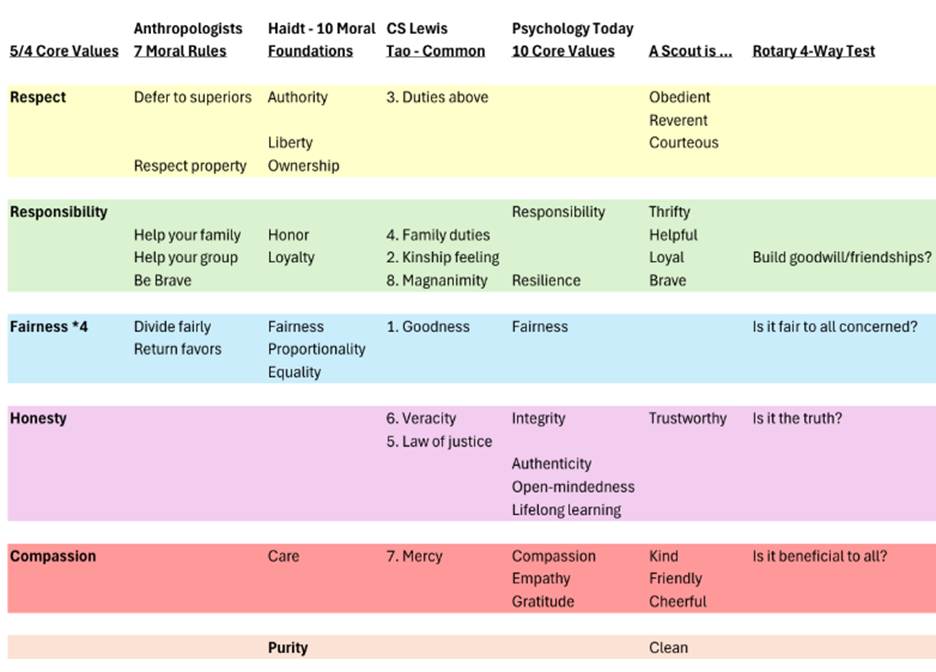
Respect, responsibility, fairness, honesty and compassion are the 5 most common social moral values.
Civility Values in Context (Tom K.)
Civility values are instrumental values, selected to be the smallest set that can effectively support the goal of delivering productive results through social discourse that recognizes differences and builds mutual respect. Respect and responsibility appear on the short list of common values above. Honesty is a component of Constructiveness. Human dignity is not in the top 5 values. It underlies acceptance, which is less common, and compassion which is common, especially today. Intentionality flows from responsibility but is defined as a distinct value. Public-spiritedness is partly supported by fairness listed above and human dignity, which is not.
Civility does not aim to replace any total moral, religious or political system. It aims to provide the skills, behaviors and habits that deliver Civil behavior and results in all domains of life. It seeks to become so widely accepted that it becomes a self-reinforcing norm, leveraging the virtuous cycle of social interaction.
Civility does not oppose other values that are proposed to make social interactions even better. Its “public-spiritedness” is a close cousin of the communitarians’ call (see above) for a more community-centered world, but Civility does not claim to know the right balance between the individual and the community.
Fairness, equity, equality and proportionality are not required, and their absence supports the essential nonpartisan stance of Civility
Purity is not required.
Constructiveness requires neutrality. Positivity is not required. Trust is a desired result of Civility rather than an underlying value.
Human rights are a step beyond human dignity.
Individualism, freedom, liberty and property ownership are not required and belong to political values.
Constructiveness requires some degree of creativity and hopefulness, but the values of idealism, utopianism, possibilities and righteousness are not needed.
Civility does not require, but hopes to produce the group values of cooperation, loyalty, belonging, honor and authority.
Civility’s combination of values often delivers but does not require moderation, avoidance, accommodation, restraint, indirect communication, subjectivity, tolerance, politeness and compromise.
Civility’s human dignity and respect do not require, but often deliver feelings, sensitivity, empathy, sympathy, care and forgiveness.
In similar fashion, it often delivers service, love, charity, mercy, selflessness and hospitality.
Based upon responsibility, constructiveness and intentionality, Civility requires rational thinking. It does not make rationality, common sense, transparency, practicality, objectivity, simplicity or curiosity a core value.
Our approach to Civility defines moral, religious, philosophical and political belief systems as support or motivation for embracing the Civility values and behaviors. It argues that Civility values and behaviors can be separated from other social values, behaviors and systems. It also allows Civility to be supported by personal, instrumental and secular factors without recourse to any overall moral system. This separation allows Civility to act as a neutral system that welcomes a wide variety of beliefs.
Civility does not reject the inclusion of values such as fairness, honesty, compassion, liberty, loyalty, community, empathy, love or service in any person or group’s definition of Civility. They are omitted to provide a smaller set of values that can be neutral on the political and religious dimensions.
The Civility values are strongly supported by the major world religions and secular humanism.
They are strongly supported by Christianity.
The vertical dimension of life, from man to the universe, eternity or God, provides a solid foundation for the Civility values.
 Good News
[…] Moral Values (3-2) – Good News […]