
Ex 3-1: Civility Values
Basis for Selecting the 7 Civility Values
Context
Civility is based upon 7 values: human dignity, respect, acceptance, responsibility, constructiveness, intentionality and public-spiritedness. These values have been identified as the foundation of Civility because they work together with the 7 Civility behaviors to deliver results while recognizing differences and building mutual respect through civil discourse.
Deliver results
Build relations
Adequate
Sustainable
Reduce costs
Broadly supported
Broadly applied
Support democracy
Actionable
Powerful
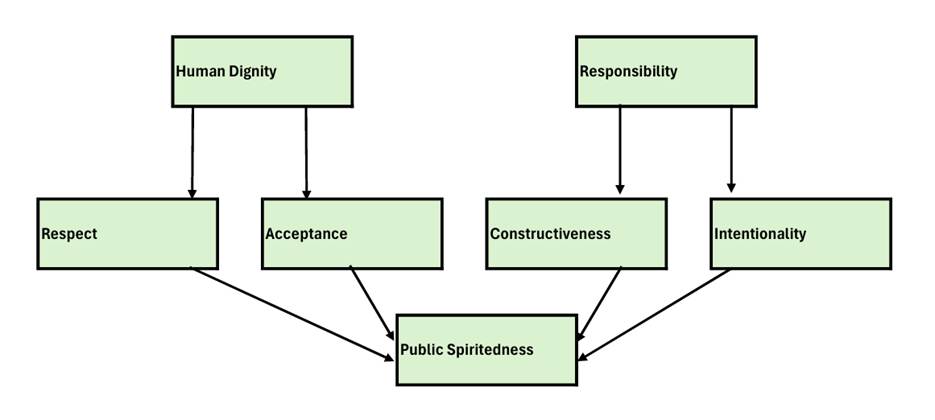
Civility is a set of behaviors based upon the seven commonly held values of: human dignity, respect, acceptance, intentionality, responsibility, constructiveness and public-spiritedness. A social, political and economic society must have some core beliefs, norms and behaviors. The modern renaissance of Civility attempts to define the beliefs, norms and behaviors so they can be shared and promoted. We need to be confident that we know what Civility is, how we should behave, how/why we should influence others and why the underlying principles make sense.
Human Dignity
Human dignity is the first principle or value underlying the Civility behaviors. It is a universally held value. In our skeptical, individualistic, subjective, relativistic era, it is essential for everyone to deeply understand the meaning of and broad support for this value.
Human dignity is at the heart of each worldview: image of God, gifted by God, preciousness of human birth, inherent divinity, self-so-ness, children of the kami, moral potential, shared humanity and moral agency.
Each worldview also has a complement to the solitary individual: public shaming, sanctity of life, sacredness of life, interconnectedness, one family, ancestral honor, roles, and rationality.
Human dignity is essential for any religious, political, philosophical, or social paradigm. Civility begins with “human dignity”.
Respect
Respect is an attitude or behavior of high regard, admiration or consideration toward a person, object, or entity.
We respect others, social roles, institutions, rules, laws and the boundaries of others.
Respect is shown through active listening, active engagement, conflict management, tolerance, maintaining safety, being courteous and considerate, honoring boundaries, intentionality, empathy, affirming and empowering others, equal treatment, trusting, justice and inclusion.
Human Dignity is a core Civility value. Respect is a recognition of that value through kindness, courtesy, and protecting rights.
Respect combined with the Civility value of Public-Spiritedness creates a need for social justice: protesting, correcting, and preventing actions that diminish human value.
Respect combined with the Civility values of Human Dignity and Intentionality requires us to proactively seek to understand and care for the needs, rights, and feelings of others.
Respect combined with the Civility values of Human Dignity and Acceptance requires us to acknowledge the value of all people, particularly those who face systemic disrespect.
Respect is supported by all major world religions.
World religions strongly emphasize respect as a necessary human value and practice.
They empathize that we are created in the image of God or as an intentional part of the universe. We must respect ourselves, others, God, nature and the universe.
Some describe us as “children of God” or very special beings or imbued with the divine spirit. Self-respect and respect for others follow. We have human dignity, something greater than our material existence.
Religions call for respect for God/the universe and the laws or commands which include respect for others.
We are to live in harmony with the created universe, respecting others, family, ancestors, elders and given social roles.
We are naturally created with the heart for compassion and empathy and are obligated to interact with love, accordingly.
Given our position in the universe, we are to live with humility, honoring God, nature, the universe and others.
Practicing humility, honor and respect are essential for personal growth.
Religions command us to have respectful “right relations” through our speech, actions, interactions with others, community participation and God.
Acceptance
Acceptance involves tolerating, respecting, and acknowledging differences. Acceptance is being open, tolerant, non-discriminating, nonjudgemental, understanding and minimizing prejudices. It is a habitual state of mind. The differences can be personal or group characteristics, beliefs, behaviors or identities.
Inclusion is acting on the value of acceptance. It includes being present, supporting others, choosing welcoming language and behaviors and preventing or reducing social exclusion.
Inclusion is primarily shown by intentionally creating positive social environments where all individuals are welcomed and feel a sense of belonging. Individuals are respected, heard, accommodated, and supported. They feel safe, trusted and free to be authentic. They are encouraged to participate, contribute and thrive.
Acceptance and inclusion help individuals to more effectively interact with others, communicate, trust, bond, listen, center, and build awareness and community.
We emphasize “acceptance” to avoid the political differences regarding “inclusion” in the DEI abbreviation. Acceptance and inclusion go “hand in hand” and are necessary foundations for embracing Civility as an idea and a set of behaviors.
The major world religions support acceptance and inclusion:
- All individuals have human dignity, created by God, worthy of acceptance and inclusion.
- Religion is practiced in communities where diverse individuals are brought together.
- The strange, vulnerable, marginalized, foreigner, widows, prisoners, and outcasts are different and must be embraced.
- Individuals are commanded to be compassionate, caring and loving to all.
- The spiritual dimension of individuals in communities makes them equally worthy of acceptance.
- Religious rituals emphasize the unity of individuals in community practice.
- The universe is one and individuals should seek harmony with all of it despite the surface level diversity.
- There are multiple, fluid paths to enlightenment or connecting with God, so diversity is natural.
- Many religions specifically call out the value of diversity, differences, designs, races, other religions, non-religious sectors and viewpoints.
- Some religions emphasize the inherent incompatibility of the individual with the whole, yet they are complementary despite the unbridgeable differences.
- Religions note the path of personal growth and learning that is driven by interacting with diverse thoughts, experiences and individuals:
Responsibility
Responsibility is willingly and actively managing our “selves” in all roles to appropriate, and even heroic, legal and moral/ethical standards.
We fill our personal, professional and social roles within the context of society. We recognize our interdependence and the need for mutual consideration.
We carefully listen, engage, empathize, apply, decide, speak, impact, influence, share, consider, decide, and act.
We welcome the joy of Responsibility with a capital R!
We consider the views and interests of others, including our families, neighbors, suppliers, customers, coworkers, bosses, employees and team members.
We consider our roles as citizens, demonstrate public-spiritedness and invest our time and resources accordingly.
We do our “fair share”. When the situation calls for it, we do more than our “fair share”.
We manage our personal, professional and ethical development.
We embrace accountability for our behavior and consequences. We seek to be considered reliable and trustworthy individuals.
We embrace “shared accountability for organizational results”.
The great religions all require Responsibility as a primary virtue. They emphasize:
- Duty to God and harmony with the universe.
- Duty to community and nation.
- Duty to nature and the environment.
- Duty to family and ancestors.
- Duty to self. Free choice.
- Personal growth and improvement, especially spiritual/ethical growth.
- Duty to the law, ethical conduct in principle.
- Duty to the church, rituals, practices and purity.
- Duty to roles, norms, expectations and stages of development.
- Duty to others based on interdependence and mutual respect.
- Compassionate duty to the poor, widows, prisoners, immigrants and vulnerable.
- Proactive responsibility.
Constructiveness
Constructiveness is the quality of being helpful, productive, and tending to build up or improve something, rather than destroy it, often involving positive contributions, useful suggestions, or fostering growth and development, as seen in “constructive criticism” or a “constructive attitude”.
Positivity focuses on maintaining an optimistic outlook and good feelings, while constructive thinking is about actively building solutions, using challenges as fuel for improvement, and taking practical action, contrasting with mere positive thinking that might ignore problems. The key difference is that positivity is an attitude, whereas being constructive is a process of building or fixing, often involving acknowledging negatives to create a better outcome.
Constructiveness is applied within the domain of civility to encourage individuals to be positive, interact, search for solutions and persist. It is affirmed by liberals and conservatives in different ways.
Left views on constructiveness emphasize the construction of new systems and social change, often with an emphasis on equality, progress, and reform. This approach views knowledge and social reality as a dynamic process that can be actively reshaped.
Right views on constructiveness emphasize the preservation and maintenance of existing social orders and traditions, often prioritizing authority, hierarchy, order, and stability. This view often relies on the idea of a “constrained vision” of human nature. Constructive action in this view often relies on private institutions and individual responsibility rather than expanded government intervention, and seeks to maintain founding principles or traditional values.
Constructiveness fits within the broad sweep of progress in modern society (500 years). It is an essential part of scientific, technical and commercial progress. Philosophically, it is supported by pragmatism. Constructiveness is a valuable principle because it is effective.
Constructiveness can be opposed if it is seen as a backdoor way of introducing a liberal bias into Civility. The philosophy of radical skepticism is incompatible with constructiveness. Constructiveness mistaken for utopian positivity is easily rejected. Other strongly negative experiences, philosophies or situations oppose it. The Civility value of Responsibility supports it. Constructiveness requires mental discipline, persistence, creativity, confidence and open-mindedness.
Constructiveness is supported by the Civility values of Responsibility and Intentionality which urge individuals to be fully present and own their choices and consequences in all environments. The Civility values of Human Dignity, Respect and Public-Spiritedness emphasize the need to be constructive in group environments and consider the needs and wishes of others.
Constructiveness is based on measured positivity and optimism, searching for possibilities at each stage of the decision-making or interaction process.
Constructiveness reflects a pragmatic modern belief in progress, reason and science, based on historical experience. It provides confidence and supports persistence.
Constructiveness is process-oriented, confident that varieties of the scientific method, logic, communications, group dynamics, business methods and instrumental logic can and will deliver results when applied. It recognizes the value of habits and the accumulation of skills, steps and wisdom through repeated experiences.
Constructiveness is proactive rather than passive or reactive. It focuses on delivering results or solutions aligned with shared goals rather than being critical, deconstructive, skeptical or merely ironic.
Constructiveness is both an emotional, willful commitment to engage and a confident belief in the effectiveness of modern decision-making and relationship development tools. It applies to both results and relationships.
Constructiveness leads to the consideration of diverse possibilities at every stage: resources, experts, information, frameworks, perspectives, creativity, combinations, win/win, compromise, good-enough steps, timeframes, decision-making tools, group and project management, delay, walk away, etc. It acknowledges that the real world is often “messy”.
Constructiveness focuses on improvements, changes and incremental progress rather than searching for a single, ideal, breakthrough solution. It supports multiple iterations and finds ways around roadblocks.
Intentionality
Having a deliberate plan or purpose before acting. An internal state of mind where an individual consciously chooses a course of action to achieve a specific outcome.
Intentionality weaves together two mental dimensions. It is purposeful, planned, logical, forward looking, rational, process-oriented, habitual, structured, informed, calculated, contextual, goal-oriented, practical, scope limited, applied and instrumental!
It is also deliberate, chosen, willful, volitional, proactive, conscious, engaged and intended.
Intentionality is a complement to responsibility, which refers to accountability for actions and consequences.
Taken together, they encourage us to be fully responsible for our choices, actions, consequences and relations. We are to consider all dimensions and make great choices. We are obligated to clearly define goals and seriously pursue them. We have human agency and a responsibility to be self-aware of our choices. We are obligated to work towards becoming mature, balanced, prudent, wise adults.
Intentionality is crucial to Civility because it:
Promotes proactivity over passivity.
Supports conscious, deliberate and purposeful commitment to treating others with respect, courtesy, and dignity.
Encourages self-awareness in decision making, including considering the impacts on others.
Challenges us to define our goals on a deep philosophical, spiritual or religious basis and seriously align our decisions and behavior with them.
Focuses on goal-oriented thinking which includes the goals of building relationships, trust and safe communities.
Emphasizes our shared responsibility for defining, supporting and reinforcing the rules of civil behavior that are mutually beneficial.
Recognizes that we are responsible for systematically evaluating, building and improving our behaviors and expectations and the norms and institutions of our communities.
The major religions offer support for being rational, considering context and consequences, being calm, balanced, focused and purposeful, but they mainly emphasize the spiritual, emotional and willful dimensions of intentionality. They encourage us to:
- Begin with the end in mind (Covey). Know, follow, engage and align with God’s will or the structure of the universe. Use the power of this knowledge and connection (holy spirit) to make the best choices.
- Make decisions based upon values and principles, not self-interest or practical concerns alone.
- Be aware, conscious, fully present in life and making decisions. You are an agent.
- Be proactive.
- Be self-aware and self-disciplined.
- Invest in spiritual growth to understand and connect with God/universe which will improve decision making in a self-improving cycle.
- Cultivate the heart and compassion as a basis for choices.
- Sincerity and proper personal intentions are critical for making choices that deliver good results and which align the person with God/universe.
An intentional person is serious about defining/prioritizing goals, making good decisions and improving themselves.
Public-Spiritedness
The quality of caring about community welfare. Altruism is considering the public good rather than just personal interests. A sense of duty to consider the community good. Willingness to act on behalf of the community.
Communities of all sizes require individual members to value community interests, not just personal interests. They require individuals to internalize this idea, belief and value to make it a habit. Humans have evolved to be able to take and hold this perspective.
The key is for individuals to consider the common, public or greater good, not to be completely selfless. Public spiritedness is not a partisan value. Classical, moderate and progressive liberals promote this value. Classic and modern conservatives promote this value.
Some liberals and conservatives reject this principle. They rely on purely individual self-interest or religious, state or philosophical systems that do not require individual choices. I argue that this “radical individualism” is one of the 6 root causes of our current dysfunctional cultural situation.
The World Religions say :
The universe exists. We must harmonize with the fixed, structured, unchanging, known universe.
Community precedes the individual.
We are interdependent.
Community provides context for life.
We are obligated to participate in community.
We must serve our communities.
We must build our communities.
We should worship in community.
We must be loyal to our communities.
We should love our neighbors, follow the golden rule.
We should be compassionate towards others.
We should be charitable and generous towards others.
Reason matters.
Justice and social justice are logical requirements.
Peace and nonviolence are important within and between communities.
Truth, honesty and integrity are crucial virtues.
Ethical intent and behavior matter.
Individuals have clear duties and responsibilities to principles and communities.
Individuals should invest in their personal ethical growth.
Public-spiritedness is a universal value, virtue and principle. Reasonable people can wrestle with the trade-offs of personal and community interests. They should all agree that the public interest matters and must be considered. This is a universal value that society can use its power to impose upon members of society. This is very difficult for our ultra-individualist society to accept or embrace. Nonetheless, it is required. We should not hesitate to educate our children, set and enforce standards in our organizations, and promote this value throughout our society. It is required for “society”. We must not apologize.
 Good News
[…] Civility Values (3-1) – Good News […]