
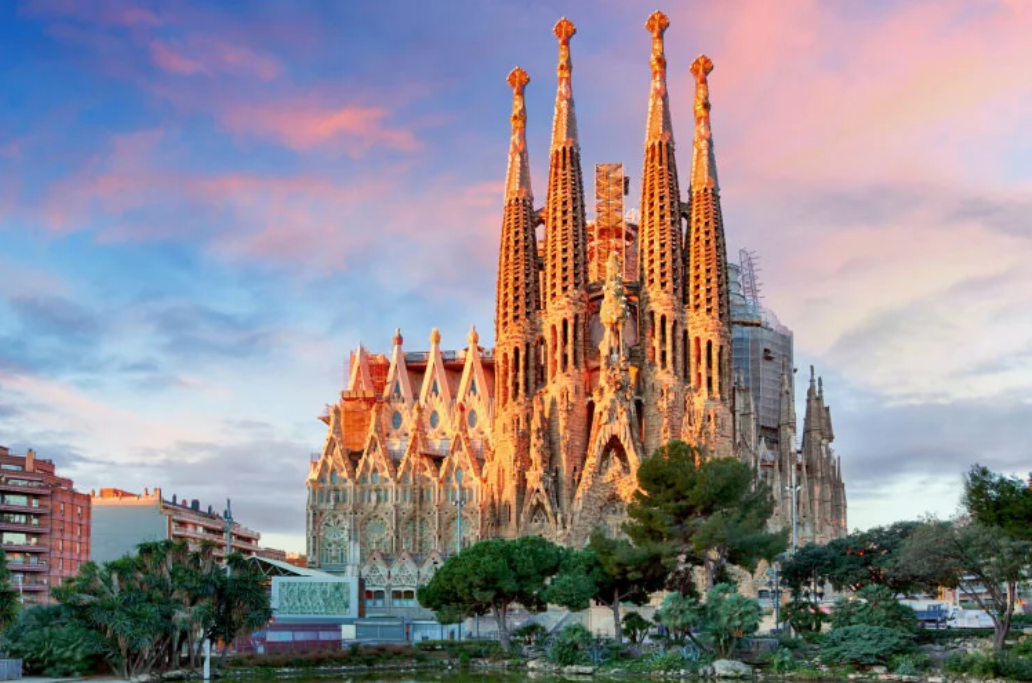
Sagrada Familia, Barcelona.
Conceptually
They say I’m a dreamer, but I’m not the only one.
The umbrella terms liberal and conservative are inadequate to political dimensions and individuals.
Despite DEI politics, most Americans support diversity, equal opportunity and acceptance.
Thought leaders realize there is no alternative to Civility for a modern society to function.
We define “certainty” for science and religion. We have post-Newton insights in the last 100 years.
We understand “victim” language. We can help ourselves and our friends to reject this burden.
Logically
Civility encourages us to accurately diagnose the current situation.
Despite political extremism, instrumental logic and facts rule the scientific and business worlds.
Civility is designed to be nonpartisan, allowing political parties to embrace this approach to effectiveness.
The 7 Civility values are equally attractive to liberals and conservatives.
Civility is able to promote public-spiritedness without leaning left.
Morally
The Civility behaviors are mostly consistent with human nature. The rest can be taught.
In a time of advanced technologies and artificial intelligence, focusing first on human dignity is wise.
While Civility focuses on behaviors and a few values, it can be driven by more emotional values.
We better understand the benefits and limits of tolerance and its role as a social value.
Most people see the costs of extreme individualism to themselves, family, neighbors and coworkers.
By highlighting the habit of skepticism, we can greatly reduce its poisonous impact.
Progressively
The track record of modern society solving problems is very strong.
Our world has an increasing experience base of finding both/and descriptions and solutions.
We do have a long track record of reducing our perceptions of “the other” as a threat.
We have more experience outsourcing government functions to reduce the sense of intrusion.
The change is based on incremental improvements rather than heroic efforts and projects.
Modern communications capabilities can effectively promote moderate, complex, less emotional positions.
As Robert Putnam documents in The Upswing, we have revised our social institutions before.
Powerfully
Civility is supported by a super majority of independents, Republicans and Democrats.
Corporations need Civility to operate complex organizations. They will recruit, train and reward Civility.
Civility embraces a wide diversity or political and religious beliefs.
Civility is supported by many churches, businesses, professions, universities and governments.
Leaders of Europe’s more secular democracies strongly embrace Civility.
There is no fundamental opposition to Civility by China’s leaders.
Civility is strongly supported by the major religions.
The 7 Civility values are supported by all major religions and philosophies.
Unquestioned religion or scientism are dead. Better insights and communication are possible.
The Catholic church can strongly support Civility.
Protestant churches can support Civility without endorsing “social justice”.
Politically
Societies have always had political differences. Our differences are no greater than in history.
In the American 2-party system, the center normally has extra political weight.
Political parties, groupings, ideologies and polarization naturally change through time.
We have 50 years of post-60’s social policy debates. We know that we will always disagree on some things.
The diversity of states allows the benefits of federalism to accrue with better policies emerging.
The reliance of the classical liberal political model on shared values is better recognized.
The unintended consequences of politically extreme policies become obvious in time.
Educationally
The impossibility of extreme political parties/factions delivering on their promises becomes apparent.
Ironically, liberals have become “cultural conservatives”, promoting a 250-year-old approach.
Liberals increasingly see the value of allowing states to determine social and economic policies.
Some liberals see that 100% enforcement of social policies drives strong opposition for little benefit.
Broadly defined insecurity has become a political priority that will generate nonpartisan solutions.
Modern cognitive science, counselling and organizational behavior are highly effective.
By defining Civility as a set of behaviors, we make it teachable, actionable and leverageable.
Virally
The Civility lessons are straightforward, allowing many to lead workshops.
Solid Civility lesson plans can be developed in many places and used everywhere.
We can fine-tune and package hundreds of Civility training exercises to serve everyone.
Organizations and individuals can rely upon counselling, groups and training.
We can greatly improve our school curriculums to teach Civility as a solution to real differences.
Civility is practiced and improved in all arenas of life. Improvements are leveraged.
In a highly specialized world, there are more opportunities to apply Civility “win-win” principles.
Civility is not an “all or nothing” set of behaviors. Incremental progress is normal.
The more challenging Civility behaviors can be practiced in safer, local environments.
Local expectations of Civility allow all individuals to apply and grow these behaviors.
Civility can be practiced in any environment without permission from anyone.
Civility skills, values, beliefs can be developed and applied without any approvals.
The virtuous cycle of Civility applies at levels. Good behavior or feedback drives more good behavior.
The practice of Civility generates “positive externalities” for others. The state should support it.
The practice of Civility provides a role model for others to emulate.
Social norms are very powerful. Most people learn them implicitly.
Civility behaviors can become habits which then apply without thought or effort.
Beneficially
Every person can serve as a Civility ambassador, champion or “civiliteer”.
High-level Civility skills are personally and professionally highly valuable.
The Civility emphasis on self-awareness and values clarification can improve quality of life.
Humans have much in common and can learn this.
Americans have much in common.
We understand “human nature” deeply, so can adjust to leverage strengths and patch weaknesses.
Americans are proud of their political system and will invest in Civility to preserve it.
Civility’s focus on human dignity supports the modern high importance of personal identity.
As individuals seek validation of their identities, Civility can help to facilitate good conversations.
Our greatly improved understanding of behavioral economics provides new policy opportunities.
Summary
The modern approach to improving and installing Civility as a major social norm is audacious, yet it has great support.
 Good News