
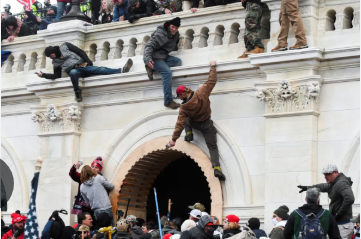
Mirror Images of Extremism
I reviewed and dismissed the “far left” challenges to the Civility movement today. The populist Republican opposition is similarly “surface level”.
Google AI Summary of Republican Party Opposition to Civility
Based on the provided search results, opposition from some members or factions of the Republican Party toward certain “civility movements” often stems from the view that such movements are used to silence legitimate political opposition, stifle aggressive accountability, or protect a “woke agenda”.

The arguments and perspectives from the search results suggest several reasons for this opposition:
View of Civility as Political Suppression: Some conservatives argue that calls for “civility” are a tool used by the left to de-legitimize passionate, tough, and direct opposition to their policies.
“Us-Versus-Them” Mentality: There is a belief among some, reflected in remarks by leaders like Mike Pence, that political rivals are not just wrong, but actively advancing an immoral or dangerous agenda, making compromise or polite discourse feel counterproductive to them.
Belief in Confrontational Politics: Many, particularly in the populist wing of the party, believe in aggressive, combative tactics that grab attention and stir up the base, rather than polite, quiet debate.
Perception of Double Standards: Some conservatives feel that the mainstream media and cultural institutions enforce a double standard, demanding civility from the right while overlooking harsh rhetoric or actions from the left.
Focus on Radical Change: Some Republicans view the current political climate as existential, where they are fighting to protect traditional values against rapid, fundamental societal changes, making “polite disagreement” feel inadequate.
Distrust of Elite Narratives: There is a strong feeling that the “civility movement” is promoted by the same “educated elite” that they believe has rigged the system, and that this movement is a way to stop conservatives from challenging that system.
These factors suggest that opposition to the “civility movement” is often not an opposition to polite behavior itself, but a rejection of what they perceive as a strategic tool to weaken their political power and silence their opposition.
Response
- Civility promotes communications as the only means to recognize existing or potential common ground. Civility does not prefer moderate political positions or the “conventional wisdom” of a time or political party. Civility does not oppose radically different positions on political issues, only the expression of positions which demonize the opposite position or its supporters. Robust debate is an essential part of what was once quaintly called “civil discourse”. Republicans are mistakenly merging Civility with the alleged restriction of “free speech” by some universities, organizations and media outlets. Civility requires partisans to clearly express their values, interests and policies in order to identify potential shared interests and evaluate differences.
- Civility is based upon the values of human dignity, respect and constructiveness. Participants are encouraged to set aside political differences and respect their common interests and humanity. The effective techniques of Civility separate the person from the policy. The Civility movement accepts and embraces differences as natural and unavoidable. https://tomkapostasy.com/2025/03/02/our-political-differences-are-not-going-away-and-thats-ok/
- The Civility approach emphasizes rational conversation, interaction, evaluation and compromise. It does not discourage passionate expression of interests. It recognizes people as thinking, feeling and doing creatures. It argues that lasting resolution of policy disagreements requires better understanding and full participation of all interested parties. Short-term tactical victories are unlikely to be sustained without some “meeting of the minds”. This warning is especially relevant at the state and local level of politics and in daily life.
- There certainly are cultural and media institutions with left-wing or right-wing biases. They are often blinded by their biases and use all of the tools of modern communications and social media to slant their messages and unfairly consider their opponents. Civility attempts to hold them to account. It promotes self-awareness, self-management, social awareness and relationship management. It is based upon the values of respect, responsibility and constructiveness. https://tomkapostasy.com/2026/01/25/the-7-civility-values-are-supported-by-world-religions/ https://tomkapostasy.com/2025/12/09/civility-is-really-about-7-behaviors/
- Civility is based upon the traditional values of human dignity, respect, acceptance, responsibility, constructiveness, intentionality and public-spiritedness. It is firmly grounded in the traditions of Western civilization and liberal democracy. Civility is not biased towards a far-left, postmodernist, secular society free of social norms and community. It recognizes the tension between the individual and the community, traditional and modern (WEIRD) and postmodern values but remains agnostic regarding the best solution other than the preservation of a communications and problem-solving framework. https://forum.effectivealtruism.org/posts/7heEBq7oZnMvbSbJa/weird-morality#:~:text=purview%20of%20morality.-,Moral%20Foundations%20Theory,sanctity/degradation
- Civility is based upon 7 widely held values and 7 commonly taught behaviors. It does not prioritize any social, political, economic or educational elite. It outlines a set of specific behaviors that lead to effective communications and problem solving in all dimensions of life. Practitioners at any social level can benefit directly or indirectly. https://tomkapostasy.com/2025/10/25/civility-whats-in-it-for-me/ https://tomkapostasy.com/2025/11/30/inspiring-civility/
Summary
The populist wing of the Republican party sounds like the far-left wing of the Democratic party. Civility is a tool of the other guys, unfair, biased, inadequate, ineffective, unreliable, soft, emotional and too slow. The Civility approach doesn’t support the simple polarizing approach of modern politics. It emphasizes facts, logic, values clarification, optimal means, compromises, discovery, short and long run trade-offs, all of the tools of the modern negotiator’s kitbag. It accepts that profound differences may remain in our political, economic and social realms. It is fundamentally a “glass half-full” approach. Civility argues that its approach is much more effective in the long run in finding reasonable solutions, minimizing deep pain for those who disagree and maintaining relationships that promote future solutions.
 Good News
[…] to Civility is Unconvincing Opposition to Civility is Unconvincing (2) Don’t Be a Political Victim (Right) Don’t Be a Political Victim (Left) […]
[…] Opposition to Civility is Unconvincing (2) – Good News […]
[…] Opposition to Civility is Unconvincing (2) – Good News […]