
https://personalityjunkie.com/08/personality-politics-liberals-conservatives-myers-briggs-big-five/
Introduction
Jonathan Haidt and his colleagues have developed a set of 9 intuitive moral values that are consistent with evolutionary psychology insights. Amateur psychologists appreciate the Myers-Briggs model while professionals promote the “Big 5” personality traits. Google AI allows us to relatively quickly check our intuitive sense of how the moral values connect with the personality traits.
Professor Haidt’s work emphasizes that moral values are part of our internal makeup based upon evolution, especially recent evolution into a social and cultural species. His team promotes the “rider and elephant” model that asserts that we acquire and reflect deep-seated moral, political and religious views in an intuitive fashion. We only use our rider/rational character to defend/explain our choices from time to time. This was developed independently of Daniel Kahneman’s system 1, system 2 “thinking fast and slow model”. We mostly think fast/intuitively but are able to think slow/rationally as required. The “Moral Foundations Theory” team says that we are 90% selfish chimp and 10% cooperative bee. We are now a hybrid species.
Dr. Haidt is an intuitive, experiential liberal whose academic/scientific work forced him to re-examine his moral beliefs and biases, and those of the left-leaning social sciences. His team documented that there are traditional moral values widely held throughout history and across cultures that do not comply with the dominant WEIRD model of western, educated, industrial, rich and democratic. They took the usual modern experimental psychologist steps and defined 5 moral values. They later expanded their model to 9 values, breaking fairing/no cheating into equality and proportionality and adding liberty/oppression, ownership and honor.
Their team was widely criticized from the left for challenging/undermining the prevailing views of modern moral values (stage-based development, ala Jean-Jacques Rousseau and Lawrence Kohlberg) and opposing the “conventional wisdom” of inevitable moral and cultural progress towards a liberal ideal. At an early stage, they determined that liberal individuals and politicians had a limited moral palate of just care/harm and fairness while conservative individuals and politicians appreciated care/harm and fairness and many traditional moral values. Circa 2013 they tried to convince Democrats that they were playing politics “with one arm tied behind their backs”. The team must have thought “in for a dime, in for a dollar” when they later added ownership and honor to the traditional values of loyalty, authority and purity as valid, universal, historical moral intuitions.
I will take a first pass at how moral intuitions relate to personality traits and then to political views.
https://www.verywellmind.com/the-big-five-personality-dimensions-2795422
https://www.myersbriggs.org/my-mbti-personality-type/the-mbti-preferences/
Charts
Comments
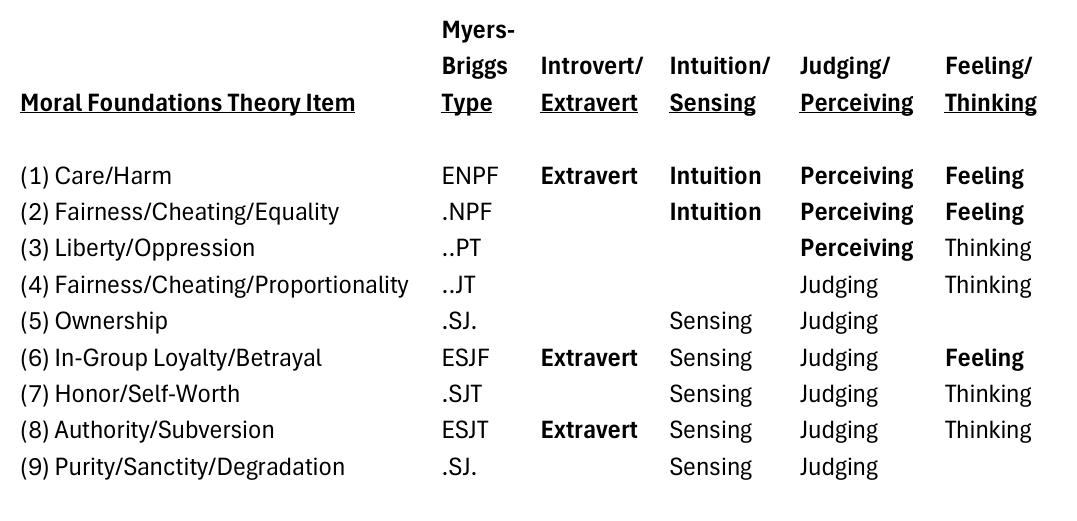
Introversion versus extraversion has a limited connection with moral intuitions or politics. Both parties and philosophies attract introverts and extroverts.
Abstract, intellectual individuals emphasize care/harm and fairness/equality as their main moral virtues. Haidt and others criticize this dominant academy view as “thin morality”, inadequate for the real world of community and politics. More concrete/specific/sensing/experiential/practical people tend to also support the conservative values of ownership, loyalty, honor, authority and purity.
Open-minded “perceiving” individuals support care, equality and liberty. Their “judging” counterparts support the 5 clearly conservative values listed above and proportionality as important principles for equity.
High “feeling” individuals tend to adopt the care and equality moral possibilities. They also tend to support the more conservative value of group loyalty. High “thinking” individuals like the structure provided by proportionality, authority and honor. They also tend to be more sensitive to liberty/oppression.
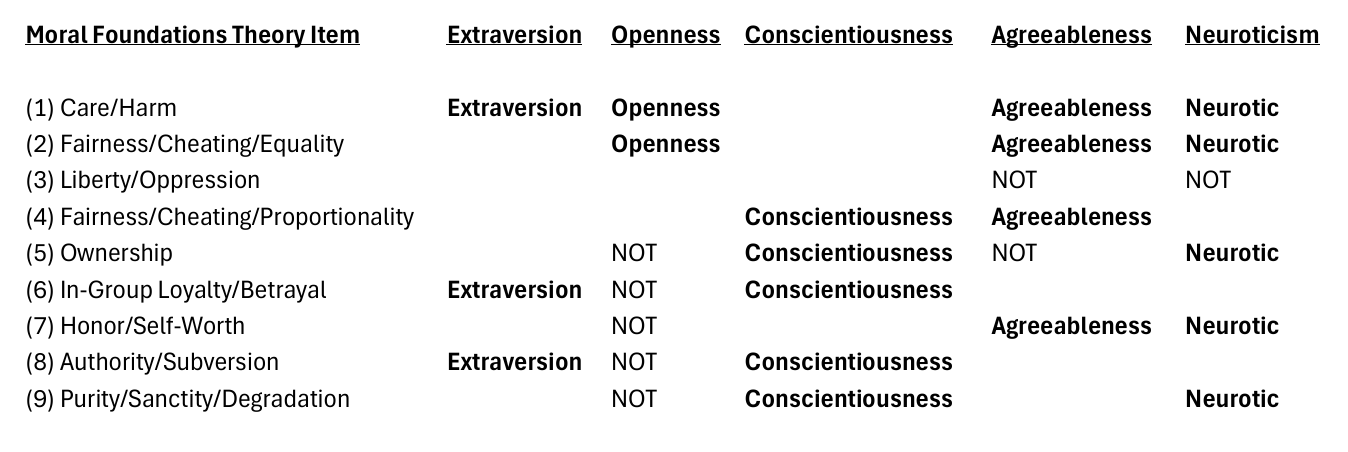
The “Big 5” personality value of “openness” to new experiences is considered the most important predictor of political views by political scientists and psychologists. High openness drives moral intuitions of care and equality. Low openness leads to a preference for ownership, loyalty, honor, authority and purity.
Conscientiousness is affiliated with the conservative values of ownership, loyalty, authority and purity. Proportionality is more neutral for politics, but clearly connected here.
Agreeableness does not align with the other factors. Friendly, high feeling individuals predictably support care and equality. But they also support conservative leaning proportionality and honor. Non-agreeable individuals are more sensitive to oppression, a relatively neutral value. Non-agreeable individuals are more interested in the conservative value of property ownership.
Neuroticism is an equal opportunity offender. Tightly wound, sensitive individuals tend to support the liberal core of care and equality. They are also attracted to the “conservative” values of ownership, honor and purity.
Summary
There is a clear left-right, liberal-conservative divide in some moral intuitions and personalities. There are statistical trends and tendencies. But real individuals are more complicated. Modern individuals are more likely to consider themselves independents with a portfolio of liberal and conservative views on specific topics. Many personality dimensions are unrelated to political views. Humans have different personalities, moral intuitions and political views. There is no clear “right and wrong” view. We are stuck with each other.
I encourage all partisans to deeply consider this result. Politicians are incentivized to win. They look for the “least common denominator”, the most effective words to assemble and maintain a voting coalition. In the modern world of politically and religiously low-engagement citizens, this is a rational and winning approach. Polarization and win/lose positioning are also logical means to election and re-election.
I think that we inherently hold different moral intuitions and political views based upon our personalities and life experiences. We are stuck with each other. We need to invest in Civility to make our political systems work. We need to embrace compromise and “good enough” political results.
 Good News
[…] Than You Think Our Political Differences are NOT Going Away; And That’s OK Moral Intuitions, Personality and Politics … Oh My! What’s the Root Cause of Our Problems?: […]
[…] Moral Intuitions, Personality and Politics … Oh My! – Good News […]