

Civility Values
Civility is a set of behaviors based upon the seven commonly held values of: human dignity, respect, acceptance, intentionality, responsibility, constructiveness and public-spiritedness. A social, political and economic society must have some core beliefs, norms and behaviors. The modern renaissance of Civility attempts to define the beliefs, norms and behaviors so they can be shared and promoted. We need to be confident that we know what Civility is, how we should behave, how/why we should influence others and why the underlying principles make sense.
Constructiveness
Constructiveness is the quality of being helpful, productive, and tending to build up or improve something, rather than destroy it, often involving positive contributions, useful suggestions, or fostering growth and development, as seen in “constructive criticism” or a “constructive attitude”.
Positivity focuses on maintaining an optimistic outlook and good feelings, while constructive thinking is about actively building solutions, using challenges as fuel for improvement, and taking practical action, contrasting with mere positive thinking that might ignore problems. The key difference is that positivity is an attitude, whereas being constructive is a process of building or fixing, often involving acknowledging negatives to create a better outcome.
Constructiveness is applied within the domain of civility to encourage individuals to be positive, interact, search for solutions and persist. It is affirmed by liberals and conservatives in different ways.
Left views on constructiveness emphasize the construction of new systems and social change, often with an emphasis on equality, progress, and reform. This approach views knowledge and social reality as a dynamic process that can be actively reshaped.
Right views on constructiveness emphasize the preservation and maintenance of existing social orders and traditions, often prioritizing authority, hierarchy, order, and stability. This view often relies on the idea of a “constrained vision” of human nature. Constructive action in this view often relies on private institutions and individual responsibility rather than expanded government intervention, and seeks to maintain founding principles or traditional values.
Constructiveness fits within the broad sweep of progress in modern society (500 years). It is an essential part of scientific, technical and commercial progress. Philosophically, it is supported by pragmatism. Constructiveness is a valuable principle because it is effective.
Constructiveness can be opposed if it is seen as a backdoor way of introducing a liberal bias into Civility. The philosophy of radical skepticism is incompatible with constructiveness. Constructiveness mistaken for utopian positivity is easily rejected. Other strongly negative experiences, philosophies or situations oppose it. The Civility value of Responsibility supports it. Constructiveness requires mental discipline, persistence, creativity, confidence and open-mindedness.
Constructiveness is supported by the Civility values of Responsibility and Intentionality which urge individuals to be fully present and own their choices and consequences in all environments. The Civility values of Human Dignity, Respect and Public-Spiritedness emphasize the need to be constructive in group environments and consider the needs and wishes of others.
Constructiveness is based on measured positivity and optimism, searching for possibilities at each stage of the decision-making or interaction process.
Constructiveness reflects a pragmatic modern belief in progress, reason and science, based on historical experience. It provides confidence and supports persistence.
Constructiveness is process-oriented, confident that varieties of the scientific method, logic, communications, group dynamics, business methods and instrumental logic can and will deliver results when applied. It recognizes the value of habits and the accumulation of skills, steps and wisdom through repeated experiences.
Constructiveness is proactive rather than passive or reactive. It focuses on delivering results or solutions aligned with shared goals rather than being critical, deconstructive, skeptical or merely ironic.
Constructiveness is both an emotional, willful commitment to engage and a confident belief in the effectiveness of modern decision-making and relationship development tools. It applies to both results and relationships.
Constructiveness leads to the consideration of diverse possibilities at every stage: resources, experts, information, frameworks, perspectives, creativity, combinations, win/win, compromise, good-enough steps, timeframes, decision-making tools, group and project management, delay, walk away, etc. It acknowledges that the real world is often “messy”.
Constructiveness focuses on improvements, changes and incremental progress rather than searching for a single, ideal, breakthrough solution. It supports multiple iterations and finds ways around roadblocks.
Constructiveness is broadly supported by the major religious traditions. [Google AI answers].
Judaism
Judaism strongly supports “constructiveness” through core concepts like Tikkun Olam (repairing the world), encouraging positive actions, personal growth, community building, and channeling emotions productively, viewing humans as co-creators with God tasked with improving the world, not just passively living in it. It emphasizes building, enhancing, and transforming the world through ethical action, kindness, and responsible leadership.
- Tikkun Olam (Repairing the World): A central idea focusing on social action, justice, and making the world a better place.
- Co-Creation: Jews are seen as God’s partners in creation, responsible for improving and building up the world, not just dominating it.
- Mitzvot & Ethical Living: Commandments and traditions guide individuals to act constructively, with emphasis on love, kindness (chesed), justice, and wisdom.
- Positive Psychology: Modern Jewish thought integrates positive psychology, focusing on virtues like resilience, creativity, and happiness to strengthen Jewish life.
- Constructive Criticism (Tochachah): The commandment to rebuke others is meant to be done privately, gently, and with love, fostering improvement, not destruction.
- Channeling Emotions: Tradition teaches controlling and directing powerful emotions (like anger) into positive actions rather than letting them become destructive.
Christianity
Christianity strongly supports constructiveness, focusing on edification, building up believers and the community through encouraging speech, wise actions, and positive creation, emphasizing that what is permissible should also be helpful and build character, not tear down. Biblical principles highlight using words and actions to impart grace and promote spiritual growth, not unwholesome talk or destruction.
Biblical Foundations for Constructiveness
- Edification: A core concept, meaning to build up or strengthen others spiritually (1 Thessalonians 5:11, Ephesians 4:29).
- Helpful Speech: Believers are encouraged to speak only what builds others up and brings grace, avoiding unwholesome talk (Ephesians 4:29).
- Discernment: Christians should ask if their actions are helpful, profitable, and edifying to their spiritual life (1 Corinthians 10:23).
- Truth in Love: Offering correction and criticism should be done gently, with a sincere motivation to help others grow in righteousness (Ephesians 4:15, Proverbs 9:8).
- Creation: Christians are called to be creative and contribute to the world, making something beautiful and useful out of God’s creation, reflecting good and wholesome things (Genesis 1:28-31).
Islam
Islam strongly supports “constructiveness,” emphasizing positive thinking, creativity, beneficial actions, community betterment, and using intellect for problem-solving, all within a framework of divine purpose and moral values. Islamic teachings encourage building a purposeful life, contributing to society, innovating for good, and engaging in positive communication and development, contrasting with negativity or destruction.
Key Islamic Principles Supporting Constructiveness:
- Purposeful Creation: The Quran highlights that creation has meaning, urging humans to live according to God’s plan and make life beneficial, not wasteful.
- ** Intellectual Engagement (Aql):** Muslims are encouraged to use their intellect (Aql) to find solutions and understand the wisdom in creation, fostering creativity.
- Positive Action & Thought: Islamic practices like prayer, charity, and remembrance (dhikr) promote positive thinking and action for individual and societal welfare.
- ** Benefitting Humanity:** Islam values making useful contributions to the community and the world, integrating innovation with moral values for betterment.
- ** Effective Communication:** Prophet Muhammad (pbuh) exemplified effective communication, valuing all people and presenting messages in ways that are understandable and impactful, a key to constructive engagement.
- ** Innovation within Limits:** Creativity and technology are encouraged as long as they align with ethical values and don’t lead to harm or evil.
Buddhism
Buddhism strongly supports “constructiveness,” viewing it as essential for spiritual progress and liberation, evident in concepts like constructive karma (positive actions leading to benefit) and the transformation of negative tendencies into creativity and compassion, guided by the Eightfold Path and a focus on beneficial, skillful states of mind rather than harmful ones.
Buddhist concepts of constructiveness:
- Constructive Karma (Kusala Karma): Actions, speech, and thoughts that are skillful, virtuous, and lead to well-being for oneself and others, directly contrasting with destructive actions, as taught in the Dvedha Vitakka Sutta.
- Transformative Practice: Buddhism encourages turning self-centeredness into concern for others, negativity into creativity, and doubt into potential, fostering a positive inner revolution.
- The Eightfold Path: This path provides a framework for constructiveness, emphasizing Right View, Right Intention, Right Speech, Right Action, and Right Livelihood, all aimed at creating positive conditions.
- Constructive Phenomena: In Abhidharma, these are virtuous mental states like detachment, lack of hostility, and lack of naivety that support liberation.
- Nirvana as Constructive: The ultimate goal, Nirvana, is described as stillness and constructiveness, a state beyond suffering and limitation.
Hinduism
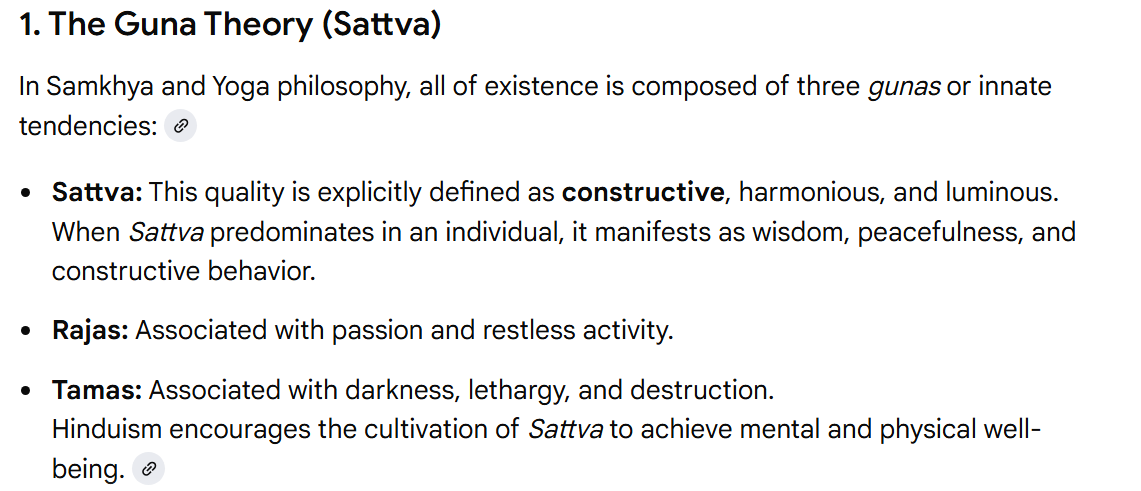
Hinduism supports “constructiveness” through its philosophical, ethical, and metaphysical frameworks, primarily centered on the concepts of Sattva (purity/goodness), Dharma (duty/righteousness), and the creative-destructive cycle of the universe.


Taoism
Taoism does support principles that align with “constructiveness,“ but it is expressed through concepts that emphasize naturalness, simplicity, harmony, and effortless action (wu wei) rather than direct, forceful human intervention to “construct” in a Western, active-driven sense.
Key Taoist concepts related to a form of “constructiveness” include:
- Harmony with Nature: Taoist thought emphasizes the need for humans to live in balance and harmony with the natural world and the Dao itself, which is the source and driving force behind the integration of all things. This balance is a form of natural “constructiveness” where one works with the flow of nature, rather than against it.
- Wu Wei (Effortless Action): This principle is often misunderstood as total inaction. Instead, it means acting in a way that is aligned with the flow of the Dao, resulting in actions that are effective and constructive without struggle or force. The text Tao Te Ching suggests that by doing nothing (in the sense of acting unnaturally), nothing is left undone.
- The Three Treasures: These core virtues of Taoism — compassion, frugality, and humility — provide a moral framework that naturally leads to a constructive and positive existence within a community and the world. Compassion involves sharing the sufferings of others and working for the happiness and peace of all beings.
- Self-Cultivation: A common goal of Taoist practice is self-cultivation, leading to a more harmonious existence and a deeper appreciation of the Dao. This inner work is the foundation for constructive engagement with the world.
- Water Logic: Taoism is often associated with “water logic,” which involves creative, flexible problem-solving and finding a better alternative by flowing around obstacles rather than confronting them directly. This approach is inherently constructive, focusing on effectiveness and positive solutions.
Shintoism
Shintoism strongly supports “constructiveness,” not as rigid moral laws, but through its core principles of harmony with nature, purification, fostering growth, celebrating life, and developing inner moral character, which all lead to positive, constructive actions and a prosperous, balanced life. The focus on cultivating purity, self-reflection (like Amaterasu’s withdrawal and return), and connecting with the life-giving Kami naturally encourages actions that build well-being for individuals and the community.
Key Elements Supporting Constructiveness:
- Harmony & Nature: Shinto sees Kami (divine spirits) in nature, promoting respect and a balanced coexistence, essential for a sustainable, constructive culture.
- Purity (Harae): Rituals and practices aim to cleanse impurity (kegare), purifying body, mind, and spirit for positive intent and action.
- Growth & Prosperity: The religion is fundamentally life-affirming, focused on growth, happiness, and prosperity through connection with nature and benevolent Kami.
- Inner Moral Cultivation: Practices like Chinkon (soul pacification) and the story of Amaterasu emphasize developing inner character, benevolence, and self-examination to overcome challenges constructively.
- Contextual Ethics: Good or bad is judged by context, intention, and purpose, encouraging thoughtful, constructive responses rather than absolute rules.
Confucianism
Confucianism strongly supports “constructiveness,” not as a modern psychological term, but through core virtues like Ren (benevolence), Yi (righteousness), and Li (propriety) that guide individuals to build harmonious relationships, develop moral character, and contribute positively to society, emphasizing self-improvement and ethical action as constructive forces. While it encourages stability, it also values growth, adaptation in teaching, and managing conflict constructively within relationships through concepts like sacrifice and appropriate conduct, though emphasis on tradition can sometimes challenge radical innovation.
Key Confucian Principles Supporting Constructiveness:
- Ren (Humanity/Benevolence): Fosters empathy and care, motivating people to act for the good of others, which is inherently constructive.
- Yi (Righteousness/Duty): Provides a moral compass, guiding individuals to do what is right, promoting ethical behavior and fairness in actions.
- Li (Propriety/Ritual): Establishes proper conduct and social order, creating stable environments where people can interact constructively.
- Self-Cultivation: Emphasizes continuous learning and moral growth, viewing adversity as a chance to develop virtuous traits and build inner strength, a very constructive process.
- Constructive Conflict Management: In relationships, it promotes pro-relationship behaviors, like sacrifice, to manage disagreements and maintain harmony, notes this University Blog Service article.
- Adaptive Teaching: Principles like “teaching according to aptitude” suggest flexible, person-centered methods to impart knowledge and morality, a constructive approach to education.
Secular Humanism
Secular humanism strongly supports constructiveness, viewing it as a core ethical principle for building a better world through reason, compassion, and human flourishing, even though it might be framed differently than in religious contexts, often focusing on human-centered betterment rather than divine mandates. Key tenets like improving life, fostering understanding, promoting societal progress, and using ethics for good align directly with “constructiveness,” emphasizing positive action and building ethical, thriving communities without supernatural reliance.
How Constructiveness Manifests in Secular Humanism:
- Focus on Human Flourishing: The goal is to create a world where humans thrive, using critical thinking and empathy to solve problems and improve conditions.
- Ethical Action: It promotes active, positive engagement in society to build justice, compassion, and understanding, rather than passive acceptance or reliance on divine intervention.
- Rational Problem-Solving: Constructiveness involves using human reason and scientific understanding to address challenges and build better systems, from governance to social welfare
- Community Building: Humanists strive to create strong, inclusive communities through dialogue, mutual respect, and shared responsibility, aligning with the “civility” values often discussed alongside constructiveness.
- Combating Negativity: It stands against nihilism, despair, and destructive ideologies, promoting hope and proactive efforts for positive change.
Summary
Skepticism and polarization work against Civility. Constructiveness is a critical value that must be defined, taught, applied and turned into behavioral habits. The broad march of history is positive and constructive. Religious traditions require constructiveness for a good life. We must embrace this essential principle.
 Good News
[…] That Drives Civility Responsibility is a Universal Value That Supports Civility Constructiveness is a Widely Supported Value and Basis for Civility Public-Spiritedness is a Universally Accepted Civility Value Civility Hope and […]
[…] Constructiveness is a Widely Supported Value and Basis for Civility […]
[…] Constructiveness is a Widely Supported Value and Basis for Civility – Good News […]