Immigration has become a strong winning issue for right-wing parties around the world and an organizing issue for extreme right-wing parties. Why? What should centrist and left-wing parties do?
Accelerants
There are more immigrants. Economic, religious, social and political immigrants. More international conflicts, civil wars and gang violence. Continued huge gaps in living standards between countries. Global communications and transportation networks that make migration possible. The demand for in-migration to developed countries is very high.
In a world of rapid change, slowing growth and religious doubt, citizens of advanced nations are insecure.
Politicians have learned that a simplistic polarization of left versus right is much easier to manage than “solving problems” and have increasingly framed all politics as “us versus them”.
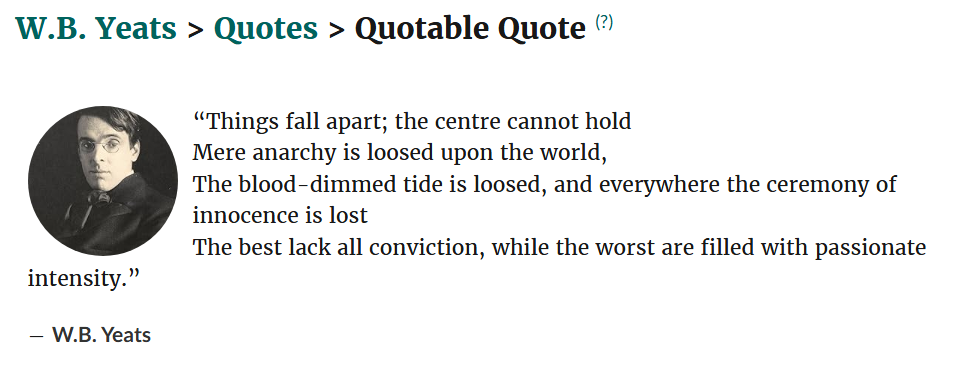
In a world of skepticism and loss of certainty caused by the undermining of religion, progress, science, socialism, fascism, or nationalism as a definite answer we increasingly turn to “identity” as our rock. Blame Rene Descartes’ “I think, therefore I am” insight or Martin Luther’s religious individualism or libertarian economic individualism or countercultural social individualism or the “therapeutic society” triggered by Sigmund Freud.
We all need a basis for our cognitive consistency. Today, our personal identity is raised as a mini-God of great importance. We merge political, cultural and personal identities. We look to national, cultural, racial, class, professional, fraternal, social, alumni or corporate identities for meaning. Identity is MUCH more important today. It is subject to political and media influence and manipulation.
Moral Foundations Framework
Jonathan Haidt and his colleagues sought to define the core, inherent, inherited moral, political and religious frameworks that we all have. They contrasted traditional and modern moral beliefs. They noted that “modern” beliefs are extraordinary and WEIRD: Western, Educated, Industrialized, Rich and Democratic. They combined social science testing, statistics and evolutionary psychology to determine 5-8 widely held moral beliefs that “make sense” based on their interpretation of human and cultural evolution. They noted that liberals emphasize just the two values of care and fairness, while conservatives add the values of loyalty, authority, purity/sanctity, proportionality, ownership and liberty.
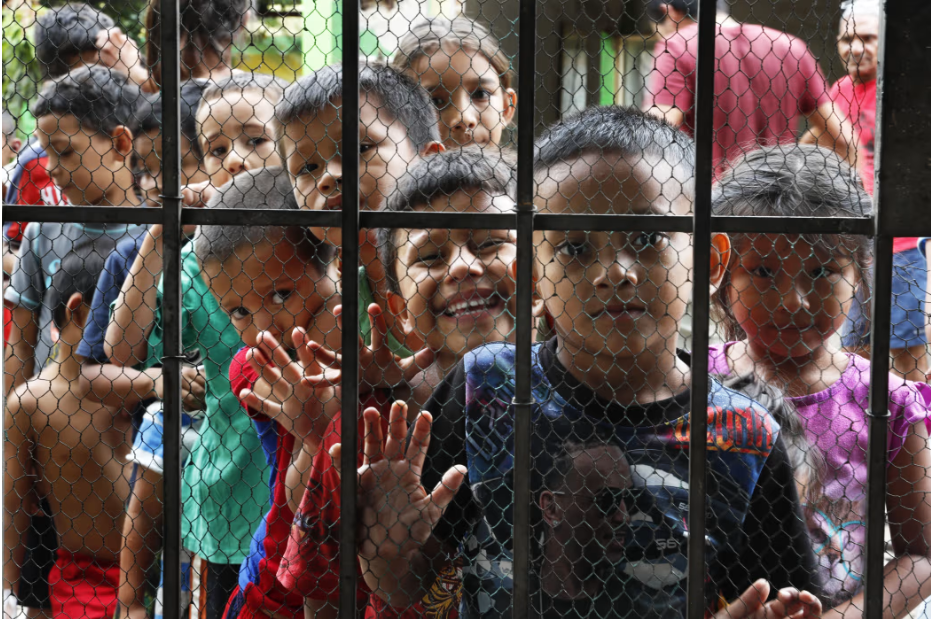
I’m insecure, framing politics in simple left versus right, “us versus them” terms and insecure in my identity. I’m sensitive to all of the moral flavors, including loyalty, authority and purity. Immigration is increasing. Illegal immigration is uncontrolled.
What do I see?
Economic threats to jobs, assets and privilege.
Unfair claims on public welfare programs.
Risk of increased crime, disease, drugs and social dysfunction.
Further dilution of and threats against traditional culture by unfamiliar “others”. Different birthplace, nationality, race, religion, class, language and expectations.
Opposition to the “rule of law”, unfairly proposing amnesty for illegal immigrants.
A feeling of personal and social violation or invasion by “others”. A loss of control.
A threat to the symbolic nation and national security.
Reasonable people take this perspective. They look at “liberals” who emphasize “immigrant rights” above this reality as insane.
Academic research generally supports the “Moral Foundations Theory” view.
Acknowledge those who feel this threat. Don’t dismiss, discount, demonize or rationalize them or the politicians that support them. Recognize their legitimate concerns.
Focus on the issue of illegal immigration. Solve it. Invest in border controls.
Implement a national ID system that prevents illegal employment.
Enhance the agricultural guest worker program.
Focus on the issue of unlimited asylum seekers. Solve it. Revise standards to be reasonable. Resolve cases within a year. Set a limit. Find ways to “share the love” with other countries.
Support a “points system” that prioritizes “value added” immigrants.
Propose a way like Reagan’s “path to citizenship” for existing illegal immigrants.
Support expulsion of all convicted felony criminals.
Ignore the extremist rhetoric about illegal immigrants.
Highlight Trump’s unwillingness to even discuss a bipartisan solution.
Highlight the much greater importance of national economic success, affordable prices, the rule of law, sustainable democracy and American global interests.
Highlight a political platform of personal and economic opportunity rather than individual “rights”.
Promote immigrant success stories at the working, middle, professional and upper-class levels. Leverage visible sports, arts, media and political figures.
Highlight diverse successful assimilation communities across the United States.
Fine-tune welfare programs to clearly exclude illegal immigrants.
Summary
Leftists often believe that their views are obvious, logical and historically “true”. Caring and Fairness are clearly the ultimate values in modern times. The other values are seen as remnants of the unenlightened past. I believe that the moral values of loyalty, authority and purity are also valid. Principled conservatism is a valid perspective.
It is easy to take an enlightened, universal, abstract, economically disinterested view when someone has the assets and talents valued by our society (standing “privilege” on its head). When an individual is unsure of his prospects (standing John Rawls on his head) in the real world, he is rooted in the familiar world of family, caste, class, neighborhood, culture, social groups and self-interest. Insecurity and threats matter. Politicians in a democratic system should listen and respond.
Immigration is a real threat to a majority of our citizens. We should manage it accordingly.
Only by managing the threat can we invest in the proper care for immigrants as a society.
I addressed this topic 4 years ago. I was less willing to fully accept the right-wing perspective.
New York Times columnist Ross Douthat says he began crafting this 2020/2021 book in 2014. He argues that we are stuck in a stagnant society that has lost its ability to reach for the future. Technological, space, business, economics, politics, ideologies, and cultural achievements in the arts, film and music have lost their dynamism. We are pictured as a weak shadow of 1945, 1965 or 1975.
He argues that stagnation eventually leads to decline or disaster. His preferred future contains “growth, innovation, aesthetic reinvention and religious ferment”. Any solution must contain “zeal, coherence, mysticism and futurism”. He outlines several possible paths to decline and further stagnation.
He also describes some potential routes to a renaissance. Modified Islam. African Christianity. Expanded Chinese influence. Massive African migration and impact on Europe. Illiberal democracies like Russia gain favor. Populism governs pragmatically. Local communities flourish in the communitarian model promoted by Patrick Deneen. Nationalism recovers its power. A revised global socialism. Pure scientism. Updated paganism or polytheism. A paradigm shift that makes religion a real option for educated elites, displacing the “materialist neo-Darwinian conception of nature”. A religious “great awakening” or new delivery mechanism. A merger of scientific and religious sensibilities that recognize our unique position as self-aware humans on planet earth.
Our columnist and critic evaluates the modern world much too negatively in my view. Despite challenges, the US and global economy is doing very well. It overcame the Great Recession and the Covid Pandemic. It is adjusting to Trump’s “tariff wars”. Growth is solid, trade is growing, employment is up. The business cycle is effectively managed. Productivity growth continues. These economies are resilient, reflected in stock market values. There are greater inequality and rent-seeking, which can be addressed politically.
Europe and other US allies are adjusting to Trump’s “America first” approach. They are adjusting to Russia’s threats and invasion of Ukraine.
Science progresses. Covid solutions. Weight control. Driverless cars. Smart phone capabilities. Artificial intelligence. Robotics. Modern satellite communications. Medicines. Fracking. Nanotechnologies. Green power. Electric cars. Blockchain and cryptocurrencies.
The ongoing integration of race, class, region and immigrants in the US continues. It’s not perfect but a solid majority embraces the multicultural US. Young Americans only know this positive world.
Many critics agree with Mr. Douthat that the arts and culture have stagnated. I’m not sure that marks “the end of civilization”. Today I have quick access to everything that has been offered for 100 years. We are culturally blessed.
The author invests several pages in analyzing Francis Fukuyama’s 1992 “end of history” claim. He agrees that the Western liberal democracies have fended off the BIG challenges of fascism and communism but notes that new and old critics have returned. He gives Fukuyama a fair treatment and notes his more recent focus on the role of “identity” in shaping political views.
Unfortunately, Mr. Douthat is not interested in refining “liberal democracy” as a solution to our alleged stagnation. He is critical of managerialism, technocracy and modern meritocracy. He sees it as inherently self-interested and narrow. I think that we have no choice but to invest in improving our historical “liberal democracy” framework.
I think the gap between science and the humanities remains even wider than it was in 1959 when CP Snow called out his educated colleagues. We need a way to connect science and religion, politics and people. The “structural” advantages of strong political, social and economic systems are not inherently opposed to human values. We should invest in closing this gap in our universities.
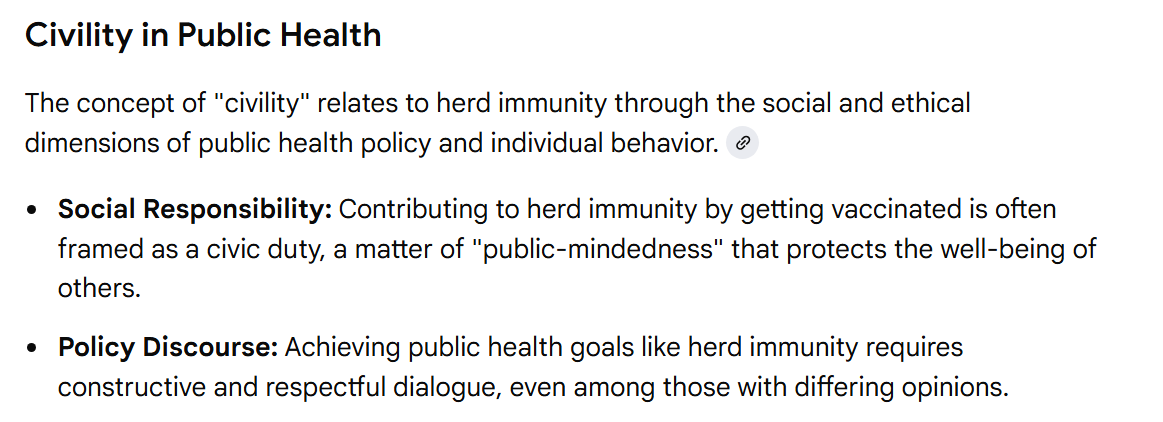
My followers know that I have become a “true believer” in the potential of “civility” to become formally defined and promoted as a shared cultural norm to support our political, social and economic institutions.
I wholeheartedly agree with his two real religious solutions. The default paradigm today is “science versus religion” and “science alone is real”. There is significant scientific and philosophical evidence to overturn this current worldview.
Many of our current challenges exist because we have not revised our laws and political structures to adapt to modern wealth, amoral political actors and media capabilities.
We could choose to invest in economic and breakthrough scientific progress by making political choices.
We could choose to support the modern “therapeutic society” approach of encouraging every child to “live a great life today” in pursuit of their self-actualizing possibilities.
We could invest in improving the productivity of our lagging economic sectors: government, education, health care and not for profits.
We could revise our goals to emphasize quality as equal to quantity.
We could invest in promoting communities of all kinds, not just those local, total communities suggested by Patrick Deneen.
We could do a better job of outlining. defining and communicating to everyone our 5-part political spectrum of left, center-left, independent, center-right and right. Individuals rarely change. We are stuck with each other. How do we effectively structure our political, social and economic systems to accommodate these different views?
Douthat argues that we have stagnated on all dimensions. We need to find a way forward. I agree with 2 of his options and offer a few more possibilities.
The national Republican Party was radicalized or very extreme by 2012. It is MUCH worse today.
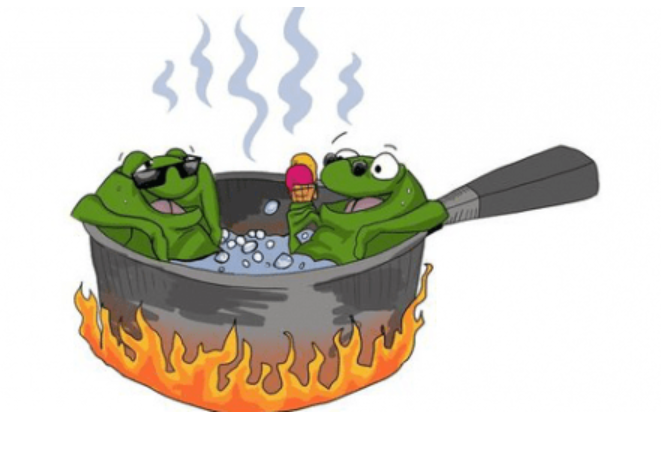
Barrels of ink have been spilled describing and analyzing the “Trump phenomenon”. We were collectively shocked in 2016 when he won the presidency. The changes toward extremism, radicalism and the loss of our democratic system have continued. Like the proverbial frogs, we have become accustomed to the onslaught of change. I’ll try to outline and make sense of the mind-boggling transformation of the “party of Lincoln” in my lifetime from Dwight Eisenhower, Dick Nixon, Nelson Rockefeller, Ronald Reagan and the Bushes to Newt Gingrich, Arthur Laffer, Grover Norquist, Rush Limbaugh, Jerry Falwell, Pat Robertson, Charles and David Koch, Sheldon Adelson, Steve Wynn, Rupert Murdoch, Elon Musk and Donald Trump. 😦
Context
Pundits blamed the Trump 2016 election on a variety of false or half-true causes. Trump’s brand image and magnetic personality. His direct approach and truthfulness. A victory for the “Tea Party” after the slow Obama economic recovery. Renewed racism triggered by Obama in the White House. A normal left to right political swing. Hillary Clinton’s poor campaign and connecting skills. Clinton karma. The lure of the “authoritarian personality” in American culture.
I generally agree with the 2022 authors of American Psychosis. There have always been extreme groups attracted to and allied with the Republican Party. The party tolerated them, used them and then welcomed them. Their numbers and influence grew compared with that of the Main Street, Wall Street, moderate and New England wings of the party. They completed the hostile takeover of the party with Trump in 2016. [There have also been extreme groups affiliated with the Democratic Party].
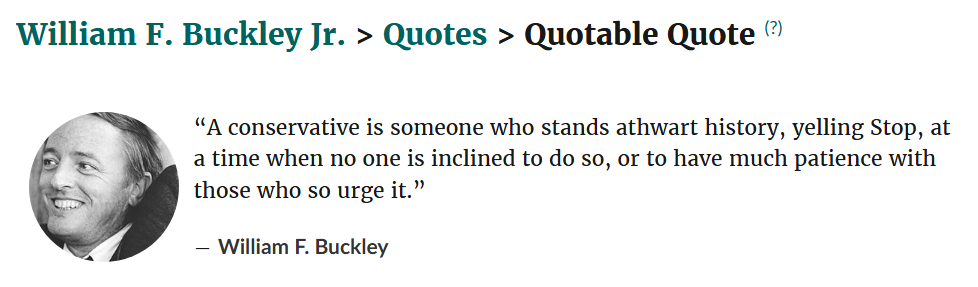
I also agree with Edmund Fawcett’s long-term analysis. Conservatism was founded as a political perspective in opposition to ALL of the changes of modernity.
1500. New religion. New economics. Urbanization. Industrialization. Trade. Property rights. Individual rights. Skepticism. Science. Change. Loss of authority. Loss of history and tradition. Cultural challenges.
For most people, modernity was a very scary set of changes. For more than 1,000 years the rules of life were fixed. They were consistent in all dimensions. The religious, political, military, social and economic dimensions were aligned. Then changes occurred. A new paradigm called “liberalism” arose in opposition. Change is good. The individual is supreme and has rights. The dimensions of life can/must be separated. Certainty is gone. Social power is flexible. Competition and meritocracy are welcomed. Rationality and scientific proof are valued. Innovation and commercial success matter. “Anything goes”!
Conservatism emerged to provide a needed counterweight. History, tradition, community, values, virtues, nobility, safety, family, familiarity, neighbors, culture, language, experience, religion, race, stability, trust, and property.
Opposition to rapid change is a core conservative value. The emergence of a capitalist, commercial, scientific, university, secular class in competition with the landholding nobility and its religious and political allies was a founding perspective of conservatism. Today, we think of the Republican Party as the party of “big business”, capitalism, laissez faire, competition, social Darwinism, libertarianism and meritocracy. Yet, conservatism looks back to culture, community, religion, institutions, family, and morality. Economic and social conservatism are not fully or easily aligned.
The Republican Party has slowly, increasingly and then overwhelmingly become the party of social conservatism end economic populism. The trend was growing. Trump saw it and formalized it. The US experience is not unique. Other western countries have had the same recent experience. We have seen these tensions for two centuries or more.
A Slippery Slope
Many American conservatives have never truly embraced modernity, urbanization, industrialization, cosmopolitanism, equal rights, racial equality, trade, capitalism, global trade, international alliances, international treaties, religious denominations, ecumenicism, tolerance, immigration, etc. A secure life based upon familiar experience and community is great. The opportunities of progress are small, risky and filled with temptations and unintended consequences.
Successful politicians have two main talents. They deeply understand human nature, and they communicate very well. Conservative leaning politicians have mined the fear dimension of human nature for centuries. With the emergence of the mass media and modern advertising and persuasion tools circa 1920 they have become increasingly more powerful.
They set out to capitalize on the lack of deep political knowledge, skills and interests of the populace. The have moved down the slippery slope of skepticism, cynicism, fear, distrust and victimhood to hate.
They discovered that humans are naturally attracted to the Manichaean opposites of good and evil. They learned to define issues as yes and no, right and wrong, us versus them. Polarization is a very effective communications technique. Newt Gingrich demonstrated its value in 1992.
They learned to frame, highlight, emphasize and communicate effectively. Both parties’ leaders and supporters have always thought that they were morally right, and their opponents mistaken, misguided or much worse.
The Democrats have mainly been stuck in the 1800’s forward class wars occasioned by capitalism and the rise of manufacturing. Labor versus capital. Poor versus rich. Exploited versus exploiters. Rural farmers and laborers versus bankers and cities. Their issues and messaging matched.
Since 1960, the Democrats have adjusted to also become the party of “human rights” on a legal basis. Civil, women’s, disabled, LGBTQ, environmental, global, animal and earth rights on top of economic rights. The messaging has mostly remained the same, contrasting the exploited with the exploiters.
The Republican Party has offered a much more diverse, richer and expanded set of political messages. The messages are all about fear. The ideas, people and threats to fear have diversified and accelerated. THE IDEAS, PEOPLE AND THREATS TO FEAR HAVE DIVERSIFIED AND ACCELERATED. This very negatively biased view threatens our democracy.
Defense and Security
The Cold War. Reds under the bed. Pinko commies.
Korean War. “The loss of China”.
Vietnam War. The domino theory. All or nothing.
Hawks versus doves. Patriots.
Cuba.
Middle east “Arabs” versus Israel.
War on terror, Iraq, Afghanistan, Isis.
Axis of Evil.
Bomb, baby, bomb.
China.
Trump has added Venezuela, narcoterrorists, Canada, Mexico, Japan, South Korea, Greenland, Panama, Africa and Europe to those who cannot be trusted.
Eisenhower warned us about the “military-industrial complex”. It has managed to ensure that we are always at war with someone. Republicans have been the main hawks.
International Affairs
The US unilaterally defined the postwar rules at Bretton Woods, New Hampshire and joined the United Nations in San Francisco. The “America First” protectionists and unilateralists never really agreed. However, both parties supported the international system that cost-effectively protected American interests for more than 80 years.
Opposition to “foreign aid” was the first crack in the united front with politicians greatly exaggerating the amount of money invested and its ineffective usage. Foreign aid and health support levels fluctuated through time. Bush II was a proponent.
Historically, opposition to “free trade” was mostly a Democratic position. Alleged unfair power, rules, labor and environmental regulations. Republican global corporations were “all in”. Japanese, Asian, European and other third world competition offered higher quality and lower price goods to Americans who bought them in the 1970’s forward. Manufacturing job losses became a Republican issue as working-class Americans moved to the Republican Party from 1970-2020.
The US rejected the League of Nations. It tolerated the United Nations. The UN added a wide variety of international organizations. Republicans positioned the UN and these agencies as a waste of money supporting individuals, countries and organizations opposed to America. Trump defunded these organizations even as the World Health Organization played a key role in resolving the Covid pandemic.
The Paris Accords on climate change were another international agreement rejected by Trump, like the multilateral Iran nuclear proliferation limits.
NATO prospered for 70 years. Trump has questioned the rationale and his commitment to supporting our allies. He has badgered NATO and other allies to pay a greater amount for their defense. Trump renegotiated NAFTA with marginal changes. He has unilaterally applied tariffs to our neighbors and threatened to disband his own agreement.
Trump has threatened to invade Venezuela, Panama and Greenland because they allegedly threaten our security. He has removed many career foreign service staff members and politicized this vital national function.
The Economy
All politicians have criticized the opposition because inflation and unemployment are too high. Republicans claim that they are “the party of business” and more effective in managing the economy although the data says the opposite.
Republicans have claimed that Democrats wish to “socialize” the economy with the government owning and controlling all industries. No nationalization has occurred for more than a century. Deregulation of transportation in the 1970’s was a bipartisan initiative.
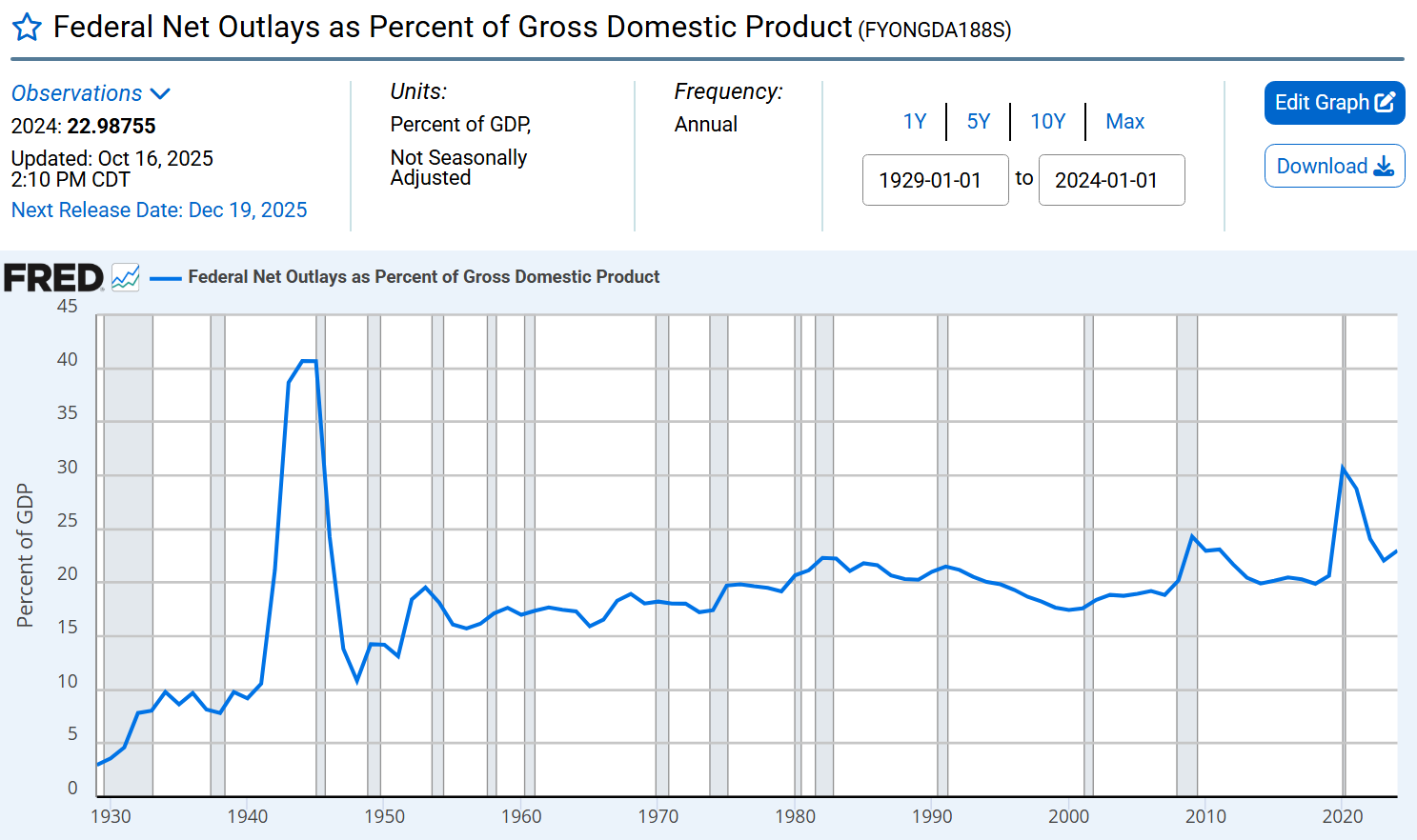
Republicans have exaggerated the size, scale, impact, employment and percentage of federal government activities for more than a century. Federal government activities DID increase very significantly during the Great Depression, WWII and the 1960’s Great Society initiatives. They have roughly remained at the same percentage of GDP since 1980.
Republicans have emphasized the “common sense” need to balance the federal budget and bemoaned the growing federal debt and its impact on future generations and “crowding out” of productive borrowing and investing. Their criticism rises when Democrats control the government and quiets when Republicans are in control as we have learned that 1-2-3% budget deficits seem to have no short or long-term deleterious effects. President Trump has no problem with running record budget deficits.
Republicans claimed that tax cuts would spur economic growth to offset the loss of revenue. The theoretical “Laffer Curve” has never been demonstrated to hold for the US. Republicans claimed that very high marginal income tax rates disincentivized highly productive Americans from working. Top marginal tax rates were cut from WWII 90% to 70% in 1965. Then lowered to 50% in 1981 and 37% or lower from 1986 forward. Grover Norquist and others after 1986 tried to “drown government in the bathtub” because “taxation is theft”. Bush I lost his reelection bid because of his “read my lips” reneged promise to not raise taxes.
Republicans claim that government regulations strangle businesses, cost money, reduce employment, stifle innovation, reduce R&D, and reduce investments. This is mostly a distraction. Regulations do require compliance costs for administration and reduced commercial activities. Corporations benefit from most drafted laws which provide opportunities for evasion and negotiation rather than strict compliance. If “clean” regulations were better they would ensure they were/are enacted.
Culture Wars / Wedge Issues
Civil rights legislation was supported by Democrats and Republicans. LBJ said “we may have lost the south for a generation”. He was right. The American South struggled with the aftermath of the Civil War, reconstruction and civil rights legislation. The belief that African-Americans should not mix with Whites died very slowly. New private schools were built to “solve the problem”. Court ordered busing to ensure equal racial opportunities in northern cities antagonized other Whites. Affirmative action court rulings divided the country, moving many Democrats to the Republican side.
Republicans made crime and drugs national issues. Directly and indirectly focusing on African-American communities.
Republicans made welfare a racial issue instead of a class, age or fairness issue.
The 1965 immigration act opened the door for poor immigrants from around the world.
President Reagan and congress agreed upon an amnesty and enforcement bill in 1986.
Bipartisan efforts to control migration were unsuccessful for the next 30 years. Trump pressured Congress to not approve a compromise bill in 2024. Trump has made immigration the center of his politics.
Education became a national political issue after the passage of the civil rights bills. Republicans advocated for “states’ rights” and the elimination of the federal “Department of Education”. The enforcement of equal racial access to public education drove these changes. The establishment of private Christian schools and the use of vouchers to fund them became a political issue.
Institutions
Historically, Republicans controlled all of the major institutions of the US. After “Brown vs. Board of Education”, they decided that institutions were not always perfect. The move of southerners from the “solid South” of Democrats to the Republican Party was a huge swing. Federal courts might not be trusted. Federal DOE might not be trusted.
The federal government was generally viewed as a positive entity based upon its activities during the Great Depression and WWII. Post-war investments in infrastructure were welcomed. The growth of federal employment, funding and power led to opposition by Republicans, claiming waste and inefficiency. Opposition to all federal staff and functions grew during the 1970’s and 1980’s.
Reagan framed it as “I think you all know that I’ve always felt the nine most terrifying words in the English language are: I’m from the Government, and I’m here to help.” In 1996, President Clinton said “the era of big government is over”.
Support for American institutions began to decline after Nixon’s presidency. His acts showed that it was possible that previously trusted institutions were no longer definitely trustworthy.
Republicans positioned “government versus business”. Business was trustworthy, subject to the iron laws of the market. Government was subject to the incentives of politicians and bureaucrats.
Entrepreneurs were positioned as wealth and job-creators. They were crafted as makers versus takers. Obama’s claim in 2012 for an equal role for the public sector sparked much political debate.
Republicans applied this negative theory to everyone. Bureaucrats were subject to the incentives of lobbying, influence, bribery and career advancement. Inherently untrustworthy. Regulators were subject to regulatory capture. Teachers were self-absorbed and union captured. Same with police and fire fighters.
Spiro Agnew began the attack on the broader cultural elites as the “nattering nabobs of negativism”. The attack on the supposed cultural elites in the university, arts, media, communications and not for profit space has continued.
Trump and his acolytes have used DEI as a wedge to force organizations to comply with his political wishes.
Republicans use the term “elites” to drive fear. Political officials, bureaucrats, professors, journalists, commentators, executives, bankers, media influencers, actors, musicians, lawyers, doctors, scientists, and public health officials. Where does this end? What about the Republican elites?
Trump has undercut any faith in institutions. DOJ and FBI politicized. All federal agencies politicized.
We no longer rely upon trust or principles. Everything is based on power and transactions. The conservative economic view seems to Trump the conservative social view in the end.
Individuals
Republicans have positioned the political world to help voters see themselves as victims or potential victims of the opposition. The evil opposition is ready to take away your: guns, religion, parental rights, language, teams, history, culture, music, voting power, flag, patriotism, money, house, medical care and rights. They have demonized the opposition as “radical leftists”. Democrats have responded with the same level of name calling. Republican leaders have chased the RINOS (Republicans in Name Only) out of the party.
Summary
Republicans have increasingly chosen fear to build and maintain their political support for 70 years. It appeals to the lowest common denominator of those motivated by fear alone. It is unsustainable. We will either have a major breakdown of our society/culture or a rejection of this negative worldview very soon.
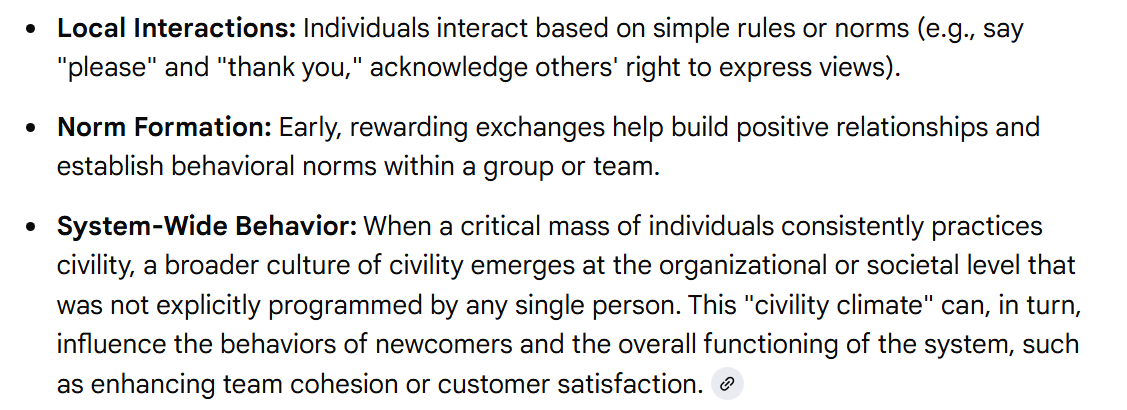
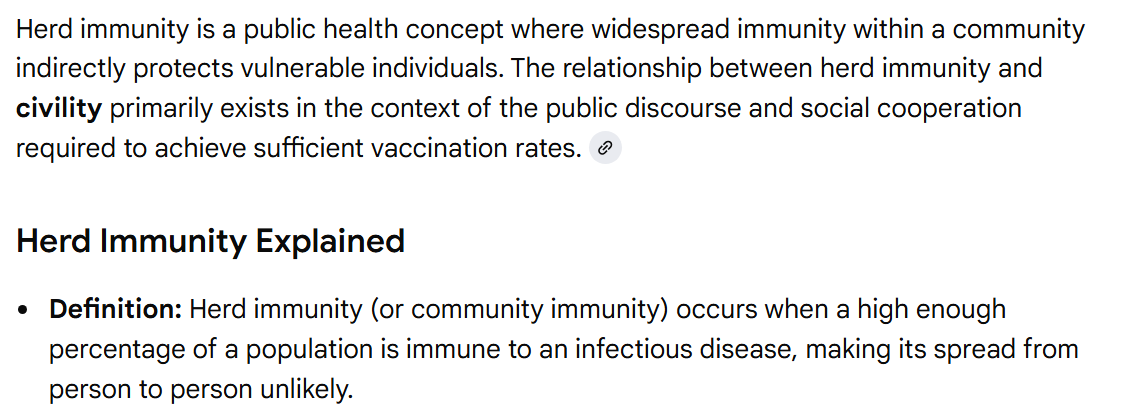
Civility is a set of behaviors based upon a set of values. It is adopted and grown by individuals based upon their conscious and unconscious experiences. The practice of Civility tends to promote Civility in others. Unchecked incivility tends to destroy Civility. The practice of Civility depends upon a communications, interaction and problem-solving process. The social commitment to Civility depends upon the rate and intensity of practice and the frequency and impact of responses to incivility. Civility is a social value that is partly conscious and partly unconscious.
Chaos Theory
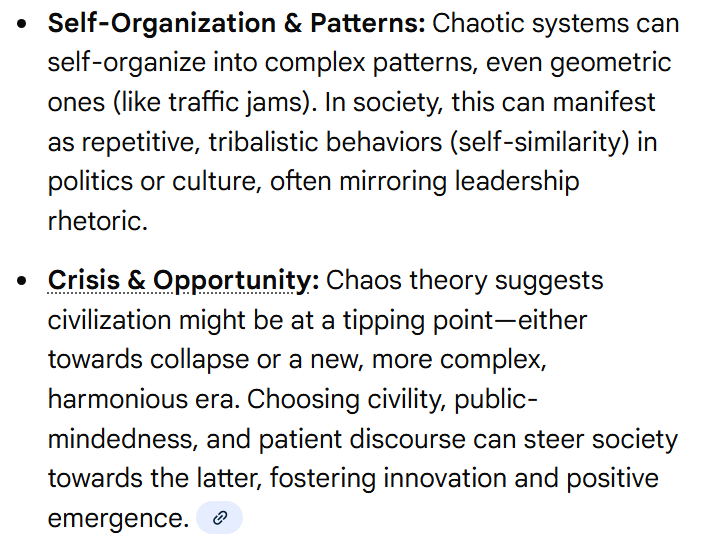
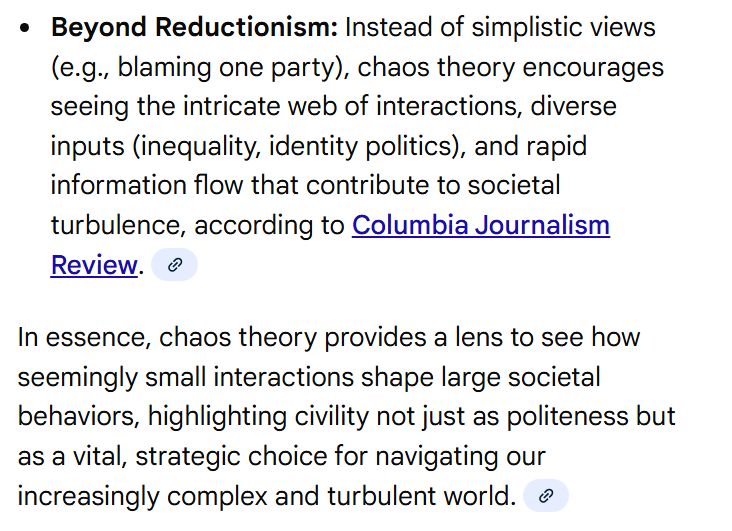
OK!!! Once we start to investigate dynamic systems, the words and concepts get abstract and “questionable” pretty quickly. Complex systems are unstable. Small changes can cause large impacts. I share this because I think that Civility is a social system subject to this kind of dynamic, nonlinear change.
Emergent Systems
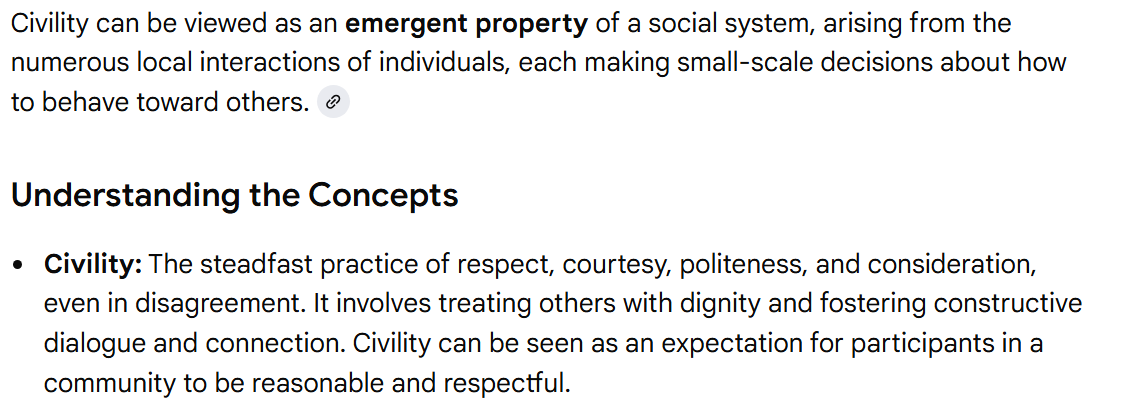
OK!!! Civility is an emergent property of people interacting. Simple, positive interactions promote more positive interactions. AI is trying to describe the idea of virtuous cycles and vicious cycles on a knife’s edge. Civility is a fragile concept and practice.
Managing Incivility
We have mixed advice. Some uncivil behaviors are so toxic they must be opposed. Yet, limiting free speech is against the core beliefs of Civility.
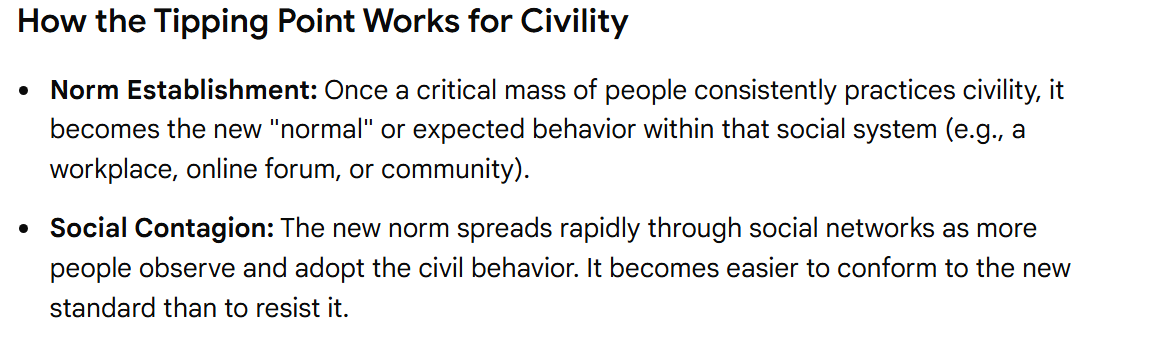
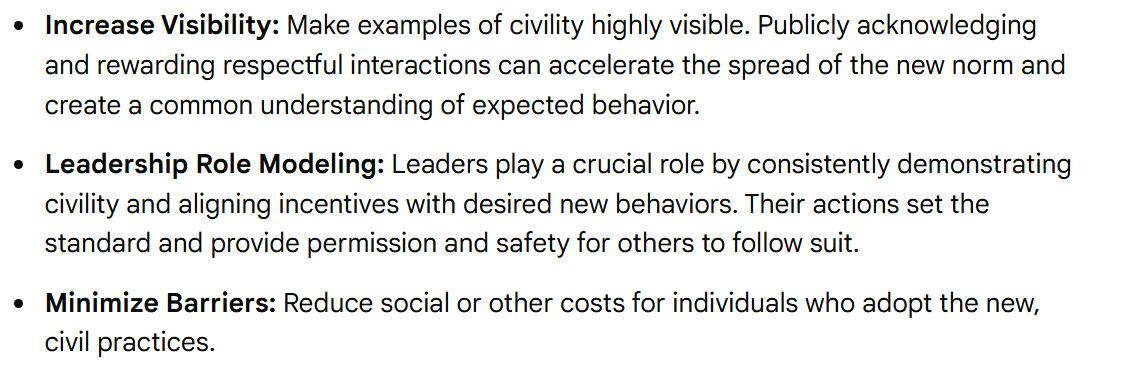
Civility, like other cultural norms, does not disappear quickly, it persists.
Tipping Point
Civility is positioned to survive. There are many individuals and groups with the incentive and capability to defend and promote Civility.
Summary
Overall, I am optimistic about the survival and progress of Civility today, December 15, 2025.
POST SCRIPT
In the process of using Google AI today, I am now EXTREMELY CONCERNED THAT THE SINGULARITY IS ABOUT TO OCCUR SOON. The responses to my complex questions are at least an order of magnitude more insightful than they were just a few days ago!
Civility has operated for a few hundred years without a brand manager. It has acquired several unfortunate associations through the years. It is commonly seen as just surface level politeness and etiquette, a magic wand problem solver, an impractical emotional approach or an apologist for passivity, power, the status quo, righteousness, the right or the left. Properly defined, Civility is not an easily discounted simplistic answer to our cultural challenges.
Civility Is …
Civility is a set of behaviors that recognizes differences and builds mutual respect: self-awareness, self-management, social awareness, relationship management, communications, growth and problem solving.
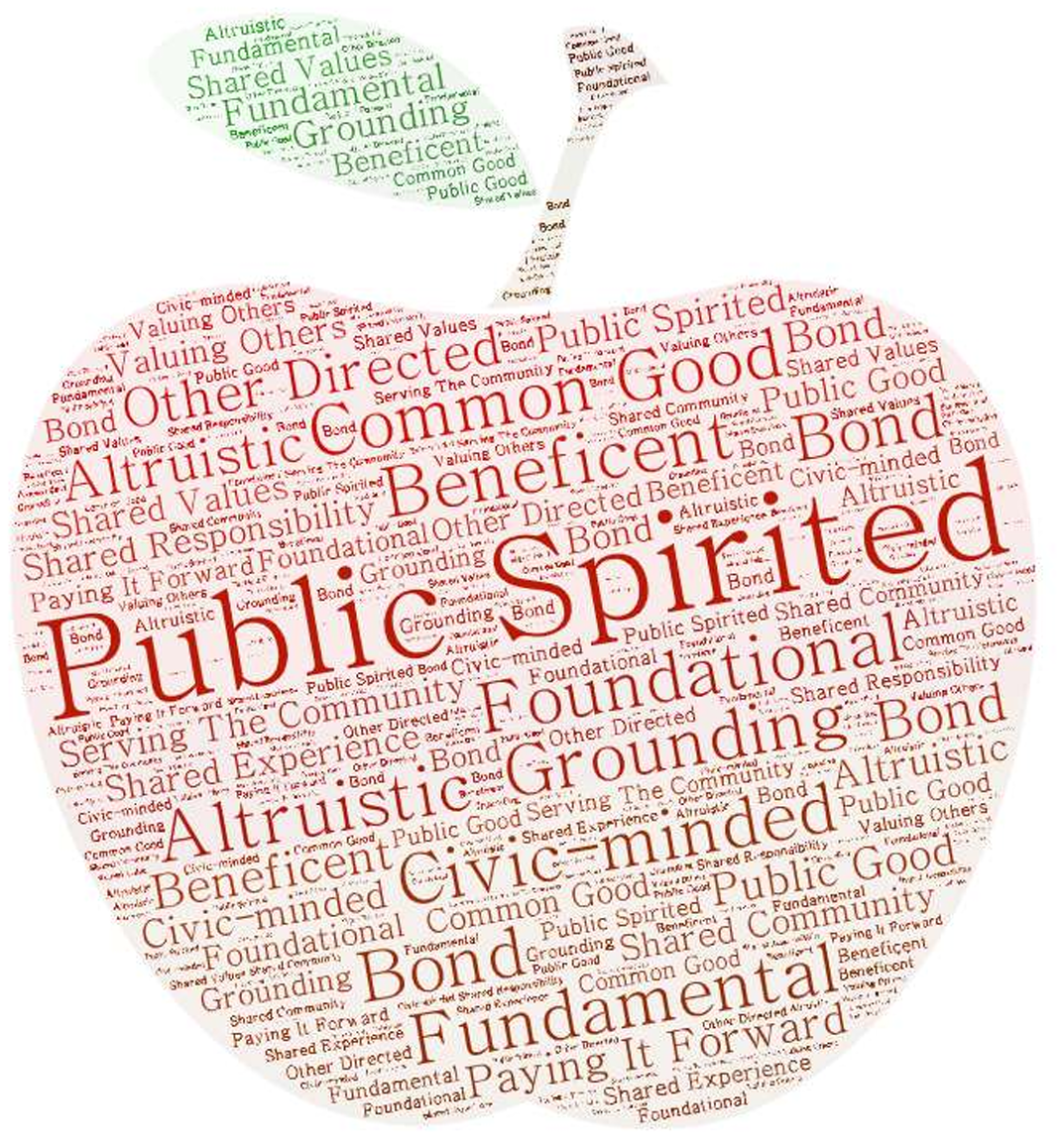
It is based on 7 nonpartisan values: human dignity, respect, acceptance, responsibility, intentionality, constructiveness and public-spiritedness.
Inherently Complex
Civility is primarily a set of habits, skills or behaviors that are used to interact with others. There are 7 groups and many specific behaviors in applied Civility. These behaviors are learned, applied, improved and based upon modern behavioral science.
There are also 7 values, principles or virtues that lie beneath the behaviors. They are nonpartisan, commonly held ideas consistent with many political, religious and philosophical systems.
These values have been identified through time as being necessary for effective interactions. They are not derived from any specific religious, political or philosophical system. No one value is the basis for the system, although “human dignity” seems to have the greatest power in driving behaviors and inspiring commitment to Civility. Descriptions of individual behaviors are shaped by the values. There are clear expectations of good behaviors and contrasting taboos.
Civility requires a commitment to engage with others in order to effectively communicate and resolve differences. As such, extraverts have a natural advantage in practicing Civility. Fortunately, the modern behavioral sciences provide training and experiences to help introverts to be “fully effective” even if it requires greater effort.
Civility embraces thinking, feeling and doing. The values and behaviors require all 3 dimensions of life.
The behaviors are inherently practical, applied and specific. The values are more abstract, intellectual and philosophical.
Embracing and applying Civility requires practical and abstract thinking, feeling and doing.
Civility emphasizes “perceiving” in its human dignity, respect, acceptance, constructiveness and public-spiritedness values. It emphasizes “judging” in its responsibility and intentionality values.
Civility focuses inward with self-awareness and self-management skills. It focuses outward for communications, social awareness and relationship management. It balances the needs and importance of the individual with those of the community.
The Whole Process
The Civility model focuses on the process of personal interactions to solve problems and manage relationships. It assumes repeated interactions that encourage participants to invest in relationships and seek long-term results. The process is expected to be iterative, encouraging participation and engagement. Results are not predetermined. Goals are clarified. Positions are shared. Solutions are proposed. Feedback and responses are welcomed. Choices are negotiated. Civility assumes a dynamic process is employed.
Civility skills and values are held by all individuals. They acquire these views throughout life. They apply these conscious and unconscious approaches in all areas of life, formal and informal. Civility norms and expectations are different in different groups and settings. Civil behavior encourages civil behavior. Uncivil behavior is sometimes shunned, encouraged or accepted. A virtuous cycle or a vicious cycle can occur.
Civility values and skills are learned and perfected through application, usage and feedback.
Nonpartisan
Civility is actively nonpartisan. Its proponents accept the results of “Moral Foundations Theory” that there are 6-9 deeply held human views that underly political (and some religious) beliefs. Individuals and political groups disagree about which are most important. Civility is not positioned to resolve these differences. It is designed to help well-meaning individuals understand each other, find common ground and negotiate results that also support relationships and the process. Civility offers a process that allows individuals and groups to maintain their views and still work effectively with others.
Civility attempts to avoid its own “righteousness”. It offers a tested process to facilitate certain interactions. It does not claim to have final religious, political or philosophical answers. It does not claim that its values, behaviors and processes will always produce good results or resolve conflicts. It acknowledges that our understanding of values and ability to implement them through behaviors is imperfect. It recognizes that “best practices” in any of the social sciences evolve through time. Civility attempts to make explicit its values, beliefs and understandings and promote them in clear, transparent ways.
Human dignity, respect and acceptance require a mature perspective. They are not easy to deeply understand, practice or master. They focus on the essence of individuals in a social environment.
Responsibility, intentionality and constructiveness are also “stretch” values. They also require us to consider the required relationship between the individual and others. It is not simple. Our obligation to others requires perspective and some broader moral framework. Building a commitment to these values requires feedback, support, experience and moral perseverance.
Public-spiritedness also requires a balance between the individual and the environment. Aside from a few saints, humans are not capable of living solely for others. They must balance these needs, wants and desires. Civility does not define how much “public spiritedness” is enough. It requires each individual to consider this difficult topic.
Summary
Civility encompasses values and behaviors, a dynamic process and personal growth. It offers a process solution to our common differences and potential conflicts. It has many component parts that change through time for each person. The core components can be learned and applied by everyone. The basics are easy. Practicing and perfecting Civility values and skills is the good work of a lifetime, worthy of our human dignity.
Civility is a set of behaviors that recognizes differences and builds mutual respect: self-awareness, self-management, social awareness, relationship management, communications, growth and problem solving.
It is based on 7 nonpartisan values: human dignity, respect, acceptance, responsibility, intentionality, constructiveness and public-spiritedness.
Civility is required for a representative democracy to thrive. Citizens must practice and embrace these habitual behaviors. Social norms must press individuals to adopt these beliefs and improve their behaviors, despite the call of opposing forces.
Civility has declined in the United States of America since the 1960’s cultural revolution and the 1980’s Reagan revolution. Individualism has ascended [perhaps too far]. Religion and culture have lost influence. Many today are working to rekindle Civility as a core set of values and behaviors necessary for a society of free individuals to succeed.
In broad terms, I have identified 6 threats to our society. I’d like to outline how Civility can be used to address these challenges. Civility alone cannot save our society, but it has the ability to prevent us from spiraling down in a vicious cycle. Civility has the ability to trigger a virtuous cycle. It is a catalyzing and leveraging force.
Radical individualism dispenses with community, society, religion, morality and philosophy. ONLY the individual now matters. Many of us have unintentionally adopted this faulty worldview: in whole or in part.
Civility begins with the claim that every person possesses INFINITE human dignity.
This is an individualistic start. But it is paired with the logical complements of respect and acceptance. If I have infinite human dignity, then all others must also have infinite human dignity. They MUST be respected. They MUST be accepted. They are not perfect, faultless, better or good. But they have the same potential for good and excellence that I enjoy.
This insight requires me to try to be self-aware, to manage myself, to be aware of others and to responsibly and intentionally manage my relationships with others. “I’m OK, You’re OK”.
Civility calls on us to be positive and constructive, not as a weak Pollyanna view but as individuals who are hopeful, who seek to find the greatest possible results.
Civility embraces public-spiritedness. It acknowledges that we live in community at all times and are responsible to consider our community obligations. We are not called to blindly accept community views, norms or decisions. But we always consider our civic and community duties and responsibilities.
Humans are never satisfied with what they have. We compare themselves to others and come up short. Our logical reasoning is imperfect. We focus on losses, the short-term, concrete items and anchors.
Civility accepts our weaknesses. It encourages us to look outwards to our neighbors to really evaluate ourselves. It promotes the “rough and tumble” of interpersonal engagement in informal and formal life. Civility guides us to be self-aware and self-managing. Civility recognizes that personal growth is an ongoing process. We cannot simply digest best practices intellectually; we must experience them.
Skepticism
Healthy scientific skepticism is fine. Unfortunately, we have often come to reject everyone and every fixed idea. Political polarization has undermined any sense of the “common good” or objective reality.
Civility embraces positivity and constructiveness. We should always pursue and consider positive opportunities.
Responsibility and intentionality require us to step above the situation and assess it objectively. We cannot take the shortcut of simplistic naive kneejerk skepticism.
Civility embraces modern behavioral and cognitive science. It uses rational modern decision-making tools. We have much stronger insights into true human nature. It is imperfect but we are better positioned to purposely lead great lives.
Despite the intellectual attraction of skepticism, America has prospered economically for 250 years. It has demonstrated that a democratic republic can succeed. The US has overcome two world wars, the Great Depression, the Vietnam War, the cultural revolution of the 1960’s, the Cold War, the Great Recession, the Covid pandemic and populism.
Religion has not died. Utilitarianism is barely remembered. Atheism is mostly rejected. Simplistic philosophies are inadequate. Scientific progress marches forward. Pure scientific rationalism loses support as a philosophy of life. Nietzsche and existentialism forced men to face the prospect of meaninglessness and we have survived. Self-awareness and social awareness help us to understand the complexity, contradictions, inconsistencies and mysteries of real life.
Imperfect Myths
Modern worldviews generally fail to replace the peace and answers of the ideals of Christendom. Civility offers a set of values and behaviors that support the practical operation of modern life with its greatly enhanced diversity.
Civility supports the 4 deep challenges of: facing death, finding a purpose beyond self, being affirmed and living as a social being in community. The commitment to human dignity, respect and acceptance help with the need to be affirmed. I’m OK, You’re OK. Civility promotes the social, interactive, growing, dynamic person. It offers a safe environment where individuals can pursue religious perspectives. It emphasizes the role that the “other” can play in personal growth.
Civility does NOT replace any of the religious, historical, cultural and national myths that have addressed human needs in the past. Civility is a set of values and behaviors that allows for constructive interactions in all areas and levels of society despite our differences. It does not choose sides in religious, political and philosophical debates. It is a necessary, but insufficient basis for modern life.
Our Secular Age
Civility accepts that we cannot easily find final deterministic solutions to the great questions of life. We have experienced 600 years of modernity without finding rational, objective, scientific, secular answers. Civility provides a social platform that supports religious belief. It supports debate on difficult subjects. It focuses on how we can live together, accept and overcome our real differences.
Our Secular Age is one in which the biggest questions – about God, man and meaning – don’t have consensus answers. No single denomination or ecumenical group holds a dominant worldview. Atheists, agnostics and “none of the above’s” are a large and fast-growing group, especially among younger age cohorts.
The loss of certainty creates existential angst for citizens. Civility responds with “human dignity” as a core belief that elevates individuals and the human condition to something of importance, a matter of ultimate concern for all. Civility offers “acceptance” as a central value, acknowledging that different backgrounds, experiences and beliefs are to be expected and welcomed. Civility encourages a positive, constructive approach to our lack of consensus on political, religious and philosophical topics. Civility promotes the virtues of responsibility, respect and initiative as tools for the required interactions with others – on topics large and small.
Finally, Civility focuses on behaviors, habits and norms of practical interaction as being most effective in living actual lives in a Secular Age. The Protestant Reformation triggered centuries of religious conflict. The principles of Civility were used to heal this divide and can apply to our differences today.
Insecurity
Modern man is surrounded by uncertainty as he is forced to make more decisions in more areas with more choices than ever before. Most of us try to ignore the surrounding forces and live our lives day to day as best as we can. We implicitly adopt some kind of philosophy of life. We stay busy. We pursue goals. We consider the changes in our worlds. But the underlying tensions make life difficult. Economic and personal striving are a cultural norm. Polarized politics is hard to avoid. It’s difficult to relax, center and fully engage in life. We treasure peace and certainty. We’re still looking for answers that work well in a world filled with options and choices.
Civility’s focus on human dignity, respect and acceptance of each person and others serves to build a strong sense of self-worth. The self-awareness and self-management skills reinforce this central validation of each person.
The values of responsibility, intentionality and constructiveness reinforce the solid self with positive real-world experience and reinforcement. The social awareness, communications and relationship management skills operationalize this good intent.
Collectively, the Civility values and behaviors provide personal assets to be successful in a challenging world. They address the need for frequent interactions with “others”. They provide confidence that individuals have the capabilities and experience to thrive in difficult situations because they have managed them before.
Summary
Civilization and daily life are guided by unspoken norms and beliefs. We have experienced significant changes in the past century that undermined the consensus view and now requires individuals to consciously consider a greater share of their daily lives. We have not reached a new consensus and may not do so anytime soon. As we work through these differences we need to reinvest in Civility skills, habits and understanding. Civility helps us individually, in groups and as a society to interact effectively despite our differences. We don’t need perfection or infinite improvement, but we need to invest in Civility and use its power as a self-reinforcing system or virtuous cycle to guide us into the future.
Civility is a set of behaviors that recognizes differences and builds mutual respect.
Self-awareness
Self-management
Social awareness
Relationship management
Communications
Growth
Problem-solving
Self-Awareness
Emotional Awareness – Identifying and understanding our emotions and their impact on our thoughts, behaviors, and others. Accurate Self-assessment – Clearly understanding personal strengths and limitations without self-criticism or inflated self-perception. Self-confidence – Firmly believing in one’s abilities, talents, and judgement. Self-respect – Properly regarding and caring for the dignity of one’s person and character. Authenticity – Acting in accordance with one’s true self, values and beliefs.
Self-Management
Emotional Self-control – Managing and regulating one’s emotional responses, preventing impulsive reactions. Adaptability – Flexibly and efficiently learning and applying that knowledge across situations. Achievement Motivation – Orientation towards success, mastery, and sense of purpose. Initiative – Recognizing needs, taking action, and pursuing outcomes without waiting for direction. Optimism – A mental attitude characterized by a positive outlook and expectations of favorable outcomes. Apologizing – Acknowledging errors and guilt, expressing regret, repenting, asking for forgiveness. Trustworthiness – Demonstrating credibility, reliability and intimacy buffered from self-interest. Resilience – Bouncing back from adversity with flexibility & strength, maintaining wellbeing despite challenges.
Social Awareness
Empathy – Understanding what other people feel, seeing their point of view, and imagining yourself in their place.
Organizational Awareness – Interpreting a group’s emotional state, relationship dynamics and power structures.
Service Orientation – Willingly anticipating, recognizing, and meeting others’ needs, before they are articulated.
Perspective Taking – Considering others’ thoughts, feelings, intentions, and motivations in a particular situation.
Cultural Awareness – Recognizing the different beliefs, values, and customs of someone based on their origins.
Relationship Management
Influence – Capacity to affect the character, development, or behavior of another person, group, or organization.
Conflict Management – Process by which disputes are resolved, negative results are minimized and positive results are prioritized.
Teamwork and Collaboration – Combined effort of a group of people working together towards a common goal or objective.
Inspirational Leadership – Inspiring and guiding people to get the job done, to bring out their best.
Change Management – Providing approaches, tools, and techniques to achieve a desired future state.
Collaboration Tools – Offering any technology or tool that can be used to help people to better work together.
Meeting Management – Organizing and facilitating meetings to ensure productivity and alignment.
Project Management – Planning, organizing, and executing tasks to create a tangible product, service, or deliverable.
Communications
Commonality – Finding and emphasizing common interests, perspectives and experiences.
Be Patient – Encouraging others to speak, not interrupting them.
Overall Awareness – Paying attention to non-verbal cues, overall message of speakers.
Recognize/Validate Others – Listening, remembering and using names, acknowledging others’ views and emotions.
Mirror Communications – Confirming listening by restating what you heard in your own words.
Speak Kindly – Using words that are neutral or supportive, not attacking others.
Understand – Asking questions, clarifying, seeking first to understand, not to reply.
Manage Praise – Giving and receiving praise for communications, actions, intentions and results, when appropriate.
Defend Properly – Defining boundaries, expressing views in “I” statements, not overreaching.
Solve the Problem – Focusing on issues, not people.
Electronic Communications – Effective email and social media communications.
Growth
Experiential Learning – Benefiting from the experience and natural results of participating in civil processes. Continuous Improvement – Maintaining newly developed skills and skill levels with support from civil colleagues. Embracing Feedback – Encouraging honest feedback provides opportunities for personal growth. New Perspectives – Gaining new approaches, viewpoints and paradigms from interacting with others. Higher Expectations – Improving goals and behaviors in response to the expectations/norms of others. Confidence – Using civil processes to address and resolve difficult situations builds personal and process confidence. Broadly Applying Skills – Trying, testing and using civility skills in all domains of life. Modelling Behaviors – Practicing civility skills helps to teach, influence and inspire others. Developing Others – Recognizing and nurturing potential in others through encouragement and honest feedback.
Problem-Solving
Analytical Tools – Critical thinking, decision making, game theory, finance, economics and operations management.
Creative Thinking – Thinking about a task or a problem in a new or different way, or generate new ideas.
Strategic Thinking – Intentionally and logically making organization level decisions with long-term impacts.
Organizational Design – Improving an organization’s effectiveness and performance.
Organizational Development – Structuring an organization to align with its strategic goals and objectives.
Systems Thinking – Cognitive skill and a way of understanding reality that emphasizes the whole rather than the sum of its parts.
Process Engineering – Approach to designing, analyzing, and optimizing steps to produce a consistent, repeatable outcome.
Public Administration – Coordination of government activities to ensure the effective delivery of services and the application of laws.
Summary
We have lost our commitment to civility in our interactions with each other in the last 50 years. On the other hand, we understand exactly how and why we should act civilly. We can learn about acting civilly within all of our institutions, setting aside our political differences. The behavioral sciences have clearly described the practice of civility. We now have the ability to learn and sharpen our civility skills. We must implement this training for our children and our fellow citizens.
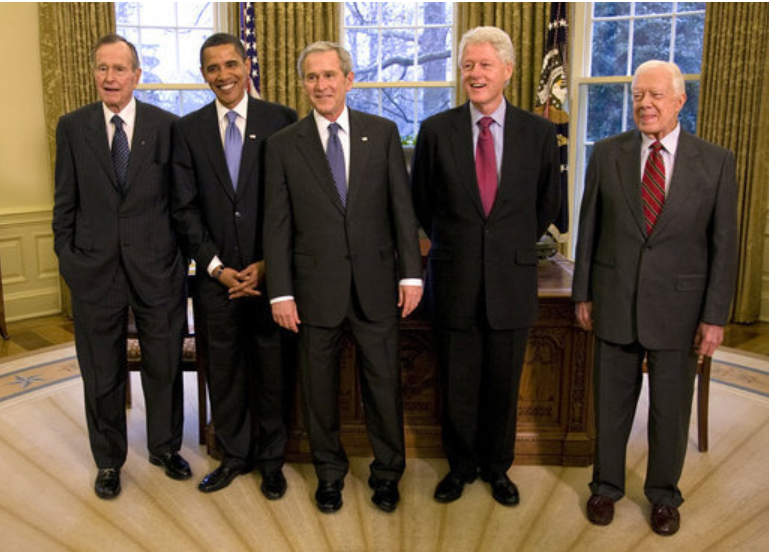
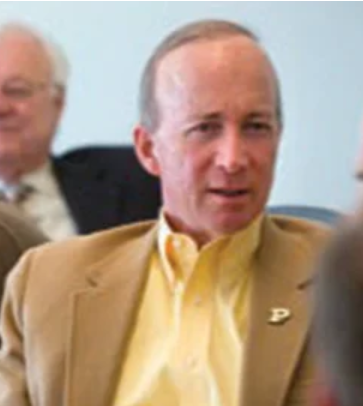
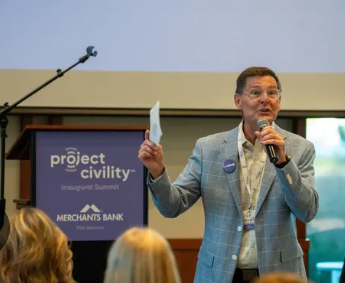
Former Indiana governor and Purdue University president Mitch Daniels provides us with a model of civility in his public life, as we have seen from many American political leaders.




















 Good News