
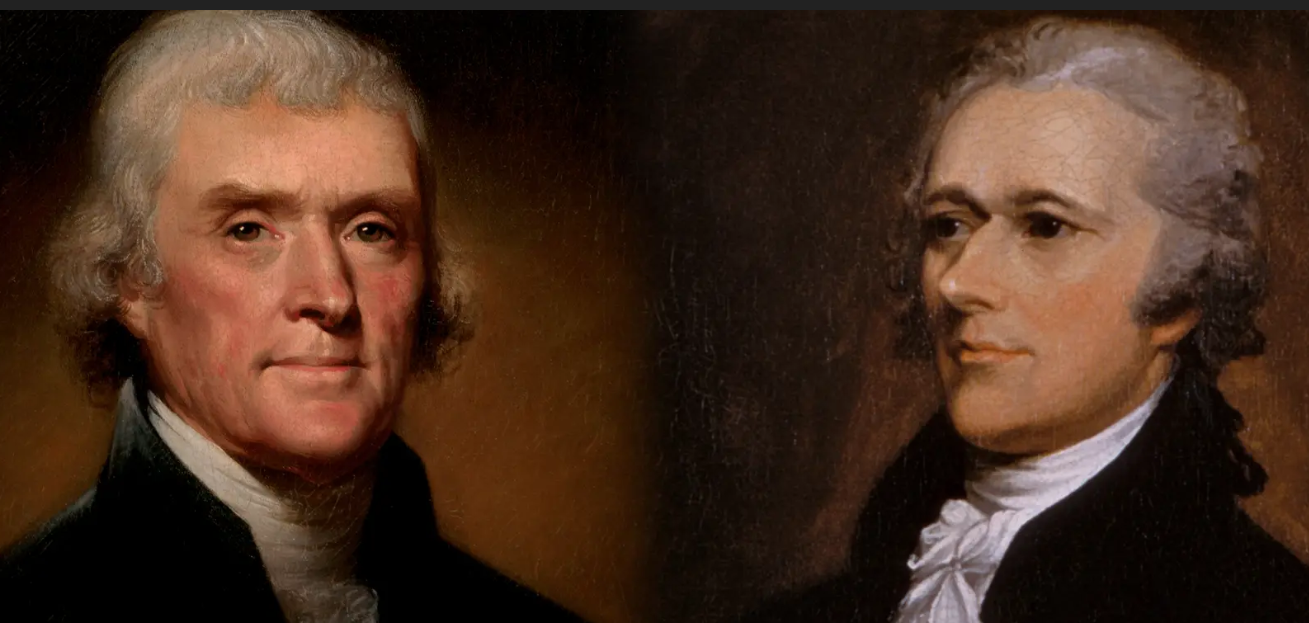
https://www.history.com/news/whose-vision-of-america-won-out-hamiltons-or-jeffersons
- Jonathan Haidt’s “moral foundations” appear to be deeply rooted in human evolution. Democrats mostly embrace care, fairness and equality. Republicans emphasize the broader menu of loyalty, authority, purity, proportionality, honor, liberty, and ownership. Policy differences are unavoidable.
2. Citizens have differing interests/views in all 4 broad domains of international relations, economics, politics and culture.
3. The basic left/liberal/progressive versus right/conservative/traditional divide has endured for 2 centuries.
4. Social scientists agree that some form of the psychological dimension of “openness” is an important driver of left versus right political views. Individuals who are more intuitive (N)/abstract/open on the second Meyers-Briggs dimension tend to take liberal views. Those with more concrete/specific/applied views tend to be conservatives. Similarly, those who are more Judging rather than Perceiving on the 4th dimension tend to be conservatives, seeing the world in an orderly, structured manner. Meyers-Briggs (T)hinkers tend to be conservative, and (F)eelers tend to be liberal, but this is a weaker statistical link.
https://personalityjunkie.com/08/personality-politics-liberals-conservatives-myers-briggs-big-five/
5. Philosophers and social scientists have worked intently for 2 centuries to find a “scientific”, objective, rational, modern view of how politics “ought” to be. Classical liberals, including Immanuel Kant and John Rawls, have proposed neutral, allegedly “value free” systems, but they have not been widely adopted.
6. Religious supporters have watched for a new “great awakening” or signs of the “end times” without success.
7. The progressive era of 1880-1920 overturned some of the political machines of the time and replaced them with scientific management style city managers and opposing political forces. “Good government” folks have since proposed and implemented city managers, commissions, outsourcing, sunset laws, zero based budgeting, process improvements and referendums but this has not removed politics from governing.
8. Philosophers have considered and combined pre-Socratic, Socratic, Neo-Platonian, Aristotelian, Augustinian, Aquinian, scholastic and modern views. They have discounted many views but not reached any true consensus on the important questions. We remain at a stalemate about the critical questions of the individual vs. community, objective vs. subjective reality, ideal/essential vs. existential/empirical world, natural and/or supernatural world, and a logical/designed vs. random/evolving world.
9. Philosophers and social scientists mostly agree that values, morality and character are inherently subjective. Some religious oriented people, philosophers and social scientists agree that a subset of core values is widely seen and shared, but this view has not gathered followers in the last half-century.
10. Classical liberals argue that the US system of democracy and representative government with “checks and balances” is fully adequate to guide society in making solid public choices. This group argues that the citizens can embrace the underlying required pluralistic political values without having to make further choices about broader cultural values. Conservatives and a growing number of moderates and liberals today complain that this approach offers a morality that is too “thin” to support a culture or a political system in the long run.
11. Perceived scarcity is not going to disappear soon, even with continued economic growth and 70 years’ worth of such predictions. Everyone remains interested in getting their fair share of the growing pie.
https://en.wikipedia.org/wiki/The_Affluent_Society
12. Class interests have not been destroyed. If anything, the life experiences between the top 1%, 10%, 20% and the middle 60% or the bottom 20% have diverged even further apart in the last 75 years. Although we don’t discuss “class” as an organizing principle for politics in the US, it has grown to become more important.
https://en.wikipedia.org/wiki/Capital_in_the_Twenty-First_Century
13. Social scientists have a much better understanding of “human nature”. We are imperfect. We have personality preferences. We can flex and learn but only so much. Nature and nurture. Tremendous potential. Education and experience are insufficient to create “perfect” citizens who can easily overcome our inherent political differences.
Summary
Despite the great progress of Western Civilization, we do not have and are very unlikely to find a single solution to our political differences. As individuals we have deeply experienced, considered and felt views of how our community should best operate. They are mutually inconsistent. We can work together to resolve some differences and agree to compromise on others. The apparently valid and opposing views don’t have an obvious resolution. I recommend that we constructively work together to find reasonable, decent compromise solutions and at the same time accept our inability to find an ideal solution without allowing that to discourage us.
 Good News
[…] Our Political Differences are NOT Going Away; And That’s OK One Page: Liberalism and Its Discontents – Fukuyama (2022) Moral Foundations Theory of Politics Morality (2020) Jonathan Sacks Modern Curriculum for Citizens Our Kids: The American Dream in Crisis (2015) Community Really Matters: Index How (NOT) to be Secular: Reading Charles Taylor All Things Shining: A Secular Age Solution? […]
[…] Our Political Differences are NOT Going Away; And That’s OK […]
[…] We Have More in Common Than You Think Common Moral Values Civility: Can’t We All Just Get Along? Our Political Differences are NOT Going Away; And That’s OK […]
[…] One Page: Liberalism and Its Discontents – Fukuyama (2022) Liberalism and Its Discontents – Francis Fukuyama 2022 Fukuyama: Identity (2018) Why We’re Polarized 2020 One Page: Why We’re Polarized – Klein (2020) The Righteous Mind: Why Good People are Divided by Politics and Religion – 2012 (Part 1) The Righteous Mind – Part 2 Moral Foundations Theory of Politics What’s The Root Cause of Our Problems?: Skepticism Civility: Can’t We All Just Get Along? Our Political Differences are NOT Going Away; And That’s OK […]
[…] Civility is Nonpartisan Civility Crisis or Civilization Crisis? Civility: Can’t We All Just Get Along? 6 Root Causes of Our Situation Facing Our Political Situation: How Do You Solve a Problem Like Maria? Morality (2020) Jonathan Sacks The Road to Character – 2015 Moral Foundations Theory of Politics Common Moral Values Our Political Differences are NOT Going Away; And That’s OK […]
[…] Our Political Differences are NOT Going Away; And That’s OK […]
[…] Our Political Differences are NOT Going Away; And That’s OK […]
[…] Civility is based upon the values of human dignity, respect and constructiveness. Participants are encouraged to set aside political differences and respect their common interests and humanity. The effective techniques of Civility separate the person from the policy. The Civility movement accepts and embraces differences as natural and unavoidable. https://tomkapostasy.com/2025/03/02/our-political-differences-are-not-going-away-and-thats-ok/ […]
[…] Have More in Common Than You Think Our Political Differences are NOT Going Away; And That’s OK Moral Intuitions, Personality and Politics … Oh My! What’s the Root Cause of […]
[…] Our Political Differences are NOT Going Away; And That’s OK – Good News […]