I believe that our society has overreached on “individualism” and lost the balance required with community and spirituality/religion. Individual personal, social and economic liberty are proposed as the primary values in modern/postmodern society by both ends of the simple political spectrum. I think we need a balance, a tension, a higher level, a combination. Individualism alone is insufficient for a “great life”, just as pure “materialism” cannot possibly support a “great life”. I want to explore the reasons why left-leaning people have hesitated to support us finding a new balance.
I’ll write a separate blog post to summarize the natural alliance of left-leaning individuals and thinkers with the benefits and essential role of community for society and leading a great life.
Challenges of Community as a Liberal Political Goal
Liberals tend to embrace Care, Equality, Liberty and Proportionality as moral foundations. They are not as interested in purity, loyalty, authority, honor and ownership. At an intuitive level, liberals are more concerned with the individual than the community. This does not reject the “community”, but it requires individuals to overcome their inherent bias towards “either/or” rather than “both/and” thinking to support community as a parallel objective.
The “individual” was created in contrast with the family, clan and tribe, religion, powerful elites, society, civil society, culture, nations, and corporations. Liberals fought for 6 centuries to free the individual from the clutches of these greater groups. Yet, the goal was not to create an isolated individual, but to situate him or her within a community that recognizes their individual choices, values, creativity, worth and results.
Early liberalism embraced reality, reason, logic, experience, and materialism against the prevailing legacy of history, revelation, tradition, supernaturalism, mystery, institutions and culture. Thinking was seen as superior to feeling and the will. Community is essentially soft, floating, spiritual, indescribable, organic, dynamic. Later progressives “turned Hegel on his head”. The romantic, progressive, new left, postmodern versions of liberalism are skeptical of any kind of fixed structure. Community fits in the middle. Some structure, some connectivity.
Liberals mostly embraced increased education, knowledge and progress through history towards a rational, technical, enlightened destination. Community is an old idea and ideal, embraced by most conservatives. Liberals embrace the global, technical, university, media, elite community naturally. Historically, they embraced the community of immigrants, ethnic groups and minorities. Progress is important to liberals, but does not exclude the importance of community as a principle and lived reality.
Social libertarians have sometimes been affiliated with the left. They claim to not reject community.
Conservatives have traditionally supported historical power bases, including various communities and institutions. After Newt Gingrich we live in a polarized political world. Liberals are suspicious of anything offered by the other party. Compassionate conservatism, outsourcing and school choice must be wrong because my opponent promotes them. Liberals are justified in considering power and politics. This does not automatically discount the potential for building stronger communities together with political opponents or using effective suppliers.
Finally, liberals may reject “community” as a second order goal. There are many more important policy areas.
Summary
Liberals cling to the individual and rationality as guideposts for political decisions. We are in a time where “individualism” reigns supreme, supported by liberals socially and conservatives economically. Many dimensions of historical liberalism are opposed to or incongruent with community as a top priority political objective. Yet, liberalism aspires to the very best understanding of man, God and nature. Community is an essential part of the good life.
We live in “a secular age”. Absolute certainty is clearly an illusion. And yet, per Indy native Kurt Vonnegut, “so it goes”. I implore liberals to overcome their historical struggles with a powerful opponent. The past is gone. We face a world of great challenges. How can “community” help us all to live a great life?
Rodney King was an imperfect human being, just like me. His question resonates today, 30 years later. I want to argue, following Jonathan Haidt and his Moral Foundations colleagues, that we are, indeed, hard wired with various deep intuitions about morality, religion and politics. Our biological selves have inherited 9, at latest count, sets of wiring that make each of us see the world as a moral place.
Unfortunately, there are 9 different intuitions. Too many to reduce to one. Inherently in tension. We each favor a different set of moral intuitions. By age 15 we have preferences. By age 25 they are largely fixed for life. Like the Gallup Strengthsfinder “talents”. They tend to cluster into left and right, liberal and conservative frameworks.
Moral, religious and political views are shaped by biology, experience, history and culture. Western culture has moved from an integrated “Christendom” in 1500 to pluralism and secularism. Individuals and groups of individuals have different views about what is fundamental about life. The last 600 years are a history of these differences. We have learned to embrace a tolerant “classical liberal” view of politics, economics and culture not because we like or emotionally embrace it as an ideal, but because it is necessary to keep us from fighting with each other. Deep divisions about moral, political and religious views are the norm. They don’t go away with progress, science, modernity, trade, globalization, education, or experience. Why?
Liberals Think
Care is first. Equality (maybe equality of results, not just opportunity) is second. Liberty is third.
Proportionality is pretty logical. Some sorts of purity are important.
Not so sure about loyalty, authority, honor and ownership. Not just absent, but maybe these are not really virtues at all.
Conservatives Think
Liberty and Authority duel for first place. Ownership/Property and Loyalty are tied for third. Proportional fairness is very important. Purity and honor are sometimes very important. Basic equality and caring are also important. Everyone knows this.
Summary
We see the moral world differently. We prioritize these factors differently. There is enough consistency on the “left versus right” dimension to see individuals as one or the other, but our lived experience rejects this oversimplification. There are very different versions of liberals and conservatives. We try to simplify this as center-left versus new left or center-right versus extreme right to stay on the single simplifying dimension, but this is inadequate. There are many dimensions. Domestic versus international. Economic versus social/cultural. Universal versus local. Personal versus groups. Thinking versus feeling. Intuitive versus logical. Individual versus community. Secular versus religious.
In general, liberals are willing to take social risks, experiment, try new options. Conservatives are reluctant to take risks, preferring to stay with what is known. Liberals are optimistic and wear their feelings on their sleeves. Conservatives are careful and quietly calculate results. In general, on average, in aggregate, social scientists present data to confirm this view. But real people don’t neatly fall into the two categories. Entrepreneurs take huge risks. Many social conservatives are now radically trying to transform the US into a society that fits their views. Some liberals are trying to define what is “acceptable” and limit free speech. Many liberals now see that the preservation of their FDR era social and political institutions and norms are critical as they are threatened by a populist leader.
The US was founded with a political system that tries to moderate the extremes and find a common ground in the middle of competing political, moral and religious views. We have lost sight of this ideal, this vision, this necessary reality. We are stuck with each other. We have different versions of the perfect world. They are not going to be miraculously overturned through education or experience.
Are those who see the world differently from me Evil? Wrong? Unworthy? Shunned? Ignorant? Clueless? Selfish? Childish? Possessed? Confused? Stunted? Misguided? Immoral? Greedy? Irrational? Emotional? Small-minded? Provincial? Utopian? Idealistic? Shortsighted? Prejudiced? Reactive? Limited? Deluded? Suckers? Hubristic? Elitist?
There is a fundamental human need to organize our world into a meaningful whole, worldview, perspective, vision and reality. There is a fundamental principle of biology that embraces sexual reproduction and the diversity/variety of genes in order to “have our cake and eat it too”. We combine genes and genetic variety in order to produce individuals who are different. This provides a species level advantage. We don’t want to go “all in”. We want to have options to face a changing environment. Probabilistic beats deterministic. Period.
The Meyers-Briggs personality dimensions are good examples. We want to preserve BOTH introversion and extraversion, intuitive/abstract and specific/analog/local, thinking and feeling, judging and perceiving. As a species, we need both. We are wired to use both ends of each spectrum, but each of us tend to favor one end or the other. A very few people learn about these options and develop the skills to be equally productive on both ends of each dimension, despite their genetic wiring.
We are intrinsically different regarding moral, political and religious views. This is unavoidable. This is good. We OUGHT to recognize and embrace these differences, not demonize others. This is an inherently “liberal”, optimistic, complex, dynamic, grey, soft worldview. I understand why others may disagree.
I’m a math major, economist, finance MBA, CPA, CMA, process engineer, COO, CFO, financial analyst, statistician, supply chain manager, risk manager, cradle Catholic, adult Presbyterian, small-town child. Put me in the box. I ought to be a highly structured person that supports the philosophical conservative world view, but I don’t. Historically, I experienced the systemic challenges of poor people. Care, fairness and equality became most important for me. I also appreciate proportionality, authority, property/ownership and loyalty.
My personal journey has many influences. I see that others have varied experiences. I respect these differences even when they lead to different moral conclusions. I’m a child of the enlightenment and the Protestant Reformation. I embrace the freedom, liberty and opportunity of the free-standing individual. Yet I try not to elevate it to an extreme. I am not God, the eternal, universal, transcendent, omnipotent. I have received both “child of God” and “inherently broken” messages. Both/and. Complicated. Dynamic. Bittersweet. Sweet and salty.
We all want to believe that “we are right”. In moral, religious and political matters, we need to accept that others see the world differently. Despite these differences, we have proven that we can work together to manage our society “well enough”. This is not an obviously inspirational message, but it is very, very important. This is as good as it gets. IMHO!
George W. Bush promoted the idea of “compassionate conservatism” to enlist local community organizations in delivering government programs. The idea didn’t go far.
I’d like to argue that the idea still has merit. America has been a unique western democracy that has promoted “associations” and “not for profits” as a 3rd alternative to public or private delivery of services. The US has been an innovator in creating organizations that serve the public. Conservatives have often supported these organizations as an alternative to government services. Historically, liberals have also supported many of these “3rd way” options.
Community gardens, food shares, farmer cooperatives.
Small business cooperatives, chambers of commerce, local industry and professional organizations.
Local church congregations.
Book clubs, public libraries, community colleges, public schools, colleges, lifetime learning.
Mutual burial, insurance, health and aid associations. Building & loans, S&L’s, credit unions.
Civic organizations, civil rights, community organizers, human rights, bar association vetting, ACLU, civil defenders, environmental and trial lawyers, neighborhood associations and local political groups.
Community events, community services, living cooperatives, Habitat for Humanity, Meals on Wheels, environmental services, family, local services, YMCA, YWCA, Salvation Army, local sports teams and leagues, outdoors clubs, cooperative preschools, seniors’ organizations, sports clubs, volunteer fire and emergency groups, women’s shelters, youth organizations
Summary
Historically and recently, left and right have argued about who should provide public services. I think we need to walk away from the philosophical politics and find solutions that work. There are many NFP organizations that effectively deliver needed services. I think that they could deliver some services currently provided by governments. I hope that my left/liberal colleagues can step beyond the title “compassionate conservatism” or the corporate origin of “outsourcing” to embrace this potential for using a more effective means to deliver important public services.
In 2011, professors Dreyfus and Kelly responded to Charles Taylor’s 2007 claim in “A Secular Age” that the Christian world view is most convincing with a history of philosophy and a proposal to return to the Homeric Greek polytheistic view of engaging with the pantheon of the “gods”: not literally but essentially. I’ll do my best to summarize their proposal which attracted great intellectual attention.
Most Important
They don’t buy into Taylor’s view that you must have either a fully materialistic or a traditional supernaturalist system. They argue, like Taylor and his “articulator” James K. A. Smith, that receptive individuals do indeed experience some version or impression of the supernatural. We all experience situations of awe, beauty, love, meaning, purpose, divine, sacred, transcendence, and “the good”. The authors see the critical importance of these experiences for living a “good life” or for simply avoiding despair in a postmodern world after Nietzsche’s “death of God”. They don’t see these experiences automatically pointing towards a monotheistic god, universal principles, certainty or an integrated, explainable universe. These experiences are essential but should only be interpreted as the “best way” that humans can interface with the universe.
We cannot bottle or control the supernatural, divine, eternal, transcendent. We can’t really understand it. Yet, we experience it repeatedly. We approach it. It moves away. We seek it. It hides. We apply philosophy, but it fails to reduce the experience. We live a natural, analog life but also experience something more. We feel and sense “something else”. We desire to “know”. We desire to “connect”. We sense the eternal, infinite and universal. We cannot capture it outside of myths and art. Our connections are indirect, dreamlike, intuitive, speculative, indescribable, brief, fuzzy but undeniable.
Main Principles
The key to life is to engage in a “right relationship” with the world as it is experienced.
No reductionistic view of the universe can account for human experience or nature.
The inner view of the subjective individual must be balanced with his connections with external reality. Community matters.
There are multiple truths, insights, perspectives, dimensions, approaches, patterns, models, feelings, and intuitions. Light is a rainbow and white.
The world is dynamic. Everything changes, even truths and the transcendent.
Live in the present. Be present in each moment as you can. But not to a crazy extreme where you try to transform boredom into mysticism.
We can’t know “ends” with fixed certainty, so focus on optimizing the “means”.
Morality flows naturally from aligning yourself with experience. (Not Christian “natural law”, per se). It is simple, naive, pragmatic, obvious. It doesn’t require a connection with God.
Principles Rejected
Monotheism, universal, integrated, fully defined reality.
Certainty.
Simple materialism. Reductionism.
Strictly fixed scientific, religious or metaphysical views (even theirs!)
Control, self-control, possibility of control.
Technology, rationality as a guide to life and meaning.
A solely subjective, internal, individual world view.
We have a version of romanticism, organicism, dynamism, existentialism, experientialism, essentialism, pragmatism. Christian and scientific modernity don’t work. Empty postmodernism fails. Let’s try to create a romantic version of existentialism.
Goals in Life
Experience all of life, broad and deep.
Seek hope, joy and comfort.
Align with reality. Respond to reality. Honor, respect and revere reality.
Focus, prioritize life on experiencing the “best stuff”: transcendent, community, beauty, art, nature, peak experiences, excellence, perfection, insights, flow. Although we are material creatures, the immaterial, spiritual?, supernatural?, indescribable, infinite, approached but not reached, transient, ephemeral, mystery, paradoxical, organic, complex, dynamic, irreducible is the key!
Be guided by the experience of life. Focus on the relationship between the world and the subjective individual. Verbs, adverbs and adjectives, not nouns.
Respect the experience of life. It’s feedback. It’s goals. It’s beauty. Art. Align and resonate with this experienced reality.
Always seek to employ your full human capacity.
Connect with communities. Experience their ineffable essence and possible transcendence.
Morality matters. It is defined by your interactions. It is obvious. Pursue the best. Reject the opposite.
Accumulate wisdom and morality from your experiences.
Ride the waves. Reality provides fleeting opportunities. This is as good as it gets.
Reality is always there for you. Develop the skills, habits, sensitivities, and perspectives to extract the most possible from every situation.
Domains of Practice
Sports, work, crafts, art, production, navigation, communication, community, nature, people. The opportunity to fully, deeply and meaningfully engage is nearly unlimited once you adopt the proper perspective.
Summary
The authors severely criticize the history of individualistic, enlightened, progressive, monotheistic, scientific, technological progress as a basis for living a good life. We have reached a “dead end” from Nietzsche through existentialism to postmodernism. The historical God may be dead, but we certainly don’t want to conclude that all life is meaningless. There is clearly “something” beyond reductionism or pure materialism. It is undeniable. We should relentlessly pursue and embrace this valuable and saving “something”.
Criticism
I think the authors have described a plausible purely secular path to pursuing a good life, overcoming existentialist angst, anxiety, dread and hopelessness. There is “something”. It cannot be reduced to a religious, scientific or philosophical certainty, but I cannot deny its existence or importance. I will dance with it.
I don’t think that this approach will satisfy many people. We deeply want to know “where’s the beef?”. What is the point? What is the “end game”? “How is it we are here; on this path we walk?”. The desire to resolve “matters of ultimate concern” seems to be intrinsic to human experience. This may be an evolutionary error or bug, or it may reflect our true essence.
I think that we have inadvertently prioritized only the individual and completely discounted the role of “community” in American life. We desperately need to rebalance.
Here you’ll find
6 “good news” posts on American trends
7 “good news” posts on Hamilton County, Indiana
2 posts on the Indianapolis metro area
3 posts on the religious dimension of community
An overview on Our American Community and links to Our Kids, Why We’re Polarized and Little Pink Houses.
Solutions such as community assets (Janesville Plan), school curriculum, civility pledges and candidate approval boards.
Historical overview of the critical role of community, how we have more in common, the role of morality and the conflict between “only the individual” and the community.
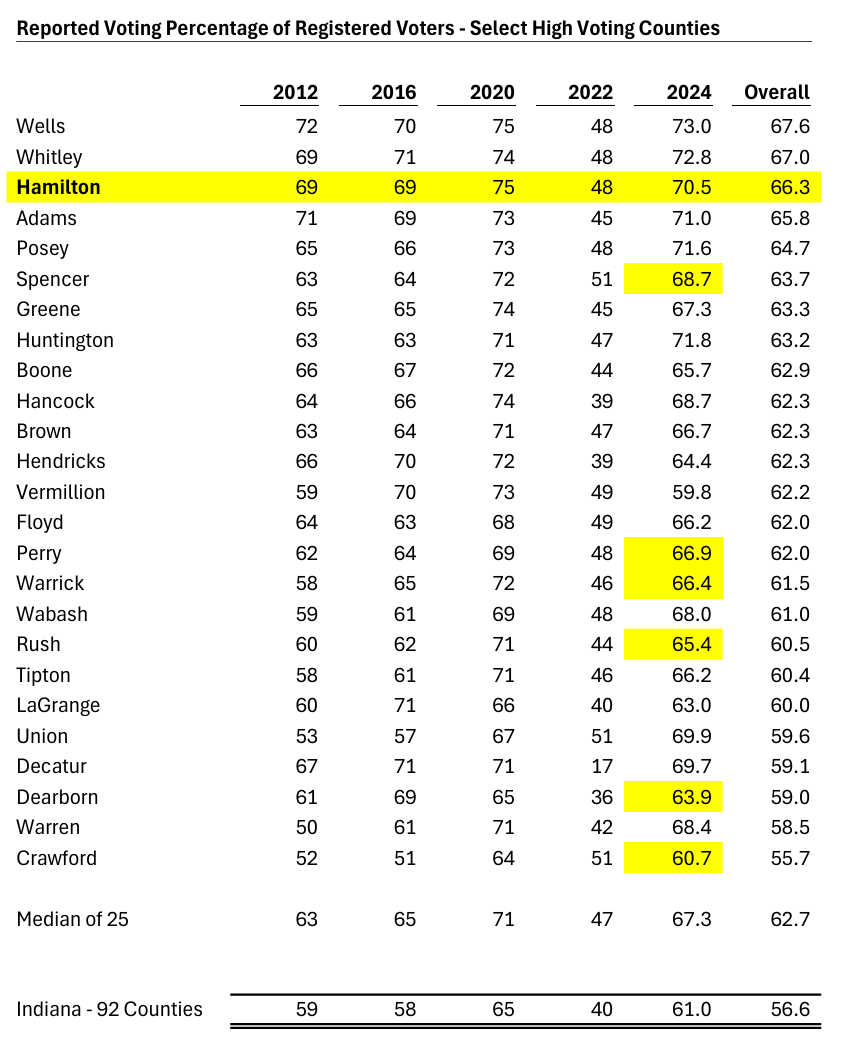
Hamilton County has the 3rd highest average voting rate of Indiana’s 92 counties in the last 12 years. It was tied for 3rd highest in 2012. It was tied for 7th highest in 2016. It was first in 2020. It was tied for 6th highest in 2022. It was 6th highest in 2024.
Hamilton County’s 2024 population is estimated to be 378,000. The 2020 US Census indicates that the non-voting age population is 25%. The resulting voting age population is 283,000. This exactly matches the registered voter population!!! It is very unlikely that every voting eligible person in Hamilton County is registered to vote. Based on national figures, 90% voter registration is the maximum level. If the valid voter registration number was 10% lower than the reported 283,200 level, it would be 254,900 making the voting percentage 78%, far above all other Indiana counties.
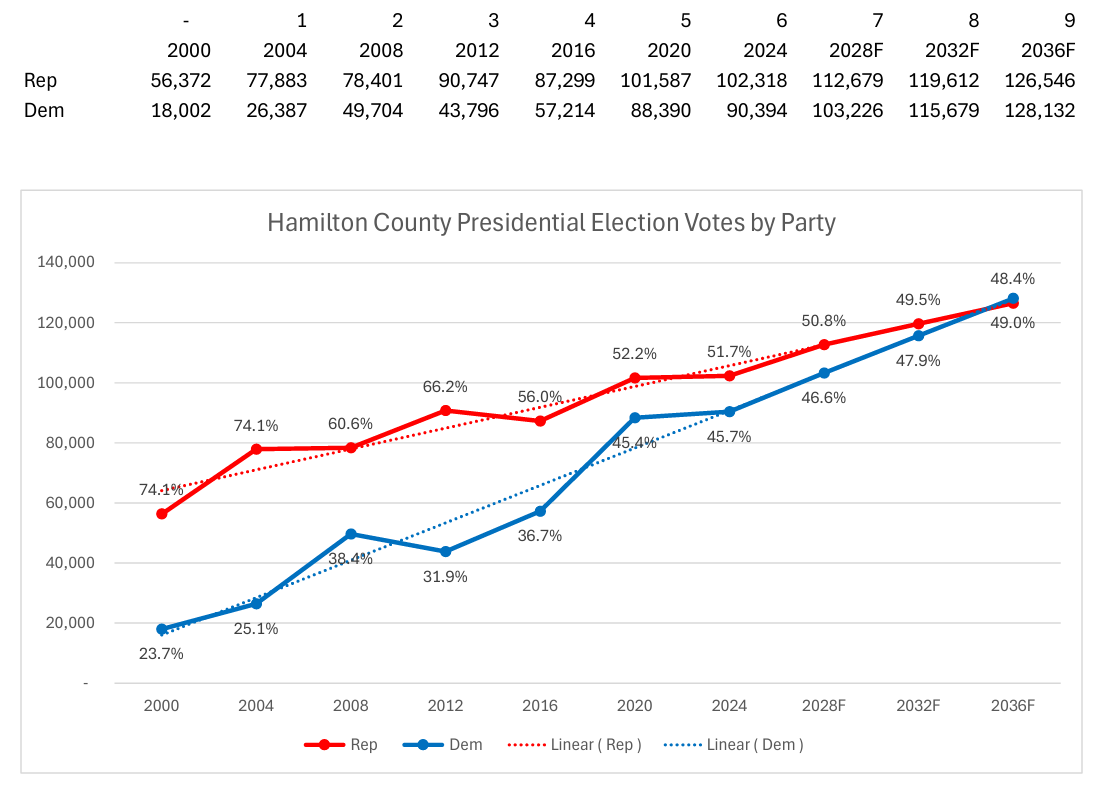
Hamilton County moved from a 30,000 vote Republican advantage in the 2016 presidential election to just 13,000 votes in 2020. Political gurus near and far watched the 2024 race closely to see if the squeeze would continue. It did not. Trump won Hamilton County by 12,000 votes in 2024, just a statistically insignificant shade below 2020.
The long-run trend indicates very competitive political races for the next 3 presidential election cycles.
Journalists, artists, pundits, entertainers and politicians all scheme for our attention. Once upon a time … we briefly thought that the internet and social media might usher in a new age of information, selection, objectivity, useful filtering, wisdom and cooperation!!!! Unfortunately, we are now deluged by “least common denominator” communications skillfully targeted to lure us into a non-stop cycle of clicking on marketable links. These communications very effectively use every trick and technique to appeal to our emotions, prejudices, weak attention, surface thinking, fears, hopes, exaggerations, etc.
Politicians of all flavors have conspired to convince us that the whole world is comprised of “good versus evil” people, politicians, parties, religions, states, policies and institutions. Everything is “win/lose”. Disagreement is motivated by bad ideas and motives rather than differences of opinion or interests. Compromise is a sign of weakness. Every political actor is purely motivated by self-interest.
We each have a moral, political, social, religious and personal responsibility to evaluate these “conclusions”. Let’s start with overturning the idea that we have nothing in common, that we must rely upon politicians to define opposing policies, parties and philosophies and fight to the death for one or the other to finally win.
Human Nature
Biologically we are all the same.
We intuitively and rationally combine thinking, feeling and doing; conscious and unconscious drives.
We each think that we are “right”. As in Lake Wobegon, we are all “above average”. We struggle to maintain self-awareness, to consider the needs of others, to even pursue our own goals consistently and effectively. We are functionally and morally imperfect.
We have a variety of needs and desires that cannot be fully met. Safety, acceptance, achievement, agency, transcendence, control, familiarity, influence, consistency, love, health, growth, expression, authenticity, loyalty.
We are primarily “analog” beings.
Human Experience
We face death, evil, suffering, disappointments, violations, violence and pain. Random, irrational, unavoidable experiences. We often respond with fear, anxiety, cautiousness, anger and victimhood. We search for ways to “manage”.
We experience life through time, learning, relationships, lessons, goals, planning, dreams, hope, commitments, doing, feeling, thinking, feedback, taking risks, managing risks and opportunities, engaging, disengaging, focusing, relaxing, looking outward, looking inward. The journey is complex and the perspective changes.
We balance and prioritize. Limited resources. Unlimited desires. Personal, family, social, community, religious, financial, and health dimensions compete. At best, we fight the many demands to a “draw”.
We struggle to keep up in a world that becomes more complex every decade: personal choices, goods and services available, information available, technical complexity, political complexity, social choices, religious choices, communications options, philosophical choices, scientific results, business complexity, international options, cultural options. More options, more choices, greater expectations.
We live in a culture that prioritizes the economic dimension of production and consumption. We have embraced a meritocracy that offers great rewards to the winners and a modest “safety net” to those who are not winning. Economic and status anxiety are very high in the most economically successful nation in history. We promote an extreme personal responsibility that undermines those who don’t always achieve and sustain their highest goals.
We live in a world that has been labelled the “therapeutic society” or the world of “expressive individualism”, summarized by the US Army slogan of “Be all that you can be”. The individual is responsible for living and achieving a great life of personal expression reflecting their talents and possibilities. The individual has many coaches, advisors, mentors and therapists, but is alone in choosing their “destiny”. They cannot rely upon tradition, religion, culture, nation, village, parents, personality profiles, or skills assessments. This radical secular humanism view places the responsibility for identifying and achieving a “world changing” destiny upon each person. Wise individuals find some way to “balance” this personal responsibility with other influences, refusing to adopt a godlike stance. They avoid becoming like Icarus and flying too close to the sun.
We live in a world that highlights the individual above nature, community, culture or religion. Complete individual liberty, freedom and opportunity are desired. No trade-offs with the other dimensions of life. “Natural consequences” frustrate those who embrace this libertarian ideal.
Life is hard. So many advances in society, business, education and technology. The challenges to “living a good life” are greater than ever. The progressive promise is undermined. All individuals must now make choices that were once reserved for kings, priests, princes, monks, scientists, philosophers, artists, governors, generals, financiers, industrialists, explorers, entrepreneurs, and presidents.
Culture
We digest the beliefs, norms and values of our culture subconsciously. The legacy of Christian Western Civilization continues. The legacy of secular humanism continues. We live in a “secular age” where deep faith and unskeptical religious commitment is unusual for the highly educated one-third. We’re “neither fish nor fowl”. Culture really matters but is today a blend of two streams like “oil and vinegar”. There is much in common. There are some big differences. We generally share the political, economic, social, religious, scientific and literary history of Western Europe, even though parts of the intellectual community have promoted disturbing alternate views for almost 200 years.
Despite living in a “secular age” and an “individualistic age”, we all need to be connected to various communities. Although community participation frequency, manner and depth vary greatly across the decades, humans always need to be connected.
We share a legacy and currency of art, media, design, architecture, music and entertainment. High-brow and low-brow. Mass market and specialized. Push versus pull connectivity. We are connected.
The US remains an unusual Western society where the not-for-profit, religious, social, volunteer world performs major social welfare functions. We share our experiences of funding, volunteering, leading and consuming from these organizations. The individual and community experience of managing these organizations shapes our world view. Our individualistic bias combines with our social/religious obligations to create and support these organizations.
We share our experiences in pre-K, elementary, high school and college education. Mainly public schools. The content shapes our perspectives.
We have moved from 6 to 4 to 3 to 2 to 1.X children per family. We invest like never before in the growth, education, experiences, guidance, mentoring, support and direction of our children. Helicopter parents. Summer programs. Internships. International experiences. The youth orientation reigns supreme.
We continue to value the “social esteem” provided by others. We comply with social norms in every dimension of life. We seek approval. We consume good and services to signal our social status. We achieve, perform and consume based on social influences.
We adopt “tolerance” as a supreme moral value. We don’t advise, influence or interfere with others, even when we strongly disagree.
We continue to struggle with the idea of a “class structure” in America despite the obvious growth in economic, social and political influence of the wealthy (top 1%) and the professional class (top 10%).
Communications
We share the American “English language”. It dominates the whole world.
We share the mass media, local newspapers, industry and professional journals, scientific and academic journals, the entertainment industry, social media platforms, community forums and the internet.
We share modern communications and information technology. A “smart-phone” is in every pocket, instantly accessing the cumulative knowledge and information of mankind.
Religion
Americans are much more “religious” than “Europeans”. We mostly believe in God and spirituality and Christianity. We have seen that shared cultural/religious beliefs can be maintained in a religiously pluralistic society. We believe in objective “right and wrong”. We intuitively accept “the golden rule”. We see “America” as part of God’s plan and history. A place for the pilgrims. A land of religious diversity. The overturning of slavery. American victories in the 2 world wars and the cold war. The moral dimension of life matters.
Economy
We still live in the world that Adam Smith described in 1776. The degree of specialization is only limited by the extent of the market. Our world is extremely specialized. A bewildering variety of products are available. Outsourcing of many functions. Regional, national and international sourcing.
We all specialize in our most productive functions today. Profession, sub-profession and industry. We all have talents. There are most highly rewarded in their professional roles.
We are producers and consumers, investors and suppliers, professionals and managers, entrepreneurs and directors. We are deeply engaged in the financial system, markets for labor, money, trade, property, goods and services. We sometimes elevate this role to be “everything”, to our detriment.
We are interdependent. We rely upon “essential workers”, universities, governments, builders, contractors, consultants, bankers, utilities, media, lobbyists, politicians, unions, secondary markets, employment firms, lawyers, engineers, IT and communications folks, etc.
We rely upon the US macroeconomy. Budget deficits. Fiscal policy. The Federal Reserve Bank. Monetary policy. Federal banking and industry regulators. The bond markets. The credit rating agencies. Animal spirits. Wall Street. Mutual funds. Municipal bonds. Mortgage bonds.
We rely upon our commitment to the capitalist, free market, free enterprise system. Laissez faire. Limited government regulation. There are specific situations and metrics that warrant government intervention, but we lean towards allowing the natural incentives of the market to police the behavior of great firms.
We believe that economic growth provides the opportunity for the political system to effectively “redistribute income”, ensuring that the economic value added by scientific and business innovation through time does not all accrue to the owners.
Globe
The benefits from international trade are well understood and have been demonstrated for 75 years.
There are opportunities to engage all nations to manage diseases, food supplies, hunger, human rights, refugees, public health, travel, immigrants, trade, communications, and ocean resources.
There are global threats that must be managed: climate change, nuclear war, chemical and biological weapons, computer hacking, artificial intelligence, species loss, food production, energy production.
Philosophy
An objective physical reality exists. An objective moral reality exists.
The individual really, really matters. Human rights.
The scientific method applied to technical issues is great. It is not everything.
Instrumental logic is a tremendous asset for science, business and life.
Pragmatism is always worth considering. “Show me the money”. Does this theory produce measurable results?
We reject anarchy, atheism, pure commercialism, communism, fascism, necessary progress, libertarianism, national socialism, racism, sexism, totalitarianism, utopian socialism, white nationalism, Christian nationalism. In essence, we reject extreme views. We’re comfortable with a “checks and balances” political system that slows changes until they’re embraced by a solid majority.
Politics
The US is a world of skeptical politics. Less is more. Trust no one. Engage the local community to find a solution. Accept the individual bias in economic and social laws. America is a special place, worthy of patriotic respect.
Political participation is a sacred duty.
Despite the structural constraints on change, the US has generally been a positive, constructive, progressive supporter of political changes through time.
Americans are willing to sacrifice for the good of the nation.
The US constitution is framed by the rationalist enlightenment. We deeply believe in “the rule of law”.
Differences can be resolved, technically, rationally, politically.
We are comfortable with “suboptimal” results from our political system. We accept that the federal, bicameral, functionally divided system is designed to prevent the “worst case” outcomes of raw democracy or concentrated power.
In general, we strongly support our government institutions, especially at the state and local levels. Judges do their jobs. Political parties hold each other accountable. Citizens participate in the democratic process as voters, poll workers, jurors, donors, and volunteers.
Summary
We live as individuals in a complex, interdependent world. We have more opportunities but less authoritative guidance for our lives. We worry about our freedom and liberty. We make many choices. We do the best that we can. We agree on many things yet disagree on many others.
Today, we understand the world better than ever. We also understand ourselves better, our strengths and weaknesses, our possibilities and limits. We manage complex technology and institutions very effectively. We know that some political and economic options don’t work or pose unacceptable risks or threats. The U.S. and Europe developed “limited government” systems apart from religious authority because disagreements were inevitable. We need to relearn those lessons today. We’re going to have a “mixed” capitalist/government economic system. We’re not going to empower any religious denomination or secular group to impose its views on society. We can delegate issues to the states and learn from their experiences. We can compromise. We can “agree to disagree”. Ideally, we can accept that there are some intractable political differences in our society and focus on those areas where we can find agreement.





 Good News