
https://www.kent.edu/may-4-historical-accuracy
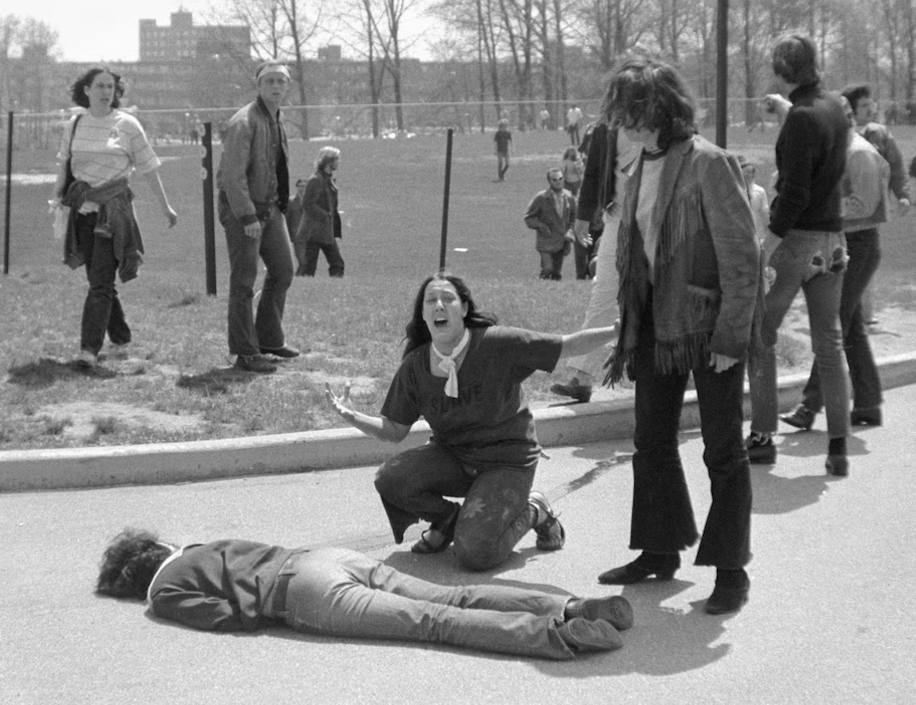
May 4, 1970. The world changed when 13 student protestors were shot and 4 killed by Ohio State National Guardsmen at Kent State University following the escalation of the “Vietnam War” into Cambodia.
Cleveland had experienced civil disorder in the hot summer of 1966 with the “Hough Riots”.
https://case.edu/ech/articles/h/hough-riots
In the 1968 election, George Wallace won 1/9 Ohio votes, tipping the state to Richard Nixon.
In the hot summer of 1969, the Cuyahoga River “caught fire” and gained national attention.
In November, 1969, the Cleveland Plain Dealer reported the atrocities of the My Lai massacre.
https://en.wikipedia.org/wiki/My_Lai_massacre

Governor Rhodes, who oversaw the state guard actions at Kent State, served for 16 years as the governor of Ohio from 1963-71, interrupted by constitutional limits, and then from 1975-83.
https://en.wikipedia.org/wiki/Jim_Rhodes
Carl Stokes was elected as mayor of Cleveland and served from 1967-71 as the first African-American mayor of a major US city.
https://case.edu/ech/articles/s/stokes-carl-b
He was followed by Republican Ralph Perk.
https://en.wikipedia.org/wiki/Ralph_Perk
Throughout the 1950’s, 1960’s and 1970’s, Cleveland was a leading venue for the growth of “rock ‘n roll”. Counterculture, but not too much.
https://www.cleveland.com/metro/2017/01/birth_rise_of_rock_n_roll_in_c.html
https://en.wikipedia.org/wiki/Upbeat_(TV_program)
https://en.wikipedia.org/wiki/CKLW
Like most major cities, Cleveland had two major daily newspapers, many radio stations and 3 network tv stations in the post-war era. Dorothy Fuldheim was a pioneering woman journalist who served throughout this period. She challenged the Kent State shootings.
https://en.wikipedia.org/wiki/Dorothy_Fuldheim
Personal View
I grew up in a small town of 4,000 people about 30 miles east of Cleveland, dominated by the Cleveland media. As a youngster, I delivered newspapers for the 2 big Cleveland and 2 local printers. Cleveland saw itself as a very major US city. 5th largest nationally in 1920. 8th largest in 1960. Cleveland was a major industrial supplier of the WWII war effort. It’s corporations greatly benefited from the post-war global industrial expansion. They struggled to face the 1970 challenges from international (Japanese) competition, environmental regulations, labor power/regulations, technological changes (IT, process), and consumer/retailer power changes.
The Cleveland economy was stagnant in the 1960’s and declining in the 1970’s. Locals supported the civil rights movement but recoiled from the Hough riots. The world was changing faster than the local economy and thought leaders could digest in 1969. With Kent State, the population and political leaders turned inward. The students were wrong. The guard did its job. A majority agreed. A substantial minority disagreed.
As a country we remain very divided, 54 years later.
The film “Network” expressed this passionate viewpoint in 1976. Economic and cultural changes were so great that people could not digest them. The difficulties of the 1960’s revolution continue 50 years later. Left and right both struggle with our situation today.
 Good News
I remember this well. I was at Butler and we were protesting too, only against women’s hours. And the divisions were not only by race but by culture. Hippies vs the establishment. You could tell who was who by the way they dressed.
Unfortunately you cannot tell who is who culturally until they speak. Finding out which of my friends are Trumpsters is depressing.
I am fearful of this divide already. But not in the form of protests but in what I fear will be utter chaos in 2025.
[…] County, Ohio: A Swing County for Presidential Elections (1952-2008) Mad as Hell and We’re Not Going to Take It Indy, Throw Me the Whip! Indiana State and Local Politics, Demographics and […]