I’ve read 2 books this week by conservative and progressive authors outlining the consolidation of working-class voters of all racial/ethnic groups into the modern Republican party.
I recently outlined some steps that either party could take to address the challenges that working- and middle-class families face in a meritocratic world.
I’ve outlined other policy steps below that might convince the two-thirds of the electorate that are working and middle class that they are the priority. My rough-cut estimate is that these changes would improve the federal budget deficit by 2% of GDP.
Government Structure
Sunset laws requiring reapproval of substantive changes after the first 10 years.
Bipartisan staff recommended simplification and clean-up laws, one functional area per year, package approval, no amendments.
Independent staff recommendation of lowest 10% benefit/cost ratios for regulations by agency every 10 years, package approval, no amendments.
Implement balanced budget across the business cycle law that considers unemployment rate and debt to GDP levels.
Require spending cuts or funding sources for new spending programs.
Require federal programs to have a minimum 20-year payback from investments.
Migrate to minimum 80% federal funding of all federal programs assigned to states.
Outsource the USPS by region, maintaining 3 day per week delivery minimums.
Government Services
Determine paternity for all births, set and enforce child support agreements, provide basic level support from the state as required.
Provide home childcare volunteer refundable tax credit up to $100 per week.
Greatly expand availability of 1-2 year National Service programs for young adults and senior citizens.
Invest in nominal co-pay front-line mental health screening, intervention, listening, training, group sessions and counseling services for less critical conditions.
Expand veterans hiring preferences to state and local governments, government suppliers and large employers.
Invest in prison to work transition programs.
Allow large employers to setup new employees with default 1% contribution to local United Way/Community Chest umbrella funding services.
Allow any group of 10 states to create a “medicare for all” health care program as a substitute for the Affordable Care Act.
Allow any group of 10 states to create a private insurance-based (qualify in 2 states, qualifies for all states to ensure competition) health care program as a substitute for the Affordable Care Act.
Housing and Transportation
Restrict issuance of new building permits in counties that do not have one-third of permits proposed for units below the existing median unit property value.
Auction regional licenses for private firms or states to offer low annual milage limit used car leases low to medium credit score individuals using federal funding for the inventory.
Create voluntary 5% of income home down payment savings program that accumulates to $50,000 after 10 years of full-time employment contributions.
Retirement
Make social security employee tax payments optional after age 62.
Remove social security payment offsets from earned income after age 65.
Auction to private firms the right to offer standard 401(k) financial advisory services for 0.5% of asset value with 100% federal match below $50,000 and 50% federal match below $100,000.
Education and Labor Market
Make any overtime or shift premium pay non-taxable (alternative to 10% rate in original proposal). Reduce taxable wages by 10% for hours worked between 6pm and 6a.
Tax university tuition income above $15,000 at 25% rate to fund public colleges.
Create German-style public-private partnerships for broad range of vocational training opportunities.
Offer career and technical training grants for up to 2 years equal to state subsidy of college education.
Offer workers up to $5,000 for relocation or temporary housing as an alternative to up to 2 years of unemployment benefits. (alternative to tax credit for moving expenses)
Provide alternate sets of courses and experience to meet minimum requirements for standard level high school diploma, rather than requiring gateway courses like Algebra II.
Offer an all-industries state administered “career skills” certification program that can be earned in 3 years of employment and classes, including some classes for academic credit in high school.
Require governments and large employers to justify any strict “BA needed” job requirements versus “education and experience” options.
Safety Net
Create a self-funded unemployment lump-sum payment system based on prior 5 years earnings. 4 months award available after 10 years. 6 months after 15 years. 8 months after 20 years. (Alternative to higher benefits and bridging option)
Maintain a present value of future social security benefits asset balance for each participant. After age 35, allow once per decade 10-year term loan at 10-year T-bill plus 2% for up to 20% of balance, maximum of $50,000 loan balance. Repayment through social security system earnings.
Provide payroll contribution funded ($200,000 max) annual income catastrophic family medical insurance (>$100,000/year) to all citizens. (alternative to $25K government provided fund)
Eliminate all specific import tariffs, but levy a 3% tariff on all goods to “protect” domestic producers and help fund government programs. (alternative to 0%)
Pay-off all student loan debt for professional degree medical professionals serving 5 years in non-metropolitan county or metropolitan county with less than 300,000 population.
Subsidize high-speed internet for rural counties.
Offer 10 year T-bill interest rate financing for qualified “low cost” retailers to build stores more than 15 miles away from any existing qualified store.
Levy a $500 per employee annual “closing costs” fee on large employers (250+) for a maximum 20 years to fund local redevelopment programs starting with $5,000 per discontinued employee.
Levy a 0.5% of annual rentals fee on landlords to fund local redevelopment of abandoned properties and areas.
Professions
Staff state professional licensing boards with a minority of regulated active professionals. Reduce licensing requirements to meet public safety standards.
Require states to provide tuition free medical care and residency spots for one doctor per 10,000 citizens each year.
Reduce medical school preparation requirement to 3 years.
Offer reciprocal medical licensing arrangements with 30 leading countries and expedited review and specific qualifications training and experience requirement defined for all others within 90 days of application.
Set a national cap on individual and class-action lawsuits at $2 million per person, adjusted for inflation.
States contract for metro and area multiple listing services and limit total real estate commissions to 4% of transaction value.
Require financial advisors to meet the fiduciary standard of professional care, putting the client’s interests first.
Set maximum prices per service and per hour for home and auto repair firms.
Certify public advisors to provide general advice on consumer economics, budgeting, banking, investing, real estate, insurance and health insurance for $100/hour to citizens, with a $50/hour, 8-hour maximum annual refundable tax credit.
Taxes
Starting with the 35% tax bracket ($462,501 married filing jointly), reduce allowable itemized tax deductions to 0 at $2 million of income.
Add a 40% tax bracket at $2 million of income.
Levy a 5% of excess price paid on personal vehicles sold for more than $50,000, boats for more than $100,000 and recreational vehicles for more than $100,000. (alternative to 10% above $1M)
Add a 10% surcharge to tax rates for residential properties larger than 5,000 square feet. (alternative to surtax above $2 million)
What does American retail and business strategy have to offer the declining Mainline religions? First, an undifferentiated strategy of serving “everyone” is doomed to failure. Kmart, Sears and JC Penney could not create a differentiated strategy. They died.
Marshall Field had a better approach.
Second, the mavens of corporate strategy offer a simple framework for addressing the “needs” today. Michael Porter is the king of corporate strategy.
Kaplan and Norton delivered insights on how to link strategy to operations.
Treacy and Wiersema consolidated this into just 3 dimensions.
A successful, disciplined organization must choose. It cannot be “all things to all people”. It must choose one of 3 general strategies. It must choose a subset of customers, not everyone.
Businesses are very highly motivated to find the most effective strategies and tactics.
One effective strategy is “operational excellence”. Be so cost effective at delivering your goods and services that you can charge the lowest price and still make a great profit. For a church, this would mean:
Low contributions, donations, tithing and specific opportunity funding.
Low price of entry. No creed. No adult baptism.
Low ongoing commitments. Low church attendance. Low volunteering. Low service. Low small group engagement. Limited liability.
Low constraints. No confession. No evaluation. Low prayer.
This is a critical dimension. Do you want to retain nominal members? There is a possibility that they will become engaged.
Do you wish to offer “cheap grace”? Lower the bar to entry, but higher the bar to membership?
Product innovation is a second winning strategy. Define a religious perspective that is different from those of others.
More liberal versus conservative.
Emphasize thinking, feeling or doing.
Emphasize modern prophets and interpreters or older ones.
Internal belief versus social response and participation.
Earthly life or eternal salvation.
Mysticism.
Community.
Love.
Deliver specific services: children, adults, poor, immigrant, counseling, small groups. adult education.
Full service.
Large or small. Known or invisible.
Third, an organization can emphasize “customer intimacy”. We know what you want and will deliver it in personalized portions.
For a church, this can mean:
Smaller congregations.
More “congregational care” staffing and volunteers.
Greater emphasis on small groups and frequent volunteer participation.
More “intrusive” style of reaching out.
Different services for different life cycle ages.
Treacy and Wiersema really emphasized the second and third strategic dimension. They argued that you should “choose” your primary customer base. Like the failed retailers, a central, “all of the above” strategy is doomed to failure. Choose a customer group and organize your products and services to exactly, precisely meet their needs. Customer groups could be defined and served:
by age, life cycle.
geography.
class, income, profession.
active or passive religious participants.
historical religious background or skeptics, secularists.
long-timers or newcomers.
religious views. close fit or searching. liberal or conservative.
activity or engagement level.
Is this segment growing or shrinking?
Does it greatly need church services or is it apparently self-sufficient?
Do the existing assets and programs of the church meet the group’s needs?
In the corporate world, the trick was to identify and serve the groups that could buy the most and deliver the greatest profit for existing and adjacent products and services. In the religious world, the key is to realistically determine what an existing congregation and denomination can offer to a world that expects its needs to be met.
Hamilton County’s 357,000 residents are a little more than 0.1% of the 332 million national citizens (1/1,000). It’s typical 80 National Merit Semifinalists are 0.5% of the 16,000 national total (1/200). It produces 5 times more than its “fair share”.
The 13 lowest population states range from 0.6 to 1.8 million citizens, averaging 1 million. Hamilton County has one-third as many citizens, on average.
Public Sheridan HS awards some NMS semifinalists. Hamilton County has a large number of students at private schools that do not report NMS semifinalists by their place of residence. University, Park Tudor, Heritage Christian, Cathedral, Roncalli and Guerin. I estimate that there are another 3-5 Hamilton County winners each year.
Hamilton County students benefit from their abilities, parental and neighbor involvement, high expectations, extracurricular opportunities and strong school systems.
Typical annual National Merit Scholarship Semifinalists:
Human progress is based on 4 things, IMHO. We are able to abstract and generalize. We accumulate our lessons learned. We innovate. We combine our structured, accumulated knowledge with innovations. Creativity and innovation get most of the attention. Yet, the accumulation of our practical and theoretical experience in language, books, records and equations may be equally important. The ability to switch “back and forth” between a fixed structure, history, religion and culture and new innovations may be the most important aspect of all. We have divergent and convergent thinking abilities. We use inductive and deductive reasoning. We intuitively prefer “either/or” but can manage “both/and” logic. The modern history of mankind’s progress points towards the importance of creativity and “both/and” logic.
Abstraction is a relatively recent phenomenon. Democritus imagined atoms, smaller and smaller particles. Heraclitus imagined all as change. The Greeks imagined earth, water, air, and fire beneath everything. Pythagoras and Euclid provided geometric proofs and ideal figures. Aristotle offered a powerful version of formal logic. Plato defined the “forms” and the ideal realm that stands above our experienced reality. Descartes defined mind versus body and the Cartesian coordinate system. Newton rationalized the universe in terms of algebraically defined laws. Kant defined pure logic and the limits to pure logic. The great appeal of abstract rules and an implicit mechanical universe remains to this day. The “Enlightenment” produced new politics, economics, culture, science and religion based upon these powerful insights.
The accumulation of knowledge has occurred in a surprisingly wide variety of forms. Life in DNA. Sexual reproduction. Man’s biological memory. Human consciousness. Spoken language. Music. Myths. Written language. Culture. Laws. Accounting systems and records. Religious practices. Architecture. Books. Libraries. Scribes. Printing. Histories. Universities. Experimental science. Prophets. Peer-reviewed journals. Scientific societies. Mass media. Recordings. Radio. Video. Internet. Wikipedia. Zoom.
The history of innovation is well known. I want to highlight the general trend away from simple, atomistic, “either/or”, static views to more complex, multi-level, “both/and”, dynamic, organic views that provide much better insights into our real experience.
Physics has moved from statics to dynamics. Classical mechanics has been replaced by complex, probabilistic quantum mechanics. The fixed, static, deterministic perspective has been replaced by Einstein’s relativity. In general, deterministic views are replaced by probabilistic views. The solid atoms have been replaced by waves and fields. Light exhibits both wave and particle behaviors. Heisenberg says we cannot measure everything. The background framework of an “ether” is no longer required. The mathematics required to describe physics has moved from algebra to multi-variate calculus to string theory. Only a handful of people truly understand the frontiers of physics in the last 100 years.
Mathematics has advanced wonderfully in the last 500 years. Newton and Leibniz invented the calculus. Man could now measure, describe, imagine and control changes through time. There is an equation underlying all activities that can, in theory, predict the future and explain the past. Dynamics can be described. Three-dimensional Euclidean geometry was superseded by multiple-dimensional geometry, Riemann curved space and fractals. Probability theory was developed to clearly describe apparently random activities, providing a solid basis for evaluating the results of experiments. Set theory evolved to encompass all of mathematics and logic, including various conceptions of infinities. Goedel’s 1931 “incompleteness theorem” undercut Russel’s attempt to define a single, bottoms-up, certain, powerful mathematics.
Biology evolved from collecting, illustrating and categorizing specimens to Lamarck’s deterministic evolution to Darwin’s evolutionary survival of the fittest perspective. Society increasingly adopted a biological, process, systems theory perspective in place of a physics, mechanical, materialistic perspective. Nature versus nurture became nature and nurture. The details of genetics is better understood as a very complex process involving multiple genes and other structures.
In philosophy, Hegel defined his dynamic thesis, antithesis, synthesis model. History now ruled. Eternal universals were much less likely. Multiple perspectives were elevated. Certainty was less likely. Marx tried to use Hegel’s general framework combined with an economic, materialist determinism but he failed.
In practical technology, we have seen the rapid accumulation of knowledge. We have also witnessed the great importance of “both/and” solutions. For example, ships and automobiles required the invention of a clutch that provided both solid propulsion and slippage. Powered vehicles first required rails but were turned loose as motor carriages. Wheels evolved from steel to rubber to accommodate shocks, turns and rough roads. Vehicles added suspension systems.
In economics, we advanced from mercantilism to comparative advantage and free trade. We left behind land, labor or capital as the only sources of value with the insights of the marginal productivity economists. We moved from static to dynamic perspectives and focused on the determinants of growth in advanced and developing nations. Keynes demonstrated that national economies were more than the sum of individual markets and that self-regulating equilibriums were not inherent in a market system.
Computer systems have evolved from fully defined linear and logical systems to massively parallel systems capable of artificial intelligence and spoken interaction with humans.
Businesses have replaced assembly lines and Taylor’s experiments with a deeper understanding of individual tasks in probability terms and the sequence of events in any process. Firms have embraced Japanese style process management and improvement, delivering constantly improving results. Supply chains span the globe. Project management is now “agile”. Strategic planning is no longer deterministic, but focused on mission, vision, values, strengths, weaknesses, opportunities, threats and culture. Investments are considered within the framework of portfolios of risks and returns. Entrepreneurs and leaders are valued above technical and professional experts.
For many, religion has evolved from a legal, literal, deterministic perspective to one that emphasizes the principles, insights, opportunities, feelings, experiences and possibilities of a given creed, despite the loss of absolute certainty in a “Secular Age”.
As humans we prefer a simpler, more deterministic view of the world. Yet the world shows us that it is more complex and that we will never fully understand it.
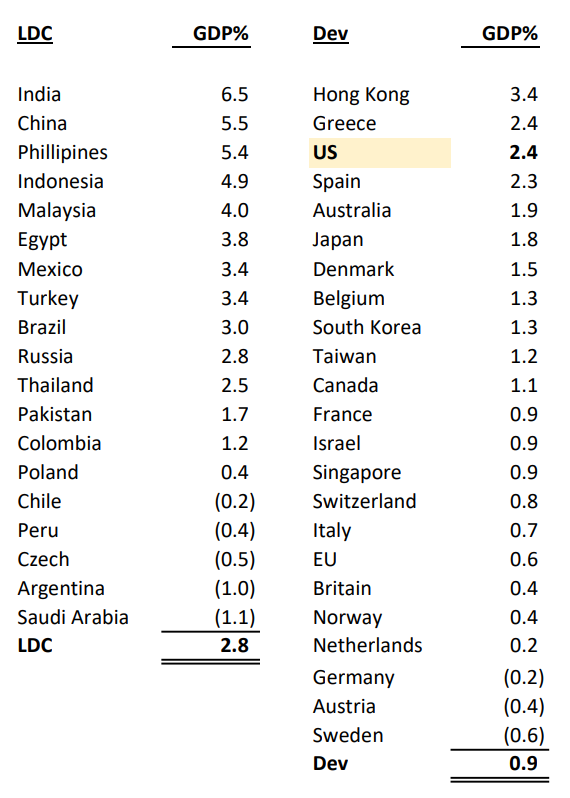
Global GDP growth in 2023 averaged 1.2%, slow but not recessionary. We have rebounded from the pandemic without a secondary recession despite the “soft landing” which has been achieved and we are now moving into take-off mode.
The US leads the “developed” world at 2.4% real growth, twice the global average.
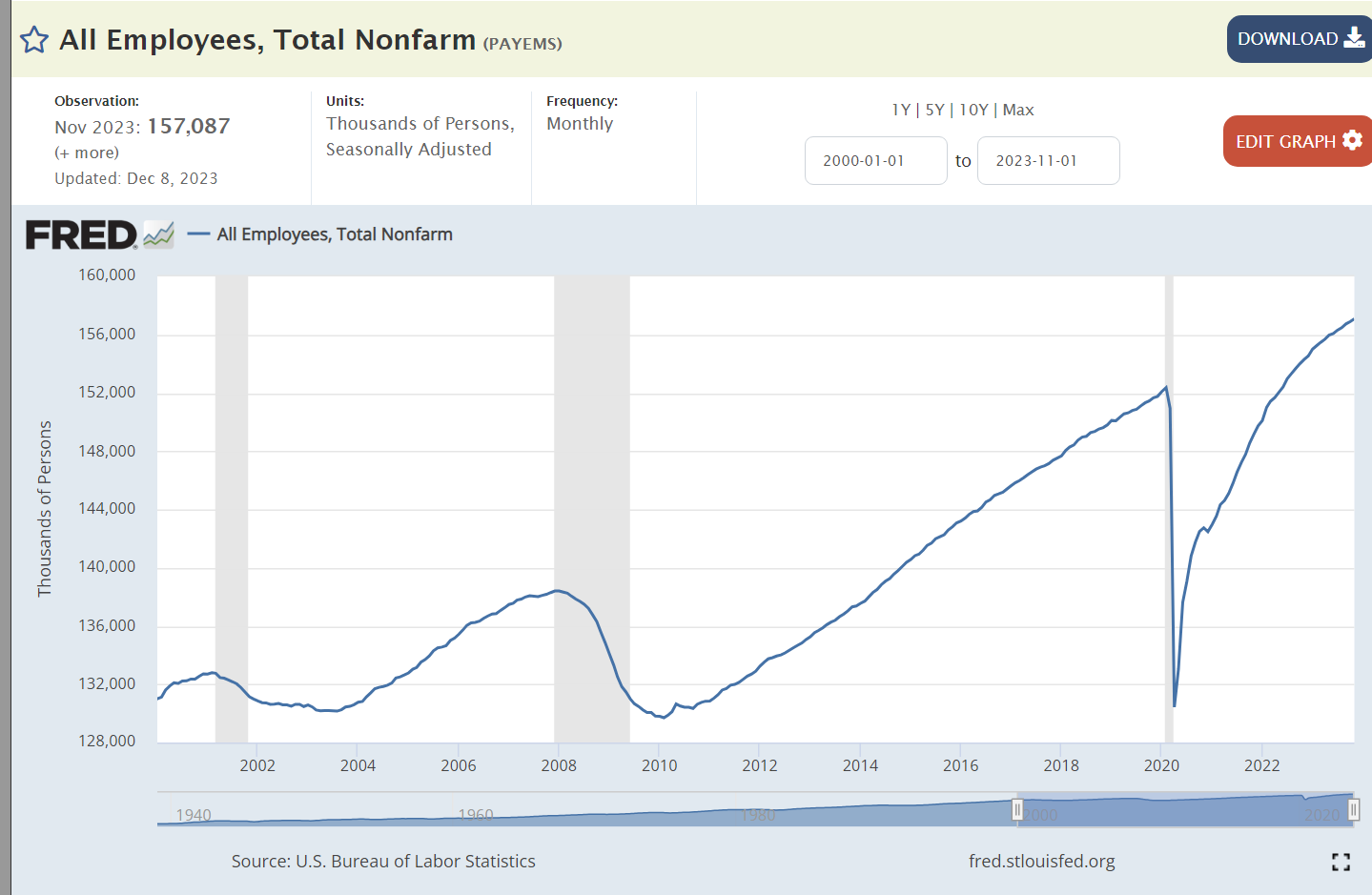
Economists prefer to measure data at business cycle peaks and troughs. After the Millenium Y2K scare, we endured a mini recession. Employment peaked at 132.8 million jobs in March, 2001. Today, in October, 2023, we have 156.9 million jobs, an increase of 24 million jobs in 22 1/2 years, almost 1.1 million new jobs created each year! This is despite the job destroying effects of the Great Recession and the Pandemic.
The longest business expansion in US history ended after 10 years in February, 2020. The pandemic eliminated almost 22 million jobs in 2 months, leaving the economy with just 130.4 million employed, barely above the trough of 129.7 million in February, 2010.
The economy replaced those jobs in just 26 months when the June, 2022 figures were reported! In addition to replacing the first 22 million jobs, the economy has added another 4.5 million jobs in the last 16 months, averaging 280,000 per month or 3.4 million per year! At the same period after the Y2K recession, the economy averaged 2.6 million new jobs per year. At the same period after the Great Recession, the economy averaged 2.8 million new jobs per year. Our economy averages 1 million new jobs per year and can accelerate to 3 million per year when recovering from a recession. The current recovery is stronger than either of the last two.
Another way to gauge progress is to measure jobs added from peak to peak. The economy added 5.6 million net new jobs by December, 2007, or 836K per year. In the 13 years until February, 2020 the economy added 22.7 million jobs, or 1.141M per year. Since then, the economy has added 4.5 million jobs, or 1.240 per year, a very solid result.
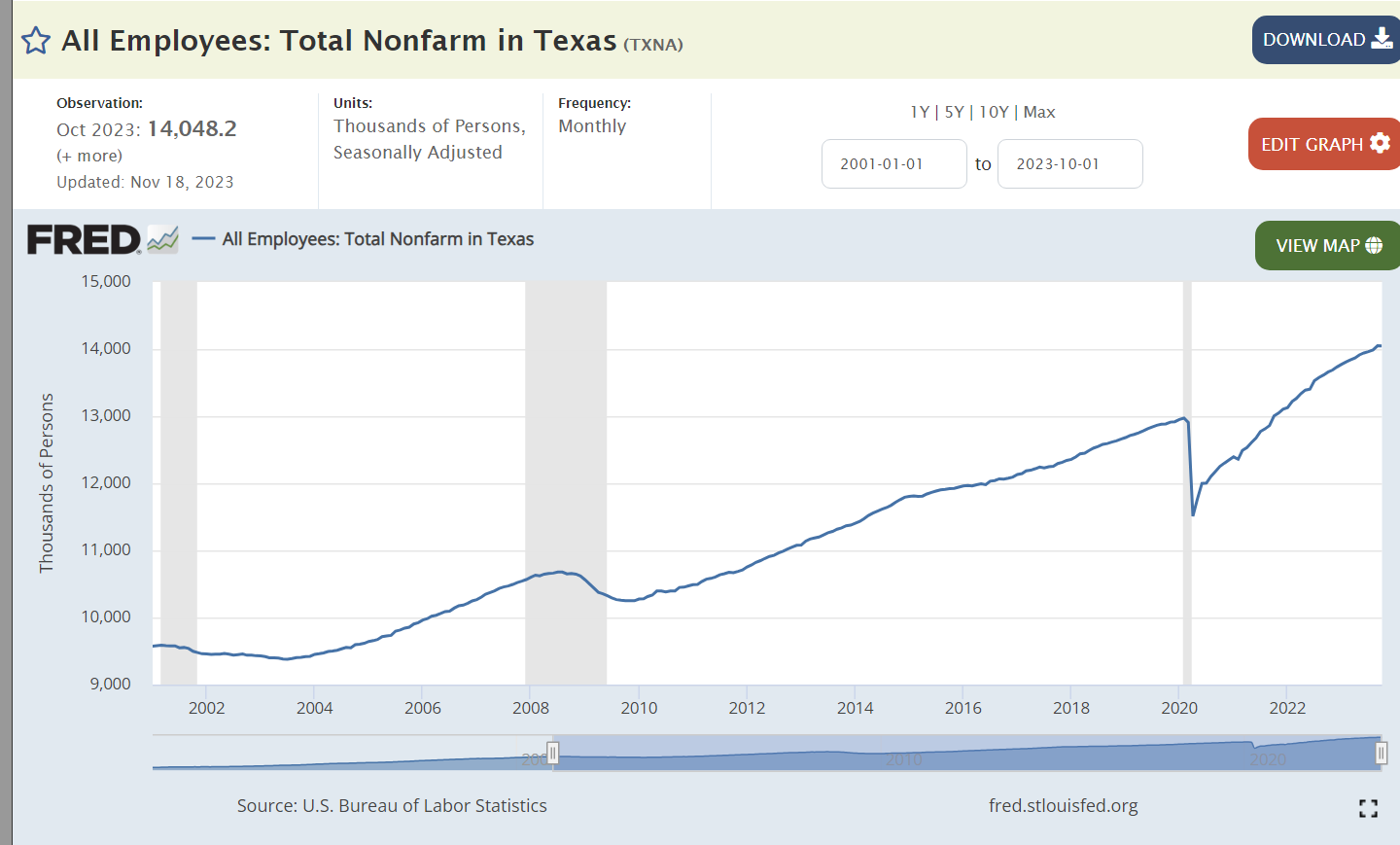
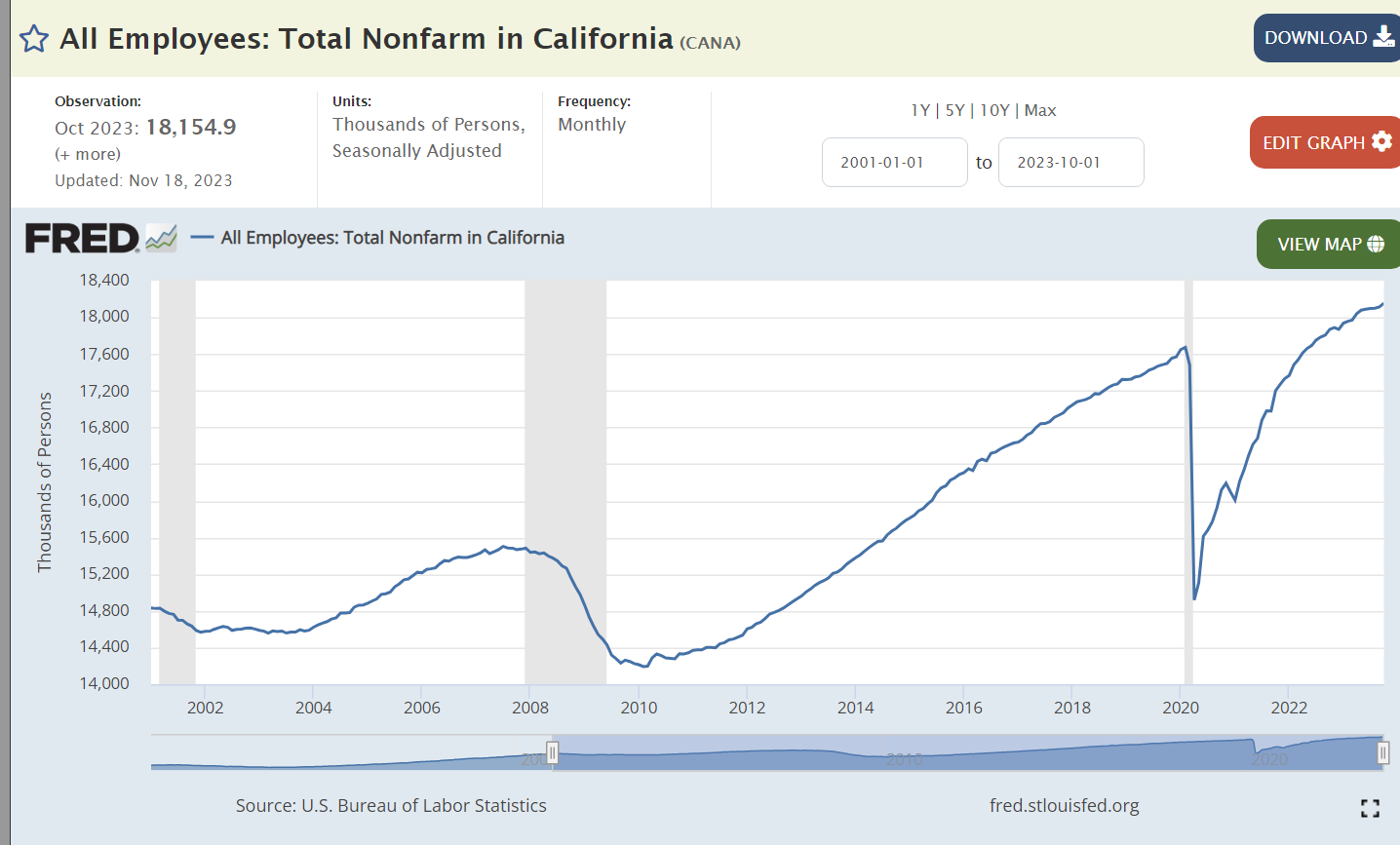
Where are the extra 4.5 million jobs? 38 states exceed their pre-Pandemic totals. Texas (1.1M), Florida (750K), California (500K), North Carolina (300K) and Georgia (250K) lead the way. Arizona, Utah, Tennessee, Nevada, South Carolina, Washington, New Jersey and Indiana each added at least 100K, for a total of 4 million by these 13 states. On the downside, New York remains 125K short and Vermont, DC, Hawaii and Rhode Island are more than 2% below February, 2020.
The post-pandemic economy is creating jobs slightly faster than the post-Great Recession economy. 17 states are growing at least 2% faster than their pre-Pandemic trend rate. Idaho, Nevada, Montana, Utah and Florida are growing at least 4% faster than before. 9 states trail their prior growth rates by at least 2%. North Dakota, Hawaii, New York and DC trail their prior growth rates by 4% or more, for various reasons.
During the full 23 years, Texas (4.5M), California (3.3M), Florida (2.7M), New York (1.1M) and North Carolina (1.0M) added the most jobs. Washington, Nevada, Arizona, Utah, Colorado, Tennessee, Georgia and Virginia each added more than one-half million, for a total of 18 million in the 13 leading states. While the nation added 18% more jobs during this period, 9 states grew by 3% or less: Louisiana, Mississippi, Illinois, Michigan, Ohio, West Virginia, Rhode Island, Connecticut and Vermont. These states accounted for more than one in six citizens in 2001, so their weak performances limited the overall economy.
Summary
The economy started the 21st century slowly with a small recession and weak jobs growth during the Bush years. Obama started his first 2 years with a 9 million job deficit before starting a very strong and long 10-year recovery that added 23 million jobs. Economists did not expect the recovery to last during the Trump administration but almost 9 million net jobs were added on his watch before the pandemic. Biden refilled the 22 million lost jobs in 26 months and has added 4.5 million more in the next 16 months. With the Fed’s higher interest rates, job growth is slowing but is generally expected to exceed 1.25 million in 2024. The US economy continues to outperform.
In 1970, Hamilton County was home to just 55,000 people. It has grown 6-fold since then to more than 330,000. One percent of the nation’s 3,143 counties have experienced similar growth in this 50-year period. These 32 counties combined have grown more than 5-fold from 2.2M (1.1% of US) in 1970 to 11.8M (3.6% of US) in 2020.
8 of the counties are Sunbelt retirement areas. 4 are smaller urban areas. 20 are suburban/exurban counties within larger metropolitan areas.
Each county remains fast growing, issuing an average of 5,000 building permits in 2022 versus an average of 500 per county nationally. Hamilton County’s 5,800 permits is above average.
As a group the counties average 16% of residents aged 65+, ranging from 11% to 25-29% in retirement counties. Hamilton County’s 14% makes it a little younger than the national average of 17%.
The percentage of adults working averages 66% versus 64% for the US as a whole, ranging from 48-54% in retirement communities up to 74%. Hamilton County’s 71% ties for second place.
Median household income at $85,000 for this group is 13% higher than the national average. Hamilton County’s $115,000 is sixth highest. 5 of the retirement counties average less than $70,000. Loudon County records a stunning $170,000.
Poverty rates are the mirror image, at 9% for the group versus 12% nationally. Rates range from 3-16%. Four retirement areas have poverty rates above the national average. Hamilton County’s 4% is tied for second lowest.
The group records 38% of adults with college degrees versus 34% for the nation. 7 retirement counties and Henry County south of Atlanta report 28% or less. Hamilton County’s 61% is second to Loudon County’s 64%.
Average home values are $345,000 for this subset, a solid 22% higher than the $282,000 national average. 10 counties reported prices below the national average, 5 in retirement areas, 4 in suburban counties and Bentonville, AR. 4 suburban counties listed their median home prices above $600K: DC, Sacramento, Nashville and Denver. Hamilton County’s $351,000 was average for the high growth group.
The group averaged 68% non-Hispanic White versus 59% for the nation as a whole. 4 counties had more minorities than non-Hispanic Whites: Ocala, FL, Henry/Atlanta, Prince William/DC and Brazoria/Houston. St. Charles County in the St. Louis Metro area had the highest non-Hispanic White share at 85%. Hamilton County’s 81% was 6th highest.
These 32 counties averaged 10% foreign born, much below the 14% national average. St. Charles County recorded only 3% foreign born. 5 counties reported 20% or higher foreign born: Forsyth/Atlanta, Ocala and Naples, FL, and Loudon and Prince William/DC. Hamilton County’s 9% is a little below the group average.
Summary
Hamilton County is one of 32 counties that have recorded tremendous growth across 50 years. It is relatively young and less diverse than most. It has higher incomes and average housing costs compared with its peers.
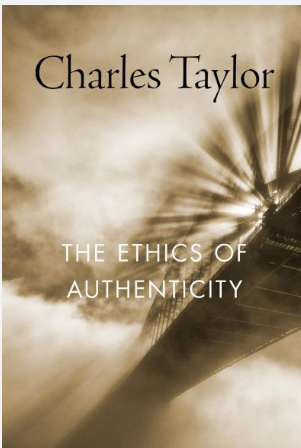
It’s 1991, heavyweight Oxford philosopher Charles Taylor is gaining popular recognition for his pathbreaking 1989 work “Sources of the Self”, a bold attempt to describe the current “self” and where it came from. He was invited to deliver the Massey Lecture in his home nation Canada, which he titled “The Malaise of Modernity”. The Berlin Wall fell at the end of 1989, ending the cold war. Ronald Reagan (1981-89) and Margaret Thatcher had abruptly ended the expansion of the state and the possibility of a counterculture; or had they?
Taylor argues that the “logic” of technology, science, economics and bureaucracy, which he terms “instrumental reason”, continues to grow in influence; larger national state or not. He argues that a historically radical “individualism” has grown throughout the post-war years, generally unexamined. Finally, he notes that these two trends combine to threaten Western representative democracy.
At the time, popular culture, reflected in TV shows like Dallas and “Lifestyles of the Rich and Famous”, celebrated the victory of the “neo-liberal” center-right and looked forward to a glorious future. In 1992, Francis Fukuyama proclaimed “the end of history”, with Western style liberal democracy and mixed market capitalism extinguishing the threats from fascism and communism. Taylor was quite pessimistic about the cultural challenges of the present, but optimistic about the long-term possibilities.
Taylor is often grouped within the diverse “communitarian” collection of philosophers and social scientists who argue that “classical liberalism” is inherently too oriented towards the individual and neglects the community dimension of life and philosophy.
Life is good, but social critics still complain. What ails the public? What “losses” or threats are being felt by the sensitive? First, the counterculture may have been buried in 1969 or 1972 but one dimension continued to revolutionize the Western world. Individuals were not giving up on “free choice” in any dimension. Speech, career, lifestyle, college, city, religion, politics, media, language, dress, etiquette, travel, leisure, gender, marriage, and child rearing choices. Twenty years of freedom had resulted in a new cultural norm of tolerance for individual choices. Nietzsche may have declared that “God is dead” in 1882, but it took a century to percolate through to large numbers of Western citizens. The post-war period witnessed a conservative cultural and religious rebound, but it was not sustained.
Taylor contrasts this radically new moral freedom with the prior 20 centuries. There are certainly advantages to freedom, especially removing the restraints of political, religious, social and economic institutions from individuals. Few people want to turn back the clock and re-install the static, hierarchical, controlling, prejudiced society. Yet, the individualistic transformation through the Renaissance, Enlightenment, Protestant Revolution, Scientific Revolution, American Revolution, French Revolution, and Russian Revolution had not been a uniform march of progress. Individuals had lost their well-defined place in an orderly, meaningful universe.
The new individualism, deeply rooted in Jean-Jacques Rousseau, attempted to rebuild this secure place by returning to the allegedly positive state of man before society had corrupted the individual. The individual was invited to look within to discover their innate goodness and role in society. By 1991 the post-war “therapeutic culture” was very well advanced. Individuals had “discovered themselves” and they liked this new freedom. They looked to counselors and educators to help with their personal growth. Many critics responded to this new approach quite negatively, calling it mere self-centeredness.
The growth of size, scale, trade, complexity, science, process, dynamics, technology, computers, finance, capitalism, business, machinery, industrialization, urbanization, law, and transportation in the 20th century greatly elevated the role of “instrumental reason”. The technical control of nature. New production methods. Cost/benefit ratios. Scientific finance. Optimization. Operations research. New technologies. Processes. Systems. Re-engineering. Social sciences. Experimental psychology. Communications. Every dimension of life can be rationalized and improved.
The scientific, urban and industrial revolutions were met by the Romantic reaction in the 19th century. Nationalism, art, music, nature, anthropology, modern poetry and literature, history, culture, language, and customs. Hegel, Marx, Freud and Jung. Methodist, Baptist and Pentecostal religious options. In the 18th century Kant asserted that man must be an end, not merely a means to an end. Humanity reacted strongly against the threats to its inherent human dignity.
Like many philosophers and social critics since 1850, Taylor worries that the market, bureaucracy and technology will become dominant over human and moral dimensions. The methodologies are highly effective and widely applied. They are continually improved. The market and bureaucracy have direct political power and influence. Mostly, Taylor worries that the ubiquitous use of these tools elevates them to become the ENDs of society. Cost/benefit. Optimized processes. GDP. GDP growth. Scientific progress. New patents. Life expectancies. Controlled risks. Optimum portfolios. He also worries that only quantitative factors that fit into the formulas will matter. Morality has to work very hard to even be considered in this world.
The widespread use of instrumental reason in markets and bureaucracies leads to a limited range of choices for individuals, employees, bureaucrats, politicians and voters. Most people can only think in terms of rational control of inputs to produce outputs. The consideration of the most valuable outputs is undermined. The scale of the political process undermines the incentives for participation. The “individualist” mindset removes citizens from political participation. Instrumental reason demonstrates effective “cause and effect”, but political participation does not produce such direct returns. Individuals lose faith in the political process.
II. The Inarticulate Debate
In 1991, without any public debate, we now live in a world that prioritizes each individual’s search for his own unique inner purpose, meaning, ends, talents, insights, creativity, feelings, intuition, identity, possibilities, strengths, and opportunities.
Each person should be true to themselves. Per Maslow they should aim for self-actualization. This is a subjective world. Each person is empowered to pursue their own goals. Others must not interfere with this choice. Tolerance is elevated to a very important social value.
Social scientists explain the increased individualism as part of economic, scientific, urban and industrial changes. They avoid moral discussions.
Taylor wants to elevate moral considerations. What does a radical individualism mean for morality? Is moral subjectivism valid, in any way? Can the individual be moral apart from his relations with individuals? Can the individual be moral apart from his relations with society? Truly radical individualism cannot be moral in Taylor’s view. The individual cannot make significant others merely tools, nor can he ignore the moral preferences of others.
Is moral relativism consistent with other values? Taylor says “no”. Choose any basis for a moral world view. Relativism cannot be supported.
III. Sources of Authenticity
Rousseau is most important. The individual is inherently good. He is altered by society. He has an opportunity to become aware of the influences of society and overcome them. This is the extreme, utopian, positive individualistic view. The individual makes choices without regard to any external influence. The individual guards against the influence of external factors.
Descartes assumed away everything except disengaged reason. No body. No society. No feelings. No actions. No relationships. No history. No art. No future. Hobbes and Locke created a world in which the individual rationally participates in the political.
Taylor notes that the “inward turn” is not inherently solipsistic. St. Augustine described his internal turn which resulted in a connection with God and the eternal.
Herder emphasized the original or unique dimension of each individual.
IV. Inescapable Horizons
Taylor applies the usual logic against pure subjectivity, relativism and tolerance. You can have no true moral view unless you prioritize one view versus another or one set of values versus another. The pursuit of individual meaning and authenticity does not require that all final, considered moral views are equal. The individual’s moral views are inescapably influenced or determined by the views of others. We cannot develop moral views in isolation, we must have dialogues with others.
There is a logical fallacy widely used. Choice is good. Diversity is good. Difference is good. Each option is good. These are merely assertions. They do not follow from any logical or values-based structure.
The individual’s process of discovery, creation and choosing is raised up to become a self-evident axiom of highest value. Taylor argues it is not self-evident and is not clearly supported by some other set of values. He says that it “could be” a highly valued part of life, but that position must be supported by some values that are defined outside the self, by the community or significant others or religion or philosophy, all outside of the narrow self.
V. The Need for Recognition
In this world of “finding yourself”, the individual also looks to others for validation and confirmation that their discovery, results, values, roles and identity are “good”. The individual cannot confirm his own journey or results but must turn to others. Self-discovery may be a highly valued good in our society, but it must be based upon something other than the self alone. The individual claims that universal human dignity supports his call for respect and affirmation. The postmodernists apply this logic to oppressed minority groups as well, claiming that they must be recognized.
Taylor dismisses the completely self-centered approach to self-discovery that rejects any need for external links to others, community, nature or God as logically incoherent. Just as Kant said that humans must be ends and not merely means, Taylor argues that external entities must also be ends and not merely instrumental means for the self.
Taylor identifies two ethical standards that are often asserted by promoters of personal growth. Each person has a right to pursue their own journey, so there is a need to limit that journey so as to not infringe upon the journeys of others. Intimate relationships are required to pursue an in-depth exploration of an individual’s inner self, capacity, resources, feelings and potential. Hence, respect for significant others is required.
Taylor returns to the “choice creates value” and “difference creates value” assertions. Some proponents of individualism argue that the fact that different people choose different “ways of being” directly makes them valuable and worthy of respect, reinforcing a universal tolerance. Taylor reminds the reader that there is no logical support for this view. Similar, some argue that men and women are equal or sexual orientations are equal because they are freely chosen. Taylor rejects this and requires that the argument return to a logical or moral basis for support.
He extensively quotes Gail Sheehy’s “Passages” to illustrate the extreme individualistic view, “You can’t take everything with you when you leave on the midlife journey. You are moving away. Away from institutional claims and other people’s agenda. Away from external valuations and accreditations. You are moving out of the roles and into the self … For each of us there is the opportunity to emerge reborn, authentically unique, with an enlarged capacity to love ourselves and embrace others … The delights of self-discovery are always available.”
VI. The Slide to Subjectivism
Taylor admits that many pursue the narcissistic version of extreme individualism directly. They don’t need to rationalize or justify it. Self-fulfilment is a self-evident moral and ethical ideal for them. Once this version of “the good life” is seen, some will adopt it as is. This worldview makes life straightforward, no need to balance the self and others or the self and community or the self and pesky demands of external moral standards.
The more extreme versions are also promoted by social situations. The individualistic culture has many threads. The market and consumerism are individual oriented. Large organizations prioritize instrumental reasoning to reach individual goals. A market economy emphasizes transactions and contracts between individuals. Many religions have individualistic perspectives today. Science, technology and instrumental reasoning focus on spare logic and atomistic views rather than organic, natural, process, dynamic and artistic ones. Individualists treat community, friendship and religious connections as instruments of their world rather than more complex, transforming, multiway relationships. Mobility undercuts personal ties. Urban living promotes impersonal interactions. One can live a very individualistic life today.
Postmodernism, the descendant of Nietzsche, seeks to undermine or deconstruct all objective values or categories as mere tools of entrenched power groups. All values are merely created as tools. Why not create “freedom” as the main value and enjoy your role as the superman; creator of values, language and life?
Taylor emphasizes the mixture of the Romantics and Nietzsche in the emergence of the self-creating artist as hero in the last century. This runs in parallel with the authenticity of personal self-discovery. Each person is unique. They pursue their special gifts through creativity and artistic production, experimentation, action and discovery. They do not imitate nature or copy existing models but create new languages, viewpoints, art, relationships, pottery, feelings, experiences, music, drama, travel, sport, etc. Expressive individualism is well described. Taylor supports this creative process, its outputs and the expansion of human capabilities.
He doesn’t support postmodernism when it only emphasizes the creative process but ignores any ties to moral values or philosophy based outside of the self alone. He disputes the need for the creative individual to automatically reject and fight against all existing forms of morality held by others or communities. He insists that the creative individual must be in dialogue with significant others and society in order to provide meaning and goals for the journey and to validate the journey. Taylor rejects the totally isolated individual model.
Taylor recognizes that the aesthetic perspective offers its own truth, beauty and satisfaction separate from the moral perspective. He sees this too as another opportunity for modern man to live an enriched life. He accepts that some individuals may prioritize the aesthetic perspective above the moral perspective but does not recommend it. He notes that authenticity is often proclaimed as its own goal by fiat or assumption. It is alleged to be a self-evident truth, goal and value not requiring a moral foundation, just like beauty. Authenticity and art become intertwined as forms of self-expression.
Taylor ends this chapter noting that an individual who truly buys into self-expression and self-creation can find a form of meaning and satisfaction in the journey and the sense of freedom and power which it provides. His complaint is that it logically cannot be isolated from other people and morality. When this is done there is no meaning remaining. There is only the self, an atom among an infinite and cold universe. The individual makes choice after choice after choice, but the choices have no meaning. The world becomes flat.
VII. The Struggle Continues
Taylor notes that critics such as Bloom, Bell and Lasch are correct to attack the extreme forms of egotistical self-fulfillment. He argues that attacking the overall expansion of individual self-exploration and growth is counterproductive. There can be no logically coherent merely individualistic philosophy. It must link to other individuals and some moral principles. The individualist genie cannot be put back in the bottle. Society as a whole, especially its thought leaders, must find a way to ensure that this connection of the individual to the community and logic occurs.
Taylor asserts that everyone, even the critics, must acknowledge that we live in a world where self-development, human potential and fulfilment are accepted goals and practices with value to individuals and society. The exact forms are not perfectly developed, but very few people are going to reject this approach to life.
He more positively notes that this path of development does provide opportunities for self-development and for social contributions. Individuals are encouraged to explore, create and live a fuller life. In an ironic way, the truly authentic journey requires greatly increased self-responsibility and self-control. The opportunities are so great. The responsibility to make wise choices, to interact with others, to consider moral frameworks, to link the individual and community, to combine freedom with commitment, to balance the claims on life is higher in a self-aware modern life.
The upside potential is great. The downside risk of a simple egoism is great. The tension between the higher and lower versions of this new path of life is great. Taylor argues that we are stuck with this situation, should not by gloomy, but should work to define the tensions, guide and encourage individuals on the high road.
VIII. Subtler Languages
Taylor returns to the journey of personal self-discovery and creation in parallel with the journey of the modern artist. The modern artist by 1800 had lost the common background of known and assumed literature, religion, culture and society. The artist was tasked with developing their own language, background, symbols, characters, plots and conclusions. The artist could not rely upon the reader, listener or observer to share a common understanding of the artistic background. The artist was forced to rely upon his own vision and experience, and then communicate that in precise ways so that the content and feeling would resonate with the consumer. This changed art into a very individual to individual format. The subject matter also often focused on the individual, BUT not necessarily so. Much great art continues to be about nature, the universe, community, the relation of the individual to others or the community.
The same contrast applies to the authentic journey of self-discovery. The manner of the journey is clearly subjective revolving around the individual. BUT the individual can find his relation to the community, nature, eternity, God, a larger order, neighbors, science, history, family, etc. The individual can find that the most important lessons are only secondarily about the self.
IX. An Iron Cage?
Taylor argues that instrumental reason/technology can be viewed as above. There is a long history of technology, science, economics and bureaucratic forms growing more complex, effective and controlling. They are supported because they work. The risk is that they replace the end goals of individuals, firms and society. Application of the decision-making forms becomes the end goal because they are, well, so efficient and effective. What other goal could there be?
Economic rationality, markets and bureaucracies, science and technology have become second nature, a background assumption in modern society. Individuals use their methods each day. This familiarity shapes our thinking in all realms. Yet, there has been a gut-level suspicion and opposition throughout the last 500 years. Analog, superstitious, grounded, habitual, traditional, organized, historical, religious creatures have resisted the creation of abstract forces that replace their familiar ways. The Luddites, Marxists, Utopian Socialists, Farmer-Labor party, romantics, science fiction writers and greens have all opposed the unchecked advance of technology.
Taylor outlines the extensive influence of instrumental reasoning as a background assumption in our society. He encourages us to look at the underlying moral frameworks that have supported technological progress and to consider this reasoning as merely a tool. He notes that disembodied reasoning in mathematics and computers is given a privileged place in our thinking but there is no good case for this view which was really just assumed one day by Rene Descartes.
“This is grounded in a moral ideal, that of a self-responsible, self-controlling reasoning. There is an idea of rationality here, which is at the same time an idea of freedom, of autonomous, self-generating thought”. Technology can be placed within the context of other moral principles such as benevolence and caring. The application of instrumental reasoning impacts real flesh and blood people, so this moral context matters.
X. Against Fragmentation
Radical individualism and dominating technology both threaten well-functioning democracies. The first simply ignores the need for community and political participation. The second makes impersonal forces appear so strong as to make political participation irrational. There is a vicious/virtuous cycle dimension. Lower participation results in worse results … More effective participation results in better results …
Finding a more effective middle ground of improved self-responsibility can help the individual, the community and politics. Finding a more effective middle ground regarding the unwarranted expansion of technology can help to re-establish moral and political principles as drivers of political debate and results. Taylor calls for a balance among the 5 competing areas of markets, government, social welfare, individual rights and democratic effectiveness. He argues that this is more effectively done at smaller scales, so decentralization is a key tool. He notes that success at any level can help to improve politics at other levels. Taylor is concerned that social trends can overwhelm institutions. Yet, he believes that intellectuals can help to clarify the role of ideas in shaping politics and culture. Better ideas can compete against simplistic models and slogans that don’t work for society. There is an unavoidable tension, a give and take, in society and politics. We have the ability to shape these debates for the common good.
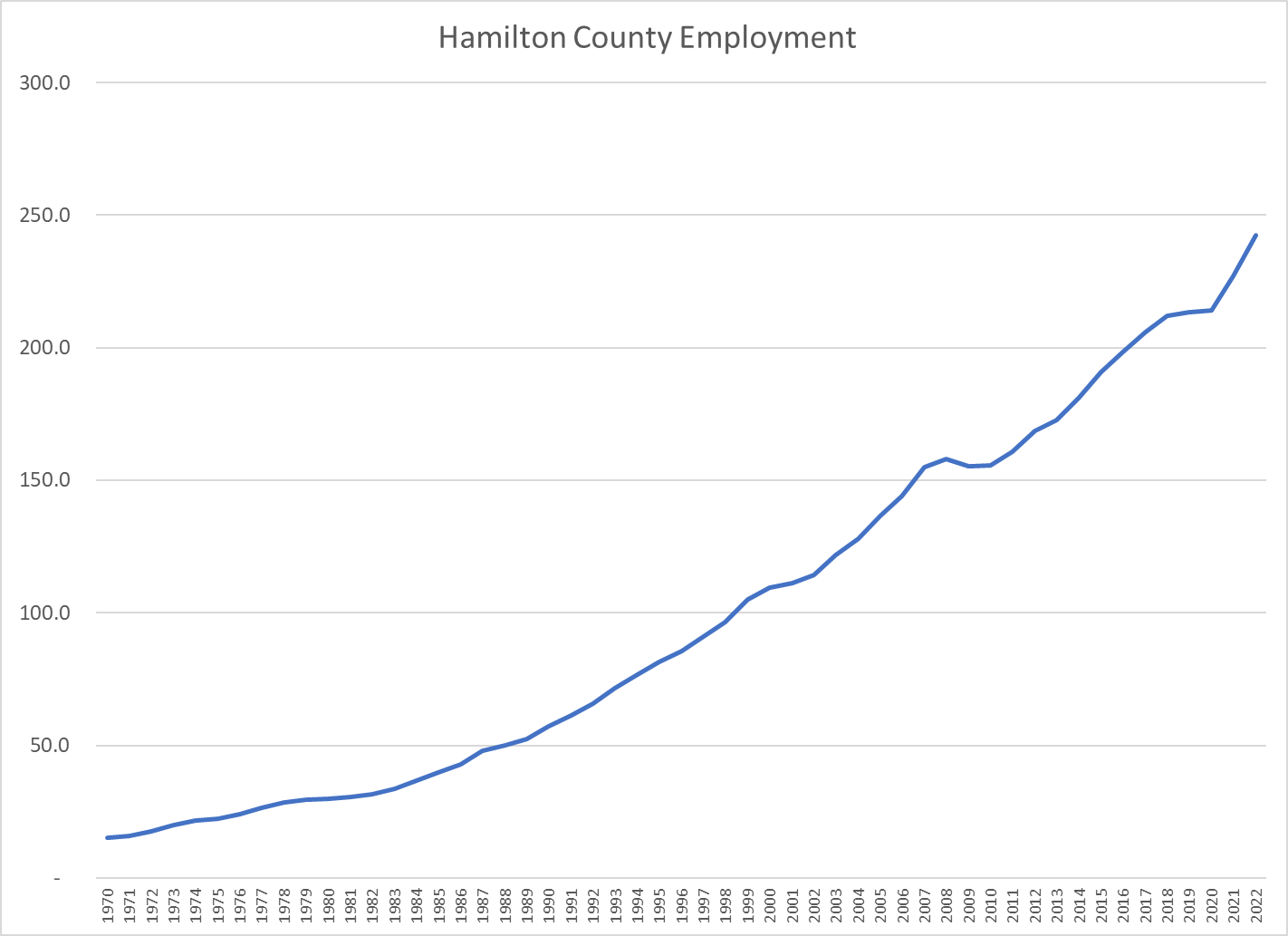
Hamilton County’s employment has grown 16-fold since 1970 from 15,000 to 243,000. This is a 52-year compounded 5.5% growth rate. You aren’t likely to find that growth rate in your stock or mutual fund portfolio!
This growth started from a low base of 1,500 new jobs per year and accelerated to 5,000 new jobs per year by 2000. Hamilton County has maintained this growth rate for 2 decades with some extra results recently!
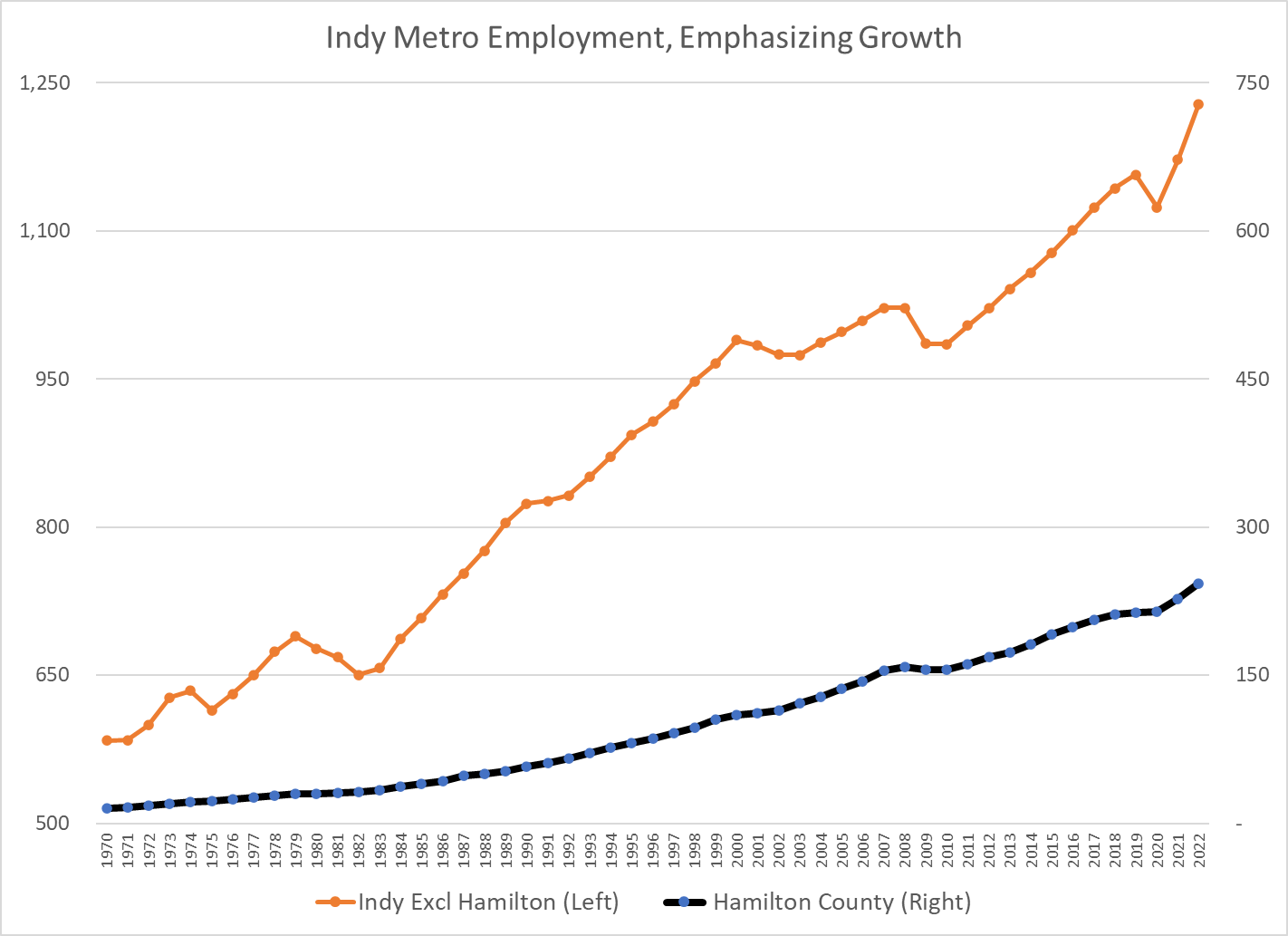
Hamilton County’s population doubled from 1970 to 1990. Metro Indy, excluding Hamilton County, grew by the same 50,000 people. In the next 30 years, Hamilton County added more than 250,000 people and the rest of metro Indy added a very solid 475,000 people (almost 2X). Hamilton County benefits from the Midwest leading growth of metro Indy.
Hamilton County employment growth has been a little faster than population growth.
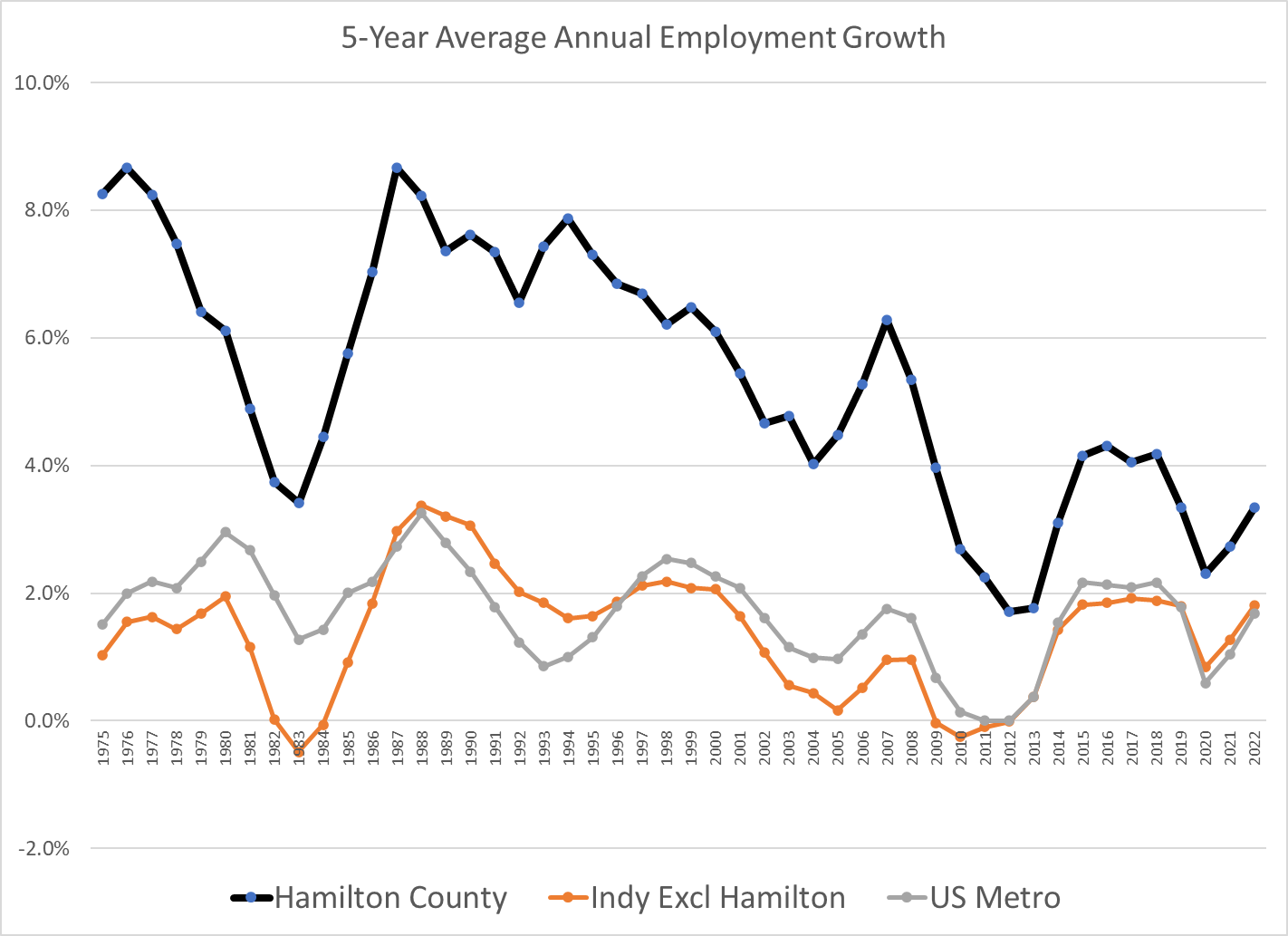
Metro US population has grown by 1% annually and employment has grown by 1.6% annually. The Indy metro area has grown at similar rates. Hamilton County has grown 3-4 times faster.
As Hamilton County has grown, its annual growth rate has declined from 7% to 4%, still far above the 1.5-2% baseline growth rate.
Hamilton County has grown from 1/3,000 US people and 1/5,000 US employees to 1/800 citizens and workers. (4-6X growth).
Metro Indianapolis has been a solid job creator. Hamilton County has grown alongside the metro area.
Hamilton County was a “bedroom suburb” in its early days but reached the national level of jobs to population by 1992 and tracked the national average thereafter.
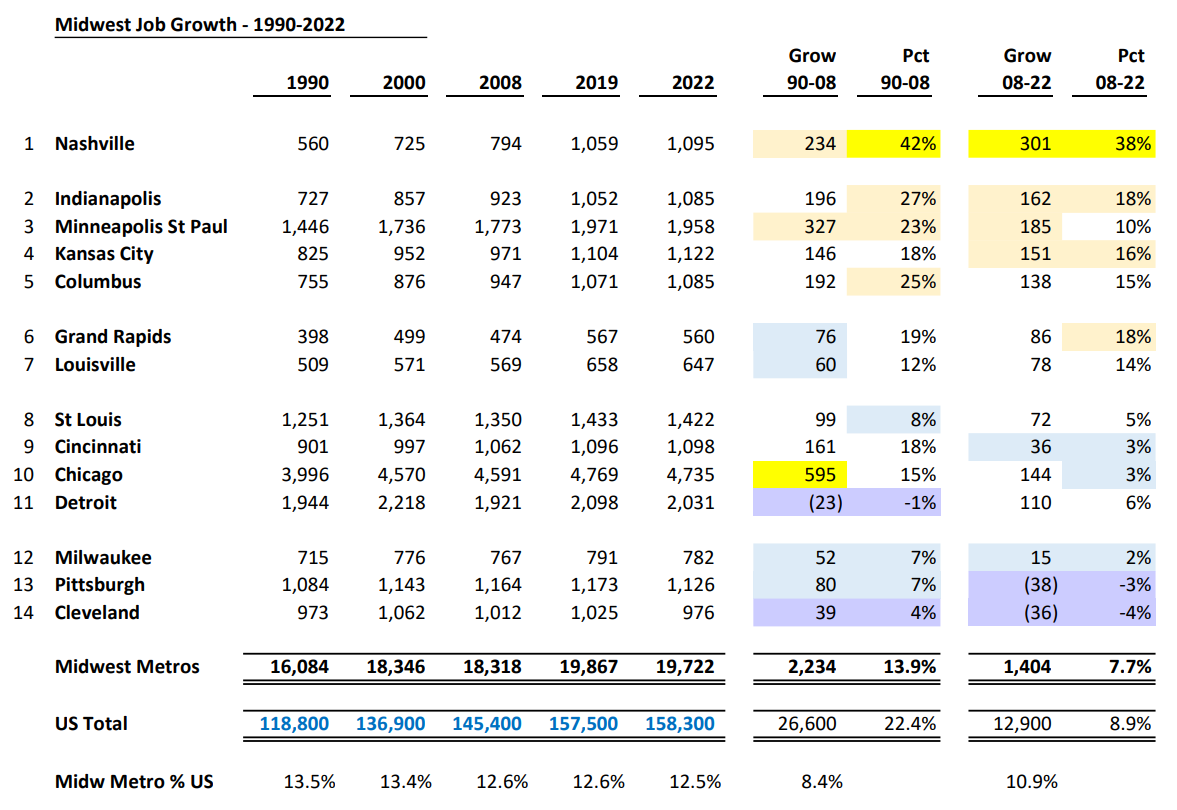
Between 1990 and 2008 US jobs grew by 22% but trailed in Midwest metro areas, increasing by only 14%. US jobs have grown by 9% since the Great Recession, with the Midwest trailing slightly at 8%. Metro Indianapolis has been a percentage growth leader in both periods, at 27% and 18%. Columbus and Kansas City show similar figures. Minneapolis has higher actual jobs added but slightly lower percentage growth on its twice as large base.
Chicago has added more total jobs, but its 18% growth is far behind Indy’s 49% and most of its growth took place back in the 1990’s. Nashville is typically grouped with the Southeastern states but if it was included in the Midwest, it would be the clear winner, nearly doubling its job base in 3 decades.


















 Good News