
https://www.peacecorps.gov/educators/resources/blind-men-and-elephant/story-blind-men-and-elephant/
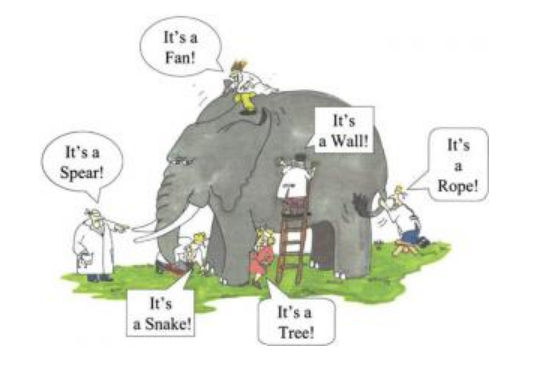
This Indian story helps us to understand that the “whole” is different than the “sum of the parts”. “Everybody wants to rule the world” is another way to express this paradox. We each have a perspective. We errantly “know” that our perspective is right.
https://en.wikipedia.org/wiki/Everybody_Wants_to_Rule_the_World
Each of the blind men mistakenly “knows” that his perspective is “right” and dominant. In society, we experience this across the various professions and industries who also “know” that they are THE “most important, valuable and insightful”.
- Rulers, politicians, judges, and bureaucrats
- Advisors, consultants, lawyers, and lobbyists
- Entertainers, artists, media, journalists, travel and leisure
- Military
- Public safety, police and fire
- Priests, ministers, rabbis
- Intellectuals, philosophers
- Educators
- Engineers and scientists
- Builders, architects, construction staff
- Farmers, foresters, fishers, miners
- Owners, capitalists, executives, bankers
- Managers, administrators, business professionals
- Traders, wholesalers, retailers
- Skilled trades, essential workers
- Health care professionals
- Care givers, counselors, psychologists, and social workers
17 distinct groups by my accounting. Each group can put forth arguments for why they are the “most important”, adding the most value now and in the future, at the critical location, taking the highest view, most essential, largest, oldest, most appreciated, best paid, driven by leaders, lifesavers, building the future, leading the way, preserving and organizing society.
Historically, the rulers, advisors, priests and owners conspired to actually run society and collectively justify their leadership. In the last 500 years the historical rulers have been challenged by each of the other groups.
- populist leaders, Machiavelli, totalitarian justification, fascism
- spin doctors, social media influencers, investment bankers
- political pundits and commentators
- the secretary of defense, the military-industrial complex, neo-conservatives, coups
- public safety unions, associations and political influence
- ecumenical associations, direct and national political influence
- freedom of speech, tenure, existentialism, postmodernism, poststructuralism
- unions, PACs, professional rights, the therapeutic society
- STEM, analysts everywhere
- infrastructure, ratings
- farm bill, political influence
- Davos, consolidation of income and wealth, political influence
- Professional class, suburbs, UMC, elites, educated
- globalization, luxury goods, Amazon, Walmart, Dollar General, Costco
- unions, tea party, occupy Wall Street, pandemic support
- AMA, med school enrollment limits, health care % of GDP, big pharma, big insurance, hospital system monopolies
- the therapeutic society, hugs
Everybody wants to rule the world. The world is bigger. More people. More wealth. More assets. More potential. More productivity. More ideas. More perspectives. More art, entertainment and leisure. More education. More scientific understanding. More resources. More nature. More opportunities. More class perspectives. More minority groups. More voluntary associations. More nations. More globalism. More trade. More religious views. More communications and information channels.
There is no single reason why our society remains knitted together. There are many forces that drive it apart. I am hopeful that the various interest groups can perceive “the elephant”. Our political, social and economic society is the greatest ever known, but it is threatened by decay from all sides.
 Good News
[…] Do You Believe in Magic? “No Labels” Proposes a Centrist Third Party The Blind Men and the Elephant R-E-S-P-E-C-T R-E-S-P-E-C-T-2 Our American […]