After 1500, Western civilization experienced the Renaissance, the Enlightenment, the Reformation, the Industrial Revolution, colonialism, the new world, the counter-reformation, Islam, religious wars, world wars, the scientific revolution, Marxism, socialism, utopianism, nuclear threats, the cold war, imperialism, alliances, nationalism, regional governments, global organizations, multinational corporations, global trade, the scientific revolution, urbanization, motorized transportation, electricity, radio, telephony, motion pictures, computers, Darwin, the agricultural revolution, and the internet.
In this unique period of tremendous change what is truly “conservative”? With this much change, conservativism might best be described as a philosophy that preserves the incremental progress of society!
DeSantis wins on 2 points as being more “conservative”, preserving the institutions, practices and values of our society. He is in favor of the traditional “nuclear family” as a preferred social model. New College is clearly more LGBTQ oriented. He favors the powerful against the common man. His acolytes have decided that they can govern New College in their way “because they can”. His budding presidential campaign is focused solely on his side, and he claims that he will destroy the opposition if given the power of the presidency which he “best understands”.
DeSantis claims to represent “traditional values” and organized religion. In reality, he represents only fundamentalist Christians. He is a reactionary. Not mainline Protestants, Catholics, Jews, Unitarians, Deists, Hindus, Muslims, Confucians, or agnostics. New College has a long tradition of students exploring and practicing various religious and spiritual traditions.
DeSantis claims that he is fighting against “wokeness”, a situation where the prevailing social, cultural and political views prevents other views from being expressed. New College is NOT the home of wokeness. Students value radical individualism. Each semester they have to convince a faculty member that their “program of study” will lead to graduation with a recognized major. Students generally “lean left” but seek to discover new worlds. Socially, there certainly are pressures to adopt the prevailing political views, but the radical individual ethos of New College has always protected students from domination by any group.
Viewing New College as a “child” of the last 500 years, it is dedicated to conserving the modern world of progress!
DeSantis proposes a radical reformation of the curriculum. New College seeks to preserve its model.
DeSantis proposes to introduce sports and Greek organizations. New College advocates for the preservation of its individual choice-based situation.
DeSantis proposes enrollment growth at any cost, simply for growth’s sake. New College has a more conservative view, restricting admission only to those who would benefit from its unique offerings.
DeSantis wants to transform NC into the “Hillsdale of the South”. New College wishes to remain true to its founding principles.
DeSantis is very concerned about “unusual” students. New College is inherently dedicated to individual rights.
DeSantis envisions a utopian “Hillsdale of the South”. That matches his religious beliefs but not those of Florida and USA students. New College has a long history of realistically surviving as a small, countercultural institution committed to its mission, vision and values. New College was founded on an idealistic basis but has accepted the constraints of reality.
DeSantis proposes a traditional standard curriculum for all students to ensure that they are acquainted/indoctrinated with western civilization. New College students have thrived for 50 years without these artificial restrictions.
DeSantis proposes a more standardized curriculum. New College has promoted extensive “independent study” to ensure that every student has a broad perspective that allows him or her, conservatively, to make proper judgements.
Finally, New College is firmly based upon individual responsibility. “In the final analysis, each student is responsible for the quality of their own education”. Ironically, this is the most extreme “conservative” principle. The individual is responsible. Not the university or faculty. Not the state. Not the parents. Not social classes. Not parents. Not expectations. Not history. Not random chance. Not race, gender or nationality. Not peer pressure.
In the “final analysis”, DeSantis is no conservative. He is a reactionary willing to do whatever it takes to claim a social conservative position to the right of Trump. New College is merely a pawn in his Quixotic quest.
THE existentialist challenge of the late 1960’s. Jerry Lieber and Mike Stoller wrote 70 top hits across 6 decades. Think Elvis Presley. This was a very unusual song for them, based on novelist Thomas Mann’s late 19th century writings and echoing the 1930’s German world.
I always thought that this was a song in Cabaret. Life sucks and then you die. Today, I see it as a more positive tune. Despite the challenges of life, we always have a positive path forward.
Finkam won 36% of the primary vote versus 32% each for Woody Rider and Fred Glynn. Her 4,595 vote total was just 400 higher than her two opponents. Finkam and Rider are experienced city council persons who have mostly supported the pro-growth, pro-density, pro-investment, pro-debt, pro-quality of life policies of 28-year mayor Jim Brainard. The mayor has been able to pursue a moderate, activist strategy as a Republican in this high income, growing suburb because he has delivered positive results. Finkam emphasized transparency and governance improvements in her campaign. Glynn campaigned and voted as a “fiscal conservative”, previously winning district elections for county council but losing elections for mayor and state representative. Rider was endorsed by Mayor Brainard and mostly campaigned on a continuation of the mayor’s policies, even though he had opposed the mayor on a number of issues historically.
Carmel has 63 precincts. Finkam won 25 while Rider and Glynn each won 19. This was a true three-way election. Finkam exceeded the neutral one-third of the vote in her winning precincts by 480 votes while Glynn beat the 33.3% benchmark by 323 votes and Rider gained 158 net votes in his winning precincts. In her 25 winning precincts, Finkam mostly pulled extra votes from Glynn. In Glynn’s winning precincts he earned 284 votes above the neutral level, reducing Rider’s votes by 188, but Finkam’s by just 96. In Rider’s winning precincts he earned an extra 193 votes, reducing Glynn’s votes by 158 and Finkam’s by just 34. To summarize, Finkam won the most precincts, and she won a few extra votes in the precincts that she did win. She and Rider both won votes from Glynn while Glynn mainly took votes from Rider.
Finkam enjoyed an average winning margin of 29 votes in her winning precincts compared with 23 for Glynn and 16 for Rider.
Finkam’s top 10 winning precincts delivered 518 extra votes versus 430 for Glynn’s top 10 and 238 for Rider’s top 10.
Two measures of “clearly winning” precincts mostly provide the same results. I used the standard deviation of percentage votes earned and the standard deviation of votes won above the one-third expected level to determine “clear” precinct winners.
Finkam clearly won 12 precincts, Glynn 10 precincts and Rider 5 precincts. Finkam clearly lost just 5 precincts while Gynn lost 12 and Rider lost 9. On a net basis, Finkam clearly won 7 precincts, Glynn lost 2 and Rider lost 4.
In a close 3-way race, two candidates can win more than one-third of the votes. Carmel has 63 precincts so 21 is the minimum required for a win. Finkam earned at least one-third of the votes in 39 precincts compared with Rider’s 26 and Glynn’s 24.
Finkam had the fewest 3rd place finishes, losing 17 districts, compared with 21 for Rider and 25 for Glynn.
Another way to slice the vote is to compare the number of votes versus a neutral 33.3% finish. The distribution of votes at the precinct level points to 15 extra or short votes as a material win or loss. Finkam earned a dozen such wins and just 4 losses by this measure. The net vote result in these precincts was 297, indicating that vote differences in just one-fourth of the precincts delivered her win. Glynn had 8 positive and 12 negative precincts with a net loss of 114 votes. Rider had 3 winning and 10 losing precincts, resulting in a loss of 142 votes.
Finkam’s precinct votes were most opposed to Glynn’s, with a negative correlation (R) of -0.60. Her correlation with Rider was a much lower -0.39. Glynn and Rider reported a middle level correlation of -0.52.
Rider’s 5 clearly winning precincts were broadly scattered. Foster Grove, Northwood Hills, Windemere, Lennox Trace and Westfield. He was competitive in most precincts but did not have a clear winning pattern.
Glynn leveraged his strengths around his home and campaign history near 106th and Keystone. He strongly won 7 precincts in this area: Orchard Park, The Woodlands, Holaday Hills and Dales, Homeplace, College Plaza, Chesterton and Carolina Commons. He also won 3 older areas of Carmel: west of Clay Terrace, 136th/Guilford = Old Meridian/Main Street and Thistlewood at 136th/Spring Mill.
Finkam’s strength was in the newer and wealthier areas north of Main Street (131st Street). She won Cool Creek North and Foster Ridge in the central area of Carmel. On the west side, she won Hunter’s Knoll, Spring Mill Ponds, Spring Mill Streams, Spring Mill Farms and Kingsborough. On the east side she won Plum Creek Farms, Avian Way, Settlers Ridge, Cherry Tree Grove, Briarwood and Legacy at 146th/River Road.
Carmel’s voting precincts can be divided into 9 geographical areas using 116th and 131st/Main Street to divide vertically and Spring Mill Road and Keystone/Carey Road to divide horizontally. By this split, Finkam won 4 regions (W, N, NE and NW), Glynn won 4 regions (C, S, SE and SW) and Rider won a single region (E). Finkam won a very strong 44% of the vote in the northeast, gaining 258 votes, mostly at the expense of Glynn. She also won a solid 39% in the northwest, winning 65 votes, mostly from Glynn. Glynn had a strong showing in his home South area, earning 46% and 142 votes, but his advantage was divided between lost votes by Finkam and Rider. He also earned a strong 39% share in the Southeast, but these extra 58 votes were mostly taken from Rider. Glynn had small wins in the Central district, taking 17 votes from Finkam and in the Southwest district, capturing 26 votes from Rider. Finkam’s fourth winning district mainly took 38 votes from Glynn. Rider’s single winning district was a near tie with Finkam, taking a total of 92 votes from Glynn.
Overall turnout was just 19.7% in Carmel in this municipal election. 86% of voters cast ballots for the Republican mayor’s race. This makes the ratio of Republican primary voters to registered voters just 16.4%, or one out of six registered residents.
Turnout in the precincts won by Finkam, Rider and Gynn varied materially from 18.3% to 16.0% to 14.2%, respectively. If the precincts all had 16.4% Republican primary voter turnout, Finkam would have lost 62 votes and Glynn would have earned 76 additonal votes, a small fraction of the 400 vote margin.
Rider and Finkam together won 68% of the vote, confirming that two-thirds of Carmel voters generally approve of the retiring mayor’s general strategy and policies. Finkam was able to solidly convince the northern subdevelopment residents that she would do a better job than Woody Rider.
Democrat Miles Nelson was elected to the city council in 2019. He is running for mayor this year. Carmel has become more Democratic in the last 20 years. I don’t think that a majority of Carmel voters will reject the path of the last 3 decades.
Conservative, suburban, small town Indiana Carmel elected Jane Reiman and Dottie Hancock as women mayors from 1980-1992. I think that Sue Finkam gets a small advantage as a woman candidate in this environment.
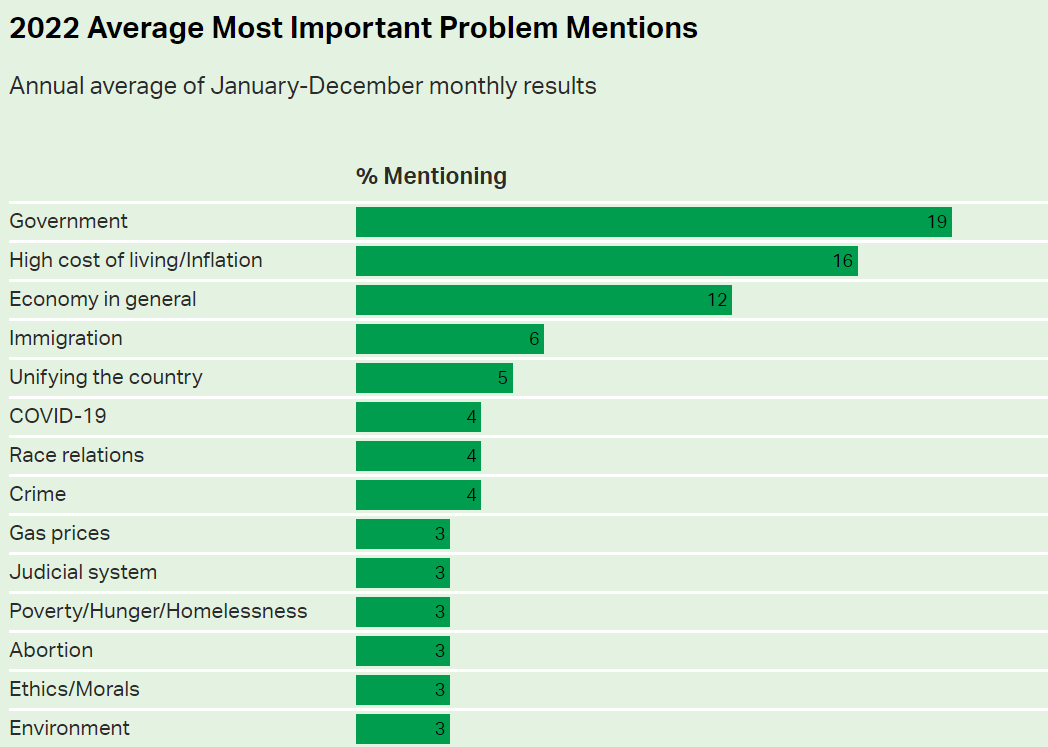
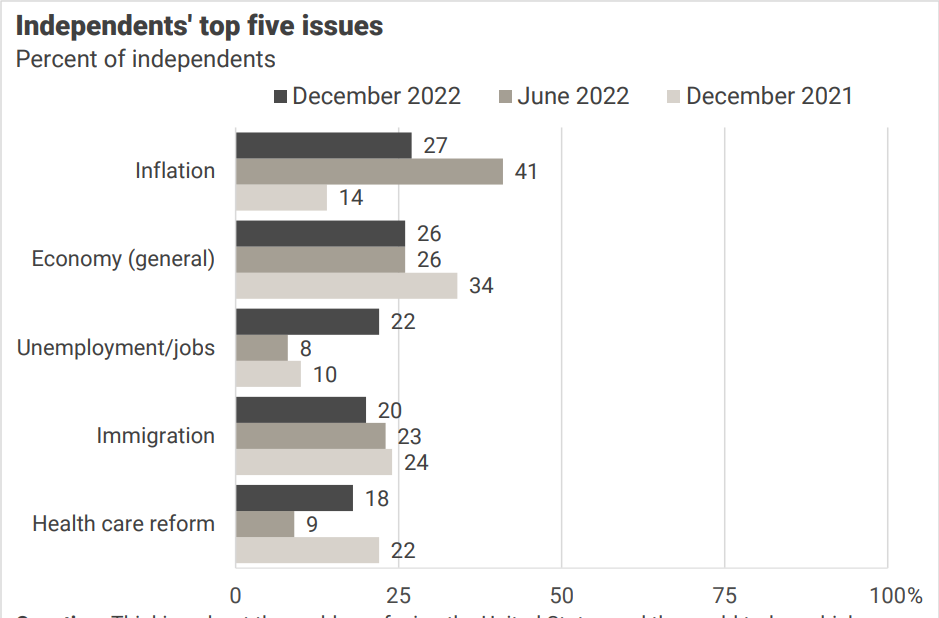
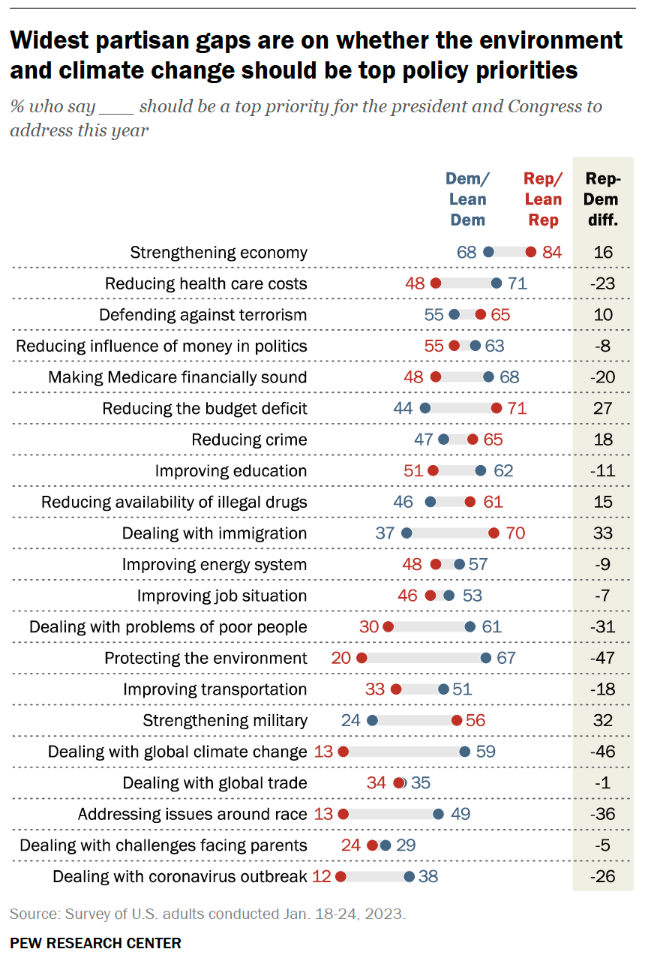
Since WW II pollsters have tracked Americans’ opinions on the most important problems or issues facing the nation. Politicians learned early that “framing” the issues was their most important tool. Helping the media and thought leaders to prioritize and highlight the “most important” issues became job one. Framing policy responses as positive, negative or “beyond the pale” became job two. The pollsters ask the questions in different ways and get slightly different responses, but the overall results are usually pretty clear. The media tends to focus on the “top 5” or the increasing differences between Democrats, Republicans and Independents. Through time there are nearly 50 items that appear as material, most important for at least 4% of Americans in a survey. This focus on the “top” and the “differences” tends to hide major changes in public perceptions.
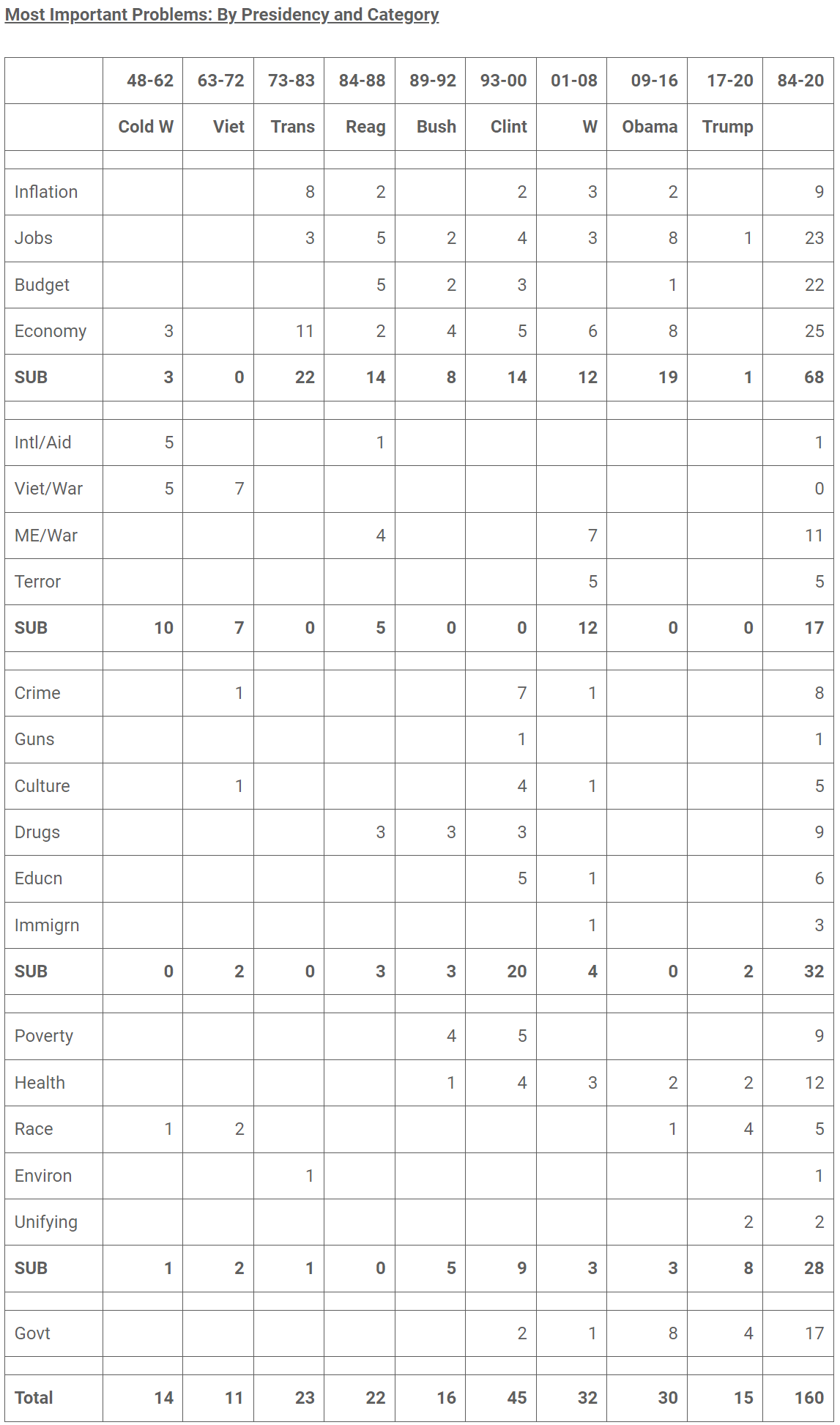
I’ve tracked the surveys back to 1948. I group the issues as policies versus institutions. I split the issues as foreign and domestic. I split the domestic issues as economic and social. I divide the social issues into those generally favoring Democrats versus Republicans. This summary shows the public’s views on the most important issues from 1948-2020 grouped by presidency.
War, terrorism, international trade and nuclear weapons were 12% (1/8) of the top issues historically. They are close to 0% today. Republicans have been more hawkish historically, emphasizing the threats to the US. This has been a political winner for them, criticizing Democrats for being “soft on defense”, “soft on terrorism” and “soft on China”. This appears to be a relatively minor political issue today with Democrats maintaining Trump’s more hawkish policies.
The economy is the top priority today for 30% of poll respondents versus 44% historically. Within the last 75 years the US economy has progressed from a moderate business cycle to stagflation to a minor business cycle plus disruptions model. Booms and busts were normal in the prewar period and the early post-war period. This pattern was moderated in the sixties, but the “guns AND butter” approach of Johnson and Nixon drove a stagflation period during Carter’s presidency. Since that time business cycle expansions have been longer, recoveries have been quicker and recessions have been mainly triggered by “exogenous” factors like oil prices, stock market crashes, real estate busts and pandemics. The economy is not as important today as it was historically. That benefits the incumbent president/party on the down cycle and limits the benefits to the president/party on the up cycle.
Democrats are benefitting today from the best job market in 50 years. Jobs were a top priority for 12% of respondents in the past, a top 4 issue. Jobs are a minor 1% concern today.
The federal budget deficit has been a political weapon for Republicans against Democrats who generally believe that some degree of deficit spending in pursuit of other policy goals has a neutral effect on the economy. This was a top issue for 12% of the people historically. It is a top issue for just 1% today. Citizens have witnessed business cycle and ongoing deficits that have not created havoc. Republican presidents have overspent as much (or more) as Democratic presidents. This issue was a lower priority today in the second half of the Obama presidency and Trump presidency. It is becoming a somewhat larger issue today, but mostly just among Republicans.
The overall “economy” was top-rated by 15% historically and 13% today. This has become a very partisan measure, with opposing parties criticizing the results of the incumbent presidents. The US economy has proved resilient and better at creating value than other countries throughout the last 75 years. Despite current Republican criticisms, Biden is winning this one.
Inflation is another important economic measure. Inflation grew through several business cycles in the 1970’s-1980’s before becoming a non-factor for 30 years. The pandemic, supply chain disruptions, Ukraine export limits and rapid recovery of goods demand after the pandemic shock drove high inflation beginning in 2021. Inflation averaged 5% of the top political priorities, but it was mostly focused on a small period of time. Today, inflation/gas prices are a large 15% priority. This hampers the incumbent Democratic presidential party.
Social issues that tend to benefit the Republican party have grown slightly from 18% to 22% of the total. Culture/morality and education remain minor at 3% each. Concerns about crime are at 6%, comparable to the historical average. Concerns about drugs have fallen from 5% to just 1%, despite the “opioid crisis” which greatly impacts the white middle class. Concerns about immigrants have more than quadrupled from 2% to 9%. Trump resurrected a powerful wedge issue despite a downward trend in illegal immigration. The recent increase in immigration from central America and Venezuela has given this issue strong legs.
Social issues that tend to benefit the Democratic party have increased by two-thirds as top priorities in recent years, from 15% to 25%. Poverty, wages, inequality and affordable housing combined remain in the 4-5% range, mostly just a progressive Democrat issue. Health care funding, coverage, obesity and nutrition have declined from 7% to 4% as a top issue. Obamacare is now accepted (even if grudgingly) as part of the country’s “safety net”. Race and racism are just a little more important at 4% versus 3% historically despite the increased media attention paid to police killings and progressive Democrats’ attempts to elevate this as a core issue. Gun control and mass shootings have grown from near zero to 5%. Democrats, independents and a share of Republicans feel a strong need to “do something” about gun crimes. The Supreme Court decision to vacate “Roe v. Wade” and Republican states’ tight abortion laws have motivated Democrats and independents to revive this as significant issue, even though the 3% score is not as meaningful as many articles have portrayed the impact on local elections. The environment/climate change was an immaterial policy issue after the passage of basic laws in the 1970s. It has grown to a solid 5%, driven by Democrats and younger voters. One-fourth of voters make these liberal leaning issues a top priority, including a decent share of independents and moderate Democrats.
A fourth category is the role of government, politics and leadership. Concerns about polarization and lack of unity have grown from zero to 5% as a top issue. Concerns about government and leadership have grown from 10% to 18%. Combined, this is a doubling, from 11% to 23%. This is a mixture of left, right and center voters. Republican concerns about government as a threat to individual liberties grew in the 80s and 90s, and then again with the Tea Party movement in the 2010’s. Republican concerns about “deficit spending” and “funding social security” have grown with each Democratic administration. A non-negotiable commitment to no tax increases is a Republican candidate requirement for the last three decades (strangle government in the bathtub).
Some of the increase is an increased emphasis by Republicans. I believe that most (75%) of the increase is due to centrists and independents watching their power undermined by the far-right wing of the Republican party, which has eclipsed the moderate, Main Street, Wall Street, New England, RINO, philosophical conservative and neoconservative factions. Extreme economic and social issues positions were adopted by national Republicans even before Trump (think Sarah Palin).
Centrists and independents also look at the Bernie Sanders, progressive, New York, California, green, woke, media, university wing of the Democratic party as being foreign to their views and priorities.
Centrists, moderate Democrats and some Republicans express increased concern about “preserving Democracy” following the rise of concentrated single party state power, partisan gerrymandering, politicized judiciaries, politicized local elections (school boards), unlimited campaign financing, debt ceiling brinkmanship, decreased civility, Supreme Court nomination politics, various Trump attacks on the independent power of federal agencies and the January 6th threat to a peaceful transition of power.
Overall, I’d say that the 23% that identify government/politics as a top issue is roughly balanced between the two parties, with the concerns driven by quite different reasons.
Category Recap
The economy is a lesser political factor today, garnering 30 percent versus 44 percent historically. The economy has done very well in the last 20 years, despite the Great Recession and the Pandemic.
International issues, trade, war and terrorism have declined from 12 percent to zero. The middle eastern wars and “war on terrorism” have left most Americans with little appetite for foreign wars. Funding Ukraine’s war and imposing maximum sanctions against Russia are supported, but any escalation is taboo. Similarly, the country is ready to support a “tougher stance” on China, but not ready for real escalation or a fight for Taiwan.
Republican leaning issues that emphasize fear of attacks from “others” maintain a slightly increased 22% share of top priorities. The increased emphasis on preserving individual/family choice on education, libraries, religion, media, and university wokeness is not yet apparent in the numbers, but media coverage of these issues has grown in the last few years.
Democratic leaning wedge issues on guns, abortion and climate have grown from near zero to 13% as a top priority. Traditional concerns about race and inequality have not grown as priorities despite data and situations that might be expected to move public opinion.
Republicans increasingly doubt the legitimacy of government activities and politics. Democrats increasingly doubt the legitimacy of government actors, processes and polarization.
This is one blog post that I won’t file under the “good news” category.



 mainly took 38 votes from Glynn. Rider’s single winning district was a near tie with Finkam, taking a total of 92 votes from Glynn.





 Good News