Good News: Living (Much) Longer

https://pubmed.ncbi.nlm.nih.gov/7565998/#:~:text=The%20average%20life%20expectancy%20in,France%2C%20England%2C%20and%20Japan.

https://www.populationpyramid.net/united-states-of-america/1950/

https://www.infoplease.com/us/health-statistics/life-expectancy-age-1850-2011

https://knoema.com/atlas/United-States-of-America/topics/Demographics/Age/Life-expectancy-at-age-80-years

https://www.ssa.gov/history/lifeexpect.html

https://www.ncbi.nlm.nih.gov/pmc/articles/PMC4861644/

https://www.infoplease.com/us/health-statistics/life-expectancy-age-1850-2011

It’s not all “good news”. Recent data indicates that life expectancy varies greatly between US states, counties, cities and census tracts. My hometown’s life expectancy is just 73.6 years, about 5% (3.7 years) less than the national average of 77.3 years. My suburban Indianapolis home for the last 30 years shows an 81.6 year life expectancy, about 5% (4.3 years) higher. That’s an 8 year (10%) difference between two midwestern cities.

https://www.rwjf.org/en/library/interactives/whereyouliveaffectshowlongyoulive.html

A Dozen Ways to Slay Inflation

1. Blue Ribbon Panel

Imitate the 1983 Greenspan Social Security committee.

https://www.washingtonpost.com/archive/business/1988/03/27/a-blue-ribbon-challenge-to-nations-red-ink/fe86db9f-2abf-49bb-8a1f-1e4c96c285ae/

6-month time limit. A dozen or less bipartisan dignitaries. Retired ambassadors, investors, CEO’s, federal reserve presidents, etc. Make Mitch Daniels the chair.

https://www.theatlantic.com/magazine/archive/2020/04/mitch-daniels-purdue/606772/

Assign 2 projects. One to cut government waste. The other anti-inflation policies. No more than a dozen recommendations in each half. Presented to congress for simple yes/no vote, without major amendments allowed.

2. Spend Less Government Money

Fiscal spending is too expansionary for the current situation. Back off. Reduce infrastructure spending for now, spend it in the next recession. Reduce marginal defense programs that only have political reasons. Cut state government spending by 3%, which is budgeted to increased by 9%.

https://www.nasbo.org/reports-data/fiscal-survey-of-states

https://rollcall.com/2021/10/18/congress-blocks-cuts-to-top-contractors-weapon-budgets/

3. Incentivize Consumers to Save More

Less aggregate demand will lower prices in many markets.

Increase 401(k) limit by $10,000 for 3 years.

Provide federal government match on first 5% of savings for all employees.

https://www.shrm.org/resourcesandtools/hr-topics/benefits/pages/2022-irs-401k-contribution-limits.aspx

https://www.tsp.gov/making-contributions/maximize-your-savings/

4. Encourage Corporate Pricing Restraint

Offer corporate income tax incentives for firms to hold prices fixed for 2 years.

Wage and price “controls” are widely criticized. Perhaps a voluntary nudge would work.

5. Add Older Workers to the Labor Supply

Stop all social security fund contributions (taxes) by workers aged 62 and older.

https://www.investopedia.com/articles/personal-finance/060515/when-do-i-stop-paying-social-security-tax.asp

Eliminate the “clawback” of social security benefits to retirees who do choose to work.

https://money.usnews.com/money/retirement/social-security/articles/what-happens-if-you-work-while-receiving-social-security

Tweak labor laws to fight age discrimination.

6. Increase Supply of Legal Immigrants

https://www.cnn.com/2022/01/11/economy/chamber-of-commerce-inflation/index.html

https://www.businessinsider.com/immigration-inflation-labor-shortage-chamber-commerce-suzanne-clark-jobs-work-2022-1

7. Eliminate Hidden Tax of Tariffs and Trade Regulation

Unilaterally eliminate all tariffs with Europe, Central America, South America, Japan, South Korea, New Zealand, India. Negotiate with China.

https://finance.yahoo.com/news/one-way-biden-could-cut-inflation-131832592.html

https://www.cnbc.com/2021/11/30/removing-us-china-trade-tariffs-would-ease-inflation-jacob-lew.html

8. Windfall Profits Taxes

https://www.cbsnews.com/news/biden-tax-how-billionaire-minimum-income-tax-works-cbs-news-explains/

https://rollcall.com/2022/03/24/windfall-profits-tax-consumer-rebate-options-under-discussion/

NEWS: Sanders Introduces Legislation to Reinstate the WWII Windfall Profit Tax to Combat Rising Inequality, Inflation, and Corporate Profiteering

https://www.bloombergquint.com/gadfly/to-fight-inflation-biden-should-tax-the-rich-shrink-the-deficit

9. Cut Transportation Costs

Tax incentive for more truck drivers.

https://www.truckinginfo.com/10166531/new-bill-aims-to-reduce-truck-driver-tax-liabilities

Open ocean shipping to competition.

Open trucking to Mexico based carriers.

10. Negotiate Drug Prices, Allow Interstate Health Insurer Competition

https://hbr.org/2021/10/the-u-s-can-lower-drug-prices-without-sacrificing-innovation

https://www.sidley.com/en/insights/newsupdates/2021/11/us-looks-to-introduce-europeanstyle-drug-price-controls

https://www.freep.com/story/news/nation/2014/09/05/dems-try-gop-idea-on-health-care-put-states-in-charge-of-cost-control/15106115/

https://www.marketwatch.com/story/six-ways-republicans-can-reduce-health-care-costs-in-their-new-plan-2017-03-11

https://www.manhattan-institute.org/reforming-health-insurance-across-states

https://www.commonwealthfund.org/blog/2017/selling-health-insurance-across-state-lines-unlikely-lower-costs-or-improve-choice

11. Increase the Supply of Housing

Increase immigration to improve labor supply. Cut tariffs to reduce supplies costs. Lean on local regulators to reduce zoning restraints and one size fits all building codes. Strategically require a higher share of affordable housing and multifamily permits annually in each metropolitan region. Phase-out the mortgage interest tax deduction for second homes.

https://www.bloomberg.com/news/articles/2022-02-04/in-sizzling-u-s-housing-market-normal-is-a-long-way-off

https://www.whitehouse.gov/cea/written-materials/2021/09/01/alleviating-supply-constraints-in-the-housing-market/

https://www.shrm.org/resourcesandtools/hr-topics/benefits/pages/2022-irs-401k-contribution-limits.aspx

12. Cut Energy Prices

Loosen regulations for 5 years to encourage increased “all of the above supplies” energy through drilling, coal, oil and nuclear. Suspend federal gas tax for 3 years. Negotiate oil price minimums/maximums between US/Europe/Japan and OPEC.

https://www.reuters.com/world/us/bidens-menu-options-high-gasoline-prices-is-not-appetizing-2022-03-23/

https://www.cbsnews.com/news/gas-prices-inflation-us-president-cbs-news-explains/

https://nymag.com/intelligencer/2022/03/heres-how-biden-can-lower-gas-prices.html

Summary

Reducing inflation is a complicated policy area. The solutions proposed by “experts” are rarely politically appealing. Competing political parties hesitate to provide “wins” to the other. However, 8% inflation after a 2-year pandemic while the US faces Russian war actions is a “national emergency”, worthy of an FDR like approach to “try a few things”. It is an opportunity to overcome individual industry opposition to things that make sense for the country. It is an opportunity to try some left and right solutions.

Latest Good News

Twice as many passport holders

American eagles recover from extinction threat

More voting in recent elections

Stable US steel production

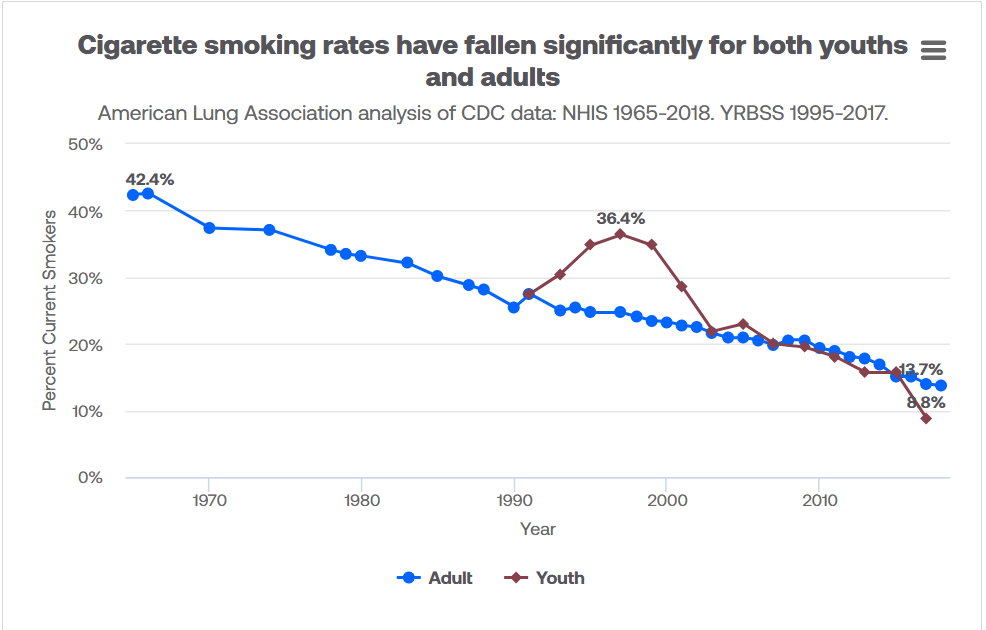
Less smoking.

Record low unemployment

US universities lead global rankings

US is Energy Self-Sufficient

Flat real gas prices

Less oil/energy intensive economy

Good News: American Eagles Soar Again

Nests With Breeding Pairs Doubled in a Decade

https://www.npr.org/2021/03/25/981272794/once-imperiled-americas-bald-eagle-populations-are-soaring#:~:text=The%20number%20of%20bald%20eagles%20in%20the%20lower%2048%20U.S.,in%20other%20American%20bird%20populations.

https://www.smithsonianmag.com/smart-news/bald-eagle-populations-have-skyrocketed-last-decade-180977342/

Good News: Record Voter Turnout in 2018 and 2020 Elections

https://www.fairvote.org/voter_turnout#measuring_voter_turnout

Setting aside turnout ratios, the growth in actual voters has been strong for a century. 40-48M voted in FDR’s elections. Kennedy and Nixon fought over 69M voters. Clinton and Bush, Sr. attracted 105M voters in 1992. But, Biden vs. Trump shattered records with 158M casting ballots.

Midterm Elections: 2018

https://www.fairvote.org/voter_turnout#voter_turnout_101

https://www.census.gov/library/stories/2019/04/behind-2018-united-states-midterm-election-turnout.html

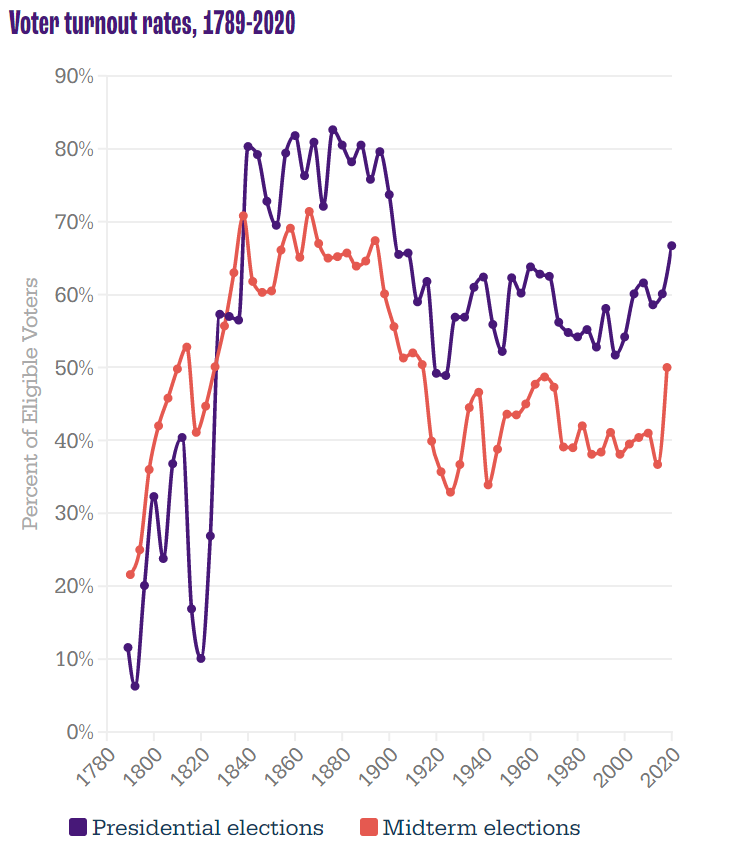
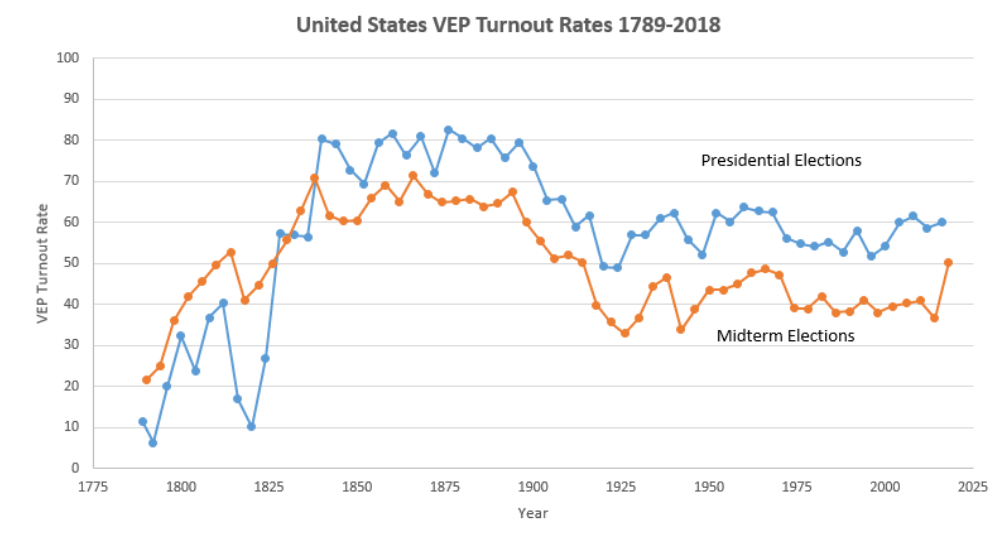
Midterm voting rates (as % of eligible voters) soared at 65% in the 19th century. They dropped to 50% at the start of the 20th century and then down to 45% for most of the 30’s to 60’s. They settled down to 40% thereafter. The 2018 election reached 50%, a full 13% points above the all-time low in 2014.

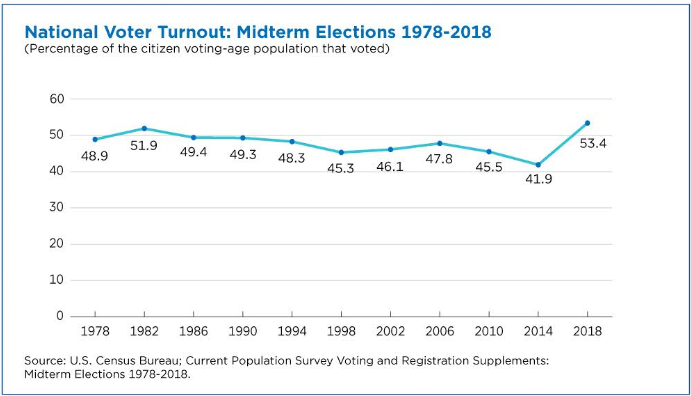
The slightly different measure, percentage of voting age population, shows the same pattern. 49% voting from 1978-94. Just 46% from 1998-2010. Record low of 42% in 2014, followed by an 11%-point climb to 53% in 2018.

https://www.census.gov/library/stories/2019/04/behind-2018-united-states-midterm-election-turnout.html

Younger voters increased their turnout by 14 points (18-44), while older voters increased by a solid 8%. High school or less educated voters increased turnout by 7 points, while college educated voters added 12 points.

Presidential Elections: 2020

https://www.fairvote.org/voter_turnout#measuring_voter_turnout

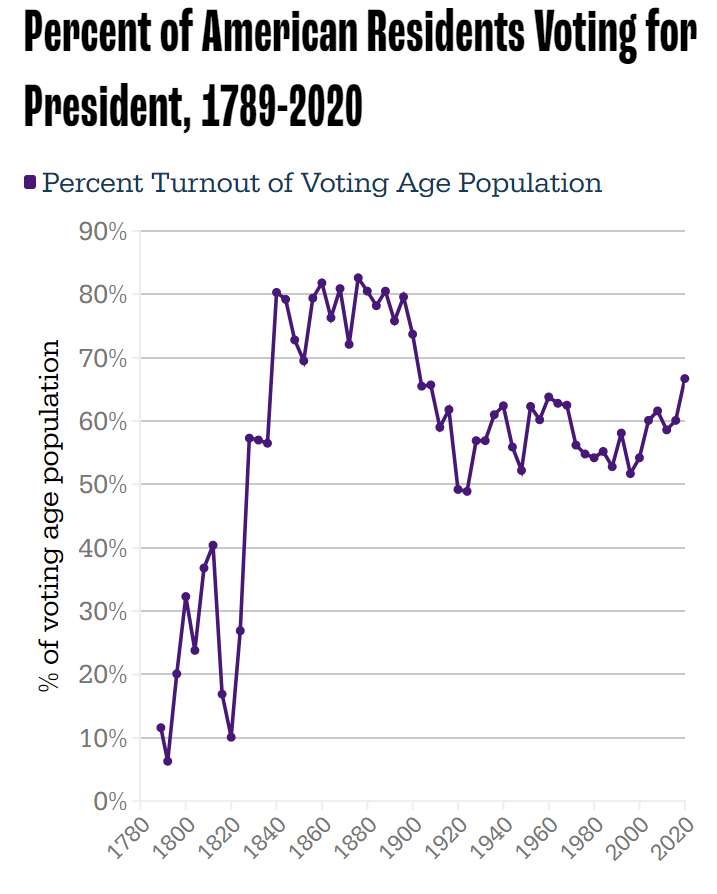
Long-term presidential and midterm voting (% of eligible voters) follows the same pattern. 80% turnout in the 19th century, dropping to 59% by 1912, then averaging 60% in the 30’s to 60’s. Further decline to just 55% for the 70’s-90’s. Minor increase to 60% in the oughts and teens, followed by 67% in 2020.

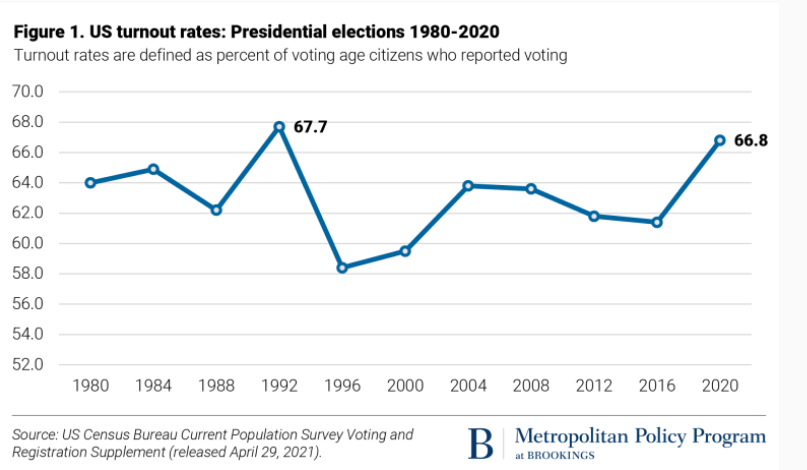
The more recent percent of voting age population shows 64% from 80-88, a one-time spike to 68% in 1992, decline to 59% from 96-200, slight increase to 61% for 04-16, and then a big jump to 67% in 2020.

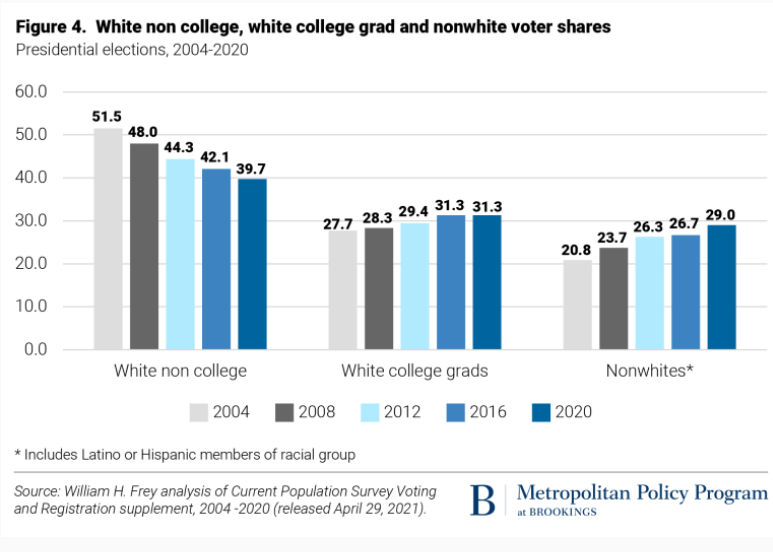
Turnout was up in all categories, but especially among Asian, 18-29 year olds and white non-college educated populations.

Voting by all racial groups of 18-24 year-olds was up significantly.

Other Sources Show The Same Results

http://www.electproject.org/national-1789-present

https://www.nationalaffairs.com/publications/detail/does-high-voter-turnout-help-one-party

The two measures (% of eligible voters and % of population) track closely. The “election project” numbers show VEP at 63% from 1952-68, declining to 58% for 72-00, increasing a little to 61% for 04-16, before spiking to 66% in 2020.

More Details

Income really matters for voter turnout, with rates ranging from one-third to one-half to two-thirds. With increased lower income support for the Republican party, this is less of a partisan issue today.

https://www.theatlantic.com/ideas/archive/2019/08/emerging-republican-majority/595504/

Since 1969, Democrats have argued that demographic trends will overturn Kevin Phillip’s description of the Emerging Republican Majority. This remains a hotly debated topic.

https://www.census.gov/library/stories/2019/04/behind-2018-united-states-midterm-election-turnout.html

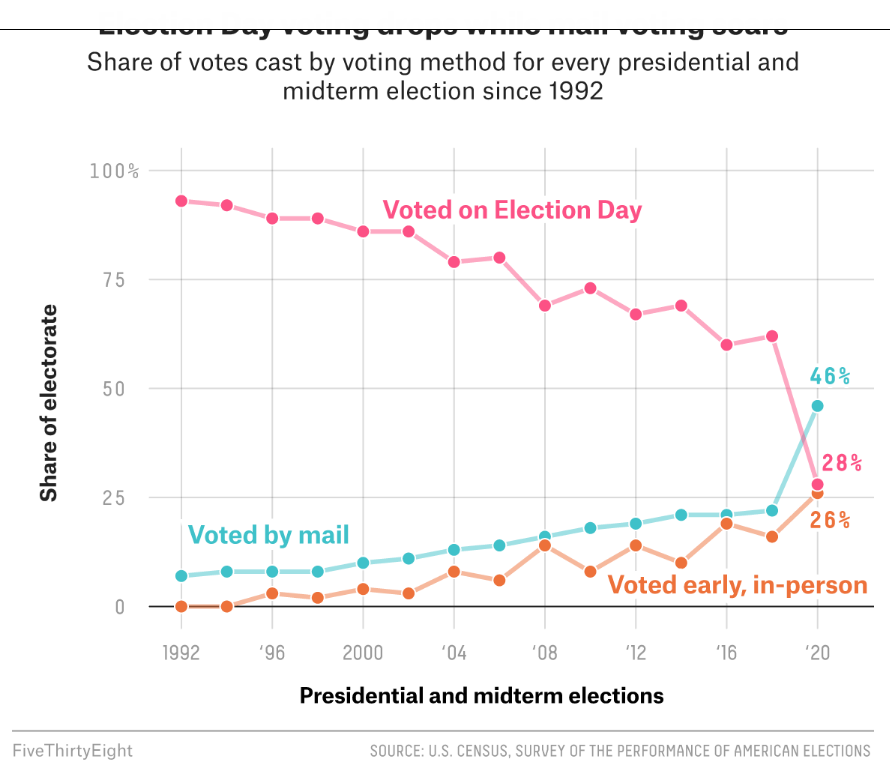
Election day voting decreased in 2018 and 2020 as mail and early, in-person voting increased. Many commentators claim that this change is a large driver of the increased turnout levels.

Good News: US Steel Production Steady Since 1980’s

Unfortunately, this followed a 30%+ decline from the 1970’s.

https://fred.stlouisfed.org/series/IPN3311A2RSQ

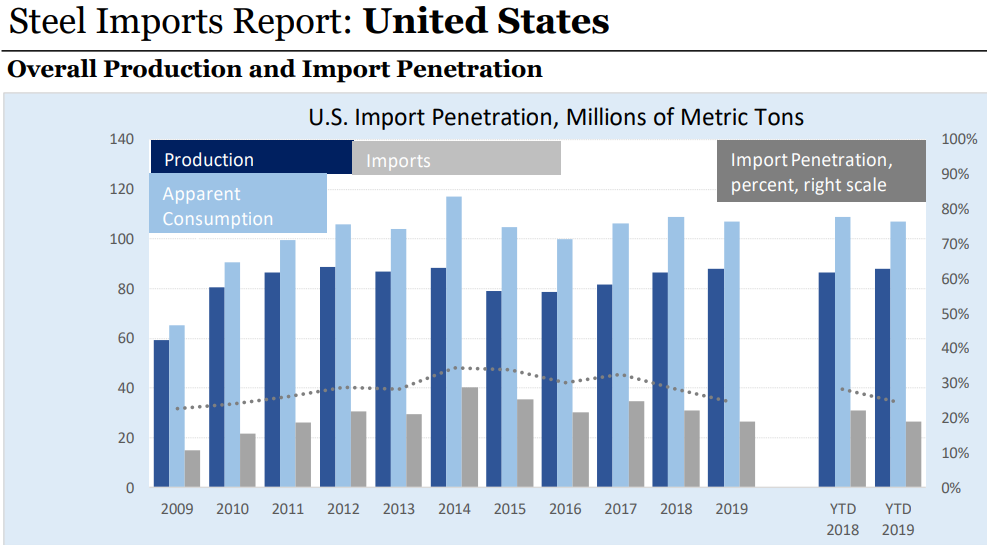
Finished Steel Imports Have 20% Market Share

Imported Steel Share of All Production is 30%

Canada, Mexico and Brazil Account for Half of US Steel Imports

US Steel Employment Has Levelled Off Since 2004

https://fred.stlouisfed.org/series/IPUEN331110W200000000

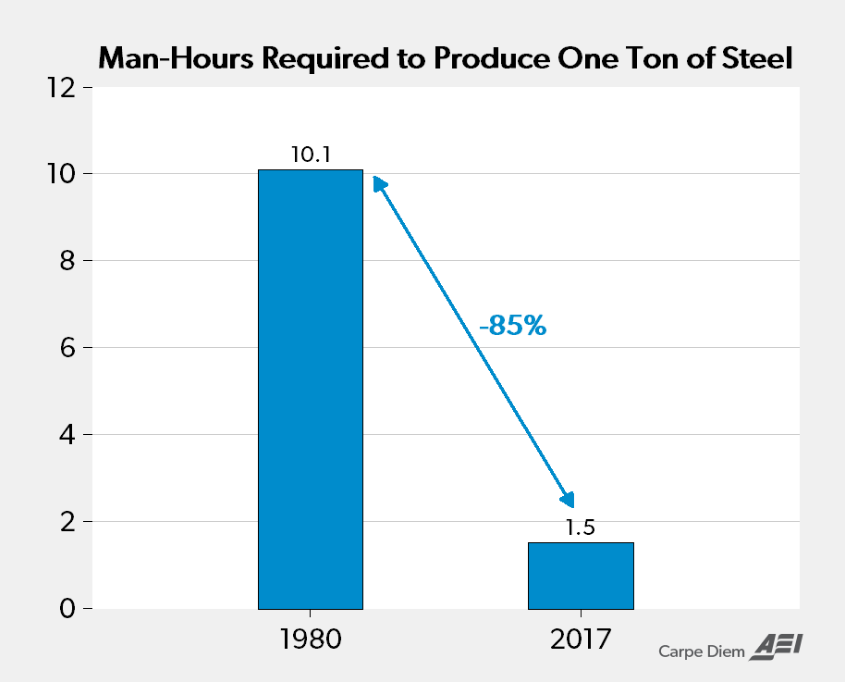
The reduction in employment has been due to improved productivity, not to imports.

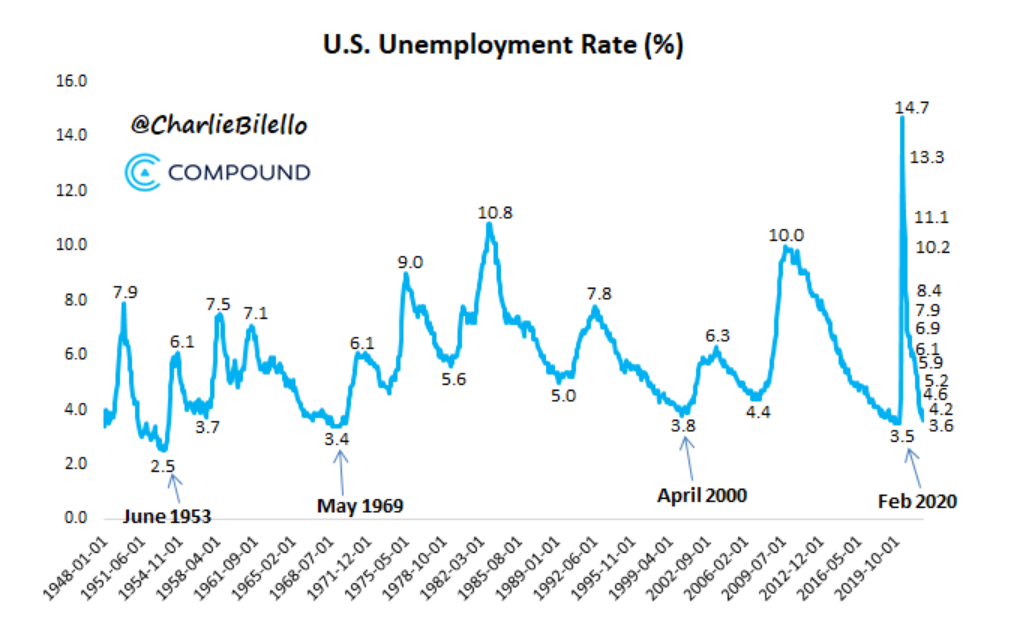
Good News: Record Low US Unemployment

Fastest Ever Post-Recession Labor Market Recovery

https://fred.stlouisfed.org/series/UNRATE

9 States Reached All-Time Record Low Unemployment Rates in February

Nebraska, Utah, Indiana, Kansas, Arkansas, Mississippi, Montana, Oklahoma and West Virginia. The Republican leaning states are “winning”. The Bureau of Labor Statistics (BLS) has been reporting state data since 1976, so this is a GREAT result.

https://www.bls.gov/news.release/laus.nr0.htm

27 states reported unemployment rates below the optimistic “full employment” level of 4%. Another 17 were in the 4.0-4.9% range. Just 6 states were burdened with unemployment rates above 5.0%, with New Mexico at 5.6% the highest.

https://www.bls.gov/web/laus/laumstrk.htm

4 of the 51 “Large” Metro Areas Reported All-Time Record Unemployment Rate Lows This Year

Salt Lake City, Indianapolis, Oklahoma City and Atlanta set new records.

Geographically dispersed Nashville, Tampa, San Jose, Phoenix and Louisville are very close to setting new records.

https://fred.stlouisfed.org/series/SALT649URN

https://fred.stlouisfed.org/series/INDI918URN

https://fred.stlouisfed.org/series/OKLA440URN

https://fred.stlouisfed.org/series/ATLA013URN

As with the states, the distribution of results for the 51 metro areas with 1 million + populations is quite convincing. 8 metro areas are below the “unsustainable” 3.0% gold standard. 29 metro areas are below the 4.0% “full employment” level. 43 metro areas are below 5%. 8 areas exceed 5%. Detroit is second worst at 5.4%. Cleveland is in last place, struggling with 6.4%.

https://www.bls.gov/web/metro/laulrgma.htm

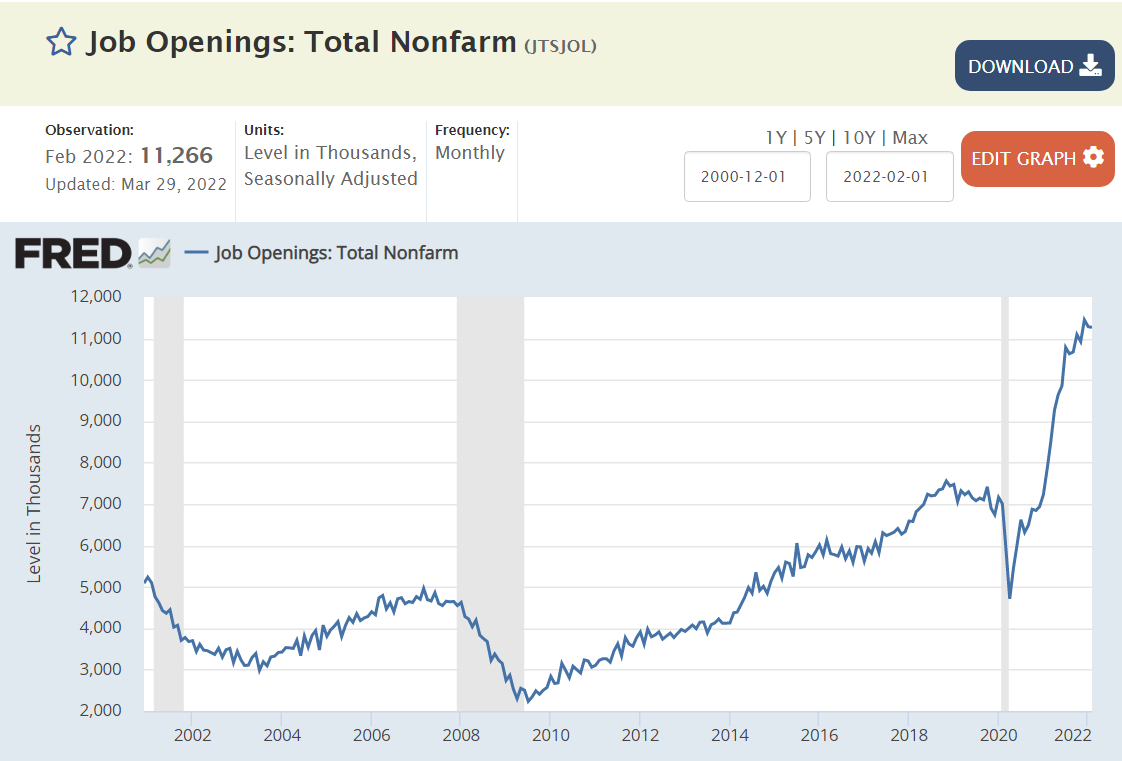
Unemployment Rate Will Fall: Record Open Jobs

https://fred.stlouisfed.org/series/JTSJOL

Unemployment Rate Will Fall: 500K Net Jobs Added Each Month in the Last 12 Months

https://fred.stlouisfed.org/series/PAYEMS

Unemployment Rate Will Fall: Labor Force Participation Rate May Increase 0.5% – 1.0%, But Not Further

https://fred.stlouisfed.org/series/CIVPART

Unemployment Rate Will Fall: Blue State Employee Returns From Covid Have Lagged

Red states have roughly returned to pre-Covid employment levels. Blue states have lagged by 3.5%. Mixed states have lagged by 2%. This can provide 3 million workers to fill some of the 11 million open jobs.

Unemployment Rates Will Fall: Wages are Up 11%

https://fred.stlouisfed.org/series/CES0500000003

Summary

I expect the overall unemployment rate will set a 68-year record in the next 3 months. The February 2020 3.5% and May 1969 3.4% lows will be eclipsed! Unemployment will be at the lowest rate in my lifetime (Jul 1956)! This is despite the many, many issues and risks we have on both the supply and demand sides of the labor market.

IMHO, there are many factors driving this GREAT NEWS. (1) American firms are making record profits based on domestic and global demand, so they are incentivized to hire more workers, even at higher than usual wages. (2) American firms are finding that they can pay higher than historic wages and still generate incremental profits from the incremental workers (see Costco). (3) The definition of “employable” workers is clear, but employers are slowly loosening their irrational requirements (college degrees). (4) Baby Boomers have accumulated unprecedented retirement assets, so they have slowly left the labor force in a “one way” exit. (5) The “informal” labor market has been institutionalized with Uber, gig, contract and temporary worker arrangements. (6) Reduced unemployment benefits have incentivized many (older, less skilled non-unionized) unemployed workers to reduce their “reserve wage” expectations and accept new employment at lower wages than their best historical experience. (7) With less stigma for “laying off” workers, employers are more actively hiring workers to fill all economically justified positions. (8) With lower recent illegal immigration, the “reserve army” of the unemployed is lower. (9) Modern recruiting systems provide employers with so many candidates that they are assured of finding matching workers relatively quickly.

In essence, we have a much more “efficient” labor market than in years past, so the minimum unemployment rate has been reduced from 5% to perhaps as low as 2%. This too, is good news.

President Biden certainly did not drive any of the above structural factors. However, he has not disrupted these forces or pushed fiscal or monetary policy to undo the good news. Sometimes, “leave well enough alone” is all that is required.

Good News: US Universities Lead Global Rankings

Various global university rankings use different measures and methodologies. US universities lead the way in all major rankings, averaging 18 of the top 30 spots, good for 60% of all world leaders.

Few of us will consider attending these institutions, but they do educate many of our college professors, they educate many of our national business leaders and their research is used in most fields of endeavor.

https://www.shanghairanking.com/rankings/arwu/2021

https://www.usnews.com/education/best-global-universities/rankings

https://www.topuniversities.com/university-rankings/world-university-rankings/2022

https://cwur.org/2021-22.php

https://roundranking.com/ranking/world-university-rankings.html#world-2021