Good News: Very Low Unemployment

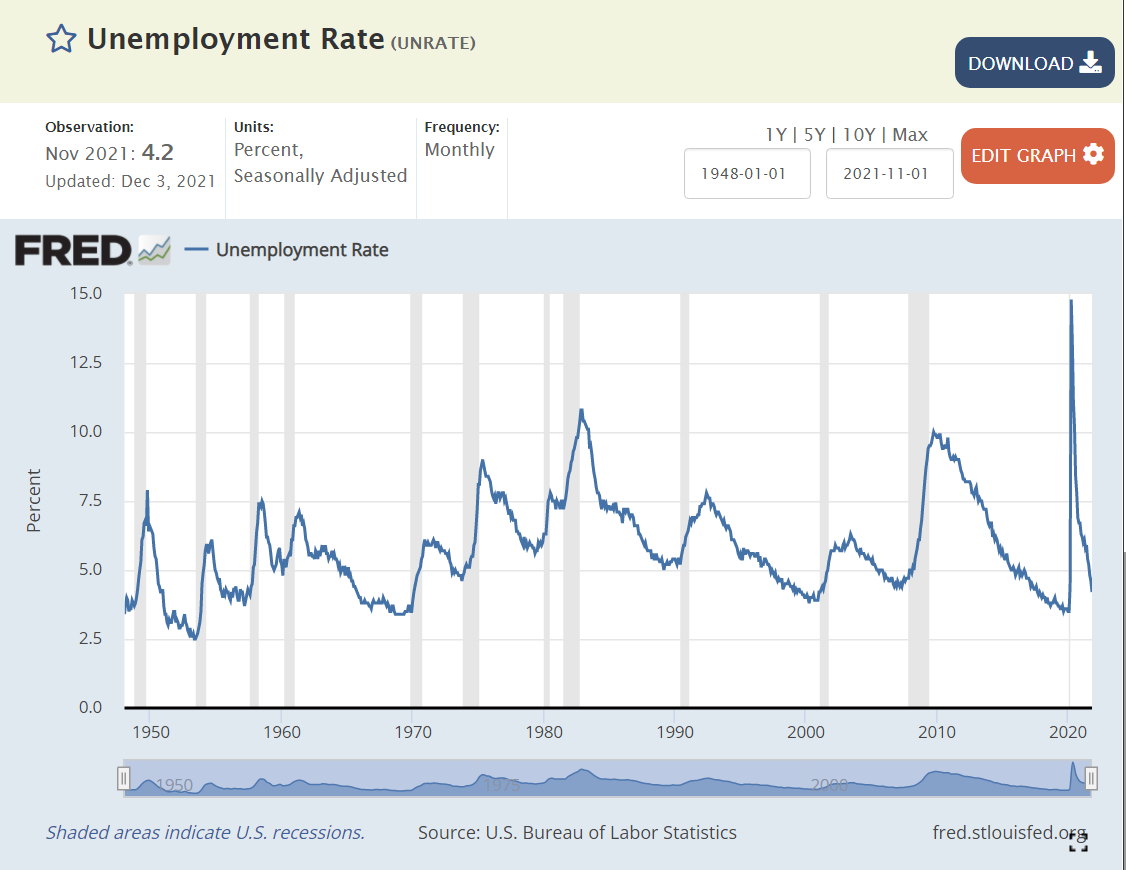
The official US unemployment rate has rarely gone below 5%, and has typically risen back above 5% in a matter of months. The post WWII boom from 1951-53 was one positive period. The Vietnam War + Great Society spending period of 1965-69 was another. The second Clinton presidency from 1997 to 2001 was another 4 year period of prosperity.

The Obama presidency started with 7.5% unemployment. It peaked at 10% in 2009, before falling consistently to 4.7% at the end of his term in 2016 (cut in half). The Trump presidency saw a continued reduction of the unemployment rate to a minimum of 3.5% 2 years later, exceeding the expectations of mainstream economists and forecasters.
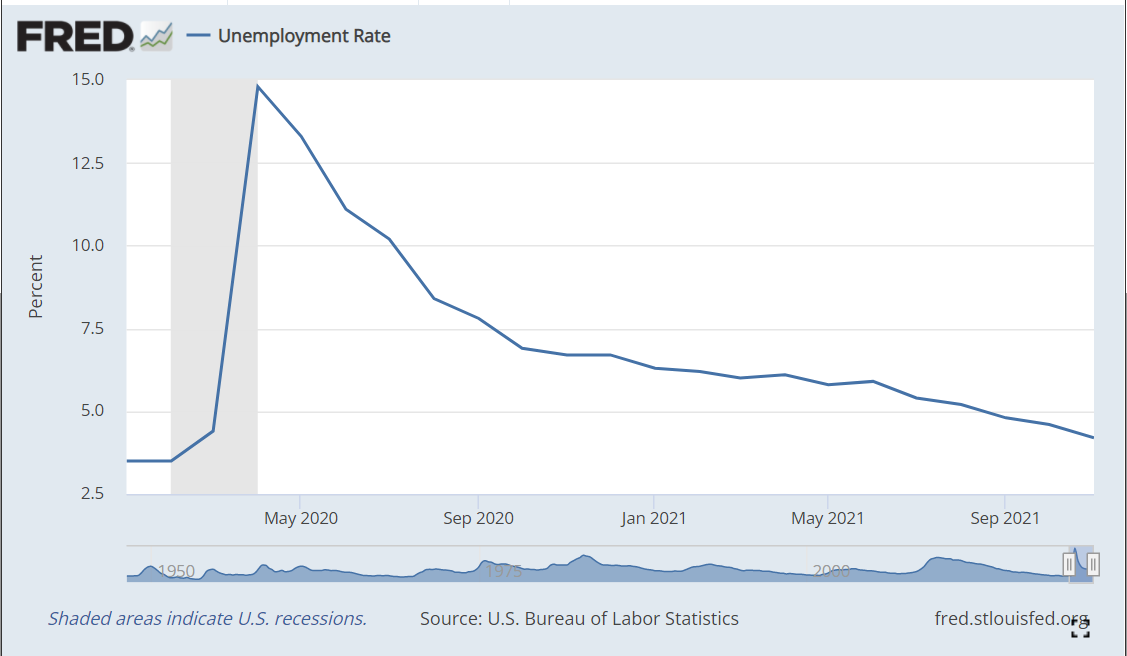
Unemployment quickly climbed to 15% during the pandemic, before falling back to 6.7% by the end of the year (2020). In the 2 years of the Biden administration, it has declined by 2.5% to 4.2%, a rate last seen in November, 2017.

Historically, “full employment” has been pegged close to 5%.

https://en.wikipedia.org/wiki/Full_employment

The extended period of lower unemployment from 2016-2020 lead many economists to revise their estimate of “full employment” to be an unemployment rate of just under 4.5%.

https://www.bloomberg.com/quicktake/full-employment

Candidate Trump repeatedly claimed that candidate Biden would “ruin” the economy. It has proven to be more resilient to a change in administrations.

https://www.cbsnews.com/news/trump-economic-club-new-york-recovery-jobs/

The economic expansion has lead to unprecedented low 1.5% unemployment rates in some Midwest communities.

https://www.indystar.com/story/news/local/hamilton-county/2021/12/28/carmel-zionsville-among-states-lowest-unemployment-rates-november/8980831002/

The recent economic recovery has had a disproportionately positive effect on Republican leaning (Red) states., which have a median 3.5% unemployment rate. Nebraska, Utah, Oklahoma, Idaho, South Dakota and Montana enjoy sub 3% unemployment rates. Democratic leaning (blue) states have a median 5.4% unemployment rate, with only the blue states of Vermont and Minnesota experiencing below average unemployment. The purple battleground states are in the middle with a median 4.5% unemployment rate.

https://www.bls.gov/web/laus/laumstrk.htm

https://www.270towin.com/content/blue-and-red-states

Large metropolitan areas have seen a slightly better than national reduction in their unemployment rates. 25 of the top 50 metro areas have unemployment rates below 4.0%. 8 have rates below 3%. Nashville (2.8%), Milwaukee (2.8%), Minneapolis (2.6%), Birmingham (2.5%), Atlanta (2.4%), Indianapolis (2.4%), Oklahoma City (1.9%) and Salt Lake City (1.4%) are clearly experiencing full employment. Another 14 metro areas have unemployment rates of 4.0 – 4.9%; in the “full employment” range. Just 11 have unemployment rates of 5% or higher.

Chicago, Houston, Philadelphia, San Diego, Sacramento, New Orleans and Hartford display marginally high unemployment rates of 5.1% – 5.4%. Just 4 of the nation’s 50 largest metro areas encounter higher rates: NYC (6.3%), LA (7.1%), Riverside (6.3%) and Las Vegas (6.6%).

https://www.bls.gov/web/metro/laummtrk.htm

Despite the prevailing “negative” media attention, if the economic recovery continues at its current rate, the unemployment rate will reach 3.5% or lower in March, 2022. This rate has been recorded only in Feb, 2020, Jul, 1969 and Nov, 1953. In the shadow of a global pandemic last experienced in 1918, this is amazing news.

We are clearly living in “interesting times”.

Personally, I agree with Fukuyama that western liberal democracies and mixed capitalist economies have won the ideological wars, leaving fascist, communist and dictator regimes behind. This is despite the rise of populist movements on the right in western democracies, the resilience of dictatorships on many continents and especially the retrograde actions of China to preserve its central place on earth as a “special” nation. The war is not complete. It calls for liberal capitalist nations to refine their ideologies and wisely play their global roles.

https://en.wikipedia.org/wiki/The_End_of_History_and_the_Last_Man

https://www.theguardian.com/books/2014/mar/21/bring-back-ideology-fukuyama-end-history-25-years-on

https://www.newyorker.com/magazine/2018/09/03/francis-fukuyama-postpones-the-end-of-history

https://www.theatlantic.com/politics/archive/2014/09/its-still-not-the-end-of-history-francis-fukuyama/379394/

https://www.opendemocracy.net/en/endism/

Good News: Lawyers Have Less Power in the US.

https://en.wikipedia.org/wiki/Let%27s_kill_all_the_lawyers

The US population has doubled from 1960-2020, so the share of new lawyers remains roughly at the same percentage, despite the greatly increased complexity of modern business, communications, intellectual property and society. This ratio is now way down from the 2000’s when it was unusually elevated.

Supply and demand drove lower salaries and higher unemployment after 2010.

https://abovethelaw.com/2021/08/law-schools-are-building-another-giant-lawyer-bubble-destined-to-burst-in-the-legal-job-market/

Starting salaries at major law firms have always been attractive to undergraduates. The distribution of starting salaries shows that the legal profession is divided between those in the top one-fourth and all of the rest. The median starting salary at $100K for 7 years of college education looks more like an engineer, pharmacist, actuary, data scientist, financial analyst or market researcher than a world changing persuader.

The percentage of US congress reps with a legal background has declined decade after decade.

Lawyers occupy 9% of CEO roles; far less than their MBA competitors.

https://hbr.org/2017/08/do-lawyers-make-better-ceos-than-mbas

In general, public opinion has less and less support for the “advocate” model of legal representation.

https://medium.com/indian-thoughts/devils-advocate-the-new-age-sophists-bf25c928eefdhttps:/

New lawyer debt is at a record high level ($150K). (page 27).

The legal profession remains 86% white, far removed from the American population distribution. (page 34).

Legal wage growth accelerated in the “oughts” and then rose by less than inflation in the teens (page 47).

The number of law school applicants dropped nearly in half from 2004 to 2015, from 101,000 to 54,000. (page 55).

Despite the great reduction in new law school entrants, the bar exam pass rate has declined from 80% to 70%. (page 80).

The highest skilled lawyers remain in high demand in the US, earning $120-180K for starting salaries. They are typically not “changing the world”. But, they are helping the owners of great wealth to maintain and improve their positions. As an accountant, engaged to measure and advise, I appreciate this value-added role in society.

Good News: American Beer

At the turn of the century (1900), there were about 2,000 brewers in the US, serving it’s 75M residents. In 1940, following prohibition, there were 750 breweries serving the nation’s 130M residents. By 1960, the population has grown to 180M, but the number of breweries had fallen to just 200. By 1980 the number of breweries had dropped to 100, while the population had reached 225M. Each brewery served 40,000 people, then 200,000 people, then 1M, then 2M. The ratio increased 50 fold! (this is a negative result, less variety and options)

In 1978, Congress passed a law that allowed “home brewing” without punitive excise taxes.

Between 1986 and 1996, the number of active breweries increased ten-fold to 1,000, exceeding the number producing in 1940.

By 1998, the brewery count reached 1,500 and plateaued for the next decade through 2008.

The following decade showed a 3-fold growth in active breweries, exceeding 5,000, a record high above the 4,000 level of the 1870’s. The new ratio of people to breweries is 70,000 to 1, twice as high as the turn of the century (1900), but 20 times better than 1980.

I served as a residence hall director at a small college in Cleveland from 1979-82. We held blind-folded beer tastings. Of a dozen “remaining” brews, the legally eligible students could only reliably identify Strohs, with its “fire-brewed” sulphur smell.

Coors was considered a very premium beer. Genessee Cream Ale from upstate NY was a good option. Old Milwaukee was an acceptable brew. Duquesne Beer from Pittsburgh was solid. Iroquois Beer from Buffalo was acceptable. POC, “pilsener on call” or “piss on Cleveland” was the bottom of the barrel, except for “Heritage House”, a private label brand at Fisher-Fazio-Costa supermarkets, which was the very lowest. Chicago’s Old Style was available, but not so special.

It’s difficult to illustrate the tremendous change in available options between 1980 and 2020, but one way is to focus on just one American city, Chicago.

Goose Island, 3 Floyds, Revolution Brewing and Two Brothers garner 10 of the 15 Chicago best. 5 others warrant acclaim.

https://www.chicagotribune.com/dining/craving/ct-chicago-best-beers-ever-food-0322-20170316-story.html

Or, consider this list of 25 historically influential brews in the US. So many great options.

https://www.chicagotribune.com/dining/drink/ct-most-important-beers-ever-food-0222-20170214-story.html

Some history lessons …

https://firstwefeast.com/features/illustrated-history-of-craft-beer-in-america

https://beerandbrewing.com/dictionary/UqfrcsPoAI/

https://www.alcoholprofessor.com/blog-posts/a-brief-history-of-beer-in-america

https://www.mixerdirect.com/blogs/mixer-direct-blog/a-brief-history-of-craft-beer

https://www.smithsonianmag.com/arts-culture/charlie-papazian-sparked-americas-craft-brew-revolution-180974877/

My Favorite Airport Landings and Takeoffs

I’ve been flying for business and pleasure for more than 40 years. I’d like to share some of my favorite domestic and international airports.

Cleveland Burke Lakefront: steps from downtown; my boss Ron Diderich used to fly here daily from DTW in 1982.

Sarasota: My first landing in 1974; so much busier today where Sue and I have our winter home.

Indy Exec Airport. I served on the local airport board for 8 years.

Boston Logan is a major NE hub with an ocean approach which I first experienced landing in 1975.

Mackinac Island is a small airport with varied service.

Chicago Midway Airport

Chicago’s Midway Airport is a Southwest hub and used to be a hub for Indy’s American TransAir (ATA). The airport is in a 1 x 1 mile block in Chicago with a very short 5,200 foot long main runway.

New York is a huge US hub; enjoy a Newark approach.

Maui (’nuff said).

Key West; Another Island Paradise

San Diego; more exciting landing than expected.

San Francisco; I observed this approach from the front seat in 1998.

Washington, DC: Reagan. The greatest mainstream US airport approach, every time.

Aspen, CO. A mountain approach and a very exciting takeoff.

Tokyo.

Nice, France.

Old Hong Kong Airport (I first experienced in 1997).

https://www.cnn.com/travel/article/hong-kong-kai-tak-airport/index.html

https://www.atlasobscura.com/articles/kai-tak-hong-kong-airport-scary-landing

Queenstown, NZ. Truly Amazing.

Hey Joe, Hey Joe … Reverse the Trump Tariffs

There are few policy choices that have 90-95% positive results compared with 5-10% negative results. Cutting international trade tariffs is one of those “rare birds”.

President Trump “delivered” on his 2016 campaign promises regarding trade deals. He unilaterally increased tariffs on imported aluminum, steel and manufactured goods from China and the rest of the world, including our trade and military allies. As with most “trade killers” (which used to be a minority Democratic party position), he claimed that this would save or restore American jobs. As usual, it had no measurable positive effect. He also claimed that this would lead to a renaissance in American manufacturing. Didn’t happen. He claimed that these actions would make America more self-sufficient in critical military and economic areas. Didn’t happen. Note pandemic issues. Finally, he claimed that these actions would form the basis for “new and improved” trade deals to replace the “awful” deals negotiated by Democrats and Republicans alike for 70 years in the post- WWII era. NAFTA 2 was concluded with minor changes. Small China commitments were obtained to buy things China wanted to buy. But, mostly the response was “HUGE” retaliatory tariffs from China and our allies.

https://en.wikipedia.org/wiki/Trump_tariffs

https://www.npr.org/2021/11/27/1054293073/whiskey-distilleries-europe-tariffs-lift

The “root cause” of the failed results in this situation, and in most other trade fights, is a logical / intellectual error. Proponents of trade restrictions believe that bilateral trade negotiations are a simple “win/lose” game. A real estate deal is a simple “win/lose” game. Bilateral trade deals are more complex. There are many winners and losers in both countries, some direct and some indirect. Higher tariffs or trade restrictions benefit the importing country’s manufacturers and their employees. However, these tariffs typically result in much higher prices for the importing country’s consumers, so the net effect for the importing country is negative. Unfortunately, bilateral trade deals or actions often don’t even help the importing country’s producers. Whatever country is “next most” competitive takes the place of the target country which has been made less competitive by the new tariffs. In the case where a country holds a large share of the global market, neither the “next best” country, nor the domestic producers benefit. The “target” country has such a strong competitive, cost, price advantage that even with added tariffs they are the preferred supplier. This is a very disappointing result for those who wish to take direct action to “save jobs”, but global markets truly matter.

Columnists, journalists and politicians say that Joe can’t reverse the tariffs for political reasons. The American voting public is too unsophisticated to understand complex trade logic. Given Trump’s framing of his actions, this will look like a capitulation to China. The progressive left doesn’t believe in “free” international trade, which undercuts worker’s pay and the environment. American “labor” is a required part of the Democratic Party coalition and opposes “free” trade. Consumers do not link tariffs to goods inflation. American business and agriculture are fully committed to the Republican Party, so will not repay beneficial actions.

https://www.cnbc.com/2021/11/30/removing-us-china-trade-tariffs-would-ease-inflation-jacob-lew.html

https://www.cnn.com/2021/10/03/politics/global-supply-chain-collapse-biden-tariffs/index.html

The American people elect leaders (of either party) to lead. Step up. The benefits of “free trade” are well known, well documented and supported by 90% of professional economists of both parties. Assign Kamala Harris, Pette Buttigieg and Jared Kushner (just kidding) to develop the communications plan for this policy decision.

The American People Benefit Directly: Taxes, Inflation and Jobs

Tariffs are simply taxes with a longer name. Exporters pay a small share, less than one-third of the total. Importing firms pay a slightly larger share, again less than one-third of the total. Consumers typically pay more than one-half of the tariffs in the form of higher prices. This is a tax, plain and simple. Estimates of the taxes paid by Americans for the Trump Tariffs range from $50-80B.

https://www.americanactionforum.org/research/the-total-cost-of-tariffs/

Tariffs provide importers with an excuse, reason, justification to increase prices. This is contributing to the current round of inflation at a level last seen in the 1980s. American consumers are paying $700 annually for these taxes.

https://www.cnn.com/2021/03/24/politics/china-tariffs-biden-policy/index.html

Tariffs are imposed to “save jobs”, but the “indirect” impact is usually larger than the “direct” impact. Domestic manufacturers who use imported products find their costs to be higher and some become uncompetitive. Domestic retailers who now sell more expensive products find their sales lower and reduce their work force accordingly. Target countries impose retaliatory tariffs on domestic export products. This is the main source of job losses. The Trump Tariffs are estimated to have cost Americans 250,000 jobs.

https://carnegieendowment.org/chinafinancialmarkets/83746

https://www.cnn.com/2021/03/24/politics/china-tariffs-biden-policy/index.html

Make American Businesses More Competitive Globally

American businesses pay one-fifth to one-third of the $80B of annual tariffs imposed. This drops straight to the bottom-line. Reduced profits result in reduced capital investments, R&D, product innovation and new markets.

Tariff administration has an overhead cost and it distracts supply chain, logistics and international trade staff from higher value added work.

Tariffs require profit-maximizing firms to accelerate their consideration of import sourcing and domestic production options. Some of this has a minor impact. Some of this activity displaces other higher value-added sourcing projects.

One estimate indicated that 8% of stock market value was destroyed by the Trump Tariffs.

https://www.forbes.com/sites/stuartanderson/2021/05/20/trumps-tariffs-were-much-more-damaging-than-thought/?sh=527605ba65bd

Sharply higher tariffs disrupt existing supply chain relationships and remove some sources as economically feasible sources. In a time of supply chain challenges, tariff make a bad situation even worse.

Farmers were most negatively impacted by the Trump Tariffs. Trump provided temporary subsidies to offset some of the pain, but farmers complained that they were seeing decades old trade lanes being permanently disrupted. Reduced tariffs and reduced retaliatory tariffs might restore these natural trade lanes.

https://www.npr.org/2021/11/27/1054293073/whiskey-distilleries-europe-tariffs-lift

Resume American Trade Leadership that Benefits America

Revert to the 70 year bipartisan American “free trade” strategy that delivered tremendous value for the US and the world. US exports tripled from 4% of GDP in 1955 to 12% in 2007 forward.

https://fred.stlouisfed.org/series/B020RE1Q156NBEA

Restore positive relationships with our historic trading partners.

Re-engage in leadership at the World Trade Organization (WTO) and regional agreements like the Asian Pacific Trade Agreement to establish beneficial trade rules for services and intellectual property.

Conclusion

Reversing the Trump Tariffs can create 250,000 jobs, reverse an $80B consumer tax increase, help American manufacturers and farmers to compete globally, improve supply chain performance, and help the U.S. to craft international trade deals that greatly benefit a country that mostly provides “world class” services.