Romantic Songs from 1950’s Movies

Set aside an hour and enjoy the (color) movies and music.

(HD 1080p CC) Theme From “An Affair To Remember”, Our Love Affair – YouTube

Some enchanted evening – South Pacific – YouTube

Love is a many splendored thing (Old Film) – MiraLove – YouTube

Percy Faith & His Orchestra – A Summer Place – 1959 – YouTube

To Sir, with Love • Theme Song • Lulu – YouTube

The Music Man Shirley Jones “Till There Was You” – YouTube

ON THE STREET WHERE YOU LIVE – YouTube

Nat King Cole – Unforgettable – YouTube

Swingrowers – Via Con Me (It’s Wonderful) – (Official Music Video) Rome in the 50s – YouTube

Doris Day – Fly me to the moon – YouTube

Zorba le Grec – Sirtaki – YouTube

Yul Brynner and Deborah Kerr perform “Shall We Dance” from The King and I – YouTube

Dean Martin – That’s Amore (HD) – YouTube

Lara’s Theme from Doctor Zhivago – YouTube

Sway with me Rita Hayworth – YouTube

Moon River – Breakfast at Tiffanys – YouTube

Doris Day – Que Sera Sera – YouTube

Good News: Auto Choices

U.S. Auto Market Share by Manufacturer

Mfgr1970198019902000201020162020
GM39443528191719
Ford28202423161515
Toyota2689151416
FCA159121491312
Honda3671099
Nissan2549896
Hyundai11544
Kia1343
Subaru111234
Volkswagen6312332
Daimler112232
BMW1222
Mazda121222
Mitsubishi121
Volvo1111
Porsche Audi2
Tesla2
1% Offerings Count6111315131416
Top 4 % Share88797974605962

2020 U.S. Auto Sales Figures by Brand | GCBC (goodcarbadcar.net)

Top Vehicle Manufacturers in the US Market, 1961-2016 – knoema.com

Animated chart of the day: Market shares of US auto sales, 1961 to 2018 | American Enterprise Institute – AEI

In 1970, GM owned a 39% market share in the US with its 6 brands. It now sells less than one-half at 19%. Ford sold 28% and now sells about one-half as much at 15%. Chrysler-Lincoln-Mercury-Jeep has done better, selling 12% in 2020 versus 15% in 1970.

In 1970 there were only 6 firms with 1% or greater market share. Today, there are 16 firms.

In 1970, the top 4 cornered the market with 88% market share. That has declined to 62%.

In the last 50 years, 11 new firms have earned 1% or greater market share. Consumer options are 3 times as great as in 1970!

A similar change has taken place for most manufactured goods. Legacy high cost American and European manufacturers have lost market share. Asian manufacturers have gained significantly (Japan, Korea, China, Taiwan, SE Asia, India). Latin American and African manufacturers have recently started to provide a fourth option.

For consumers, this is great news. More choices. More competitors. Lower prices. Improved products.

Compare the 2021 Honda Accord LX sedan with the 1970 Chevy Impala option to get a sense of the improved features available on a standard “family sedan” today versus 50 years ago.

2021 Honda Accord Prices, Reviews, and Pictures | Edmunds

Chevrolet Impala (fourth generation) – Wikipedia

Good News: Parks and Forests

The 65 official national parks contain 52 million acres of land, about 2% of the total U.S. land area (2,430 acres).

A complete break down of the US National Parks by Size – National Park Obsessed

There are 423 national park “areas” accounting for 85 million acres in total (3% of U.S.).

Frequently Asked Questions (U.S. National Park Service) (nps.gov)

NPS-Acreage-9-30-2020.pdf

National park system areas continue to be added each year.

Park Anniversaries – NPS Celebrates! (U.S. National Park Service)

National Park Visitors

YearVisitors (M)
2019328
2010281
2000286
1990256
1980220
1970168
196072
195033

Annual national park visitors count has increased ten-fold in 70 years.

Visitation Numbers (U.S. National Park Service) (nps.gov)

State parks contain another 14 million acres. State parks had 807 million visitors in 2017, more than two and one-half times the national parks, despite their smaller areas. In total, that’s 1.1 million annual visits or 3.4 for each of the 330 million U.S. citizens. Between 1984 and 2017 attendance has increased by 30%.

Parks and Recreation in the United States: State Park Systems (rff.org)

Attendance trends threaten future operations of America’s state park systems | PNAS

During the pandemic, state parks attendance increased significantly, although national parks attendance fell due to mandated closures.

Summertime Visitors Swarm State Parks and Budgets | The Pew Charitable Trusts (pewtrusts.org)

Data for local (county and city) parks is not readily available. One summary shows more than 2 million acres of “city” parks in selected major cities.

CityParkFacts_2017.4_7_17.FIN_.LO_.pdf (tpl.org)

Parks and Recreation in the United States: Local Park Systems (rff.org)

My experience in Indiana, Ohio and Illinois indicates that the total “local” parks acreage is at least twice as great as this indicator. For example, 42 of Ohio’s 88 counties have a parks district.

Parks and Natural Areas – (ohiobiota.com)

There are an additional 56 million acres in voluntary land trust conservation areas. While these areas often have limited access and improvements, they served another 6 million visitors in 2015.

56 Million Acres Voluntarily Conserved in America, National Land Trust Census Reveals | Land Trust Alliance

The Nature Conservancy: A World Where People & Nature Thrive

Home Page | ACRES Land Trust

The total federal, state, local and private “parks” areas equals 161 million acres, nearly 7% of the total U.S. land area.

Federally managed forests contain 238 million acres and state forests contain 83 million acres. Most of these lands provide significant access for hiking, hunting and riding. At 321 million acres, they represent 13% of the total U.S. land area.

Forest Ownership Statistics – National Association of State Foresters

Grand total of 482 million acres of parks and forest lands, fully 20% of the U.S. land area.

This has nearly all been created since 1900.

History of the National Park Service – Wikipedia

Good News: Labor Productivity from 1970 to 2020, A Personal Perspective

Nonfarm Business Sector: Real Output Per Hour of All Persons (OPHNFB) | FRED | St. Louis Fed (stlouisfed.org)

I formally retired this Spring at age 65. I started working in 1966 at age 10 as a newspaper delivery boy. I’d like to reflect on the big changes in the economy during these 5 decades.

The US Bureau of Labor Statistics tracks the real output per hour in the nonfarm business sector, or “labor productivity”. The media reports this number as it has “real” and “political” importance. The average annual improvement has been 1.9%. That is a 95% increase in 50 years, nearly a doubling, on an arithmetic basis. However, productivity compounds geometrically, just like compound interest, so the 2020 worker is actually 159% more productive. Or, the 1970 worker was 39% as effective as the 2020 worker!!! The 2020 worker delivered 5 units of output for every 2 units of output in 1970!!! Expressed in these terms, it’s clear to see this is a really important measure.

The annual productivity increase has ranged from -1.6% (1974, when I finished high school) to 4.5% (1992). 3 times below 0% and 3 times above 4%. The measured productivity growth increases and decreases through time. From 1970-76, labor productivity grew by 2.4% annually, a very good result. This was the end of the post WWII boom period. Japanese and European competition, oil cartels, sleepy consolidated industries, environmental laws and stagflation disrupted this progress. The next 13 years (1977-89) were a time of transition (disco). Labor productivity grew by just 1.4% per year, despite the early positive effects of the computer revolution. 1% per year lower doesn’t look like much, but it means that output in 1989 was 13% less than it would have been if the country had maintained it’s early 1970’s productivity improvements. The impact of the “Reagan Revolution” in freeing American capitalism from regulations and taxation was not clear during his presidency. The next 8 years (1990-97) showed some improvement, to 1.7% annually, but not a true revolution that either Bush or Clinton could celebrate. The next 13 years (1998-2010) were the golden years for improved labor productivity, averaging 2.9% annually, DOUBLE the improvements from 1977-89. The later Clinton years and the whole George W Bush presidency witnessed these results. The next 6 years (2011-16) reflected the slow recovery from the Great Recession with labor productivity growing by just 0.7% annually, half of the poor 1977-89 time frame. Productivity growth started to recover in the last 4 years, averaging 1.7%.

Economists tend to focus on the role of “capital” in driving labor productivity. In essence, if workers have more or better machines and computers, they will produce more per hour. In very rough terms, about one-half of labor productivity improvements come from better tools.

How Capital Deepening Affects Labor Productivity (stlouisfed.org)

The economists who try to measure the output part of labor productivity (real GDP) try to be consistent and conservative. That means that they understate real GDP. They don’t include the value of reduced pollution. They try to adjust for the improved quality of goods and services, but count only the obvious benefits. In a world dominated by services, this is a major gap. They make no attempt to estimate the benefits of less time spent buying goods and services. They make no estimate of the value of shorter delivery times. They are unable to account for the benefits of transparent and deep markets for goods and services.

Finally, they do not account for the value of product variety, broader consumer choices and customized goods. The fact that modern products more exactly fit consumer needs adds no value to GDP. By the 1990’s firms understood the universal customer value framework (QSFVIP) outlined by Deming, Juran, Shingo, Schonberger and others.

Amazon.com: Building a Chain of Customers eBook: Schonberger, Richard J.: Books

Firms understood Marshall Field’s dictum to “give the lady what she wants” and pursued it with a vengeance in order to gain market share, fight imports and improve margins. Based on my experience, firms devoted at least as much time to delivering upon these “soft”, qualitative, unmeasured productivity factors throughout the last 50 years. Hence, true productivity growth may have been twice as high as officially reported.

What changed in 50 years?

Secretaries and administrative assistants disappeared. Managers and professionals learned to do their own “paperwork”.

Clerks disappeared. Fewer transactions. Lower transaction costs. Standardized transactions. Automated transactions. No data entry operators.

All processes were subject to measurements like Ford’s assembly line.

More “analysts” working to improve all functions. Not just chemistry and engineering specialists. Financial analysts, marketing analysts, pricing analysts, logistics specialists, forecasters, inventory specialists, brand managers, compensation analysts, trainers, quality specialists, process engineers, systems engineers, professional purchasing analysts, etc.

Documentation revolution. Policies and procedures. Standardization. Say what you do.

Quality/process/TQM/lean 6 sigma revolution. Every activity can be defined and improved. Do what you say. Improve.

Process management via Goldratt’s theory defined in “The Goal”.

Import substitution due to lower transport, finance and transaction costs.

Outsourcing and specialization. Finance, accounting, HR, engineering, IT, facilities, marketing, advertising, logistics, distribution, legal, labor, manufacturing, design, project management, testing, returns, maintenance, leasing, equipment rental, etc. Stick to your core functions.

Flatter organizations. Fewer middle management layers.

New product introduction as a well-defined process that can be improved and outsourced.

Business viewed as a portfolio of products and channels and markets.

Competitive banking. Competitive equity markets. Venture capitalists. Bankruptcy processes. Leveraged buyouts. Asset based financing. Leases. Portfolio theory. International funds flows.

Reduced barriers to international trade. Tariffs. Regulations. Lower shipping costs due to containerization. Rule of law reducing costs like letters of credit. Fax machines. Reduced foreign travel costs. Japanese supplier partner concepts.

Improved suppliers. Supplier partnerships. Supplier measures. Contracts. Supplier improvement plans. Less bidding, negotiations or transactions.

Capital allocation/investment within firms. Basic ROI/NPV education. Portfolio of products. New products, new channels, new brands, process improvements, supplier improvements. Improved supplier opportunities. Acquisition value. Improved project management and risk management.

Jack Welch view: be number 1 or 2 or else. Walmart or niche service positioning, not JC Penney or Sears or Kmart. Firms dedicated their products to what customers would willingly buy.

Benchmarking to world class standards. Belief that reaching this performance level is possible and required.

Computerization of all processes. Transactions. Planning. Scheduling. Forecasting. Controls. Budgets.

Immediate communications. Supplier transactions. Product development. Project management. Inventory management.

Digital replacement of analog publishing.

Role of network effects. Clear standards.

Internal planning and scheduling tools.

Improved current and futures markets for all commodities and business inputs.

Reduced costs for transportation, agriculture, manufacturing, minerals and standardized inputs.

Reduced construction costs through design, standardization, sourcing, project management tools.

Greatly improved hiring frameworks and tools (fill the bucket). Management development training. Employee evaluation and feedback tools.

Social support for necessary “downsizing” at larger firms during economic downturns.

Basic productivity improvements from Microsoft Office tools: spreadsheets, word processing, publishing, web publishing, forms, database structure, queries, reporting, projects, etc.

Internal planning, analysis and control tools. Activity based costing. Balanced scorecard.

Much of the productivity improvements of the last 50 years have been due to improvements in “administration”. The lean 6 sigma quality revolution points to continued improvements in the future, perhaps with a lesser measured impact.

Breakthrough improvements in chemistry, biotechnology, physics, nanotechnology, DNA, plastics, materials, communications and energy may be required to drive productivity improvements in the next 50 years.

I’m an optimist. Science delivers opportunities. Profit oriented firms in competitive market find and apply these opportunities. Output per labor hour will be 150% higher again in 2070 (5/2 X). That means that workers in 2070 will be more than 6 times as productive as those in 1970!


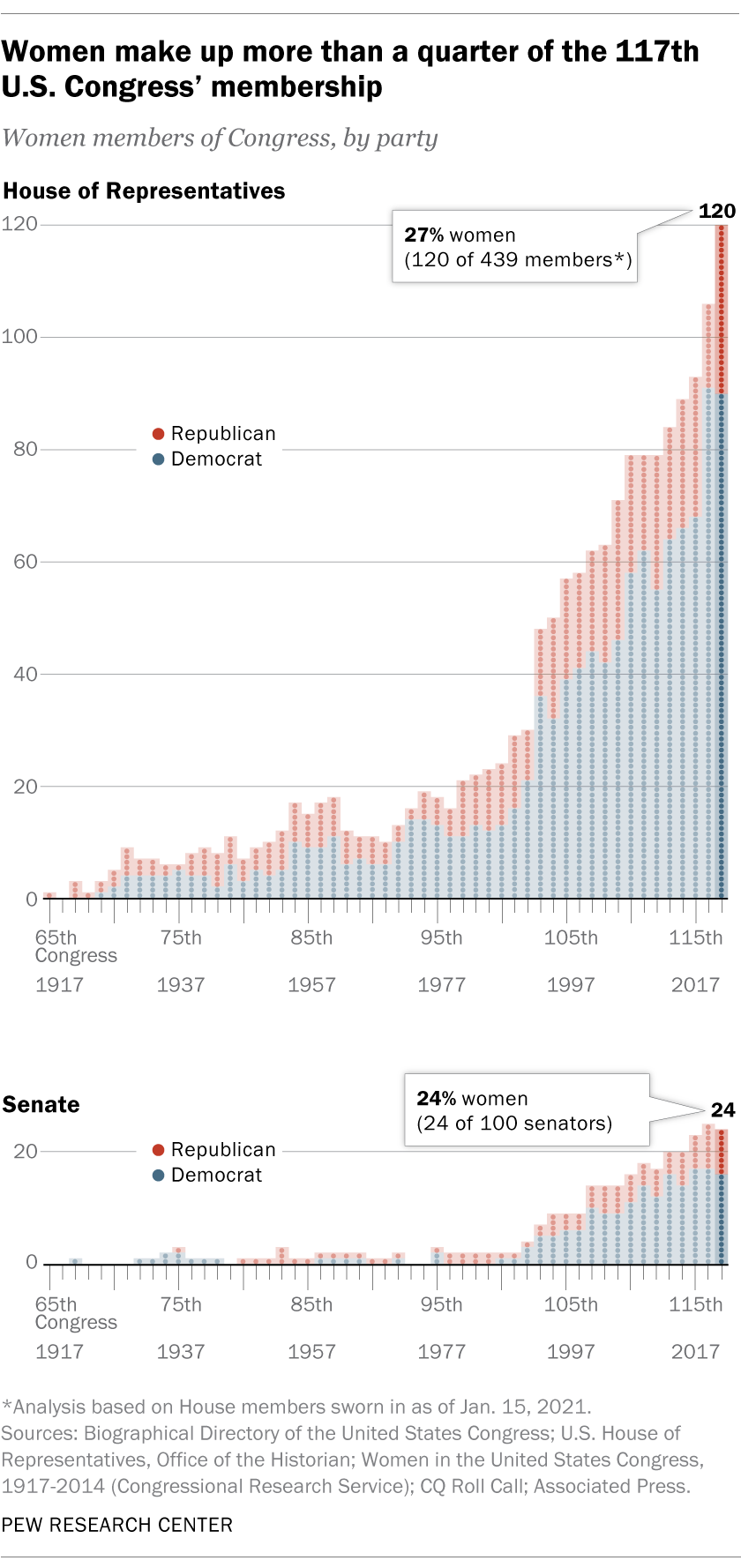
Good News: More Women in Political Leadership Roles

A record number of women are serving in the 117th Congress | Pew Research Center

27% in the House and 24% in the Senate.. Consistent increases, especially since the large increase in 1992. Democrats have more than twice as many women representatives, at 38% versus 14% for Republicans.

Details on congressional data.

Women in Congress | US House of Representatives: History, Art & Archives

History of Women in the U.S. Congress | CAWP (rutgers.edu)

Women now hold 36% of state and federal judgeships.

Statistics | National Association of Women Judges (nawj.org)

Women hold 31% of the seats in state legislatures. This number was flat at 25% from 2009 through 2018 before increasing to 29% in 2019. Two-thirds of these reps were Democrats. States that lean Democratic have significantly more women representatives. Only one state, Nevada, has a majority of female legislators.

Women in State Legislatures 2021 | CAWP (rutgers.edu)

Women hold just 18% of governorships. Here, Democrats and Republicans have performed equally well.

History of Women Governors | CAWP (rutgers.edu)

The Pew Research Organization tracks several other measures of female participation in leadership positions. Biden’s cabinet has a record 48% female proportion. 7% of Fortune 500 CEOs are women. 27% of corporate board seats are now held by women. 31% of college presidencies are held by women.

The Data on Women Leaders | Pew Research Center

In general, the growth in participation by women in these public and private leadership positions has been relatively consistent for the last 25 years. Additional progress appears highly likely during the next 25 years.

Politico takes a more negative view of progress, highlighting the continuing inequality, weak progress in some states and stalled progress by some measures. It provides helpful state level data.

Why state legislatures are still very white — and very male (politico.com)

Indiana Music (1880 – 1980)

https://en.wikipedia.org/…/On_the_Banks_of_the_Wabash…

https://www.youtube.com/watch?v=9qVjOJq9IXQ

https://en.wikipedia.org/wiki/Back_Home_Again_in_Indiana

https://www.youtube.com/watch?v=7wcgaRkHAWY

Hoagy Carmichael – Stardust / Georgia on my mind

https://www.youtube.com/watch?v=Em3xyZz_mow

https://www.youtube.com/watch?v=5k0bKSJOywc

Cole Porter (#3)-Anything Goes

https://www.youtube.com/watch?v=3aeQ3DmKU7A

https://www.youtube.com/watch?v=5WX_fKVWX2s

https://www.youtube.com/watch?v=cCYGyg1H56s

https://www.youtube.com/watch?v=7qf_QorYgDE

https://www.youtube.com/watch?v=1T6SG0t9jfQ

Ink Spots – I don’t want to set the world on fire

https://www.youtube.com/watch?v=6l6vqPUM_FE

Bill Monroe -Southern Flavor

https://www.youtube.com/watch?v=9NcCgsAMxhs

Four Freshmen – Poinciana

https://www.youtube.com/watch?v=l4NafK3NFhA

j j Johnson trombone – buzzy (Charlie parker)

https://www.youtube.com/watch?v=J6uT4WPbTz0

Wes Montgomery – Round Midnight / Full House

https://www.youtube.com/watch?v=MOm17yw__6U

https://www.youtube.com/watch?v=fP1Bw0wKZtU

Bill Gaither – He Touched Me

https://www.youtube.com/watch?v=5m–ptwd_i

Freddie Hubbard – Cantaloupe Island (Herbie Hancock)

https://www.youtube.com/watch?v=8B1oIXGX0Io

Michael Jackson / Jackson 5 (#1)

https://www.youtube.com/watch?v=s3Q80mk7bxE

https://www.youtube.com/watch?v=ho7796-au8U

https://www.youtube.com/watch?v=sOnqjkJTMaA

https://www.youtube.com/watch?v=oRdxUFDoQe0

https://www.youtube.com/watch?v=Zi_XLOBDo_Y

McCoys

https://www.youtube.com/watch?v=TlTKhPkZSJo

Crystal Gayle

https://www.youtube.com/watch?v=C9lz_yzrGZw

John Mellencamp (#2)

https://www.youtube.com/watch?v=h04CH9YZcpI

https://www.youtube.com/watch?v=4dOsbsuhYGQ

https://www.youtube.com/watch?v=qOfkpu6749w

https://www.youtube.com/watch?v=0CVLVaBECuc

https://www.youtube.com/watch?v=joNzRzZhR2Y

R Dean Taylor DeLong

https://www.youtube.com/watch?v=fZL_tZxyBDo

Van Halen – David Lee Roth !!!!!

https://www.youtube.com/watch?v=fZL_tZxyBDo

John Hiatt

https://www.youtube.com/watch?v=fZL_tZxyBDo

Guns N Roses – Axl Rose Shannon Hoon

https://www.youtube.com/watch?v=8SbUC-UaAxE

Joshua Bell

https://www.youtube.com/watch?v=laGT9IB2bFo

Janet Jackson

https://www.youtube.com/watch?v=OAwaNWGLM0c

Kenny Edmonds

https://www.youtube.com/watch?v=GbrSO81KhBY

Tom Petty – Mary Jane’s last dance

https://www.youtube.com/watch?v=aowSGxim_O8

Josh Garrels

https://www.youtube.com/watch?v=DzCRgIg-VnI