
How Could We Lose? Democrats Lament.

In the 2020 elections, Democrats once again earned a smaller share of votes than expected. Republican candidates in national, state and local election outperformed. Candidate Trump registered 74M votes, 11M more votes than in 2016. Americans were voting for the “real Trump”, not just the imagined populist candidate Trump. He earned 47.0%, up from 46.4%. Biden registered 81M votes, 15M more than Hillary’s performance. The Democratic share increased from 48.5% to 51.3%. A presidential win, a narrow House win and a very narrow Senate win.

“How can this be?” questioned the Democratic party leaders and supporters. “Where is our landslide victory?”

There was a higher voting percentage, which usually helps Democrats.

There were more registered and voting minorities, which always helps Democrats.

There were more young voters and fewer older voters, which helps Democrats.

The “special” negatives of Hillary as a candidate could not effect the results.

America is becoming less religious and less evangelical, which helps Democratic results.

Voter surveys show 60% plus support for many leading Democratic policies.

Despite the 2010 “Citizens United” Supreme Court case that eliminated restrictions on campaign contributions, Democrats raised money as effectively as Republicans.

Obama was able to win convincingly in 2008 and 2012 as a moderate Democrat, increasing the number of independents who would consider voting for Democrats at all levels.

Democrats deliver results on social, environmental, international, military and economic issues.

Like all political parties, Democrats “know we are right”.

Setting aside the “policy content” of the 2020 election for this article, Republicans had their own advantages in these elections.

The “megatrend” in the US and west continues to lean toward conservative politicians since the Reagan/Thatcher switch. There is great momentum in voting.

The U.S. Senate and electoral college provide an advantage to Republican leading states, adding 2-4% to the pure voting totals.

Republicans captured a greater share of state legislatures in 2010 and took advantage of this position to gerrymander state and national districts in their favor. At the national level, this adds 1-2% to the Republican House team.

The Republican supporting media (Fox) and talking heads continue to be more effective than the Democrats who are still “catching up.” Republicans have effectively undercut the legitimacy of the “mainstream media” for many, causing them to abandon centrist platforms and consume only Republican supporting sources.

The Republican advantage in the public policy “think tank” arena continues. See the article aggregators at RealClearPolitics or RealClearMarkets for samples of “policy pieces”. Left-leaning contributors from the academy, unions, not-for-profits, entertainment industry and Democratic party publish fewer articles and generally restrict their content to research articles.

Republicans continue to have an advantage in painting Democrats as extremists, socialists, communists, radicals, anarchists, irresponsible, anti-American, soft on crime, atheists, secularists, relativists, opportunists, special interest supporters, pinkos, big spenders, etc.

While Democrats always considered themselves “the party of the big tent”, Ronald Reagan was able to erect a tent which welcomed various somewhat incompatible streams of “conservativism”: philosophical, main street, wall street, religious, social, economic, libertarian, traditional, military and American. Republicans have leveraged this advantage, cooperating on “conservative” policies and ignoring those with conflicts.

Republicans since Newt Gingrich have effectively defined a very polarized world view. Democrats are the enemy. Party discipline is paramount. Results matter most. Insufficiently conservative or loyal reps have been chased from the party. This means that all Republicans vote for all Republican candidates in the general election. Any Republican is better than any Democrat.

Far left, new left, progressive Democrats take a different stance. They support progressive policies and candidates. They are not sure that a moderate, center-left Democrat is “better” than a Republican. They may not vote, cast a write-in ballot, or choose the libertarian or the socialist option. This costs mainstream Democratic candidates 1-4% of the general election vote. In Europe, they would have a party to vote for and the coalition building stage of a parliamentary government would give them influence, from time to time.

Republicans continue to win the framing and communications wars, better positioning their policies and candidates. Pro-choice versus pro-life. American versus globalist. Free market versus government control. States rights versus central government. Regulations versus necessary limits. Common man versus elites. Balanced budget versus deficit spending! US versus UN.

In recent years, Republicans have started to shape election laws to favor turnout from their supporters and discourage turnout from their opponents. This did not appear to have a major impact on the 2020 results, but could do so in the future.

“politics ain’t beanbag”.

Republicans have very effectively managed their political resources and campaigns in recent years. The Democratic demographic trends are simply not enough to assure wins in the short-run.
Free Trade

Historically, for more than 200 years, economists, conservatives, industrialists and western countries have supported free trade, based upon the theories of Smith and Ricardo. Free trade creates more valuable goods and services. Free trade provides opportunities. Free trade forces domestic firms to become more competitive. The losers from free trade can have their losses mitigated through enlightened government policies. Leftists and labor unions have opposed free trade because governments have not always provided those “enlightened” policies to offset the negative effects on workers and because far leftists cannot support any positive results from capitalism.

3 typical pro trade arguments.

Benefits of free trade – Economics Help

Why is free trade good? | The Economist

Why Free Trade? | IFT (ifreetrade.org)

Conservatives in the west have generally supported free trade for these last two centuries. Western firms and their beneficial owners were positioned to benefit (on average) from free trade. Part of this was the justification for imperialism and economic extraction from “less developed countries”, but most advocates saw the local, corporate and global benefits of trade. Republican support of free trade has been consistent in the post WW II era. Most Republican policy wonks agree with their Democratic colleagues that the great depression was deepened and prolonged by anti-trade legislation in the US and elsewhere.

The Benefits of Free Trade: Addressing Key Myths | Mercatus Center

7 Reasons to Support Free Trade – Foundation for Economic Education (fee.org)

The Benefits of International Trade | U.S. Chamber of Commerce (uschamber.com)

Economists of mainstream political views tend to support “free trade” as a government policy which can provide benefits for countries and the global economy.

Is free trade always the answer? | Business | The Guardian

Economists Actually Agree on This: The Wisdom of Free Trade – The New York Times (nytimes.com)

A Super-Majority of Economists Agree: Trade Barriers Should Go | Cato at Liberty Blog

Center for Economic Research and Forecasting | Economists Do Agree on Something! (clucerf.org)

4 Politically Controversial Issues Where All Economists Agree – The Atlantic

The free trade position has been opposed in the last 200 years by many. Leftists and less developed countries see this as gloss to justify exploitation. Marxists oppose capitalism. Labor sees the negative impact on domestic wages. Environmentalists see trade as a way to export pollution. Anti-globalization advocates see trade as a way to provide power to multinational corporations, so oppose it. Supporters of “less developed countries” argue that pure free trade unfairly prevents firms from developing. Incumbent firms argue that competitors have “unfair” advantages, including government support, that must be offset.

Why do economists support Free Trade? | Jobs Back (JobsBack.com)

Free Trade Is Killing American Manufacturing | IndustryWeek

Free trade in economic theories | Exploring Economics (exploring-economics.org)

Economists on the Run – Foreign Policy

The Folly of Free Trade (hbr.org)

While the “science” and “interests” of free trade may be clear, the “politics” is less clear. In a simple, win/lose, Manichean view, evil foreigners attempt to defeat good domestic firms and their employees. Populist politicians of both left and right views are tempted to tap this voting block.

Here’s why everyone is arguing about free trade (cnbc.com)

Failing at Free Trade: Why Economists Haven’t Won the Debate (dtnpf.com)

Finally, 2 articles that consider both sides.

Free Trade Agreement Pros and Cons (thebalance.com)

4 Reasons Free Trade Has Become A Contentious Political And Economic Issue (forbes.com)

As with many modern public policy issues, there is a professionally supported position (pro, with some limits or compensations). However, the gap between the relatively complex analysis (comparative advantage, history, statistics) required to support these conclusions and votes is wide and used by politicians to frame and tell stories in their best interest, not the interest of the nation or its citizens.

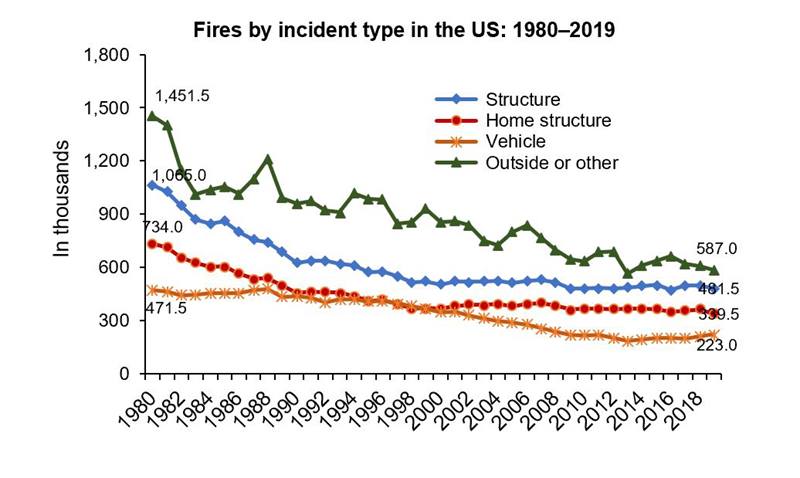
Good News: Fewer Fires

Fire Incidents

NFPA report – Fire loss in the United States

YearOutsideStructureVehicle
19801,4001,000470
19901,000650450
2000900550350
2010700500220
2020600500220

As with most well-defined problems and risks, the incidence or occurrence of fires has declined through time. In the last 40 years, the incident rate has been cut in half for outside, structure and vehicle fires. The US population grew by 45%, from 227M to 330M during this period. Hence, the incident rate per person declined by 70%.

Fire Deaths

Fire-related Fatalities and Injuries – Injury Facts (nsc.org)

YearDeathsUS Pop (M)Deaths/M
19787,50022334
19885,80024524
19983,90027614
20083,60030412
20183,60032711

Fire deaths have been cut in half over the last 50 years. The population has increased by 47%. The number of fire deaths per million has decreased by two-thirds, from 34 to just 11.

Real Cost of Fires Per Person

Archived Tables | III

US Population by Year (multpl.com)

Consumer Price Index, 1913- | Federal Reserve Bank of Minneapolis (minneapolisfed.

YearNominal Cost $B2019 Real Cost/Person
19991269
20001472
20011787
20021888
200321102
20041781
20052193
20062087
200724101
200831121
200928110
20102078
20112072
20122486
20131966
20142275
20152067
20162478
201737116
201847146
201937113

While the incident and deaths figures show a clear pattern of significant decline from 1980 to 2010, with relative stability from 2010 to 2020, the real cost of fires per person has much greater annual variability and a less certain trend in the last 20 years. Using 1990-2016 as the time period, the trend is clearly downward, from $90 to $80 per person per year. Adding the last 3 years, with their higher costs, the trend line moves upward from $80 to $100 per person per year.

Overall, the cost of fires per person is flat in the last 20 years, even though the outside incident rate has declined by one-third, the vehicle fire rate has declined by one-third and the structure rate has declined by 10%. Clearly, structure fires have the greatest weight on the cost measure. The unusually high costs in the last 3 years must be driven by a greater number of very high cost incidents.

Federal Government Employees

YearExecPostalEx+PostActMilTotalSubDefSubCivilianU.S. Pop
19551.9.42.32.95.24.11.1166
19601.8.42.22.54.73.51.2181
19651.9.42.42.75.03.71.3194
19702.2.52.83.15.94.31.6206
19752.1.62.82.14.93.21.7216
19802.2.52.82.14.83.01.8227
19852.3.73.02.25.23.31.9238
19902.3.83.12.15.13.12.0250
19952.0.82.81.54.32.32.0265
20001.8.82.61.44.02.02.0282
20051.9.72.61.44.02.02.0295
20102.1.62.81.44.22.22.0309
20152.1.52.61.34.02.11.9321
20202.2.52.81.44.12.12.1331
YearExecPostalEx+PostActMilTotalSubDefSubCivilian
19551.1%.22%1.4%1.8%3.1%2.5%.64%
19601.0%.23%1.2%1.4%2.6%2.0%.66%
19651.0%.23%1.2%1.4%2.6%1.9%.69%
19701.1%.27%1.4%1.5%2.8%2.1%.76%
19751.0%.26%1.3%1.0%2.3%1.5%.79%
19801.0%.24%1.2%0.9%2.1%1.3%.79%
19851.0%.30%1.3%0.9%2.2%1.4%.80%
19900.9%.30%1.2%0.8%2.1%1.2%.82%
19950.8%.28%1.1%0.6%1.6%0.9%.76%
20000.6%.28%0.9%0.5%1.4%0.7%.70%
20050.6%.24%0.9%0.5%1.4%0.7%.68%
20100.7%.19%0.9%0.5%1.4%0.7%.65%
20150.7%.15%0.8%0.4%1.2%0.6%.59%
20200.7%.15%0.8%0.4%1.3%0.6%.62%

All Employees, Federal (CES9091000001) | FRED | St. Louis Fed (stlouisfed.org)

All Employees, Federal, Except U.S. Postal Service (CES9091100001) | FRED | St. Louis Fed (stlouisfed.org)

All Employees, U.S. Postal Service (CES9091912001) | FRED | St. Louis Fed (stlouisfed.org)

1970 (usps.com)

US Population by Year (multpl.com)

DCAS Reports – Active Duty Deaths by Year and Manner (osd.mil)

U.S. Military Personnel 1954-2014: The Numbers (historyinpieces.com)

How Many People Does the U.S. Federal Government Employ? (historyinpieces.com)

Federal Workforce Statistics Sources: OPM and OMB (fas.org)

Executive Branch Civilian Employment Since 1940 (opm.gov)

Total Federal Government employment has ranged from 4-5 million across the last 65 years, from 1955, when post WW II changes were in effect until today, 2020.

While Federal Government jobs have been flat to down 20%, the U.S. population has doubled, from 166 million to 331 million people.

Hence, the ratio of federal jobs to population has dropped from 3.1% in 1955, or 2.6% in 1960-1965 to just 1.25% in 2020. The much maligned and mistrusted federal government is less than half as large, in relative terms, as it was from 1955-1965.

The detailed components are somewhat complex. The judicial and legislative branches have employed a relatively immaterial 30,000 to 66,000 during this time, doubling with the population.

The Executive Branch includes both the Department of Defense and other civilian agencies. It does not include active military employees. It typically does not include the postal service (USPS), which is seen as a truly independent agency. The Executive Branch started with 1.860 M employees and ended with 2.206 M in 2020. The low was 1.778 M in 2000 and the high was 2.252 M in 1990. In rough terms, flat employment for 65 years. As a percentage of the population, it has ranged from 1.12% to 0.65%, declining throughout the period.

The postal service started with 367,000 in 1955, grew to 761,000 in 1990, flattened out for 1995-2000, before declining to 492,000 in 2015 and 496,000 in 2020. So, we have a doubling in the first 45 years, adding 400,000 staff, followed by a reduction of one-quarter million in the last 20 years. As a percentage of the population, it grew from 0.22% to 0.30%, before declining to 0.15% in 2015-2020.

Combining the executive, legislative, judicial and postal branches, we get a subtotal that excludes the active military category. This is what most people think of as “federal” employees. This started at 2.3 M in 1955, grew to 3.1 M in 1990 before settling down a bit to 2.8 M in 2020. As a percentage of the population, it began at 1.36% and ended at 0.84%. This is a 38% reduction, removing more than 0.5% of the population from government employment.

The active military population has declined from 2.9M in 1955 and 3.1M in 1970 (Vietnam winding down) to 1.4M in 2000 (peace dividend), where it has remained. As a percentage of the population, this function declined from 1.77% in 1955 to 0.99% in 1975 to 0.49% in 2000 to 0.42% today. This is a 3/4ths reduction. moving 1.25% of the population out of military service.

The “Total” column shows the 5.2M start and 4.2M end. The percent of population falls from 3.13% down to 1.25%. The Federal Government is a much smaller employer today than in the “post-war” era.

The next column combines the Department of Defense in the Executive Branch with the active military to give a total military. This does not include the Veterans Affairs or Department of Homeland Security which serve quasi-military functions. We start with 4.1M in 1955, touch 4.3M in 1970, fall to 3.2M in 1975 and 2.0M in 2000, ending at 2.1M in 2020. The percentage of populations falls from 2.5% down to 0.6%.

The remaining federal employees began with 1.1 M in 1955 and grew fairly constantly to 2.0M in 1990, remaining flat for the next 30 years, ending at 2.05M in 2020. As a percentage of the population, this measure started at 0.64%, peaked at 0.82% in 1990 and has since declined to 0.62%, just below where it started.

After the Clinton/congress budget compromises in the mid-1990’s, criticism of the size and growth of Federal employment quieted down for the next 2 decades. Some criticism has restarted, as Federal agencies have increased the amount and variety of outsourcing employed through contracting and grants. The main summary shows that “contract” employees, those who work directly on Federal contracts, have been in the 3-5 million range since 1985. It reports that grant funded employees have been 1-2 million per year. The total is 4-7 million, the same order of magnitude as “regular” federal employment. I was unable to find comparable numbers for the 1955-1980 timeframe, so cannot be sure that this category has grown faster than the U.S. population. My guess is that there is some degree of “employee shifting” from regular to contracted employment. A subset of this is probably politically motivated, to please congressional oversight committees. On the other hand, corporate America discovered outsourcing to foreign factories and specialized firms in the 1980’s and probably moved 15-25% of jobs out of the Fortune 500. At one point, firms like GM and AT&T had 1 million employees.

Public service and the federal government (brookings.edu)

How big is the federal workforce? Much bigger than you think. – The Washington Post

The True Size of Government | The Volcker Alliance

The true size of government is nearing a record high (brookings.edu)

The sheer size of our government workforce is an alarming problem | TheHill

Good News: US STEM Degrees Up 50% in 8 Years

Number and percentage distribution of science, technology, engineering, and mathematics (STEM) degrees/certificates conferred by postsecondary institutions, by race/ethnicity, level of degree/certificate, and sex of student: 2009-10 through 2018-19

Group201120122013201420152016201720182019
Total378404424447476512545565581
Residents322344361377393410431448468
Male210224235246255264276286297
Female112120125131138146154163171
Black232527272829313234
Hispanic242730343842475157
Asian444649505357616569

STEM degrees awarded at the bachelors, masters and doctoral level continue to increase in response to market demands from 2011 to 2019, increasing by 54% in total and by 45% for U.S. residents. Most of the increase has been at the bachelors level, from 255,000 to 379,000 degrees (+49%). Masters degrees have increased from 53,000 to 72,000 (+36%). Doctoral degrees have increased from 14,000 to 17,000 (21%).

African-American degree earners have increased by 46%. Hispanic Americans have increased by 137%. Asian-Americans have increased by 57%. White Americans have increased by 28%, from 224,000 to 287,000 (+63,000).

US resident male degree earners increased from 210,000 to 297,000 (41%). Female degree earners increased from 112,000 to 171,000 (52%).

By contrast, the US population increased by just 5% during this period, from 312M to 329M.

I don’t find many news stories highlighting this very good news. In a world that requires technological innovation, application, maintenance and understanding, the US is quickly increasing the number of graduates with these skills. Women and minorities are increasing their relative share of the graduates in these subject areas, which historically have been well paid.

Data check: U.S. producing more STEM graduates even without proposed initiatives | Science | AAAS (sciencemag.org)

More Students Earning Degrees in STEM Fields, Report Shows | STEM Solutions | US News

There is room for improvement. Women and minorities are still underrepresented. They graduate at lower rates than white whites. Non-residents earn a significant (19%) share of US degrees awarded.

6 facts about America’s STEM workforce and those training for it | Pew Research Center

STEM crisis or STEM surplus? Yes and yes : Monthly Labor Review: U.S. Bureau of Labor Statistics (bls.gov)

STEM Education Stats for 2021 | Jobs & Careers, Growth, Minorities & Degree Statistics (idtech.com)

In the prior decade, between 2000 and 2010, the number of STEM bachelors degrees awarded increased by 31%.

STEM Education Data and Trends (nsf.gov)

Bottom line: US residents are earning about one-half million STEM degrees each year. This is double the one-quarter million degrees awarded in 2000. Note that compounding of 31% and 54% growth yields 102% total growth, not just 85% (a core STEM skill).

Good News: 25-29 Year Olds, % With 4 Years of College Completed

CPS Historical Time Series Tables (census.gov)

Group194019501960197019801990200020102020
Total6811162323293239
Male71015202424282835
Female568132123303644
Black23571213181928
Hispanicnananana88101425

Since WWII, the US has increased college graduation rates overall 5-fold, from 6-8% to 39%. We now graduate 2 out of 5 individuals. We used to graduate 1 in 12 to 1 in 16.

Graduation rates have increased every decade, including a 7% increase, from 32% to 39% between 2010-2020. That increase is equal to the total college graduation rate after WWII!

Male graduation rates have increased more than 4-fold, from 7-10% to 35%.

Female graduation rates have increased 8-fold, from 5-6% to 44%.

African-Americans have increased their graduation rates 10-fold, from 2-3% to 28%. From 1 in 40 college graduates to 1 in 4.

Hispanic Americans were not tracked separately in the first 4 decades, but they have tripled from 8% to 25% in the last 40 years.

Critics can challenge the modern value/difficulty of a degree versus those after WWII. They can highlight the “pause” in 1980-1990 when degree attainment barely rose. They can note that male graduation rates paused from 1980-1990 and then again from 2000-2010. They can observe that men earned twice as many degrees in 1950-60, before being exceeded by women by 2000 and exceeded by 9% points, 44% to 35% (25% advantage) in 2020. They can point to the very rapid increase in degree attainment between 2010-2020 being suspiciously high. They can bemoan imperfect 4-year or 6-year graduation rates. They can note the financial challenges faced by college students, especially those with lower incomes or first generation attendance status.

However, even assuming that some good portion of these criticisms are appropriate and relevant, the overall results are clear. The U.S. is educating far more residents at a college graduation level. Men and women are benefitting. Minorities are improving their performance and have better access to higher education. Overall, this makes for a fairer society. It improves our ability to run a democratic form of government. It makes us a more economically competitive and creative society. Ideally, it allows more individuals to pursue their dreams, take advantage of their talents and contribute to the community.

U.S. Population Spotlight: Educational Attainment | U.S. Department of Commerce | Performance Data Pro