
Ryan Burge is THE data guy on American religion. Sociologist, political scientist and ordained minister. He got everyone’s attention with his projection that the historically important Presbyterian Church would be gone – poof – within 20 years. Let’s review the forecast.

The data is straight from PCUSA reports and the trend is really tight.

Decline in every year, but 2012-18 is really brutal. The whole period averages 63,000 lost members per year. 2019-22 averages 53,000.
I’ve never seen a trend continue in a linear fashion all the way to zero. There are always countervailing forces. The rate of decline varies. So, I think we should frame this like the “half-life” of a radioactive isotope. How long does it take for the church to lose one-half of its members? At this point, it’s more likely that some level of percentage decline will continue than a straight linear model of decay.
The national member decline points to 9 years for one-half of todays members still remaining. The relatively better last 4 years indicates 11 years. Hmmm. Pretty close to Burge’s 20-year forecast.

The percentage loss is a better predictor. The percentage decline was alarming but just 2%ish in the “oughts”. It accelerated to more than 5% per year in the dark years before dropping a little to 4.3%. The long-term and recent annual declines are both 4.3% per year. A very scary rate. Thanks to the “benefits” of compounding, it takes 16 years for 96% of 96% of 96% to reach 50%.

Churches and congregations are quite resilient. Presbyterians are not exactly governed on the fully “Congregational” model. They have a national and regional structure that has some impact on local affairs. Nonetheless, local congregations consider themselves to be in charge and act that way. The church decline is much slower. The acceleration in 2012-18 is obvious here too.
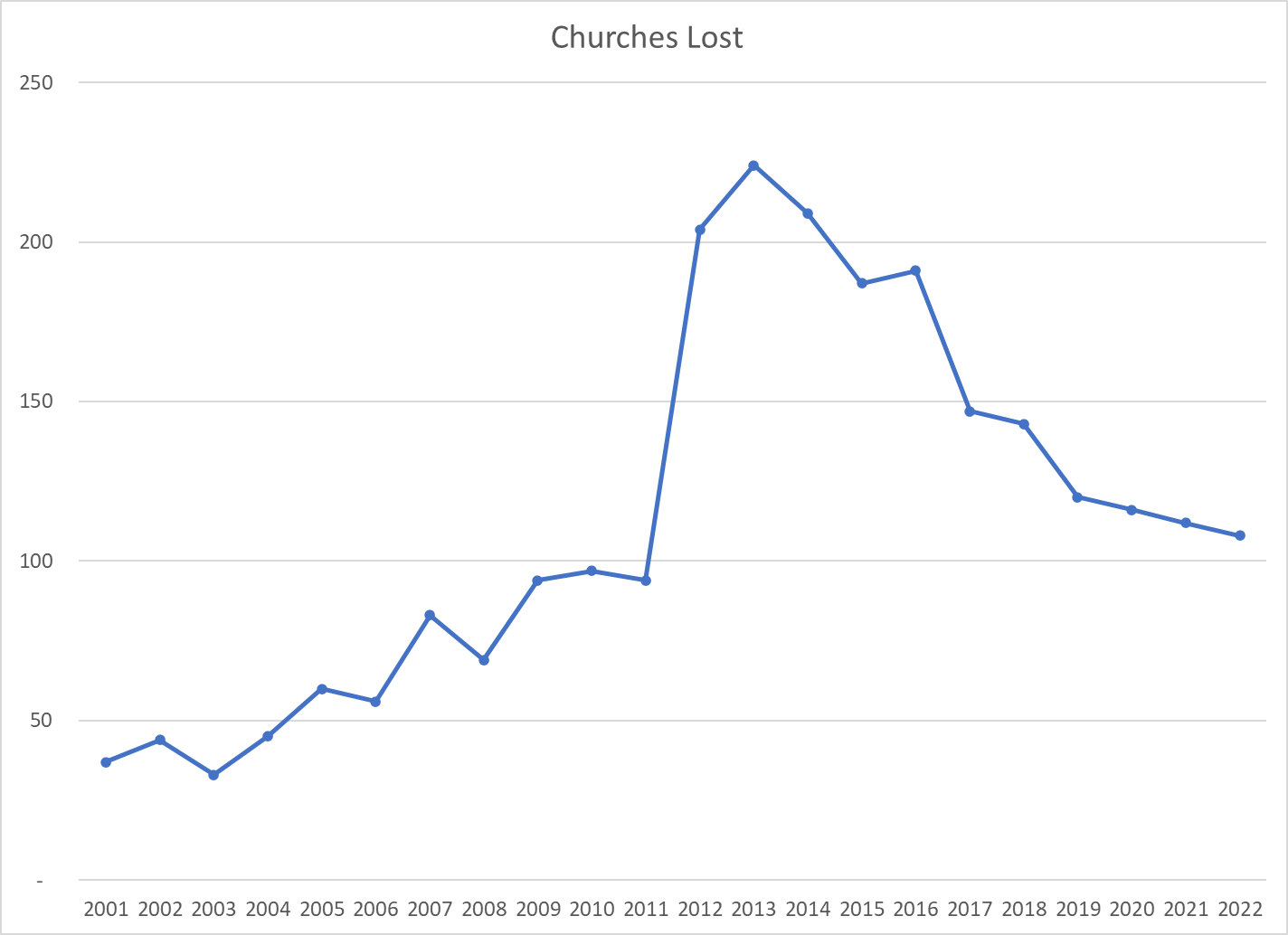
50 net lost churches per year became 100 and then 200! The losses have since declined towards 100 per year. Not “good news”, but improvement.

The “percentage” chart mirrors the “changes” chart. The recent 1.4% loss per year points to 50 years to cut the number of churches in half. Resilient, indeed! Ironically, the loss of churches can be “good news” for the remaining churches who absorb some of the lost church members.

The members/church graph is quite similar to the members graph, but the decline is a little slower.
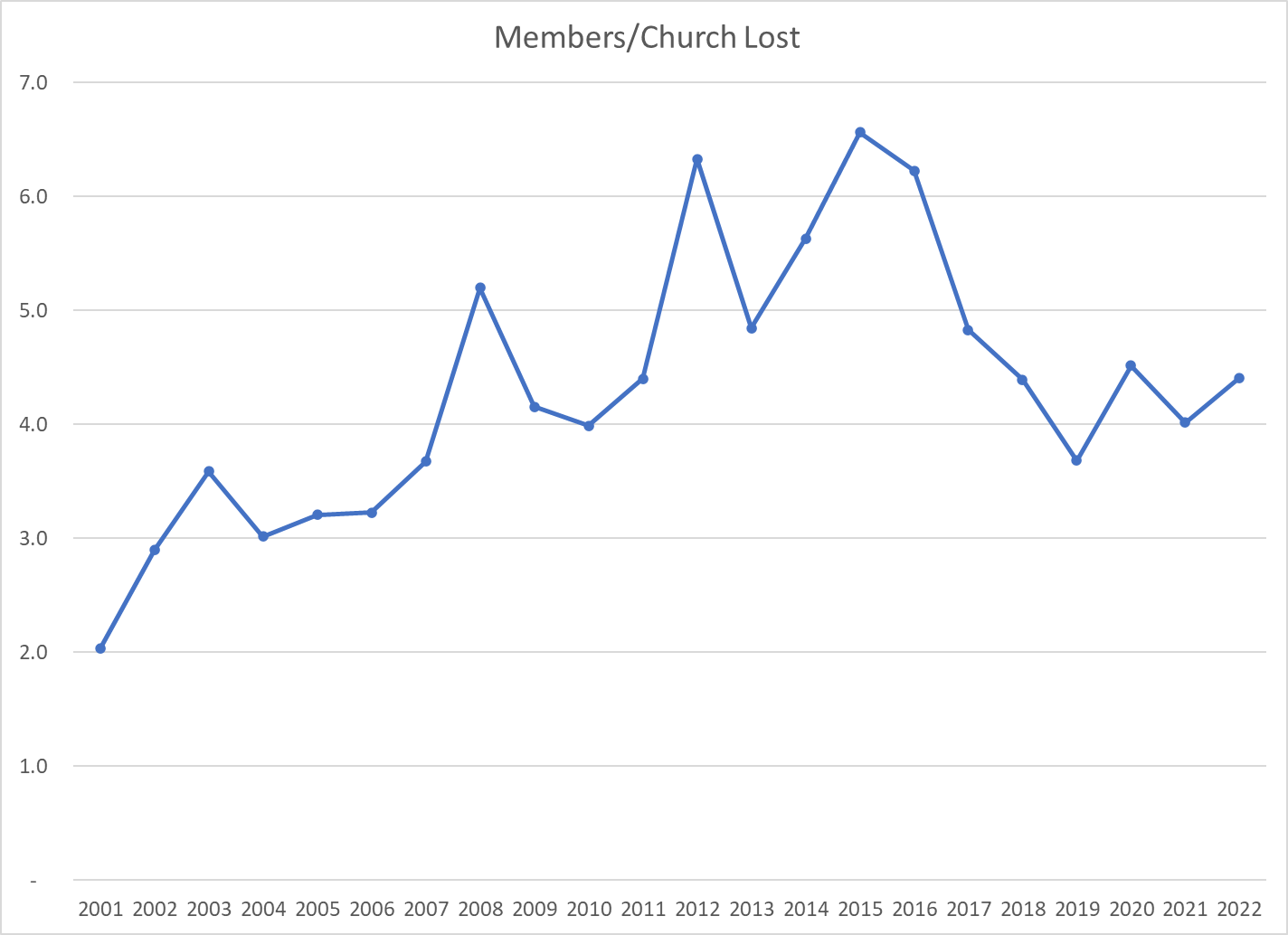
The overall and recent numbers are a loss of 4.3 members per year. It takes 15 years to lose 50% at this rate.

Local congregations saw their loss percentage grow from 1% to 4% in 15 years. The recent 6-year average is 3.2%, That provides 22 years to lose one-half of remaining members. If I was wagering in an on-line market, this would be my bet. Continued 3% loss per year for the next 5 years is likely.
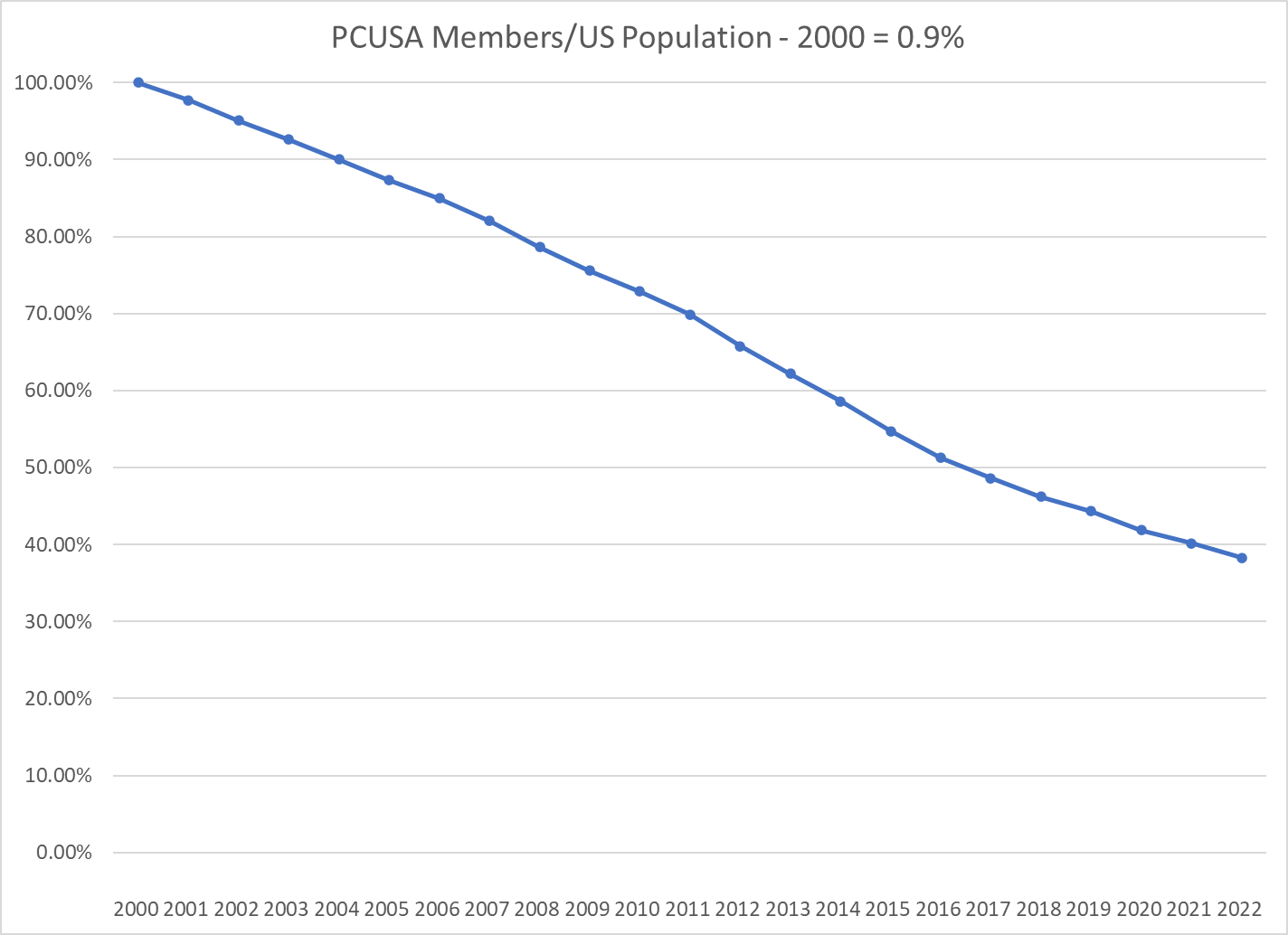
The US population has grown by 18%, adding 50 million people since 2000. PCUSA has been shrinking while the country has been growing. Presbyterians were 1/110 citizens in 2000 but are only 1/300 today. A two-thirds reduction in their share.
Can/will the denomination survive?
The significant improvement between 2012-18 and 2019-22 charted above provides evidence that the trend is improving.

Presbyterian Future
Megatrends greatly impact religious organizations. Some (generally) optimistic observations for the long run.
- The US is a more highly educated country. The Presbyterian emphasis on thinking and “the Word” should be attractive.
- The world has generally evolved to hold more complex views on science, politics, economics and philosophy. Presbyterians have been able to adapt to these changes without compromising their theology.
- The worlds of trade, migration, culture, media, technology and globalization continue to evolve. Adaptability matters.
- The era of “Big Government” is over. High service religions are filling the void.
- We live in “A Secular Age” where the default view is skepticism and materialism. The Reformed Church’s blend of conservative core and liberal application is well suited to address religious seekers in this context. It is also equipped to wrestle with the extreme claims of atheism.
- Younger adults claim that “authenticity” is their highest value. Presbyterians have a 500-year history of seriously reading and applying scripture, and then living their beliefs (imperfectly).
- Teens and adults invest a great deal of time in constructing and affirming their personal identity today. The surface Presbyterian identity may require some marketing help, but most Presbyterians are very comfortable with the positive role that religion plays in their identity.
- We live in a politically polarized time of left versus right. Our current challenges could lead us back to the center with the Presbyterians, mixed market capitalism and liberal democracy regaining their appeal.
- We live in an “individualistic” age. Presbyterians embrace individualism through man’s direct relationship to God and responsibility for moral understanding and choices. Presbyterians also emphasize the balance of community in their governance, role in the universal church and service/mission projects.
- We live in a “therapeutic age“, where every child has unlimited growth potential and a need to find and live their own path to self-fulfillment. Presbyterians embrace potential and personal development but retain a strong sense of original sin, human weakness and the need for help in living a moral life.
- There is pressure for individuals to choose a political side, red or blue. Yet, a greater share of voters claim to be independent or to hold a variety of so-called liberal and conservative views on individual issues. The Presbyterian Church has roughly equal numbers of these 3 groups and they mostly function well together.
- We live in a time when individuals demand “certainty“, even though scientists, mathematicians and philosophers have removed the possibility of absolute certainty. The Presbyterian emphasis on serious study of God’s Word and world allows members to cope with only a “strong” certainty that increases with time.
- We live in a scientific age. Presbyterians have been able to reconcile their theology with modern science throughout the last century.
- We are said to live in a post-structural or post-modern world with everything based on subjective views, except that powerful actors oppress the weak and that it is moral to reject this oppression. Presbyterians embrace an objective view of morality and are historically intertwined with the advance of “Western Civilization”, mixed market capitalism and liberal democracy. Those who find postmodernism to be a dead end may look back to the center.
- We live in a materialist consumer culture. Presbyterians are not highly effective at defining their product, defining a brand, determining target markets or conducting marketing campaigns except through traditional personal means.
- We live in a culture that emphasizes rights before responsibilities. Deeply serious Presbyterians emphasize responsibilities to God, neighbor, community and self. Presbyterians recognize equal rights for each of God’s children and have supported modern “rights” campaigns.
Presbyterianism may continue as a smaller denomination and never regain the size and influence that it once had in the US. It has many assets to support a positive future.
 Good News
[…] by Politics and Religion – 2012 (Part 1) The Righteous Mind – Part 2 Congregational Strategy: Presbyterian Church (USA) Membership Congregational Strategy: Let’s Join the Presbyterian Church Congregational Strategy: […]
[…] Congregational Strategy: Presbyterian Church (USA) Membership – Good News (tomkapostasy.com) […]
[…] Congregational Strategy: Presbyterian Church (USA) Membership Presbyterian Church Decline and Recovery […]